Goa Board Class 12 Sample Paper 2027 Chemistry
Finished viewing? Save it for later —
Download Goa Board Class 12 Sample Paper 2027 Chemistry (PDF · 28 pages)About Goa Board Class 12 Sample Paper 2027 Chemistry
Goa Board Class 12 Sample Paper 2027 Chemistry is available here for free download. Published by Goa Board for Class 12, this sample paper can be viewed online or downloaded as a PDF (28 pages). Candidates preparing for Class 12 can use Goa Board Class 12 Sample Paper 2027 Chemistry to understand the exam pattern, the type of questions asked, and the overall difficulty level.
Frequently Asked Questions
How can I download Goa Board Class 12 Sample Paper 2027 Chemistry?
Open this page and click the Download button to save Goa Board Class 12 Sample Paper 2027 Chemistry as a PDF. It is completely free on AglaSem Docs.
Is Goa Board Class 12 Sample Paper 2027 Chemistry free to download?
Yes. Goa Board Class 12 Sample Paper 2027 Chemistry can be viewed online and downloaded as a PDF free of cost on AglaSem Docs.
How many pages does Goa Board Class 12 Sample Paper 2027 Chemistry have?
Goa Board Class 12 Sample Paper 2027 Chemistry contains 28 pages, which you can read online or download together as a single PDF.
Where can I find more Class 12 study material?
You can find more Class 12 question papers, sample papers, syllabus, and answer keys on AglaSem Docs.
Goa Board Class 12 Sample Paper 2027 Chemistry – Text
Read the full text of this sample paper below — useful to quickly search, copy and reference the content online without downloading the PDF.
📄 View text version (29 pages)
Page 1
Goa Board Class 12
Sample Paper 2027
Chemistry
EXAM YEAR TYPE SUBJECT
Goa Class 12 2027 Sample Paper Chemistry
Notes · Sample Papers · Previous Year Papers · Mock Tests
Page 2
om .co
m . c s em
se g la SECONDARY
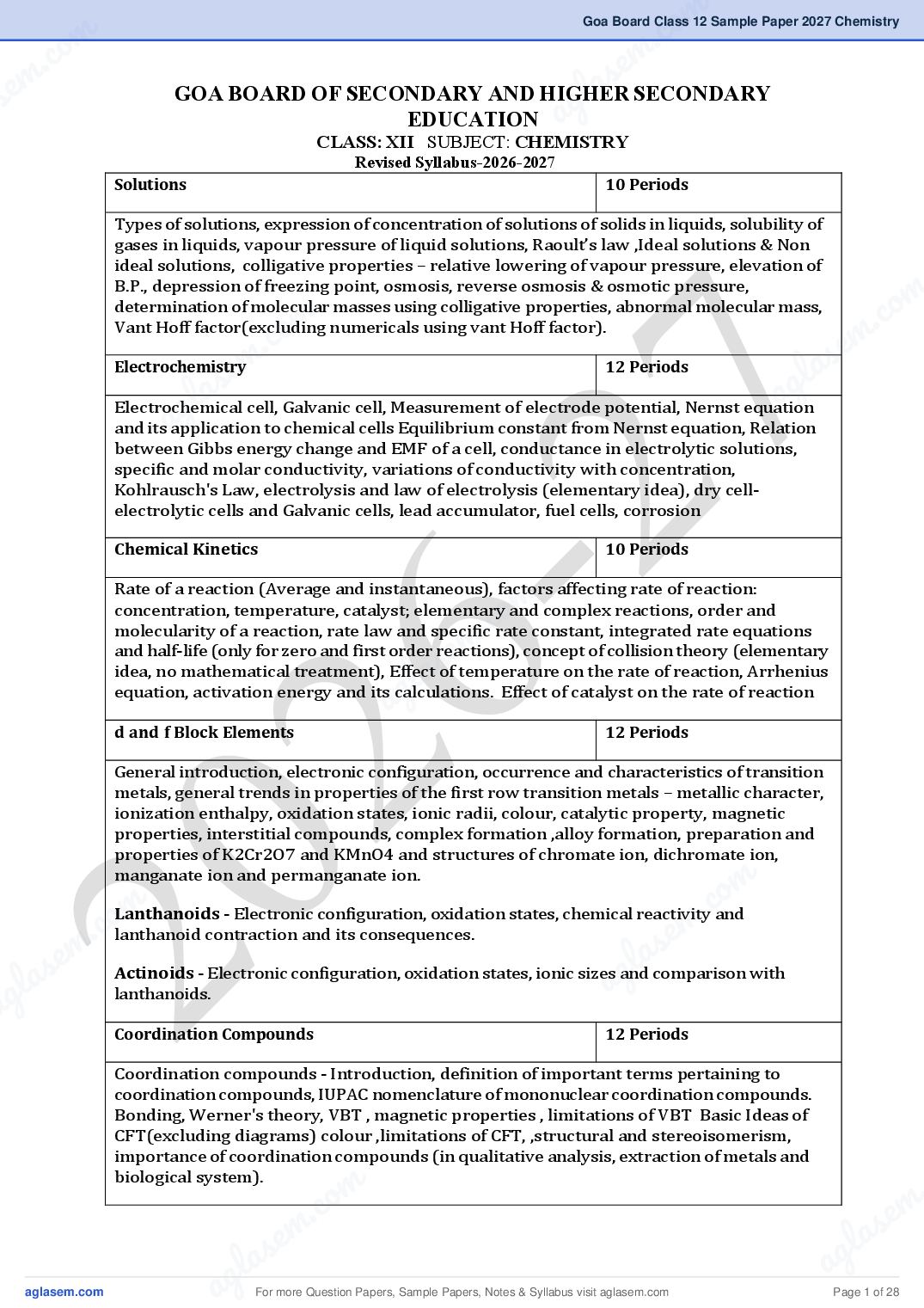
GOA BOARD OF SECONDARY AND HIGHER
EDUCATION a
CLASS: XII SUBJECT: CHEMISTRY
Revised Syllabus-2026-2027
Solutions 10 Periods
Types of solutions, expression of concentration of solutions of solids in liquids, solubility of
gases in liquids, vapour pressure of liquid solutions, Raoult’s law ,Ideal solutions & Non
ideal solutions, colligative properties – relative lowering of vapour pressure, elevation of
B.P., depression of freezing point, osmosis, reverse osmosis & osmotic pressure,
m
m
determination of molecular masses using colligative properties, abnormal molecular mass,
.co
.co m
Vant Hoff factor(excluding numericals using vant Hoff factor).
Electrochemistrym s e
s e 12 Periods
g l a
l a
g cell, Galvanic cell, Measurement of electrode potential, Nernst equation a
and itsa
Electrochemical
application to chemical cells Equilibrium constant from Nernst equation, Relation
between Gibbs energy change and EMF of a cell, conductance in electrolytic solutions,
specific and molar conductivity, variations of conductivity with concentration,
Kohlrausch's Law, electrolysis and law of electrolysis (elementary idea), dry cell-
electrolytic cells and Galvanic cells, lead accumulator, fuel cells, corrosion
Chemical Kinetics 10 Periods
m
Rate of a reaction (Average and instantaneous), factors affecting rate of reaction:
.co
concentration, temperature, catalyst; elementary and complex reactions, order and
m
molecularity of a reaction, rate law and specific rate constant, integrated rate equations
e
las
and half-life (only for zero and first order reactions), concept of collision theory (elementary
idea, no mathematical treatment), Effect of temperature on the rate of reaction, Arrhenius
ag
equation, activation energy and its calculations. Effect of catalyst on the rate of reaction
d and f Block Elements 12 Periods
General introduction, electronic configuration, occurrence and characteristics of transition
metals, general trends in properties of the first row transition metals – metallic character,
ionization enthalpy, oxidation states, ionic radii, colour, catalytic property, magnetic
properties, interstitial compounds, complex formation ,alloy formation, preparation and
properties of K2Cr2O7 and KMnO4 and structures of chromate ion, dichromate ion,
manganate ion and permanganate ion.
o m
m c
- Electronic configuration, oxidation states, chemical reactivity. and
c. olanthanoid
Lanthanoids
s e m
em Actinoids - Electronic configuration, oxidation states, ionic sizes and
contraction and its consequences.
s g l acomparison with
g la a
a
lanthanoids.
Coordination Compounds 12 Periods
Coordination compounds - Introduction, definition of important terms pertaining to
coordination compounds, IUPAC nomenclature of mononuclear coordination compounds.
Bonding, Werner's theory, VBT , magnetic properties , limitations of VBT Basic Ideas of
CFT(excluding diagrams) colour ,limitations of CFT, ,structural and stereoisomerism,
importance of coordination compounds (in qualitative analysis, extraction of metals and
biological system).
m .
.co s e m
s em l a
g la ag
a For more Question Papers, Sample Papers, Notes & Syllabus visit Page 1 of 28
Page 3
Haloalkanes: Nomenclature, classification ,methods of preparation, nature of C–X bond,
physical and chemical properties, optical rotation, mechanism of substitution
reactions
,Stereochemical aspects of nucleophilic substitution .
Haloarenes: Nomenclature, Nature of C–X bond, methods of preparation, substitution
reactions (Directive influence of halogen in monosubstituted compounds only)
,electrophilic substitution reactions, reactions with metals.
Polyhalogen compounds - dichloromethane, trichloromethane, tetrachloromethane,
iodoform, freons, DDT.
Alcohols, Phenols and Ethers 10 Periods
Alcohols: Classification, Nomenclature, methods of preparation, physical and chemical
properties
identification of primary, secondary and tertiary alcohols(Oxidation ,dehydrogenation
reactions and Lucas test), mechanism of dehydration,
Phenols: Nomenclature, methods of preparation, physical and chemical properties, acidic
nature of phenol, Reactions of Phenol.
Ethers: Nomenclature, methods of preparation, physical and chemical properties.
Aldehydes, Ketones and Carboxylic Acids 10 Periods
Aldehydes and Ketones: Nomenclature, nature of carbonyl group, methods of preparation,
physical and chemical properties, mechanism of nucleophilic addition, reactivity of alpha
hydrogen in aldehydes, uses.
Carboxylic Acids: Nomenclature, acidic nature, methods of preparation, physical and
chemical properties; uses.
Amines 10 Periods
Amines: Nomenclature, classification, structure, methods of preparation, physical and
chemical properties, uses, identification of primary, secondary and tertiary amines.
Diazonium salts: Preparation, chemical reactions.
Biomolecules 12 Periods
Carbohydrates :Classification (aldoses and ketoses), monosaccharides (glucose and
fructose),
D-L configuration, oligosaccharides (sucrose, lactose, maltose), polysaccharides starch,
cellulose, glycogen (excluding structures)
Proteins - Elementary idea of alpha - amino acids(only structure of Glycine and Alanine)
classification, peptide bond, polypeptides, proteins, primary structure, secondary
structure, tertiary structure and quaternary structure (qualitative idea only),
denaturation of proteins :enzymes. Hormones - Elementary idea excluding structure.
Vitamins – Classification and functions.
Nucleic Acids: DNA and RNA(excluding structures).
For more Question Papers, Sample Papers, Notes & Syllabus visit Page 2 of 28
Page 4
om .co
. c e m
m as
se ag l
GOA BOARD OF SECONDARY AND HIGHER SECONDARY EDUCATION
CLASS: XII SUBJECT: CHEMISTRY SUB CODE:H-4703
m
Mid First Board
.co
Exam Term Term Exam
m
.co m
Month Aug Oct Feb
Sr No Unit
m s e
1
s e
SOLUTIONS 5±1 8+1 7±1
gl a
2
g l a
ELECTROCHEMISTRY 9±1 9±1
a
3
4
a CHEMICAL KINETICS
THE d-& f-BLOCK ELEMENTS
5±1
5±1
8+1
8±1
7±1
7±1
5 COORDINATION COMPOUNDS 7±1
6 HALOALKANES & HALOARENES 5±1 7+1 6±1
7 ALCOHOLS, PHENOLS AND ETHERS 7±1 6±1
8 ALDEHYDES, KETONES AND CARBOXYLIC ACIDS 8±1
9 AMINES 6+1 6±1
10 BIOMOLECULES 7±1 7±1
m
.co
Sr No Question Details
1 MAXIMUM MARKS 20 60 70
2 DURATION IN MINUTES
e m 60 150 180
3 NUMBER OF QUESTIONS
las 10 31 35
4
5
MULTIPLE CHOICE QUESTION (1MARK)
ag
VERY SHORT ANSWER ( VSA) (1 MARK)
2
2
8
4
8
5
6 SHORT ANSWER I (SA I)—2 MARKS 3 12 12
7 SHORT ANSWER (SA II)—3 MARKS 2 4 7
8 LONG ANSWER (LA) —4 MARKS 1 3 3
9 KNOWLEDGE % 30 ±5 30 ±5 30 ±5
10 UNDERSTANDING % 40±5 40±5 40±5
11 SKILL(Diag/Structure/Graph) % 10±5 10±5 10±5
12 APPLICATION % 20 ±5 20 ±5 20 ±5
m
c. o30±5
Difficulty Level
m1
.co m
EASY 30±5 30±5
m
2 AVERAGE 50±5 50±5 50±5
s e
s e 3 DIFFICULT 20±5 20±5 20±5
g l a
g l a SCHEME OF EXAMINATION AND MARKS DISTRIBUTION (2026- 27) a
a
Internal assessment : 20/2=10 MARKS
FIRST TERM PRACTICAL EXAMINATION
VOLUMETRIC ANALYSIS 16 Marks
JOURNAL + VIVA 04 Marks (2+2)
TOTAL 20 Marks
DURATION 120 Minutes
m .
.co s e m
s em l a
g la ag
a For more Question Papers, Sample Papers, Notes & Syllabus visit Page 3 of 28
Page 5
VOLUMETRIC ANALYSIS 08 Marks
JOURNAL + VIVA 02 Marks (01+01)
ANALYSIS OF SALT 10 Marks
TOTAL 20 Marks
DURATION 180 Minutes (Three Hours)
For more Question Papers, Sample Papers, Notes & Syllabus visit Page 4 of 28
Page 6
om .co
m . c s em
MODEL BLUEPRINT OF MID TERM TESTla
se ag ( 2026 – 2027)
XII SCIENCE SUBJECT : CHEMISTRY MARKS : 20 DURATION : 60min
OBJECTIVES DIFFICULTY LEVEL
K U S A Easy(E) Average (Av) Difficult(D)
Percentage 30% 40% 10% 20% 30% 50% 20%
Marks 6 8 2 4 6 10 4
m
m .co
.co m
Variation of ± 5% is permitted in the above Objectives and Difficulty Level
s e
s em l a
g la ag
a question
Type of Marks per No. of Questions Total marks
Question
MCQ 1 2 2
VSA 1 2 2
SA- I 2 3 6
SA- II 3 2 6
LA 4 1 4
Total …….. 10 20
m
m .co
MCQ = Multiple choice Question
s e
la
VSA = Very Short Answer
SA – I = Short answer type -I
SA – II = Short answer type – II ag
LA = Long Answer
m
m .co
m .co s e m
s e g l a
g l a a
a
m .
.co s e m
s em l a
g la ag
a For more Question Papers, Sample Papers, Notes & Syllabus visit Page 5 of 28
Page 7
ALTO-PORVORIM GOA.
BLUEPRINT OF MIDTERM TEST 2026-2027 ( CHEMISTRY – XII SCIENCE )
Difficulty Duration
Q. No. Type Unit Name Objectives Level (min) Marks
1 MCQ Solutions K E 2 1
2 MCQ The ‘d’ and ‘f’ block elements U Av 2 1
3 VSA Haloalkanes and Haloarenes K E 2 1
4 VSA The ‘d’ and ‘f’ block elements S E 2 1
5 SA-I Chemical Kinetics A D 5 2
6* SA-I Solutions
OR K+S Av 4 1+1=2
6* SA-I Solutions
7 SA-1 Solutions A D 5 2
8 SA-II The ‘d’ and ‘f’ block elements K E 8 3
9 SA-II Chemical kinetics U Av 8 3
10* LA Haloalkanes and Haloarenes
OR U Av 12 4
10* LA Haloalkanes and Haloarenes
TOTAL DURATION IN MINUTES AND MARKS 50 min 20mks
*Internal Choice
For more Question Papers, Sample Papers, Notes & Syllabus visit Page 6 of 28
Page 8
om .co
m . c s em
se g l a
a EDUCATION
GOA BOARD OF SECONDARY AND HIGHER SECONDARY
ALTO PORVORIM - GOA.
MODEL BLUEPRINT OF THE QUESTION PAPER FOR FIRST TERM EXAM (2026 – 2027)
STD: XII SCIENCE SUBJECT: CHEMISTRY
m
.co
MAXIMUM MARKS : 60 DURATION: 150 min.
m
.co s e m
s em DIFFICULTY LEVEL g
l a
g la OBJECTIVES
a
a K U S A
Easy
(E)
Average Difficul
(Av) t
(D)
Percentage 30 40 10 20 30% 50% 20%
% % % %
Marks 18 24 6 12 18 30 12
m
.co
Variation of ± 5% is permitted in the above objectives and Difficulty level.
e m Number of
Type of
l as Total
ag1
Questions Marks questions marks
MCQ 8 8
VSA 1 4 4
SA - I 2 12 24
SA - II 3 4 12
m
m .co
.co
LA 4 3 12
e m
e m l as
s
TOTAL ----- 31 60
l a ag
ag MCQ=Multiple Choice
question
VSA = Very Short Answer
SA I = Short Answer
type I
SA II= Short Answer
type II
LA = Long Answer
m .
.co m
Choice to be provided for one question of 2 mks, one question of 3 mks and one question of 4 mks.
s e
s em l a
g la ag
a For more Question Papers, Sample Papers, Notes & Syllabus visit Page 7 of 28
Page 9
ALTO - PORVORIM
GOA.
MODEL BLUEPRINT OF THE QUESTION PAPER FOR FIRST TERM EXAM (2026 – 2027)
STD : XII SCIENCE SUBJECT : CHEMISTRY DURATION : 150 min. MARKS: 60
DURATION IN
Q. DIFFICULTY MINUTES
MARKS
No. NAME OF THE UNIT OBJECTIVE LEVEL TYPE
U Av 2
1 BIOMOLECULES MCQ 1
U Av 2
2 ELECTROCHEMISTRY MCQ 1
U Av 2
3 THE d-& f-BLOCK ELEMENTS MCQ 1
A D 2
4 AMINES MCQ 1
U Av 2
5 ALCOHOLS, PHENOLS AND ETHERS MCQ 1
U Av 2
6 CHEMICAL KINETICS MCQ 1
U Av 1
7 HALOALKANES AND HALOARENES MCQ 1
A D 2
8 SOLUTIONS MCQ 1
K E 2
9 AMINES VSA 1
U Av 2
10 BIOMOLECULES VSA 1
S Av 1
11 THE d-& f-BLOCK ELEMENTS VSA 1
U Av 2
12 HALOALKANES AND HALOARENES VSA 1
U Av 5
13 CHEMICAL KINETICS SA-I 2
K E 4
14 BIOMOLECULES SA-I 2
S+K Av 5
15 SOLUTIONS SA-I 1+1
K E 5
16 ELECTROCHEMISTRY SA-I 2
U Av 7
17 AMINES SA-I 2
K E 6
18* HALOALKANES AND HALOARENES SA-I 2
K E
18* HALOALKANES AND HALOARENES SA-I 6 2
For more Question Papers, Sample Papers, Notes & Syllabus visit Page 8 of 28
Page 10
om .co
m . c s em
se g la
a EDUCATION,
GOA BOARD OF SECONDARY AND HIGHER SECONDARY
ALTO - PORVORIM
DURATION
IN
Q. DIFFICULTY
OBJECTIVE MINUTES MARKS
No NAME OF TOPIC LEVEL TYPE
m
.co
K E SA-I 5 2
m
.co
19 THE d-& f-BLOCK ELEMENTS
e m
em
S E SA-I 4 2
l as
20
s
ELECTROCHEMISTRY
la PHENOLS AND ag2
g
K Av SA-I 6
a
21 ALCOHOLS,
ETHERS
K E SA-I 6 2
22 CHEMICAL KINETICS
U Av SA-I 6 2
23 SOLUTIONS
K E SA-I 5 2
24 AMINES
A D SA-II 8 3
25 HALOALKANES AND
o m
HALOARENES
. c
s em
S+K E SA-II 7 1+2
la U
26 CHEMICAL KINETICS
27 BIOMOLECULES ag Av SA-II 7 3
A D SA-II 7 3
28* SOLUTIONS
28* SOLUTIONS A D SA-II 7 3
29 S+U Av LA 10 1+3
ELECTROCHEMISTRY
om
U Av LA 7 4
30
o m
THE d-& f-BLOCK ELEMENTS
. c8
c
. ALCOHOLS,
A D LA
e m 4
e m31* PHENOLS AND
l as
s
ETHERS
l a g
aLA
ag 31* ALCOHOLS, PHENOLS AND
A D 8 4
ETHERS
TOTAL DURATION IN MINUTES AND MARKS 140 min 60 mks
*Internal choice
m .
.co s e m
em a
8|P age
s l
l a ag
ag For more Question Papers, Sample Papers, Notes & Syllabus visit Page 9 of 28
Page 11
Q. Objective Difficulty Q-Type Duration Marks
No. Unit Name Level (min)
1 BIOMOLECULES K E MCQ 1 1
2 SOLUTIONS U A MCQ 2 1
3 CHEMICAL KINETICS U A MCQ 2 1
4 THE d-& f-BLOCK ELEMENTS K E MCQ 1 1
5 ELECTROCHEMISTRY A D MCQ 3 1
6 HALOALKANES AND HALOARENES U A MCQ 3 1
7 ALCOHOLS, PHENOLS AND ETHERS U A MCQ 3 1
8 ALDEHYDES, KETONES AND A D MCQ 3 1
CARBOXYLIC ACIDS
9 THE d-& f-BLOCK ELEMENTS VSA
S A 3 1
10 BIOMOLECULES K E VSA 2 1
11 ALCOHOLS, PHENOLS AND ETHERS U A VSA 3 1
12 AMINES A D VSA 4 1
13 CHEMICAL KINETICS K E VSA 3 1
14 ELECTROCHEMISTRY S A SA-I 4 2
15 ELECTROCHEMISTRY A D SA-I 5 2
16 COORDINATION COMPOUNDS K E SA-I 4 2
17 *COORDINATION COMPOUNDS U A SA-I 5 2
OR
17 COORDINATION COMPOUNDS U A SA-I 5 2
18 BIOMOLECULES U A SA-I 4 2
19 HALOALKANES AND HALOARENES U A SA-I 6 2
20 CHEMICAL KINETICS K E SA-I 4 2
21 ALCOHOLS, PHENOLS AND ETHERS A D SA-I 7 2
22 ALCOHOLS, PHENOLS AND ETHERS SA-I
U A 5 2
23 SOLUTIONS K E SA-I 5 2
24 THE d-& f-BLOCK ELEMENTS K E SA-I 5 2
25 AMINES U A SA-I 6 2
26 CHEMICAL KINETICS
A D SA-II 8 3
27 COORDINATION COMPOUNDS S+ U A SA-II 7 2+1
28 HALOALKANES AND HALOARENES K E SA-II 8 3
29 *THE d-& f-BLOCK ELEMENTS U A SA-II 7 3
OR
29 THE d-& f-BLOCK ELEMENTS U A SA-II 7 3
30 AMINES K E SA-II 7 3
31 BIOMOLECULES SA-II
K E 6 3
32 ALDEHYDES, KETONES AND U A SA-II 7 3
CARBOXYLIC ACIDS
33 *SOLUTIONS
S+ U A LA 9 2+2
OR
33 SOLUTIONS S+ U A LA 9 2+2
9|P age
For more Question Papers, Sample Papers, Notes & Syllabus visit Page 10 of 28
Page 12
om .co
. c e m
m 34 as
se l LA
ag LA
*ELECTROCHEMISTRY U A 9 4
OR
34 ELECTROCHEMISTRY U A 9 4
35 *ALDEHYDES, KETONES AND A D LA 9 4
CARBOXYLIC ACIDS
OR
35 ALDEHYDES, KETONES AND A D LA 9 4
CARBOXYLIC ACIDS
TOTAL DURATION (MIN) & MARKS 170 70
m
c o m m .co
GOA BOARD .OF SECONDARY AND HIGHER SECONDARY EDUCATION s e
e m l a
las ALTO - PORVORIM GOA.
PAPER FOR HSSC FINAL EXAMINATION IN CHEMISTRY ag
g
MODEL QUESTION
a FEBRUARY/MARCH 2027
MAXIMUM MARKS : 70 DURATION :180 mins TOTAL NUMBER OF QUESTIONS : 35
INSTRUCTIONS : (i) There are 35 Questions to answer. However Q. Nos. 17, 29, 33, 34 and 35
have internal choice.
(ii) Answer each question only once.
(iii) Use of calculator is not permitted. Logarithm tables shall be supplied on
request.
m
(iv) For Question Nos. 1 to 8, select and write the correct alternative from the
.co
options given below the statement.
m
(v) Question Nos. 1 to 13 carry one mark each.
s e
(vi) Question Nos. 14 to 25 carry two marks each.
la
(vii) Question Nos. 26 to 32 carry three marks each.
g
a
(viii) Question Nos. 33 to 35 carry four marks each.
*******************************************************************************************
*****************************
Q.1 Which among the following is an example of Globular protein? 1
● Keratin
● Enzymes
● Myosin
● Fibroin
m
.co
The value of Henry’s constant KH is
om
Q.2 . 1
● greater for gases with lower solubility.
m . c ● greater for gases with higher solubility.
s em
s e ● constant for all gases.
g l a
laQ.3 For a first order reaction the ratio of the time required for completion of 3/4a to the time required for
● not related to the solubility of the gas.
ag th
1
completion of ½ is
● 1.5
● 2.0
● 2.5
● 3.0
Q.4 Which transition element among the following has +8 oxidation state? 1
● Osmium
● Manganese
m .
.co s e m
em a
10 | P a g e
s l
l a ag
ag For more Question Papers, Sample Papers, Notes & Syllabus visit Page 11 of 28
Page 13
● Niobium
Q.5 When hydrogen gas electrode is dipped in HCl solution it shows a potential of -0.177v at standard 1
temperature and pressure, the pH of solution is found to be
● 2.07
● 0.73
● 1.00
● 3.00
Q.6 Which of the following represents a geminal dihalide ? 1
● Ethylene dichloride
● 1,2-dichloropropane
● 1,3-dichloropropane
● 2,2-dichloropropane.
Q.7 Which among the following alcohols undergo dehydration easily? 1
● Ethanol
● Propan- 1-ol
● 2- Methylpropan-1-ol
● 2-Methylpropan -2-ol
Q.8 The reagent used to convert p- Fluorotoluene to p- Fluorobenzaldehyde is…………… 1
● PCC
●O3/H2O-Zn dust
● CO,HCl/Anhyd. AlCl3
● i) CrO2Cl2,CS2, ii) H3O+
Q.9 Draw the structure of Chromate ion. 1
Q.10 Write the chemical name of Vitamin C. 1
Q.11 Write the structure of the major product formed when sodium salt of phenol is heated with CO2 1
followed by acidification.
Q.12 An organic compound with molecular formula C3H9N on heating with chloroform and alcoholic 1
KOH gives a product having extremely unpleasant smell.Write the structure of this product.
Q.13 Define Rate of reaction. 1
Q.14 Draw a neat labelled diagram of H2-O2 Fuel cell. 2
Q.15 The cell in which the following reaction occurs 2
2Fe3+(aq) +2I‐ ‐—-> 2Fe2+(aq) +I 2 has E⁰cell= 0.236v at 298k. Calculate the standard Gibbs free
energy and Equilibrium constant for the reaction. ( Given F =96500 C)
Q.16 Write IUPAC name of each of the following Complexes. 2
(i) K3 [ Cr ( C2O4 )3 ] (ii) [Pt Br 2(CO)2 ]
Q.17 On the basis of VBT deduce the type of hybridisation and predict the magnetic property of the 2
high spin complex [Fe (H2O)6 ]⁺³
OR
Q.17 On the basis of VBT deduce the type of hybridisation and the number of unpaired electrons in the 2
tetrahedral complex [NiCl4 ] ⁻²
Q.18 Differentiate between DNA and RNA with respect to its secondary structure and the nitrogenous 2
11 | P a g e
For more Question Papers, Sample Papers, Notes & Syllabus visit Page 12 of 28
Page 14
om .co
. c e m
m as
se bases present in them.
ag l
Q.19 Explain giving reasons for each of the following : 2
(i) Chloroform is stored in dark coloured bottles filled up to the brim.
(ii) Cyclohexylchloromethane undergoes SN-2 reaction faster than cyclohexylchloride
Q.20 A reaction is second order with respect to a reactant R,write the rate law expression and unit of 2
rate constant k.
Q.21 An organic compound A having molecular formula C2H4O on treatment with Methylmagnesium 2
m
m .co
Iodide followed by acid hydrolysis gives compound B.When Vapours of compound B are passed
.co m
over heated copper at 573k,acetone is formed.Write the sequence of reactions involved and name
the compounds A and B.
m s e
s e g a
l 2
Q.22
g l a
Write chemical equations for the conversion of
(i) Anisole to Phenol, a
a
(ii) Ethyl bromide to Diethyl ether.
Q.23 Define: (i) Molality (ii) Azeotropes 2
Q.24 State two consequences of Lanthanoid contraction. 2
Write the electronic configuration of Gadolinium. ( Z= 64)
Q.25 An amide on treatment with Bromine and alkali gets converted to aniline which has one carbon 2
atom less than the amide.Write the structure of the amide.
m
.co
Arrange the following amines in the increasing order of their pKb values
m
CH3NH2, C6H5NHCH3, C6H5NH2, (CH3)2NH
s e
la
Q.26 Radium decays into Helium and Radon. Write rate law expression and order for the decay 3
reaction.
ag
The rate constants of a reaction at 500K and 700K are 0.08s-¹ and 0.04s-¹respectively. Calculate
activation energy of the reaction. (Given R= 8.314 J/K/mol)
Q.27 Draw the geometrical isomers of [ Pt(en)2 Cl2 ]⁺² 3
Why is a solution of [Ni (H2O)6 ]⁺² green in colour while that of [Ni(CN)4 ]⁻² colourless ?
Q.28 Identify the structure or IUPAC name of the Compounds A, B and C in the following. 3
(i) But-1-ene + HBr in presence of peroxides → Compound A (major product)
→ Compound B (major product)
(ii) Chlorobenzene + nitrating mixture
m
m
(iii) Compound C + Na metal / ether → 2,3 -dimethylbutane
.co
.co s e m
s em Among
Q.29
the given transition metal ions of 3d series Zn ,Cu , Cr , Sc g
l
Write the ionic equation to show the disproportionation of K MnO in acidic a medium. 3
a
2 4
l a
2+ 2+ 3+ 2+
ag Select the ion which is most paramagnetic giving the reason.
OR
Q.29 Write the chemical equation for oxidation of Fe 2+ by Cr2O72- in acidic medium. 3
Among the given transition metals of 4d & 5d series Zr, Mo,Hf,Cd
Select the softest metal, giving reason.
Q.30 Name the major products L,M and N in the following reactions 3
m .
.co s e m
em a
12 | P a g e
s l
l a ag
ag For more Question Papers, Sample Papers, Notes & Syllabus visit Page 13 of 28
Page 15
+ C2H5NH2 -------------------- > M
Q.31 State the effect of denaturation on the structure of protein? 3
Name the two components of starch.
Write the products obtained during hydrolysis of Lactose.
Q.32 Write chemical equations for each of the following and name the reaction . 3
i) Benzoyl chloride is hydrogenated in the presence of Palladium and Barium sulphate.
ii) Benzene is treated with acetyl chloride in presence of anhydrous aluminium chloride.
iii) Acetone is treated with Zinc amalgam and concentrated Hydrochloric acid.
Q.33 Draw a neat labelled graph to illustrate the type of deviation from Raoult’s Law by a mixture of 4
ethanol and acetone.
Ethylene glycol(C2 H6 O2 ) is an antifreeze agent. Calculate the mole fraction of ethylene glycol in
an aqueous solution containing 20 percent of ethylene glycol by mass.
( Given : at.mass C=12, H=1, O =16 )
OR
Q.33 Draw a neat labelled graph to illustrate the effect on the boiling point of water upon the addition
of common salt in it.
An aqueous solution containing 21.6 milligram of a hormone in 100 ml of solution has an Osmotic 4
Pressure of 0.00487 bars at 25 ⁰C . Calculate the molar mass of the hormone.
(Given : R = 0.0821 lit bar /K/ mole.)
Q.34 With respect to Leclanche cell answer the following: 4
(i) Leclanche cell is also called primary battery. Explain.
(ii) Which part of the cell acts as anode?
(iii) Write the cathodic reaction taking place in this cell.
(iv) Write the chemical composition of the paste used in between the two electrodes?
OR
Q.34 With respect to corrosion, answer the following. 4
(i) Corrosion acts essentially as an Electrochemical cell. Explain
(ii) Write the formula of the Rust.
(iii) Write the cathodic reaction involved.
(iv) Write the name of any one method for prevention of Corrosion.
Q.35 Complete the following chemical equations & label the compounds P, Q, R and S. 4
1. P + Cl2/hv, H3O+ --------- > benzaldehyde
13 | P a g e
For more Question Papers, Sample Papers, Notes & Syllabus visit Page 14 of 28
Page 16
om .co
. c m
m 2. 4-Oxocyclohexanecarbaldehyde + Tollen’s reagent -‐—> Qla
se
se a g
3. 2 mol of R + conc.kOH —--> Methanol + Potassium formate
4. S +NaOH+I -‐—-> Sodium benzoate +Iodoform
2
OR
Q.35 Complete the following chemical equations & label the compounds W,X,Y and Z 4
1. W + H2O, H+ ‐—---> 2- Methyl propanamide
2. X + CO2, DDE, H3O+—---> n- Valeric Acid
3. Y + H2O —---> Benzoic Acid + Ethanoic acid
4. Z + Àlkaline KMnO4, H30+ —--> Benzoic Acid
m
m .co
m .co s e m
s e l a
g l a ag
a
GOA BOARD OF SECONDARY AND HIGHER SECONDARY EDUCATION
ALTO - PORVORIM GOA.
ANSWERKEY TO MODEL QUESTION PAPER OF FINAL BOARD EXAM IN CHEMISTRY
FEBRUARY / MARCH 2027
● m
c. o
1 Enzymes 1mk
em
2 ● Greater for gases with lower solubility 1mk
●2
las
g
3 1mk
4 ● Osmium a 1mk
5 ●3 1mk
6 ● 2,2-dichloropropane 1mk
7 ● 2-Methylpropan-2-ol 1mk
8 ● i)CrO2Cl2, CS2 ,ii) H3O+ 1mk
m 1mk
m .co
9
m .co s e m
s e g l a
g l a a
a
10 Ascorbic acid 1mk
11 1mk
m .
.co s e m
em a
14 | P a g e
s l
l a ag
ag For more Question Papers, Sample Papers, Notes & Syllabus visit Page 15 of 28
Page 17
13 Change in concentration of a reactant or product in unit time . 1mk
14 2mk
Diagram 1mk
Any 2 labels 1mk
15 ΔG = -nFE⁰cell ‐ -------- >½ 2mk
= -2 × 96500 ×0.236
= - 45,548 J/ mol ‐ -------- >½
Log kc = n E⁰cell/ 0.059‐------- >½
= 2 × 0.236 / 0.059
= 8.00
Kc = 1.00 × 10⁸ ----------- >½
16 (i) Potassium trioxalatochromate(III) 1mk
+
(ii) Dibromidodicarbonylplatinum(II) 1mk
17 2mk
Fe(III) config = ½ mk
Fe(H2O)6 ]⁺³ config = ½ mk
Type of hybridisation =sp³ d² = ½ mk
Magnetic property = paramagnetic =½ mk
OR
15 | P a g e
For more Question Papers, Sample Papers, Notes & Syllabus visit Page 16 of 28
Page 18
om .co
. c e m
m as
se 17
ag l 2mk
m
m .co
.co
Ni(II) config = ½ mk
[NiCl4 ]⁻² config = ½ mk
e m
em
Hybridisation = sp³ = ½ mk
l as
s
Number of unpaired electrons = 2= ½ mk
lisadouble-stranded, forming a double helix, while RNA is usually single- ag
18
a
DNA g
stranded.
1mk
+
Bases present in DNA are adenine, thymine, cytosine, and guanine, while Bases 1mk
present in RNA are adenine, uracil, cytosine, and guanine.
19 (i) In presence of light and air chloroform undergoes oxidation to produce I mk
phosgene - a highly poisonous substance. So it is stored in dark coloured bottles
filled upto the brim to keep out light and air. +
(ii) Because cyclohexylchloromethane is a primary halide, it undergoes SN-2 1mk
m
.co
reaction faster.
20
s em 2mk
la
Rate = k[A]² 1mk
Lmol-1s-1 1mk
ag
21 Dry ether,H+/H2O 2mk
CH3CHO +CH3MgI—--------------------------->(CH3)2–CH–OH ½ mk
Cu,573K
(CH3)2CH-OH—--------------------------> CH3COCH3 ½ mk
A– Ethanal/Acetaldehyde ½ mk
B–Propan-2-ol/isopropyl alcohol ½ mk
m
m .co
.co m
22
m s e
s e g l a
g l a a
2mk
a 1mk
CH3CH2Br +CH3CH2ONa—---------------> CH3CH2OCH2CH3 +NaBr 1mk
23 Molality - it is defined as the number of moles of solute present in per kilogram of
solvent OR number of gram moles of solute dissolved in 1000 grams of solvent. 1mk
Azeotropes - are liquid mixtures which boil at same temperatures without
undergoing any change in composition OR are binary mixtures having the same +
m .
composition in liquid and vapour phase and boil at a constant temperature
c. o m
1mk
s e
em a
16 | P a g e
s l
l a ag
ag For more Question Papers, Sample Papers, Notes & Syllabus visit Page 17 of 28
Page 19
The atomic radii of Zr and Hf are almost the same hence difficult to separate
them. +
Covalent character of cations increases. 1mk
Electronegativity of trivalent ions increases slightly.
( Any two, ½ mark each)
[Xe] 4 f 7 5 d 1 6 s 2
25 2mk
1mk
(CH3)2NH< CH3NH2 < C6H5NHCH3 < C6H5NH2 1mk
26 All radioactive decay follows 1st order 1/2mk 3mk
Rate =K [Ra] 1/2mk
Log K2/k1 = Ea / 2 303 R x T2 - T1/ T1 x T2 1/2mk
Log 0.08/0.04 = Ea /2.303 ×8.314 × 200 / 500 × 700 1/2mk
Log2 × 2.303 × 8.314 × 500 × 700/200 = Ea
Ea = 10,085J/mol 1mk
27 3mk
Each isomer = 1mk q
Hexaaquanickel(II) has two unpaired electrons (H2O is a weak field ligand). So d-
d transition is possible and it is hence coloured…1/2 mk
Tetracyanonickelate(II) has no unpaired electrons(CN is a strong field ligand ).So
d-d transition is not possible and hence it is colourless..½ mk
28 Compound A = 1-bromobutane CH3 CH2 CH2 CH2 Br
3mk
Compound B = 1-chloro-4-nitrobenzene
Compound C = 2-chloropropane or 2-bromopropane or 2-iodopropane
CH3 CH( Cl )CH3 CH3 CH(Br) CH3 CH3CH(I) CH3
Formula or IUPAC name of each = 1 mk
29 3mk
17 | P a g e
For more Question Papers, Sample Papers, Notes & Syllabus visit Page 18 of 28
Page 20
om .co
m . c s em
se (½ mk for equation+ ½ mk for balancing)
g l a
3+
Cr , ( 1mk) a
It has maximum no of unpaired electrons, i.e it has 3 unpaired electrons (1mk)
OR
29 3mk
(½ mk for equation+ ½ mk for balancing)
Cd ( 1mk)
Weak interatomic metallic bonding &/fully filled 3d orbitals ( 1mk)
m
m .co
30 L = Iodobenzene 1 mk 3mk
.co s e m
em
M = N-Ethylbenzenesulphonamide 1 mk
s l a
g la ag
Na
= 2,4,6-Tribromoaniline 1mk
31 Globules get unfolded and helixes get uncoiled. Secondary and tertiary structures 3mk
of protein are destroyed, but the primary structures remain unaltered. ( any one
point 1mk)
Amylose & Amylopectin (½ + ½ mk)
Glucose & Galactose (½ + ½ mk)
32
m
m .co
s e Rosenmund Reduction
g la
a
3mk
Friedel Craft Acylation
ZnHg/HCl
CH3COCH3 ------------------→ CH3CH2CH3
Acetone Propane Clemmensen reduction
m
m Reaction !/2mk .co
m .co Name 1/2mk
s e m
s e g l a
g l a a
a
m .
.co s e m
em a
18 | P a g e
s l
l a ag
ag For more Question Papers, Sample Papers, Notes & Syllabus visit Page 19 of 28
Page 21
4mk
Graph = 1mk
Labelling =1mk
Molar mass of ethylene glycol =62
Molar mass of water = 18
Mass of ethylene glycol =20g
Mass of water =80g
Number of moles of ethylene glycol = 20 / 62 = 0.322
Number of moles of water = 80/18 = 4.44
Mole fraction of ethylene glycol = moles of ethylene glycol
Moles of ethyleneglycol+moles of water
= 0.322 / 0.322 + 4.44
= 0.0676
Formula = ½ mark, Substitution = 1 mark , Ans = ½ mark
OR
33
4mk
Graph = 1mk
Labelling = 1mk
Mass of hormone = 21.6 x 10 ⁻³gms
Volume of solution = 100 / 1000 = 0.1 lit
Osmotic pressure = 0.00487 bar
Temperature = 25 + 273 = 298 K
R= 0.0821 lit bar /k /mol
Π V = w2 RT / M2
Or M2 = w2 R T / Π V
= 21.6 x 10 ⁻³ x 0.0821 x 298 = 1085 g/mol
0.00487 x 0.1
Formula = ½ mk , Substitution = 1 mk , Answer = ½ mk
34 (i)Leclanche cell is also called primary cell because the reaction occurs 4mk
only once and after use after a period of time the battery becomes dead
and cannot be reused.
19 | P a g e
For more Question Papers, Sample Papers, Notes & Syllabus visit Page 20 of 28
Page 22
om .co
m . c s em
se (ii)Anode - zinc
g l a
(iv)Mixture of NH Cl & ZnCl
4
2
2
a
(iii)Cathodic reaction MnO + NH +1e ‐‐—> MnO(OH)
4
+ -
+ NH -
3
1mk each x 4 = 4mks
OR
34 (i)At one part of iron rod oxidation takes place and this spot acts as 4mk
anode. Electrons released at anode move through metal and go to
another spot and reduce oxygen and this spot act as cathode
(ii)Fe203.xH20
m
.co
(iii)O2(g) + 4H+(g) + 4e ‐—---> 2H2O
m
.co m
(iv)Use of paint or use of sacrificial anode like Mg, Zn or Sn
m
1mk each ×4 = 4mks
s e
s e 4mk l
a
l a ag
35
ag
½ mk
P = Toluene 1/2mk
m
m .co
s e
a
1/2mk
l
ag CH OH +HCOOK
Q = 4-Oxocyclohexane carboxylate 1/2mk
2HCHO +KOH(conc)--------------> 3 1/2mk
R = Methanal/Formaldehyde ½ mk
C6H5COCH3 +NaOH +I2—------------------>C6H5COONa +CHI3 1/2mk
S = Acetophenone ½ mk
m 4mk
OR
m (CH3)2CH –CN + H2O/H+----------->( CH3)2CHCONH2
.co
.co
35 ½ mk
m
W = 2– Methylpropanamide. ½ mk
s em
l as e i) Dry ether
gla ½ mk
CH CH CH CH MgBr +CO —-----------------> CH CH CH CHaCOOH
g
3 2 2 2 2 3 2 2 2
a ii) H O+
X= n-Butylmagnesium bromide
3
½ mk
½ mk
Y= Benzoic ethanoic anhydride ½ mk
m .
.co s e m
em a
20 | P a g e
s l
l a ag
ag For more Question Papers, Sample Papers, Notes & Syllabus visit Page 21 of 28
Page 23
— ---------------------- >
H3O+
Z =Toluene ½ mk
FIRST TERM PRACTICAL EXAMINATION
VOLUMETRIC ANALYSIS 16 Marks
JOURNAL + VIVA 04 Marks
TOTAL 20 Marks
DURATION 120 Minutes
GOA BOARD FINAL PRACTICAL EXAMINATION
VOLUMETRIC ANALYSIS 08 Marks
JOURNAL + VIVA 02 Marks (01+01)
ANALYSIS OF SALT 10 Marks
TOTAL 20 Marks
DURATION 180 Minutes (Three Hours)
COMPUTATION OF INTERNAL MARKS : (Max 10)
1) For performing five activities in the school lab (may be carried out in a group of five to six students) and
recording the same in the journal=10 Marks.
2) For Completing any one of the innovative methods=10 Marks.
COMPUTATION OF CHEMISTRY MARKS FOR FINAL HSSC EXAMINATION
HSSC Theory examination 70 Marks 180 Minutes
HSSC Practical examination 20 Marks 180 Minutes
HSSC Internal Marks 10 Marks
Total 100 Marks
Note: *HSSC Internal Marks = Total 20 marks allotted for internal assessment to be divided by two to
convert it to 10 marks
21 | P a g e
For more Question Papers, Sample Papers, Notes & Syllabus visit Page 22 of 28
Page 24
om .co
m . c s em
se g la Education
Goa Board of Secondary & Higher Secondary
Alto, Betim-Goa a
Model Paper for First term Practical Examination-2026-27
CHEMISTRY
Date: Duration: 120 Minutes
Session: Max. Marks: 20
m
N. B.
m
1) On your answer books write your Examination Seat number and your Laboratory
.co
table number.
m .co s e m
e
2) Get the burettesreading
gl a
l a initialed by the Examiner.
a
3) Check if thegnumber on (i) your table (ii) answer script and (iii) the containers A, B,
a
and C are the same. If not, report immediately to the Examiner.
4) Use of non - programmable calculator is allowed.
Atomic Masses:- H=1, C=12, N=14, O=16, S=32, K=39, Mn=55, Fe= 56.
m
.co
Q .1 You are provided with two solutions as follows:-
Container A: N/M stock solution of hydrated Oxalic acid / Mohr’s
s em
a
salt.
Container B: KMnO4 Solution gl
a
Using the stock solution from Container A, prepare 100 mL of N/M
hydrated Oxalic acid /Mohr’s salt in the given Standard Measuring flask C.
Using the solution prepared in flask C, determine N/M of the solution in
container B.
m
.co
Also calculate.
m
.co s e m
s em • The strength of the solution in container B in terms ofggrams
l a per mL.
g la • The percentage purity of the solution in container B,a
a g of which have
been dissolved per mL. (16 Marks)
Q.2. Journal + Viva (2+2 Marks)
m
-----------------------------------------------------------------------------------------------------------------------------
.
.co s e m
em a
22 | P a g e
s l
l a ag
ag For more Question Papers, Sample Papers, Notes & Syllabus visit Page 23 of 28
Page 25
Scheme for allotment of marks for First term practical examination
1. Volumetric analysis ................................................................ 16 marks
a. Correct observations (burette solution, solution in the flask, indicator and colour change) (2 marks)
b. Calculation of correct volume.................................................. 2 mark
c. Titre reading ................................................. 08 marks
Error in titre reading Marks
+0.2mL 8
+0.3mL 6
+0.4mL 4
+0.5mL 2
+0.6mL 1
d. Calculations............................................. 2 + 2 mark (4Marks)
2. Journal + Viva ............................................ 2 + 2 mark
*****************************************************
23 | P a g e
For more Question Papers, Sample Papers, Notes & Syllabus visit Page 24 of 28
Page 26
om .co
m . c s em
se SEAT NO:-
g l a TABLE NO:-
a
Goa Board of Secondary & Higher Secondary Education
Alto, Betim-Goa
HSSC Practical Examination –FEB/MARCH 2027
CHEMISTRY
Date: Duration: 3 Hours
m
Session: Max. Marks: 20
m .co
.co m
N. B.1) Write your Examination Seat number and your Laboratory table number on your
answer book.
m s e
s e l a
ag
2) Get the burette reading and confirmatory tests initialed by one of the Examiner.
l a
3) Check if the number on (i) your table (ii) answer book and (iii) the containers A, B,C and D
g
a
are the same. If not, report immediately to the Examiners.
4) Use of non - programmable calculator is allowed.
Atomic Masses:- H=1, C=12, N=14, O=16, S=32, K=39, Mn=55, Fe= 56.
SECTION – I
Q.1 You are provided with two solutions as follows:-
Container A: N/M stock solution of hydrated Oxalic acid / Mohr’s salt.
o m
c
Container B: KMnO4 Solution
m . 100 mL of
e
Using the stock solution from Container A, prepare N/M hydrated
l as Measuring flask C.
Oxalic acid /Mohr’s salt in the given Standard
C,gdetermine N/M of the solution in container B.
Using the solution prepared in flask a
Also calculate.(any one)
• The strength of the solution in container B in terms of grams per mL.
• The percentage purity of the solution in container B, g of which have been dissolved
per mL. (08 Marks)
m
Q.2 Journal + Viva om Marks)
c. (1+1
.co s e m
s em SECTION – II
g l a
g la a
a Q.3 Analyse the inorganic salt given in container D bearing your table number qualitatively
and detect the cation and anion present. Give a complete report of all the tests performed.
Write the formula of the compound detected. (10
Marks)
*******************************************************************
m .
.co s e m
em a
24 | P a g e
s l
l a ag
ag For more Question Papers, Sample Papers, Notes & Syllabus visit Page 25 of 28
Page 27
EDUCATION Alto, Betim – Goa
HIGHER SECONDARY SCHOOL CERTIFICATE EXAMINATION
GUIDELINES FOR CONDUCT OF THE H.S.S.C. PRACTICALS IN CHEMISTRY -2026-27
1 Student should report in journal:
(a) Minimum of 4 volumetric exercises.
(b) Minimum 10 inorganic qualitative analysis.
(c) Minimum Five Activities .
2 List of the compounds.
COMPOUND COMPOUND
NH4Cl Zn(NO3)2
NH4Br ZnCl2
(NH4)3PO4
CoCl2
(NH4)2CO3
CoSO4
Pb(NO3)2
Pb(CH3COO)2 Co(NO3)2
CuSO4 CaCl2
CuCl2
Ca(NO3)2
Cu(NO3)2
AlCl3 Sr(NO3)2
Al2(SO4)3 SrCl2
Al(NO3)3 BaCl2
FeCl3 Ba(NO3)2
Fe(NO3)3
MgSO4
MnCl2 MgCl2
MnSO4 KCl
NiSO4 KI
NiCl2 KBr
Ni(NO3)2 K2SO4
ZnSO4 K2CO3
K3PO4
K2C2O4
25 | P a ge
For more Question Papers, Sample Papers, Notes & Syllabus visit Page 26 of 28
Page 28
om .co
m . c s em
se
1. Scheme for allotment of marks.
g la
Q1. In organic Volumetric Analysis (Redox titration) a (8 marks)
(a) Correct observations (burette solution, solution in the flask, indicator and colour change) (1 mark)
(b) Calculation of correct volume ............................................... (1 mark)
(c) Range of titre reading for allotment of marks is as follows: (Maximum 4 marks)
Error in titre reading Marks
+0.2mL 4
+0.3mL 3
m
.co
+0.4mL 2
+0.5mL 1
m
.co e m
Pilot reading and a set of three concordant reading shall be recorded in the observation table and thus
em
the concordant reading should be taken as the correct reading for assigning the marks for accuracy in the
as
s gl
reading.
g la a
a
(d) Calculations:-
(1) Calculation of N/M of solution in container B,by using
(2 marks)
(1)N1V1=N2V2 (2)N=aM
a1M1V1=a2M2V2formula/e, (a= number of electrons lost or gained per molecule )….…
(1 mark)
(2) Calculate the following…………. (1 mark)
Strength of the solution in container B in terms of g/ mL
Or % purity of solution in container B
m
.co
N.B. In case the titre reading is not within the range of error then for calculations (correct formula) ½
em
mark to be allotted out of the 1 mark allotted for each calculation.
las
The marks are to be allotted as follows: g
Q 2. JOURNAL+Viva (2 Mark)
a
a. For the experiments performed and recorded during the year. (1 mark)
b. Viva on volumetric analysis (Two questions ½ marks each) (1 mark)
Q 3. Qualitative analysis of Inorganic Compound (10 marks)
Dry/PreliminaryTests .......... (4 marks) WET TESTS FOR CATION…..(3 marks)
Colour ..............................(½ mark) 1) Group separation........................ (1 mark)
Heating in a dry test tube……..(½ mark) 2) Identification of cation …..…(1 mark)
m
.co
Flame test ……………..…(½ mark) 3) C.T. for cation………………(1 mark)
m
c.DiloHCI test..................... (½ mark)
Test for NH + ………. ………(½ mark)
4
e m
s
WET TESTS FOR ANION AND
e m Conc H SO l a
s
RESULT....................... (2 marks)
l a
2 (½ mark)
4 .........................................
Phosphate test ………..…(½ mark) ag
(1) Identification of anion……..(1 mark)
ag KMnO4test…………...……(½ mark)
(2) C.T. for anion……………. (1 mark)
(3) CORRECT FORMULA OF SALT
If no anion is detected and if it is SO -2, it need
4
…................................................. (1 mark)
not be reported as given in the chart.
****************************************
m .
.co 26 | P a ge
s e m
s em l a
g la ag
a For more Question Papers, Sample Papers, Notes & Syllabus visit Page 27 of 28
Page 29
1. Five different activities to be performed out of the 10 activities listed
below.
Two marks each for reporting 5 activities in the journal. Total of 10 marks
to be allotted for the same.
• Preparation of dyes.
• Preparation of coordination compounds.
• Effect of concentration on the rate of reaction.
• Effect of temperature on the rate of reaction.
• Enthalpy of neutralisation.
• Setting up of Daniel cell.
• Setting up of electrolytic cell.
• Chalk chromatography.
• Preparation of Tollen’s reagent and Iodoform.
• Detection of functional group (tests to distinguish between Alcoholic
and Phenolic group, Phenolic and Amino group, Ketonic and
aldehydic group)
2. Innovative methods (any one topic 10 marks).
Suggestive topics for innovative methods.
• Investigatory project.
• Working/static model.
• Visit to industrial units.
• Survey.
• Poster based assignment.
• Power point presentation.
NOTE: Student should submit a hand written report and the same to be
evaluated as per the marking scheme given below.
➢ Submission of report – 5 marks.
➢ Method adopted - 3 marks.
➢ Viva - 2 marks
*************************************************************************
27 | P a ge
For more Question Papers, Sample Papers, Notes & Syllabus visit Page 28 of 28
Document Details
| Board / Org | Goa Board |
| Exam | Class 12 |
| Type | Sample Paper |
| Pages | 28 |
| Updated | 03 Nov 2026 |