ICSE Class 10 Question Paper 2025 Chemistry
Finished viewing? Save it for later —
Download ICSE Class 10 Question Paper 2025 Chemistry (PDF · 16 pages)About ICSE Class 10 Question Paper 2025 Chemistry
ICSE Class 10 Question Paper 2025 Chemistry is available here for free download. Published by CISCE for Class 10, this question paper can be viewed online or downloaded as a PDF (16 pages). Candidates preparing for Class 10 can use ICSE Class 10 Question Paper 2025 Chemistry to understand the exam pattern, the type of questions asked, and the overall difficulty level.
Frequently Asked Questions
How can I download ICSE Class 10 Question Paper 2025 Chemistry?
Open this page and click the Download button to save ICSE Class 10 Question Paper 2025 Chemistry as a PDF. It is completely free on AglaSem Docs.
Is ICSE Class 10 Question Paper 2025 Chemistry free to download?
Yes. ICSE Class 10 Question Paper 2025 Chemistry can be viewed online and downloaded as a PDF free of cost on AglaSem Docs.
How many pages does ICSE Class 10 Question Paper 2025 Chemistry have?
ICSE Class 10 Question Paper 2025 Chemistry contains 16 pages, which you can read online or download together as a single PDF.
Where can I find more Class 10 study material?
You can find more Class 10 question papers, sample papers, syllabus, and answer keys on AglaSem Docs.
ICSE Class 10 Question Paper 2025 Chemistry – Text
Read the full text of this question paper below — useful to quickly search, copy and reference the content online without downloading the PDF.
📄 View text version (16 pages)
Page 1
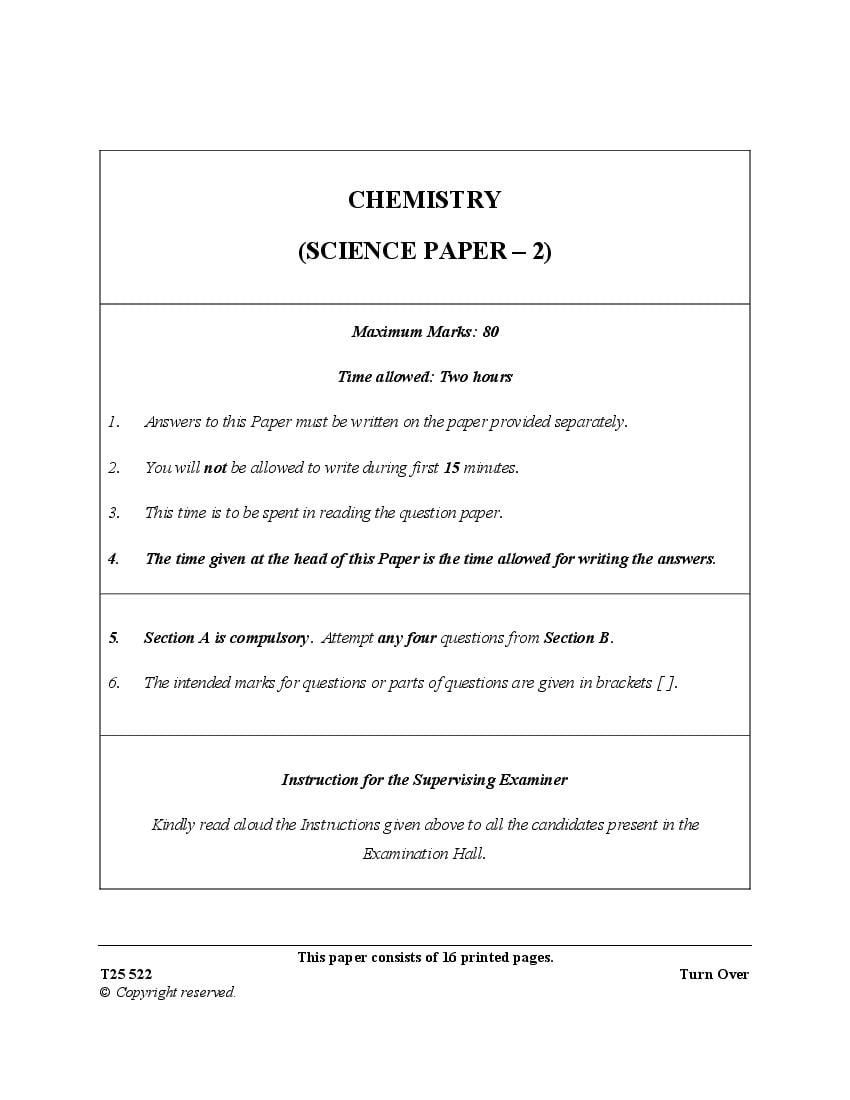
(SCIENCE PAPER – 2)
Maximum Marks: 80
Time allowed: Two hours
1. Answers to this Paper must be written on the paper provided separately.
2. You will not be allowed to write during first 15 minutes.
3. This time is to be spent in reading the question paper.
4. The time given at the head of this Paper is the time allowed for writing the answers.
5. Section A is compulsory. Attempt any four questions from Section B.
6. The intended marks for questions or parts of questions are given in brackets [ ].
Instruction for the Supervising Examiner
Kindly read aloud the Instructions given above to all the candidates present in the
Examination Hall.
This paper consists of 16 printed pages.
T25 522 Turn Over
© Copyright reserved.
Page 2
(Attempt all questions from this Section.)
Question 1
Choose the correct answers to the questions from the given options. [15]
(Do not copy the questions, write the correct answers only.)
(i) Which gas decolourises potassium permanganate (KMnO4) solution?
(a) Sulphur dioxide
(b) Ammonia
(c) Hydrogen chloride
(d) Carbon dioxide
(ii) Which formula represents a saturated hydrocarbon?
(a) C4H8
(b) C5H12
(c) C4H6
(d) C5H10
(iii) The metal whose oxide can be reduced by common reducing agents:
(a) Copper
(b) Sodium
(c) Aluminium
(d) Potassium
T25 522 2
Page 3
organic compound is:
[Atomic weight: C = 12, H = 1]
(a) CH4
(b) C2H4
(c) C2H6
(d) C3H8
(v) In the reaction given below sulphuric acid acts as a/an:
S + 2H2SO4 3SO2 + 2H2O
(a) Non-volatile acid
(b) Dibasic acid
(c) Oxidising agent
(d) Reducing agent
(vi) Assertion (A): The tendency of losing electrons increases down the Group.
Reason (R): The most reactive metal is placed at the top of Group 1.
(a) Both (A) and (R) are true, and (R) is the correct explanation of (A).
(b) Both (A) and (R) are true, and (R) is not the correct explanation of (A).
(c) (A) is true but (R) is false.
(d) (A) is false but (R) is true.
(vii) The ore that can be concentrated by using magnetic separation:
(a) Corundum
(b) Haematite
(c) Calamine
(d) Bauxite
T25 522 3 Turn Over
Page 4
Which option represents the correct electronic configuration of atoms A and B
before combining together to form the above molecule?
A B
(a) 2, 4 2, 8, 6
(b) 2, 4 2, 8, 7
(c) 2, 8 2, 8, 8
(d) 2, 6 2, 8, 7
(ix) Which of the following options has all the compounds which are members of the
same homologous series?
(a) CH4, C2H6, C3H8
(b) CH4, C2H6, C3H6
(c) C3H4, C3H6, C3H8
(d) C2H4, C3H6, C4H10
T25 522 4
Page 5
obtain sulphuric acid.
Reason (R): Dense fog or misty droplets of sulphuric acid are formed which is
difficult to condense.
(a) Both (A) and (R) are true, and (R) is the correct explanation of (A).
(b) Both (A) and (R) are true, and (R) is not the correct explanation of (A).
(c) (A) is true but (R) is false.
(d) (A) is false but (R) is true.
(xi) Given below are four ions:
Cl–, Li+, Al3+, K+
Identify the pair of ions which have the same electronic configuration.
[Atomic number: Cl = 17, Li = 3, Al = 13, K = 19]
(a) Cl– & Li+
(b) Al3+ & K+
(c) Cl– & K+
(d) Li+ & K+
(xii) Which pair of reactants can be best used to produce lead (II) sulphate?
(a) Sulphuric acid + Lead
(b) Sulphuric acid + Lead hydroxide
(c) Sodium sulphate + Lead nitrate
(d) Potassium sulphate + Lead oxide
T25 522 5 Turn Over
Page 6
Which statement about the electrolysis is not correct?
(a) An oxidation reaction occurs at the positive electrode.
(b) The current is carried through the electrolyte by ions.
(c) The positive electrode loses mass.
(d) The number of copper (II) ions in the electrolyte decreases.
(xiv) X, Y & Z are three metallic atoms in successive order belonging to the same group
such that atomic radii of ‘X’ is the smallest. Which of the three atoms is the best
reducing agent?
(a) X
(b) Y
(c) Z
(d) All three have the same reducing power.
(xv) 40 cm3 of methane (CH4) is reacted with 60 cm3 of oxygen.
The equation for the reaction is given below:
CH4 + 2O2 CO2 + 2H2O
All volumes are measured at room temperature.
What is the total volume of the gases remaining at the end of the reaction?
(a) 60 cm3
(b) 40 cm3
(c) 45 cm3
(d) 50 cm3
T25 522 6
Page 7
(i) A student was instructed by the teacher to prepare and collect ammonia gas in the [5]
laboratory by using aluminium nitride. The student had set up the apparatus as
shown in the diagram below. Study the given diagram and answer the following
questions:
(a) Name the substance X added through the thistle funnel by the student.
(b) Write a balanced equation for the reaction occurring between Aluminium
nitride and substance X.
(c) Identify the substance Y.
(d) State the function of Y.
(e) Why could the student not collect ammonia gas at the end of the experiment?
(ii) State the terms for the following: [5]
(a) Undistilled alcohol containing a large amount of methanol.
(b) A salt formed by the partial replacement of the hydroxyl group of a di-acidic
or a tri-acidic base by an acid radical.
(c) Organic compounds having the same molecular formula but different
structural formula.
T25 522 7 Turn Over
Page 8
when combined in a compound.
(e) The type of covalent bond in which electrons are shared unequally between
the combining atoms.
(iii) Complete the following sentences by choosing the correct word(s) from the [5]
brackets:
(a) ____________ solution forms a coloured precipitate with ammonium
hydroxide which is soluble in excess of ammonium hydroxide.
[Ferrous chloride / Copper nitrate]
(b) Zinc blende is converted to zinc oxide by _________. [Calcination / Roasting]
(c) ___________ conducts electricity by the movement of ions.
[Molten iron / Molten sodium chloride]
(d) The reaction that takes place at the anode during the electrolysis of aqueous
Sodium argentocyanide with silver electrodes is ___________.
[Ag Ag+ + e– Ag+ + e– Ag]
(e) The salt formed when ZnO reacts with hot concentrated NaOH is
___________. [sodium zincate / zinc hydroxide]
(iv) Match the Column A with Column B: [5]
Column A Column B
(a) N2 + 3H2 ⇌ 2NH3 1. Vanadium Pentoxide
(b) 4NH3 + 5O2 4NO + 6H2O 2. Nickel
(c) 2SO2 + O2 ⇌ 2SO3 3. Iron
(d) C2H4 + H2 C2H6 4. Concentrated Sulphuric acid
(e) CuSO4.5H2O CuSO4 + 5H2O 5. Platinum
T25 522 8
Page 9
1. 2-methyl propene
2. butanal
(b) Give IUPAC name for the following organic compounds:
1.
2.
3.
SECTION B (40 Marks)
(Attempt any four questions from this Section.)
Question 3
(i) The atomic number of two atoms ‘X’ and ‘Y’ are 14 and 8 respectively. [2]
State:
(a) the period to which ‘X’ belongs.
(b) the formula of the compound formed between ‘X’ and ‘Y’.
(Do not identify X and Y)
T25 522 9 Turn Over
Page 10
(a) Anode is known as the oxidizing electrode.
(b) Graphite electrodes are preferred in the electrolysis of molten lead bromide.
(iii) The reaction between concentrated sulphuric acid and magnesium can be [3]
represented by the equation given below:
Mg + 2H2SO4 MgSO4 + 2H2O + SO2
If 60 g of magnesium is used in the reaction, calculate the following:
(a) The mass of sulphuric acid needed for the reaction.
(b) The volume of sulphur dioxide gas liberated at S.T.P.
[Atomic weight: Mg=24, H=1, S=32, O=16 ]
(iv) Give one significant observation when: [3]
(a) a solution of barium chloride is added to zinc sulphate solution.
(b) lead nitrate is heated in a test tube.
(c) chlorine gas is passed over moist starch iodide paper.
Question 4
(i) A gas cylinder can hold 150 g of hydrogen under certain conditions of temperature [2]
and pressure. If an identical cylinder with the same capacity can hold 450 g of
gas ‘G’ under the same conditions of temperature and pressure, find:
(a) the vapour density of the gas ‘G’.
(b) the molecular weight of gas ‘G’.
T25 522 10
Page 11
CaO
(a) CH3COONa + NaOH Δ
(b) CH3COOH + Mg
(iii) Name the gas produced during each of the following reactions: [3]
(a) When copper is treated with hot, concentrated nitric acid.
(b) When ammonia is burnt in an atmosphere of oxygen.
(c) When ferrous sulphide reacts with dilute hydrochloric acid.
(iv) Study the table given below. Use only the letters given in the table to answer the [3]
questions. Do not identify the elements.
IA IIA IIIA IVA VA VIA VIIA 0
E J Q
L G
M D P
N
(a) State the valency of element ‘G’.
(b) Which element can exhibit catenation?
(c) Write the formula of the compound formed between ‘M’ and ‘P’.
Question 5
(i) Given below are two sets of elements from two different periods. [2]
Name the element with the highest ionisation potential in each of the following sets.
(a) Al, Cl, Mg
(b) Ne, O, F
T25 522 11 Turn Over
Page 12
(a) Name the gas evolved.
(b) What will be the colour of the residue that is left in the combustion tube at the
end of the reaction?
(iii) Give balanced equations for the following: [3]
(a) Action of dilute hydrochloric acid on ammonium carbonate.
(b) Oxidation of sulphur with hot concentrated nitric acid.
(c) Reaction of concentrated sulphuric acid with carbon.
(iv) Rohit took two different salt solutions in test tubes C and D as shown in the figure [3]
below. He added dilute HCl to each of the two test tubes. The products formed in
the test tubes C and D are silver chloride and lead chloride respectively.
dilute dilute
HCl S HCl
AgNO3 Pb(NO3)2
solution solution
Test tube C Test tube D
State:
(a) one common observation made by Rohit in both the reactions.
(b) the observations made by him on addition of excess of ammonium hydroxide
to the products formed in:
1. test tube C
2. test tube D
T25 522 12
Page 13
(i) Given below is a diagram showing the placement of five different oxides. With [3]
respect to the given diagram answer the following questions:
(a) Name the type of oxide represented in region X in the diagram.
(b) Identify the oxide which has been incorrectly placed in the above diagram.
(c) Name the oxide from the above diagram which will form an alkali when
dissolved in water.
(ii) Given below are organic compounds labelled A to F. [3]
Answer the questions that follow:
A. B. C.
D. E. F.
(a) Which compound forms a single product with bromine?
(b) Which two compounds have the same molecular formula?
(c) Which two compounds will react together in the presence of concentrated
H2SO4 to form a product with a fruity smell?
T25 522 13 Turn Over
Page 14
percentage of carbon and hydrogen are 47.4% and 10.5% respectively. The relative
molecular mass of ‘X’ is 76. Find the empirical formula and the molecular formula
of ‘X’.
[Atomic weight: C = 12, O = 16, H = 1]
Question 7
(i) Seema added a few pieces of copper turnings to a test tube containing concentrated [2]
acid P and she noticed that a reddish-brown gas evolved.
(a) Name the acid P used by Seema.
(b) Write a balanced chemical equation for the reaction that took place.
(ii) Answer the following questions with reference to the concentration of bauxite ore. [2]
(a) Name the process used to concentrate the ore.
(b) Give a balanced chemical equation for the conversion of aluminium hydroxide
to pure alumina.
(iii) Draw the dot and cross structure of the following: [3]
(a) An ionic compound formed when Mg reacts with the dilute HCl.
(b) A covalent compound formed when H2 reacts with Cl2.
(c) The positive ion produced when ammonia gas is dissolved in water.
[Atomic number: Mg = 12, Cl = 17, H = 1, N = 7]
T25 522 14
Page 15
Answer the following questions:
(a) Why is dilute sulphuric acid added to water?
(b) Write the reaction taking place at the cathode.
(c) What is the observation at the anode?
Question 8
(i) (a) State Avogadro’s Law. [2]
(b) Define Co-ordinate bond.
(ii) Differentiate between the following pairs of compounds using the reagent given in [2]
the bracket:
(a) Ammonium chloride and Sodium chloride (using an alkali)
(b) Zinc Nitrate solution and Calcium Nitrate solution
(using excess sodium hydroxide solution)
(iii) You are provided with some compounds in the box. [3]
PbO CH4 PbO2 CO2
HCl NCl3 SO2
Choose the most appropriate compound which fits the descriptions (a) to (c) given
below:
(a) A colourless gas which turns acidified K2Cr2O7 from orange to green.
(b) A yellow explosive oily liquid formed when excess chlorine gas reacts with
ammonia gas.
(c) A yellow metallic oxide formed on thermal decomposition of PbCO3.
T25 522 15 Turn Over
Page 16
P – Simple displacement
Q – Neutralisation by titration
R – Precipitation
S – Direct combination
Choose the most appropriate method to prepare the following salts:
(a) PbCl2
(b) FeCl3
(c) Na2SO4
`
T25 522 16
Document Details
| Board / Org | CISCE |
| Exam | Class 10 |
| Type | Question Paper |
| Pages | 16 |
| Updated | 24 Sep 2026 |