WBCHSE Class 11 Syllabus for History
Finished viewing? Save it for later —
Download WBCHSE Class 11 Syllabus for History (PDF · 3 pages)About WBCHSE Class 11 Syllabus for History
WBCHSE Class 11 Syllabus for History is available here for free download. Published by West Bengal Board for Class 11, this syllabus can be viewed online or downloaded as a PDF (3 pages). Candidates preparing for Class 11 can use WBCHSE Class 11 Syllabus for History to understand the exam pattern, the type of questions asked, and the overall difficulty level.
Frequently Asked Questions
How can I download WBCHSE Class 11 Syllabus for History?
Open this page and click the Download button to save WBCHSE Class 11 Syllabus for History as a PDF. It is completely free on AglaSem Docs.
Is WBCHSE Class 11 Syllabus for History free to download?
Yes. WBCHSE Class 11 Syllabus for History can be viewed online and downloaded as a PDF free of cost on AglaSem Docs.
How many pages does WBCHSE Class 11 Syllabus for History have?
WBCHSE Class 11 Syllabus for History contains 3 pages, which you can read online or download together as a single PDF.
Where can I find more Class 11 study material?
You can find more Class 11 question papers, sample papers, syllabus, and answer keys on AglaSem Docs.
WBCHSE Class 11 Syllabus for History – Text
Read the full text of this syllabus below — useful to quickly search, copy and reference the content online without downloading the PDF.
📄 View text version (3 pages)
Page 1
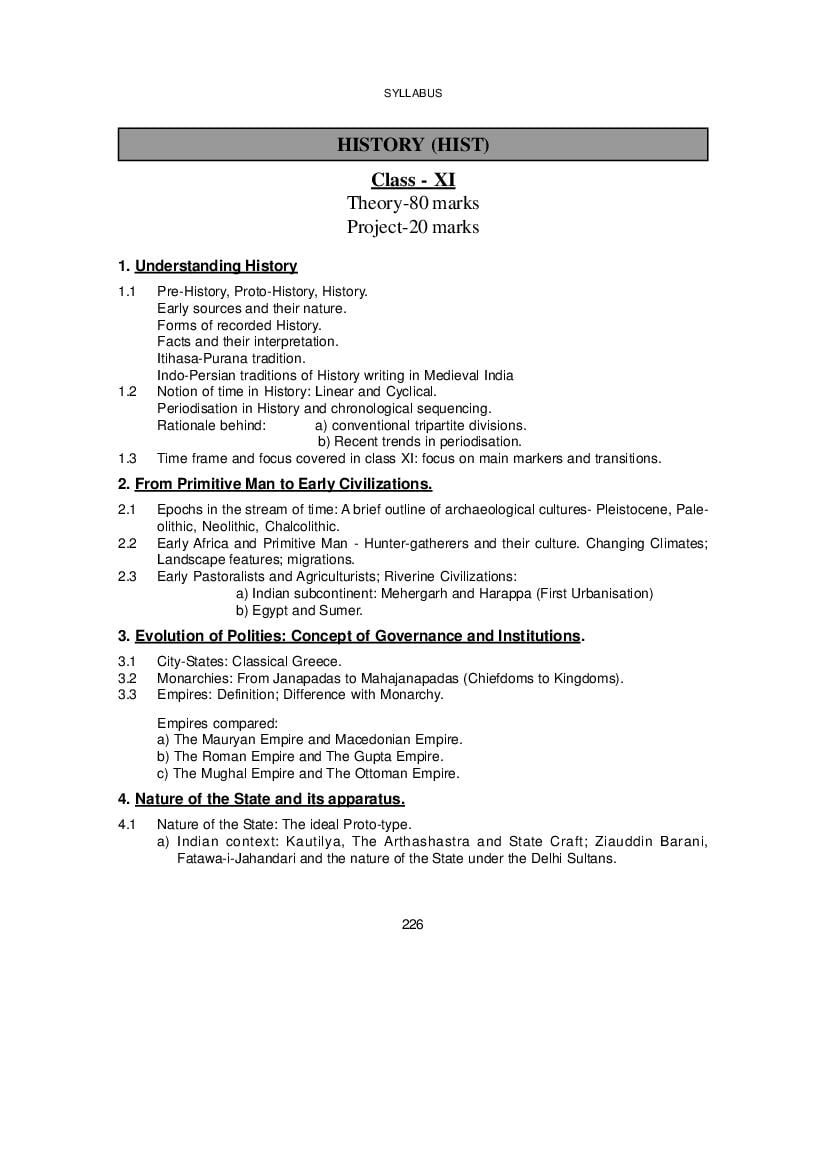
Class - XI
Theory-80 marks
Project-20 marks
1. Understanding History
1.1 Pre-History, Proto-History, History.
Early sources and their nature.
Forms of recorded History.
Facts and their interpretation.
Itihasa-Purana tradition.
Indo-Persian traditions of History writing in Medieval India
1.2 Notion of time in History: Linear and Cyclical.
Periodisation in History and chronological sequencing.
Rationale behind: a) conventional tripartite divisions.
b) Recent trends in periodisation.
1.3 Time frame and focus covered in class XI: focus on main markers and transitions.
2. From Primitive Man to Early Civilizations.
2.1 Epochs in the stream of time: A brief outline of archaeological cultures- Pleistocene, Pale-
olithic, Neolithic, Chalcolithic.
2.2 Early Africa and Primitive Man - Hunter-gatherers and their culture. Changing Climates;
Landscape features; migrations.
2.3 Early Pastoralists and Agriculturists; Riverine Civilizations:
a) Indian subcontinent: Mehergarh and Harappa (First Urbanisation)
b) Egypt and Sumer.
3. Evolution of Polities: Concept of Governance and Institutions.
3.1 City-States: Classical Greece.
3.2 Monarchies: From Janapadas to Mahajanapadas (Chiefdoms to Kingdoms).
3.3 Empires: Definition; Difference with Monarchy.
Empires compared:
a) The Mauryan Empire and Macedonian Empire.
b) The Roman Empire and The Gupta Empire.
c) The Mughal Empire and The Ottoman Empire.
4. Nature of the State and its apparatus.
4.1 Nature of the State: The ideal Proto-type.
a) Indian context: Kautilya, The Arthashastra and State Craft; Ziauddin Barani,
Fatawa-i-Jahandari and the nature of the State under the Delhi Sultans.
226
Page 2
chy; Intellectual underpinnings of the Early Modern State.
4.2 Apparatus of Governance:
a) Persia: Satraps.
b) China: Mandarins.
c) Delhi Sultanate: Iqtadars.
d) Mughal: Mansabadars.
5. Aspects of Economy.
5.1 Slave Economy and Slavery as an Institution:
a) Rome and Egypt
b) India
5.2 Feudal Economy:
a) Western Europe, The Classical Model
b) Indian experiences: Gupta Empire and The Delhi Sultanate;
5.3 Trade and urbanisation. Between Expansion and Contraction: European and Indian Expe-
riences compared.
6. Dynamics of Society.
6.1 Social Stratification:
a) Slave Society: Greece-Helot, Periocei, and their relationship with Citizens.
b) Varna and Jati (special mention of Forest-dwellers viz Nisadas)
c) Fallen Ksatriyas- Yavanas, sakas, Hunas
d) Rajputs as a status group.
6.2 Women in society: Indian context.
a) Education of Women
b) Forms of Marriage and the Household
c) Inheritance and Property Rights (Streedhan)
d) Outstanding Women in Political authority: Egypt: Nefertiti, Cleopatra; India: Rani
Durgavati, Razia, Noor-Jahan.
7. Religion.
7.1 Religion and the State:
a) India: Asoke and Dhamma,
Alauddin Khalji, The Sharit and the Ulema.
Akbar, Din-i-llahi and Sulh-i-Kul
b) Western Europe: The Holy Roman Empire and papacy.
Crusades.
c) Arab World: The Universal Caliphate.
7.2 Religion and Society:
a) Vedic religion.
b) Polytheism and the European context.
c) New religious movements (Buddhism and Jainism).
d) Reformation movements in Europe.
227
Page 3
8.1 Origins of Modern Science: Alchemy to chemistry, Astrology to Astronomy- towards a
Solar- centric Universe.
8.2 Technological advances: Agricultural, Military and technologies of Production, Ship build-
ing.
8.3 Printing revolution in Western Europe (Mention the contributions of China and the Arab
world to the art of printing).
8.4 Geographical Explorations - towards a ‘New world’.
9. Cultural and intellectual traditions.
(For Project Work- on any one topic, 750-800 words)
9.1 The European context.
a) Renaissance - Definition of the term; critiquing the validity of the proposition.
b) Twelfth Century renaissance.
c) Renaissance Humanism.
d) Italian Renaissance - Impact on art, culture and Political thinking; Role of
Patronage - different roles of the Pope, the Medicis, The Sforzas, Flemish burghers.
9.2 Systems of Knowledge and Literature: the Indian context.
a) Schools of Indian Philosophy - an overview
b) The Sciences, Mathematics, Astronomy, Medicine, Technology.
c) Court literature: Sangram, Sanskrit, Persian.
d) Vernacular literature - special reference to Bengali literature (from Charyapada to
Vaishnave literature Mangala Kavya and translations).
9.3 Architecture, Sculpture and Painting: The Indian context
a) Painting: Cave painting (From Bhimbetka to Ajanta), Miniatures (Mughal and Rajputs).
b) Sculpture: Buddhist, Shaiva, Vaishnave Iconography.
c) Temple architecture: Chola temples and Bengal Temple architecture
d) Tombs, Mosques and forts in medieval India.
228
Document Details
| Board / Org | West Bengal Board |
| Exam | Class 11 |
| Type | Syllabus |
| Pages | 3 |
| Updated | 22 Jul 2026 |