CBSE Class 12 Physics Question Paper 2020 Set 55-4-3
Finished viewing? Save it for later —
Download CBSE Class 12 Physics Question Paper 2020 Set 55-4-3 (PDF · 16 pages)About CBSE Class 12 Physics Question Paper 2020 Set 55-4-3
CBSE Class 12 Physics Question Paper 2020 Set 55-4-3 is available here for free download. Published by CBSE for Class 12, this question paper can be viewed online or downloaded as a PDF (16 pages). Candidates preparing for Class 12 can use CBSE Class 12 Physics Question Paper 2020 Set 55-4-3 to understand the exam pattern, the type of questions asked, and the overall difficulty level.
Frequently Asked Questions
How can I download CBSE Class 12 Physics Question Paper 2020 Set 55-4-3?
Open this page and click the Download button to save CBSE Class 12 Physics Question Paper 2020 Set 55-4-3 as a PDF. It is completely free on AglaSem Docs.
Is CBSE Class 12 Physics Question Paper 2020 Set 55-4-3 free to download?
Yes. CBSE Class 12 Physics Question Paper 2020 Set 55-4-3 can be viewed online and downloaded as a PDF free of cost on AglaSem Docs.
How many pages does CBSE Class 12 Physics Question Paper 2020 Set 55-4-3 have?
CBSE Class 12 Physics Question Paper 2020 Set 55-4-3 contains 16 pages, which you can read online or download together as a single PDF.
Where can I find more Class 12 study material?
You can find more Class 12 question papers, sample papers, syllabus, and answer keys on AglaSem Docs.
CBSE Class 12 Physics Question Paper 2020 Set 55-4-3 – Text
Read the full text of this question paper below — useful to quickly search, copy and reference the content online without downloading the PDF.
📄 View text version (16 pages)
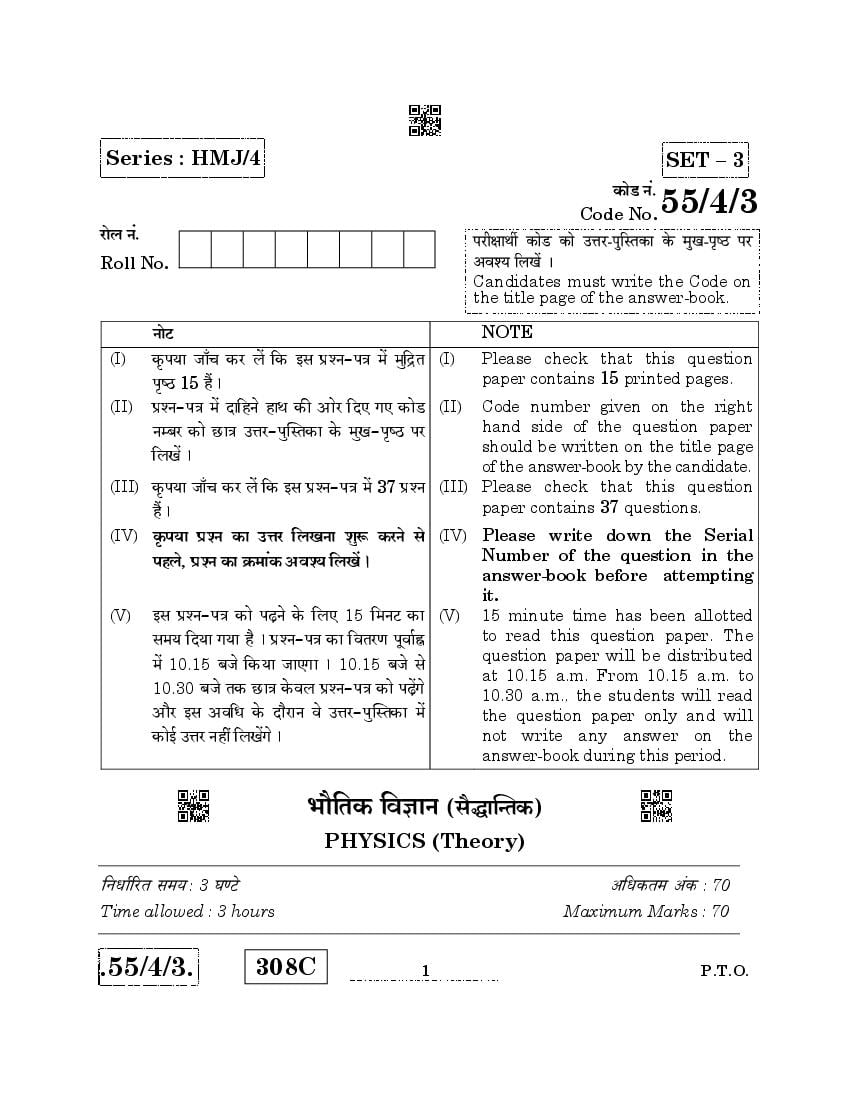
Page 1
.
Code No. 55/4/3
.
Roll No.
Candidates must write the Code on
the title page of the answer-book.
NOTE
(I) - (I) Please check that this question
15 paper contains 15 printed pages.
(II) - (II) Code number given on the right
- - hand side of the question paper
should be written on the title page
of the answer-book by the candidate.
(III) - 37 (III) Please check that this question
paper contains 37 questions.
(IV) (IV) Please write down the Serial
, Number of the question in the
answer-book before attempting
it.
(V) - 15 (V) 15 minute time has been allotted
- to read this question paper. The
question paper will be distributed
10.15 10.15
at 10.15 a.m. From 10.15 a.m. to
10.30 - 10.30 a.m., the students will read
- the question paper only and will
not write any answer on the
answer-book during this period.
()
PHYSICS (Theory)
{ZYm©[aV g‘¶ : 3 KÊQ>o A{YH$V‘ A§H$ : 70
Time allowed : 3 hours Maximum Marks : 70
.55/4/3. 308C 1 P.T.O.
Page 2
(i) - – , ,
(ii) - 37
(iii) - 1 20 , 1
(iv) - 21 27 2
(v) - 28 34 3
(vi) - 35 37 5
(vii) , - , - ,
- -
(viii) , ,
(ix)
(x) ,
c = 3 108 m/s
h = 6.63 10–34 Js
e = 1.6 10–19 C
0 = 410–7 Tm A–1
0 = 8.854 × 10⁻¹² C2 N–1 m–2
1
= 9 109 N m2 C–2
40
(me) = 9.1 10–31 kg
= 1.675 × 10⁻²⁷ kg
= 1.673 × 10⁻²⁷ kg
= 6.023 × 1023
= 1.38 × 10⁻²³ JK–1
.55/4/3. 2
Page 3
Read the following instructions very carefully and strictly follow them :
(i) This question paper comprises four sections – A, B, C and D.
(ii) There are 37 questions in the question paper. All questions are
compulsory.
(iii) Section A : Q. no. 1 to 20 are very short-answer type questions carrying
1 mark each.
(iv) Section B : Q. no. 21 to 27 are short-answer type questions carrying
2 marks each.
(v) Section C : Q. no. 28 to 34 are long-answer type questions carrying
3 marks each.
(vi) Section D : Q. no. 35 to 37 are also long answer type questions carrying
5 marks each.
(vii) There is no overall choice in the question paper. However, an internal
choice has been provided in two questions of one mark, two questions
of two marks, one question of three marks and all the three
questions five marks. You have to attempt only one of the choices in
such questions.
(viii) However, separate instructions are given with each section and
question, wherever necessary.
(ix) Use of calculators and log tables is not permitted.
(x) You may use the following values of physical constants wherever
necessary :
c = 3 108 m/s
h = 6.63 10–34 Js
e = 1.6 10–19 C
0 = 410–7 Tm A–1
0 = 8.854 × 10⁻¹² C2 N–1 m–2
1
= 9 109 N m2 C–2
40
Mass of electron (me) = 9.1 10–31 kg
Mass of neutron = 1.675 × 10⁻²⁷ kg
Mass of proton = 1.673 × 10⁻²⁷ kg
Avogadro’s number = 6.023 × 10²³ per gram mole
Boltzmann constant = 1.38 × 10⁻²³ JK–1
.55/4/3. 3 P.T.O.
Page 4
: :
1. d
I 2d
I I
(a) 2I (b) (c) (d) 4I 1
4 2
2. X- -
v Y-
(a) , XZ
(b) , YZ
(c) , X-
(d) , Y- 1
3 r I y-z
:
(a) r (b)
(c) r (d) I 1
4. r emf (E) R
R V
1
5. 10A
10 cm –
(a) 1.2 × 10⁻⁵ T (b) 2 × 10⁻⁵ T
(c) 3 × 10⁻⁵ T (d) 2 × 10⁻⁵ T 1
6. 4R
–
R
(a) 2R (b) R (c) (d) 4R 1
2
7. - - :
(a) (b)
(c) (d) 1
.55/4/3. 4
Page 5
Select the most appropriate option from those given below each question.
1. A photo-cell connected in an electrical circuit is placed at a distance ‘d’
from a source of light. As a result current I flows in the circuit. What will
be the current in the circuit when the distance is increased to ‘2d’ ?
I I
(a) 2 I (b) (c) (d) 4 I 1
4 2
2. There are uniform electric and magnetic fields in a region pointing along
X-axis. An -particle is projected along Y-axis with a velocity v. The shape of
the trajectory will be
(a) circular in XZ plane
(b) circular in YZ plane
(c) helical with its axis parallel to X-axis
(d) helical with its axis parallel to Y-axis 1
3. A circular loop of radius r, carrying a current I lies in y-z plane with its
centre at the origin. The net magnetic flux through the loop is :
(a) directly proportional to r (b) zero
(c) inversely proportional to r (d) directly proportional to I 1
4. A cell of emf (E) and internal resistance r is connected across a variable
external resistance R. The graph of terminal potential difference V as a
function of R is –
1
5. A current of 10 A is flowing from east to west in a long straight wire kept
on a horizontal table. The magnetic field developed at a distance 10 cm
verticaly above the wire is :
(a) 1.2 × 10⁻⁵ T, acting towards south (b) 2 × 10 –5 T, acting towards north
(c) 3 × 10⁻⁵ T, acting downwards (d) 2 × 10⁻⁵ T, acting upwards 1
6. A uniform wire of resistance 4R is bent in the form of a circle. The
effective resistance between the ends of any diameter of the circle is :
R
(a) 2 R (b) R (c) (d) 4R 1
2
7. In the particle scattering experiment, the shape of the trajectory of the
scattered particles depend upon :
(a) only on impact parameter.
(b) only on the source of particles.
(c) both impact parameter and source of particles.
(d) impact parameter and the screen material of the detector. 1
.55/4/3. 5 P.T.O.
Page 6
(a) (b)
(c) (d) 1
9. - 4 eV 1 eV -
–
(a) 2:1 (b) 1:1 (c) 1:2 (d) 4:1 1
10.
:
(a) (b) 0 (c) (d) 1
2 4
: :
11.
_______ 1
_______
1
12. ________ ,
- 1
13. 10
5 B -
–
1 10 4
0n + 5 B 2He + …… 1
14. , _______
1
15. Io
_________ 1
:
16. A.C.
? 1
17. p-n p- n-
? 1
p-n
1
.55/4/3. 6
Page 7
(a) Infrared region
(b) Ultraviolet region
(c) Visible region
(d) Partly in ultraviolet and partly in visible region 1
9. The kinetic energy of a proton and that of an -particle are 4 eV and 1 eV,
respectively. The ratio of the de-Broglie wavelengths associated with
them, will be
(a) 2:1 (b) 1:1 (c) 1:2 (d) 4:1 1
10. When a wave undergoes reflection at an interface from rarer to denser
medium, adhoc change in its phase is :
(a) (b) 0 (c) (d) 1
2 4
Note : Fill in the blanks with appropriate answer :
11 To minimize the percentage error in the determination of unknown
resistance of a conductor in meter bridge experiment, the balance point is
adjusted near _______ of the wire. 1
OR
In potentiometer, a long uniform wire is used to _______ potential
gradient along the wire. 1
12. Torque acting on an electric dipole placed in an electric field is maximum
when the angle between the electric field and the dipole moment is _______. 1
10
13. A neutron is bombarded on a 5 B nucleus and an alpha particle is emitted.
The nuclear reaction involved is
1 10 4
0n + 5 B 2He + …… 1
14. A proton released from rest in an electric field, will start moving towards
a region of _______ potential in the field. 1
15. Unpolarised light of intensity Io is incident on two crossed polaroids. The
intensity of light transmitted by the combination will be _______. 1
Answer the following :
16. An A.C. source with variable frequency is connected to a parallel plate
capacitor. How will the displacement current be affected with the
decrease in frequency of the source ? 1
17. Can a slab of p-type semi-conductor be physically joined to another n-type
semiconductor slab to form p-n junction ? Justify your answer. 1
OR
In a p-n junction diode the forward bias resistance is low as compared to
the reverse bias resistance. Give reason. 1
.55/4/3. 7 P.T.O.
Page 8
? 1
19. ? 1
20. (+q) (→ →
E ) E
- 1
–
21. p-n -
, 2
22. A, B C
(i) A
(ii) B -
(iii) C
2
?
(i) (ii) 2
23. Lo Ro 1.5 Lo -
(a) l R
(b) 1.5 Lo ? 2
24. 2 F, 3 F 6 F
13
(a) 3 F
(b)
? 2
25. (a) -
(b) (i) (ii) - 2
.55/4/3. 8
Page 9
Which of the two produces image of better quality ? Justify your answer. 1
19. What is the change in the value of angle of dip when one goes from the
equator to the north pole of earth ? 1
→
20. A charged particle (+q) moves in a uniform electric field ( E ) in the
→
direction opposite to E . What will be the effect on its electrostatic
potential energy during its motion ? 1
SECTION – B
21. Briefly explain how a potential barrier is set up across a p-n junction as a
result of diffusion and drift of the charge carriers. 2
22. Light of same wavelength is incident on three photo-sensitive surfaces A,
B and C. The following observations are recorded.
(i) From surface A, photo electrons are not emitted.
(ii) From surface B, photo electrons are just emitted.
(iii) From surface C, photo electrons with some kinetic energy are emitted.
Compare the threshold frequencies of the three surfaces and justify your
answer. 2
OR
If the frequency of light incident on the cathode of a photo-cell is
increased, how will the following be affected ? Justify your answer.
(i) Energy of the photo electrons.
(ii) Photo current. 2
23 A wire of length Lo has a resistance Ro. It is gradually stretched till its
length becomes 1.5 Lo.
(a) Plot the graph showing variation of its resistance R with its length l
during stretching.
(b) What will be its resistance when its length becomes 1.5 L o ? 2
24. You are given three capacitors of 2 F, 3 F and 4 F, respectively.
(a) Form a combination of all these capacitors of equivalent capacitance
13
F.
3
(b) What is the maximum and minimum value of the equivalent
capacitance that can be obtained by connecting these capacitors ? 2
25. (a) Explain the formation of energy bands in crystalline solids.
(b) Draw the energy band diagrams of (i) a metal and (ii) a semiconductor. 2
.55/4/3. 9 P.T.O.
Page 10
/4 C
/4 L, C R
(i)
(ii) 2
27. (a) ?
(b) I1 I2 (I1 > I2) V-I
2
(a) (LED) -
(b) LED 2
–
28. 5 × 10⁻² W m–2
/6 ,
,
(a)
(b)
(c) 3
29. (a) - ? Z-
- →
B X-
(b) - 3
30. 9 cm
6 cm ,
¼th 3
31. (a)
(b) 2H 100 ms
0.5A
(i)
(ii) emf. 3
.55/4/3. 10
Page 11
voltage V = Vo sin t. The voltage is found to lead current in phase by /4.
If the inductor is replaced by a capacitor C, the voltage lags behind
current in phase by /4. When L, C and R are connected in series with the
same source,
Find the :
(i) average power dissipated and
(ii) instantaneous current in the circuit. 2
27. (a) Why is a photo diode operated under reverse bias condition ?
(b) Draw V-I characteristic curves of photo diode for incident light of
intensities I1 and I2 (I1 > I2). 2
OR
(a) State the level of doping and biasing condition used in light emitting
diode (LED).
(b) Write any two advantages of LED over the conventional low power
lamps. 2
SECTION – C
28. Two coherent light waves of intensity 5 × 10 –2 Wm–2 each super-impose
and produce the interference pattern on a screen. At a point where the
path difference between the waves is /6, being wavelength of the wave,
find the
(a) phase difference between the waves.
(b) resultant intensity at the point.
(c) resultant intensity in terms of the intensity at the maximum. 3
29. (a) How are electro-magnetic waves produced ? Depict an electro-
→
magnetic wave propagating in Z-direction with its magnetic field B
oscillating along X-direction.
(b) Write two characteristics of electro-magnetic waves. 3
30. A concave mirror forms a real image of an object kept at a distance 9 cm
from it. If the object is taken away from the mirror by 6 cm, the image size
1
reduces to th of its previous size. Find the focal length of the mirror. 3
4
31. (a) Differentiate between self inductance and mutual inductance.
(b) The mutual inductance of two coaxial coils is 2H. The current in one
coil is changed uniformly from zero to 0.5A in 100 ms. Find the :
(i) change in magnetic flux through the other coil.
(ii) emf induced in the other coil during the change. 3
.55/4/3. 11 P.T.O.
Page 12
emf 3
33. r1 r2 Q
–q
(a) (i) (ii) ?
(b) -
3
(a)
x (E)
(b) x E 3
34. (a)
(b) emf 5V 10 m
-
emf E1 E2 (i) (ii)
-
700 cm 100 cm
emf 3
:
35. (a)
A m
(b) PQ 1.5 ABC
(i)
(ii) 1.4 , ? 5
.55/4/3. 12
Page 13
and obtain the expression for the emf produced in the coil. 3
33. A hollow conducting sphere of inner radius r1 and outer radius r2 has a
charge Q on its surface. A point charge –q is also placed at the centre of
the sphere.
(a) What is the surface charge density on the (i) inner and (ii) outer
surface of the sphere ?
(b) Use Gauss’ law of electrostatics to obtain the expression for the
electric field at a point lying outside the sphere. 3
OR
(a) An infinitely long thin straight wire has a uniform linear charge
density . Obtain the expression for the electric field (E) at a point
lying at a distance x from the wire, using Gauss’ law.
(b) Show graphically the variation of this electric field E as a function of
distance x from the wire. 3
34. (a) Explain the principle of working of a potentiometer.
(b) In a potentiometer, a standard source of emf 5V and negligible
internal resistance maintains a steady current through the
potentiometer wire of length 10m. Two primary cells of emf E 1 and
E2 are joined together in a series with (i) same polarity and (ii)
opposite polarity. The combination is connected to the potentiometer
circuit in each case. The balancing length of the wire in the two cases
are found to be 700 cm and 100 cm, respectively.
Find the values of emf of the two cells. 3
SECTION-D
35. (a) Draw the ray diagram showing refraction of ray of light through a
glass prism. Derive the expression for the refractive index of the
material of prism in terms of the angle of prism A and angle of
minimum deviation m.
(b) A ray of light PQ enters an isosceles right angled prism ABC of
refractive index 1.5 as shown in figure.
(i) Trace the path of the ray through the prism.
(ii) What will be the effect on the path of the ray if the refractive
index of the prism is 1.4 ? 5
OR
.55/4/3. 13 P.T.O.
Page 14
(b) 1.5 10 D
50 cm
5
36. (a) N = No e–t
238
(b) - U 4.5 × 10⁹
92
(c)
? 5
(a)
(b)
5
37. (a)
(b) 7 cm 5 2A
X-Y
5
(a)
, 1A
(b) 3A m2
10 cm
F 30
0.25 T
F
F , ? 5
______________
.55/4/3. 14
Page 15
expression for the focal length of this combination in terms of the
focal lengths of the two lenses.
(b) A converging lens of refractive index 1.5 has a power of 10 D. When
it is completely immersed in a liquid, it behaves as a diverging lens
of focal length 50 cm. Find the refractive index of the liquid. 5
36. (a) Derive the law of radioactive decay N = N o e–t
238
(b) The half life of U undergoing -decay is 4.5 × 10⁹ years. Find its
92
mean life.
(c) What fraction of the initial mass of a radioactive substance will
decay in five half – life periods ? 5
OR
(a) State the postulates of Bohr’s model of hydrogen atom and derive the
expression for Bohr radius.
(b) Find the ratio of the longest and the shortest wavelengths amongst
the spectral lines of Balmer series in the spectrum of hydrogen atom. 5
37. (a) Show that a current carrying solenoid behaves like a small bar
magnet. Obtain the expression for the magnetic field at an external
point lying on its axis.
(b) A steady current of 2A flows through a circular coil having 5 turns of
radius 7 cm. The coil lies in X-Y plane with its centre at the origin.
Find the magnitude and direction of the magnetic dipole moment of
the coil. 5
OR
(a) Derive the expression for the force acting between two long parallel
current carrying conductors. Hence, define 1 A current.
(b) A bar magnet of dipole moment 3 Am2 rests with its centre on a
frictionless pivot. A force F is applied at right angles to the axis of
the magnet, 10 cm from the pivot. It is observed that an external
magnetic field of 0.25 T is required to hold the magnet in equilibrium
at an angle of 30° with the field.
Calculate the value of F.
How will the equilibrium be effected if F is withdrawn ? 5
____________
.55/4/3. 15 P.T.O.
Page 16
Document Details
| Board / Org | CBSE |
| Exam | Class 12 |
| Type | Question Paper |
| Pages | 16 |
| Updated | 22 Jul 2026 |