WBCHSE Class 11 Syllabus for Home Management and Family Resources
Finished viewing? Save it for later —
Download WBCHSE Class 11 Syllabus for Home Management and Family Resources (PDF · 4 pages)About WBCHSE Class 11 Syllabus for Home Management and Family Resources
WBCHSE Class 11 Syllabus for Home Management and Family Resources is available here for free download. Published by West Bengal Board for Class 11, this syllabus can be viewed online or downloaded as a PDF (4 pages). Candidates preparing for Class 11 can use WBCHSE Class 11 Syllabus for Home Management and Family Resources to understand the exam pattern, the type of questions asked, and the overall difficulty level.
Frequently Asked Questions
How can I download WBCHSE Class 11 Syllabus for Home Management and Family Resources?
Open this page and click the Download button to save WBCHSE Class 11 Syllabus for Home Management and Family Resources as a PDF. It is completely free on AglaSem Docs.
Is WBCHSE Class 11 Syllabus for Home Management and Family Resources free to download?
Yes. WBCHSE Class 11 Syllabus for Home Management and Family Resources can be viewed online and downloaded as a PDF free of cost on AglaSem Docs.
How many pages does WBCHSE Class 11 Syllabus for Home Management and Family Resources have?
WBCHSE Class 11 Syllabus for Home Management and Family Resources contains 4 pages, which you can read online or download together as a single PDF.
Where can I find more Class 11 study material?
You can find more Class 11 question papers, sample papers, syllabus, and answer keys on AglaSem Docs.
WBCHSE Class 11 Syllabus for Home Management and Family Resources – Text
Read the full text of this syllabus below — useful to quickly search, copy and reference the content online without downloading the PDF.
📄 View text version (4 pages)
Page 1
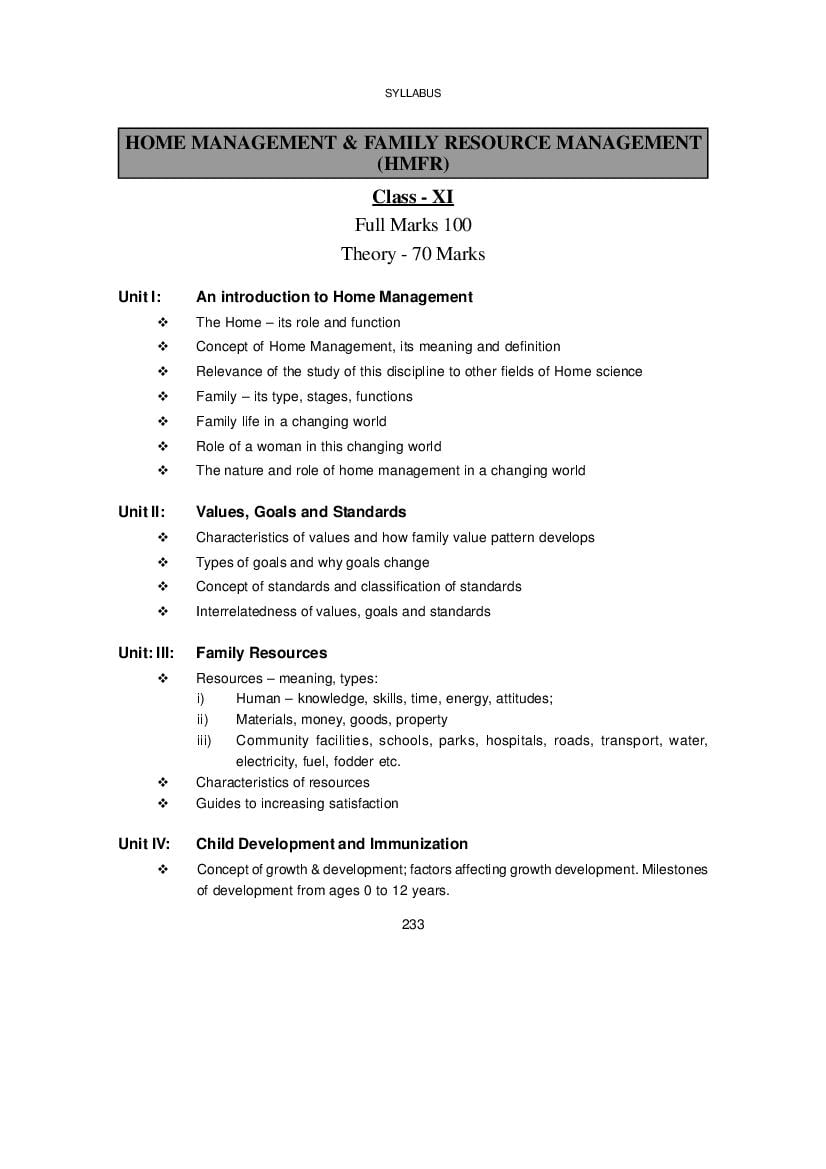
Full Marks 100
Theory - 70 Marks
Unit I: An introduction to Home Management
The Home – its role and function
Concept of Home Management, its meaning and definition
Relevance of the study of this discipline to other fields of Home science
Family – its type, stages, functions
Family life in a changing world
Role of a woman in this changing world
The nature and role of home management in a changing world
Unit II: Values, Goals and Standards
Characteristics of values and how family value pattern develops
Types of goals and why goals change
Concept of standards and classification of standards
Interrelatedness of values, goals and standards
Unit: III: Family Resources
Resources – meaning, types:
i) Human – knowledge, skills, time, energy, attitudes;
ii) Materials, money, goods, property
iii) Community facilities, schools, parks, hospitals, roads, transport, water,
electricity, fuel, fodder etc.
Characteristics of resources
Guides to increasing satisfaction
Unit IV: Child Development and Immunization
Concept of growth & development; factors affecting growth development. Milestones
of development from ages 0 to 12 years.
233
Page 2
years of age (infancy, early, childhood, middle childhood and late childhood) –
physical, motor, cognitive, emotional social and language development.
Factors influencing development – development is multi dimensional and inter
disciplinary development is continuous and cumulative; it is variable, reflecting
individual variation; cultural difference are reflected in development; both heredity
and environment influence development.
Substitute care at home and outside: siblings, grand parents, neighbours creche,
day care centres etc. Integrated Child Development Scheme (ICDS) – objectives
and functions.
Protection from preventable diseases: immunization – concept and types (natural
and acquired), breast feeding (one of the ways to develop natural immunity);
immunization chart; symptoms and incubation period of childhood diseases – TB,
DPT, polio, measles, cholera, diarrhoea.
Unit –V Food and Nutrition
Relationship of food, nutrition and health.
Classification of food on the basis of nutrients and functions. Functions of food:
physiological, psychological and social.
Elementary study of macro and micro nutrients. Functions and sources of nutrients:
carbohydrates, proteins fats, minerals (iron, calcium, iodine and phosphorous) and
vitamins (A, D, E, K, B1, B2, Niascin, Folic Acid & C); role of water and fibre in the
diet.
Recommended Dietary allowances (RDA) for all nutrients mentioned above.
Unit- VI- Textiles (Fibre to Fabric)
Textile fibres. Types of fibre:
I. Natural- cotton, silk and wool
II. Man-made –nylon, polyester and blended fibres (terrycot, terrysilk, terrywool,
cotton silk)
Identification of fibres – physical and chemical tests
Fabric construction: Basic procedure of any yarn making (spinning, mechanical
spinning, chemical spinning, weaving: plain, twill & stain, other methods – knitting
234
Page 3
garment.
Finishing: meaning and importance; types
I. Basic: cleaning, bleaching, stiffening, tendering
II. Special: mercerisation, shrinkage control, water proofing, dyeing and printing.
Unit – VII Interior Decoration
Elements of Design and art
Principles of Design
Use of colour in interiors – prang’s colour wheel, characteristics of colour, colour
schemes
Unit- VIII First Aid at Home
Meaning, aims & scope of first aid
Bandages and dressings
Rendering first aid in case of an accident, sprain, fractures, cuts, burns, foreign
body, bites, fainting.
235
Page 4
Practical Marks - 30
1. Prepare materials for stimulating the sensory development of infants.
2. Observe and record the motor development of infants and prepare a chart based on
your findings.
3. Identification of fibres – physical and chemical methods
4. Identify different weaves and finishes.
5. Basic stitches, running, hemming, back stitch, blanket stitch
6. Buttonhole and attaching buttons.
7. Preparing prang’s colour chart and colour harmony
8. Application of elements and principles of design in flower arrangement and floor
decoration (Alpana and Rangoli)
9. Application of bandages (roller and triangular)
10. Use of 24 hours dietary recall method to analyze and compare nutritional sufficiency
of RDA.
Seminar or group discussion on:
1. Role of women in changing world
2. A comparative study between the rural and an urban homemaker
3. Interrelatedness of goals, values and standards and its implication on individual or
family decisions.
4. Impact of working parents on the development of a child.
Marks Allotment:
Practical – 15
Viva - 5
Record Book - 10
236
Document Details
| Board / Org | West Bengal Board |
| Exam | Class 11 |
| Type | Syllabus |
| Pages | 4 |
| Updated | 22 Jul 2026 |