WBCHSE Class 11 Syllabus for Maths
Finished viewing? Save it for later —
Download WBCHSE Class 11 Syllabus for Maths (PDF · 4 pages)About WBCHSE Class 11 Syllabus for Maths
WBCHSE Class 11 Syllabus for Maths is available here for free download. Published by West Bengal Board for Class 11, this syllabus can be viewed online or downloaded as a PDF (4 pages). Candidates preparing for Class 11 can use WBCHSE Class 11 Syllabus for Maths to understand the exam pattern, the type of questions asked, and the overall difficulty level.
Frequently Asked Questions
How can I download WBCHSE Class 11 Syllabus for Maths?
Open this page and click the Download button to save WBCHSE Class 11 Syllabus for Maths as a PDF. It is completely free on AglaSem Docs.
Is WBCHSE Class 11 Syllabus for Maths free to download?
Yes. WBCHSE Class 11 Syllabus for Maths can be viewed online and downloaded as a PDF free of cost on AglaSem Docs.
How many pages does WBCHSE Class 11 Syllabus for Maths have?
WBCHSE Class 11 Syllabus for Maths contains 4 pages, which you can read online or download together as a single PDF.
Where can I find more Class 11 study material?
You can find more Class 11 question papers, sample papers, syllabus, and answer keys on AglaSem Docs.
WBCHSE Class 11 Syllabus for Maths – Text
Read the full text of this syllabus below — useful to quickly search, copy and reference the content online without downloading the PDF.
📄 View text version (4 pages)
Page 1
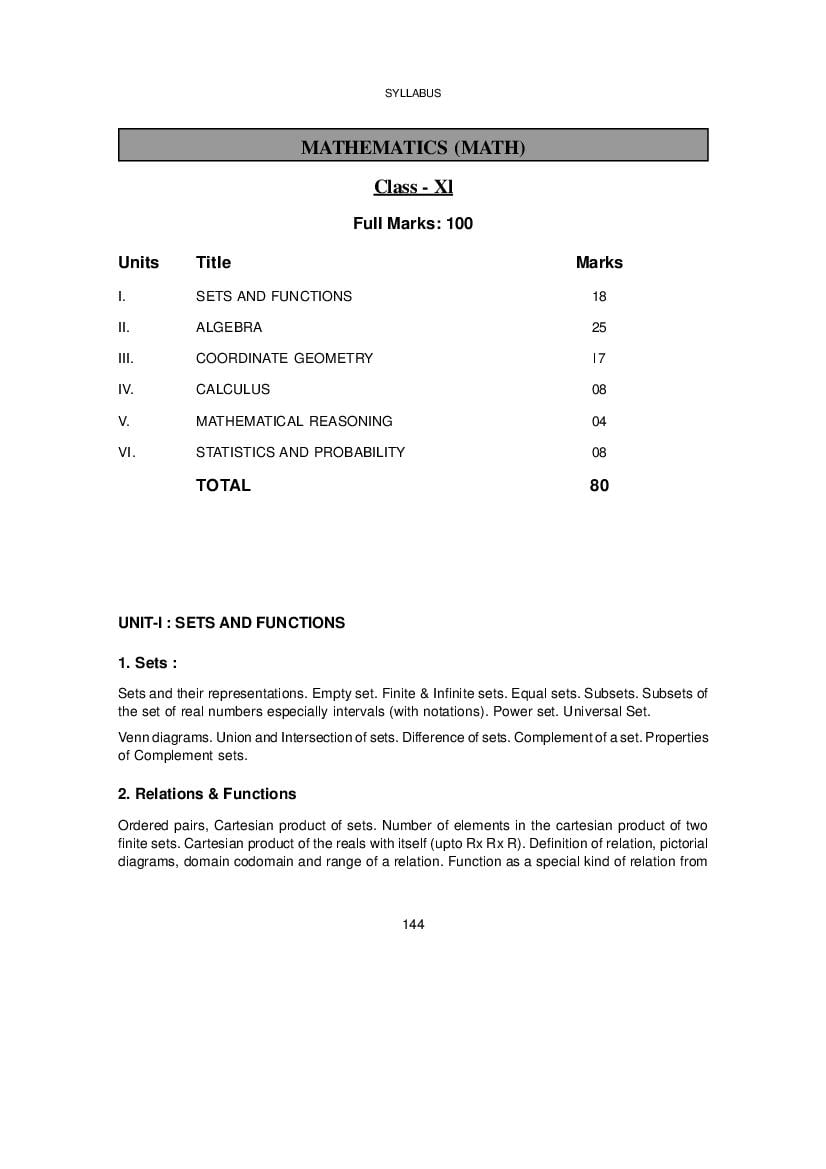
Class - Xl
Full Marks: 100
Units Title Marks
I. SETS AND FUNCTIONS 18
II. ALGEBRA 25
III. COORDINATE GEOMETRY l7
IV. CALCULUS 08
V. MATHEMATICAL REASONING 04
VI. STATISTICS AND PROBABILITY 08
TOTAL 80
UNIT-I : SETS AND FUNCTIONS
1. Sets :
Sets and their representations. Empty set. Finite & Infinite sets. Equal sets. Subsets. Subsets of
the set of real numbers especially intervals (with notations). Power set. Universal Set.
Venn diagrams. Union and Intersection of sets. Difference of sets. Complement of a set. Properties
of Complement sets.
2. Relations & Functions
Ordered pairs, Cartesian product of sets. Number of elements in the cartesian product of two
finite sets. Cartesian product of the reals with itself (upto Rx Rx R). Definition of relation, pictorial
diagrams, domain codomain and range of a relation. Function as a special kind of relation from
144
Page 2
Real valued function of the real variable, domain and range of these functions, constant, identity,
polynomial, rational, modulus, signum and greatest integer functions with their graphs. Sum,
difference, product and quotients of functions.
3. Trigonometric Functions :
Positive and negative angles. Measuring angles in radians and in degrees and conversion from
one measure to another. Definition of trigonometric functions with the help of unit circle. Truth of
the identity Sin2X + Cos2X = 1, for all X. Signs of trigonometric functions and sketch of their
graphs. Expressing Sin (X Y) in terms of Sin x, Sin y, Cos x & Cos y. Deducing the identities like
it following :
tan x tan y Cot x Cot y 1
tan (x y) = , Cot (x y) =
1 tan x tan y Cot y Cot x
x+y x-y x+y x-y
Sin x + Sin y = 2 Six Cos , Cos x + Cos y = 2 Cos Cos
2 2 2 2
x+y x-y x+y x-y
Sin x - Sin y = 2 Cos Sin , Cos x - Cos y = 2 Sin Sin
2 2 2 2
Identities related to sin2x, cos2x, tan2x, sin3x, cos3x and tan 3x. General solution of trigonometric
equations of the type sinθ = sinα, cosθ = cosα and tanθ = tanα.
Prcof and simple application of sine and cosine rules only.
UNIT-II : ALGEBRA
1. Principle of Mathematical Induction:
Process of the proof by induction, motivating the application of the method by looking at natural
numbers as the least inductive subset of real numbers. The principle of mathematical induction
and simple applications
2. Complex Numbers and Quadratic Equations:
Need for complex numbers, especially -1, to be motivated by inability to solve every quadratic
equation. Brief description of algebraic properties of complex numbers. Argand plane and polar
representation of complex numbers.
Statement of Fundamental Theorem of Algebra, solution of quadratic equations in the complex
number system.
Square-root of a complex number, Cube roots of unity and their properties.
145
Page 3
Linear inequalities. Algebraic solutions of linear inequalities in one variable and their representation
on the number line. Graphical solution of linear inequalities in two variables.
Solution of system of linear inequalities in two variables - graphically. Inequalities involving
modulus function.
4. Permutations & Combinations:
Fundamental Principle of counting. Factorial n. (n!) Permutations and combinations, derivation
of formulae and their connections, simple applications.
5. Binomial Theorem:
History, statement and proof of the binomial theorem for positive integral indices. Pascal's triangle,
General and middle term in binomial expansion, simple applications.
6. Sequence and Series :
Sequence and Series. Arithmetic progression (A.P.), arithmetic mean (A.M.), Geometric
progression (G.P.), general term of G.P., sum of n terms of a G.P., geometric mean (G.M.),
relation between A.M. and G.M. Arithmetic/geometric series, infinite G.P. and its sum, Sum to n
terms of the special series Σn, Σn2 and Σn3.
UNIT-III : COORDINATE GEOMETRY
1. Straight Lines:
Brief recall of 2D from earlier classes. Shifting of origin. Slope of a line and angle between two
lines. Various forms of equations of a line : parallel to axes, point-slope form, slope-intercept
form, two-point form, intercept form and normal form. General equation of a line. Equation of
family of lines passing through the point of intersection of two lines. Distance of a point from a
line.
2. Conic Sections:
Sections of a cone: circle, ellipse, parabola, hyperbola, a point, a straight line and pair of intersecting
lines as a degenerated case of a conic section.
Standard equation of a circle; General equation of a circle; Standard equations and simple
properties of parabola, ellipse and hyperbola. Introduction of directix of an ellipse and hyperbola.
146
Page 4
Coordinate axes and coordinate planes in three dimensions. Coordinates of a point.
Distance between two points and section formula.
UNIT-IV : CALCULUS
1. Limits and Derivatives:
Derivative introduced as rate of change both as that of distance function and geometrically,
intuitive idea of limit. Definition of derivative, relate it to slope of tangent of the curve, derivative
of sum, difference, product and quotient of functions. Derivatives of polynomial and trigonometric
functions.
UNIT-V : MATHEMATICAL REASONING
1. Mathematical Reasoning:
Mathematically acceptable statements. Connecting words / phrases consolidating the
understanding of "if and only if (necessary and sufficient) condition", "implies", "and/or", "implied
by", "and", "or", "there exists" and their use through variety of examples related to real life and
Mathematics. Validating the statements involving the connecting words difference between
contradiction, converse and contrapositive.
UNIT-VI : STATISTICS & PROBABILITY
1. Statistics:
Measure of dispersion; mean deviation, variance and standard deviation of ungrouped/grouped
data. Analysis of frequency distributions with equal means but different variances.
2. Probability:
Random experiments outcomes, sample spaces (set representation). Events: occurrence of events,
'not', 'and' and 'or' events, exhaustive events, mutually exclusive events Axiomatic (set theoretic)
probability, connections with the theories of earlier classes. Probability of an event, probability of
'not', 'and' & 'or' events.
Project : 20 Marks
147
Document Details
| Board / Org | West Bengal Board |
| Exam | Class 11 |
| Type | Syllabus |
| Pages | 4 |
| Updated | 22 Jul 2026 |