CBSE Class 12 Physics Question Paper 2020 Set 55-5-2
Finished viewing? Save it for later —
Download CBSE Class 12 Physics Question Paper 2020 Set 55-5-2 (PDF · 24 pages)About CBSE Class 12 Physics Question Paper 2020 Set 55-5-2
CBSE Class 12 Physics Question Paper 2020 Set 55-5-2 is available here for free download. Published by CBSE for Class 12, this question paper can be viewed online or downloaded as a PDF (24 pages). Candidates preparing for Class 12 can use CBSE Class 12 Physics Question Paper 2020 Set 55-5-2 to understand the exam pattern, the type of questions asked, and the overall difficulty level.
Frequently Asked Questions
How can I download CBSE Class 12 Physics Question Paper 2020 Set 55-5-2?
Open this page and click the Download button to save CBSE Class 12 Physics Question Paper 2020 Set 55-5-2 as a PDF. It is completely free on AglaSem Docs.
Is CBSE Class 12 Physics Question Paper 2020 Set 55-5-2 free to download?
Yes. CBSE Class 12 Physics Question Paper 2020 Set 55-5-2 can be viewed online and downloaded as a PDF free of cost on AglaSem Docs.
How many pages does CBSE Class 12 Physics Question Paper 2020 Set 55-5-2 have?
CBSE Class 12 Physics Question Paper 2020 Set 55-5-2 contains 24 pages, which you can read online or download together as a single PDF.
Where can I find more Class 12 study material?
You can find more Class 12 question papers, sample papers, syllabus, and answer keys on AglaSem Docs.
CBSE Class 12 Physics Question Paper 2020 Set 55-5-2 – Text
Read the full text of this question paper below — useful to quickly search, copy and reference the content online without downloading the PDF.
📄 View text version (24 pages)
Page 1
.
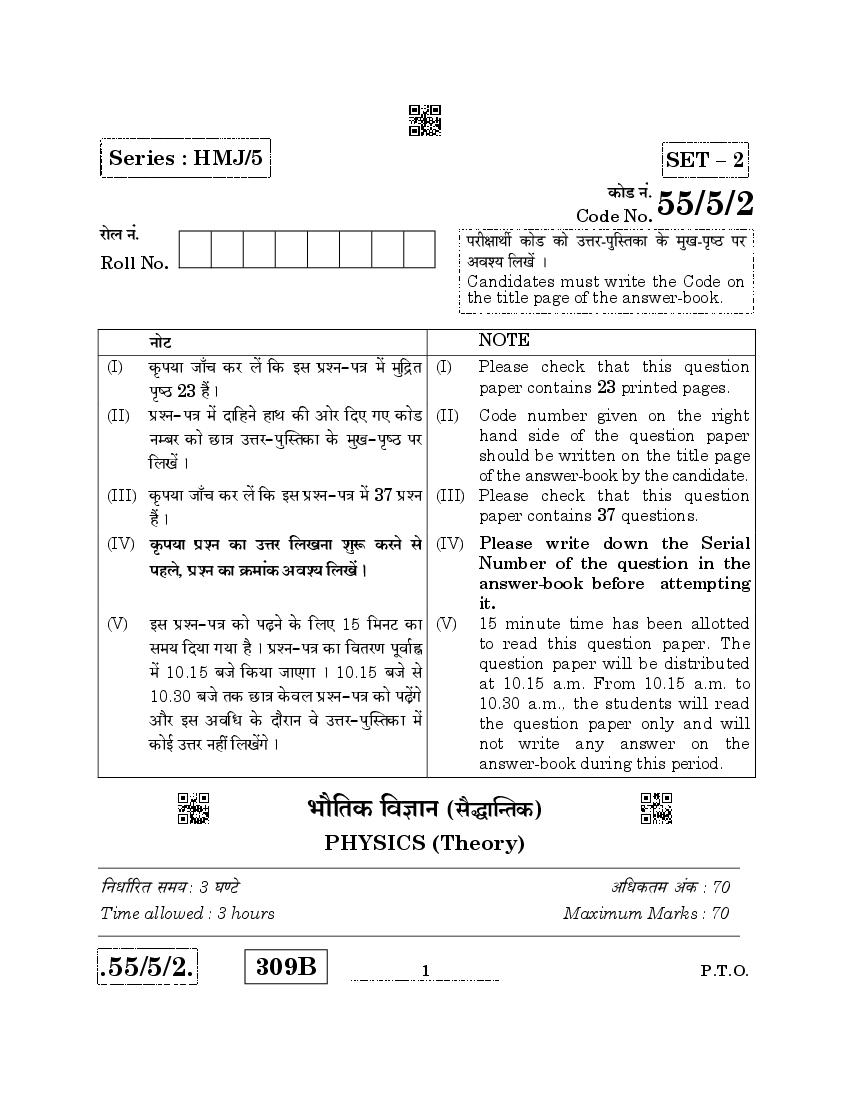
Code No. 55/5/2
.
Roll No.
Candidates must write the Code on
the title page of the answer-book.
NOTE
(I) - (I) Please check that this question
23 paper contains 23 printed pages.
(II) - (II) Code number given on the right
- - hand side of the question paper
should be written on the title page
of the answer-book by the candidate.
(III) - 37 (III) Please check that this question
paper contains 37 questions.
(IV) (IV) Please write down the Serial
, Number of the question in the
answer-book before attempting
it.
(V) - 15 (V) 15 minute time has been allotted
- to read this question paper. The
question paper will be distributed
10.15 10.15
at 10.15 a.m. From 10.15 a.m. to
10.30 - 10.30 a.m., the students will read
- the question paper only and will
not write any answer on the
answer-book during this period.
()
PHYSICS (Theory)
{ZYm©[aV g‘¶ : 3 KÊQ>o A{YH$V‘ A§H$ : 70
Time allowed : 3 hours Maximum Marks : 70
.55/5/2. 309B 1 P.T.O.
Page 2
(i) - – , ,
(ii) - 37
(iii) - 1 20 , 1
(iv) - 21 27 2
(v) - 28 34 3
(vi) - 35 37 5
(vii) , - , - , -
-
(viii) , ,
(ix)
(x) ,
c = 3 108 m/s
h = 6.63 10–34 Js
e = 1.6 10–19 C
0 = 410–7 Tm A–1
0 = 8.854 × 10⁻¹² C2 N–1 m–2
1
= 9 109 N m2 C–2
40
(me) = 9.1 10–31 kg
= 1.675 × 10⁻²⁷ kg
= 1.673 × 10⁻²⁷ kg
= 6.023 × 1023
= 1.38 × 10⁻²³ JK–1
.55/5/2. 2
Page 3
Read the following instructions very carefully and strictly follow them :
(i) This question paper comprises four sections – A, B, C and D.
(ii) There are 37 questions in the question paper. All questions are
compulsory.
(iii) Section A : Q. no. 1 to 20 are very short-answer type questions carrying
1 mark each.
(iv) Section B : Q. no. 21 to 27 are short-answer type questions carrying
2 marks each.
(v) Section C : Q. no. 28 to 34 are long-answer type questions carrying 3 marks
each.
(vi) Section D : Q. no. 35 to 37 are also long answer type questions carrying
5 marks each.
(vii) There is no overall choice in the question paper. However, an internal
choice has been provided in two questions of one mark, two questions
of two marks, one question of three marks and all the three questions
of five marks. You have to attempt only one of the choices in such
questions.
(viii) However, separate instructions are given with each section and
question, wherever necessary.
(ix) Use of calculators and log tables is not permitted.
(x) You may use the following values of physical constants wherever
necessary.
c = 3 108 m/s
h = 6.63 10–34 Js
e = 1.6 10–19 C
0 = 410–7 Tm A–1
0 = 8.854 × 10⁻¹² C2 N–1 m–2
1
= 9 109 N m2 C–2
40
Mass of electron (me) = 9.1 10–31 kg
Mass of neutron = 1.675 × 10⁻²⁷ kg
Mass of proton = 1.673 × 10⁻²⁷ kg
Avogadro’s number = 6.023 × 10²³ per gram mole
Boltzmann constant = 1.38 × 10⁻²³ JK–1
.55/5/2. 3 P.T.O.
Page 4
: :
1. LED –
(a)
(b)
(c)
(d) 1
2. (p) - ()
–
1
3. LCR a.c.
(a) L R (b) L R
(c) L R (d) L=R 1
4. ?
(a) (b)
(c) (d) 1
5. v
(a) c cos = v (b) v tan = c
(c) c = v tan (d) v cos = c 1
.55/5/2. 4
Page 5
Note : Select the most appropriate option from those given below each question.
1. The wavelength and intensity of light emitted by a LED depend upon
(a) forward bias and energy gap of the semiconductor
(b) energy gap of the semiconductor and reverse bias
(c) energy gap only
(d) forward bias only 1
2. The graph showing the correct variation of linear momentum (p) of a charge
particle with its de-Broglie wavelength () is –
1
3. The selectivity of a series LCR a.c. circuit is large, when
(a) L is large and R is large (b) L is small and R is small
(c) L is large and R is small (d) L=R 1
4. Photo diodes are used to detect
(a) radio waves (b) gamma rays
(c) IR rays (d) optical signals 1
5. The relationship between Brewster angle and the speed of light v in the
denser medium is
(a) c cos = v (b) v tan = c
(c) c = v tan (d) v cos = c 1
.55/5/2. 5 P.T.O.
Page 6
(a) f (b) f/2
(c) 2f (d) 4f 1
7. LCR
(a) (b) /2
(c) /3 (d) 1
8. v A B, : 3/4 v 2/3 v ,
A B
(a) 2:3 (b) 4:3
(c) 3:4 (d) 3:2 1
9. ?
(a)
(b) ,
(c)
(d) 1
10. V
r V
(a) 2r (b) 2r
(c) 4r (d) r/ 2 1
.55/5/2. 6
Page 7
lenses. The focal length of each part will be
(a) f (b) f/2
(c) 2f (d) 4f 1
7. The phase difference between the current and the voltage in series LCR
circuit at resonance is
(a) (b) /2
(c) /3 (d) zero 1
8. Photons of frequency v are incident on the surfaces of two metals A and B
of threshold frequencies 3/4 v and 2/3 v, respectively. The ratio of
maximum kinetic energy of electrons emitted from A to that from B is
(a) 2:3 (b) 4:3
(c) 3:4 (d) 3:2 1
9. The electric flux through a closed Gaussian surface depends upon
(a) Net charge enclosed and permittivity of the medium
(b) Net charge enclosed, permittivity of the medium and the size of the
Gaussian surface
(c) Net charge enclosed only
(d) Permittivity of the medium only 1
10. A charge particle after being accelerated through a potential difference ‘V’
enters in a uniform magnetic field and moves in a circle of radius r. If V is
doubled, the radius of the circle will become
(a) 2r (b) 2r
(c) 4r (d) r/ 2 1
.55/5/2. 7 P.T.O.
Page 8
11. ‘r’ ‘2r’
_________. 1
12. C, Si Ge ________
1
13. ________
1
14. ________ SI NC–1m 1
15. - d.c.
_______ 1
: :
16. (i) (ii) 1
17. emf
1
emf E0 () ac (L),
(C) (R) ()
1
18. X- - ,
Y- , 1
.55/5/2. 8
Page 9
11. A point charge is placed at the centre of a hollow conducting sphere of
internal radius ‘r’ and outer radius ‘2r’. The ratio of the surface charge
density of the inner surface to that of the outer surface will be _______. 1
12. The ________, a property of materials C, Si and Ge depends upon the
energy gap between their conduction and valence bands. 1
13. The ability of a junction diode to ________ an alternating voltage, is based
on the fact that it allows current to pass only when it is forward biased. 1
14. The physical quantity having SI unit NC–1 m is ________. 1
15. A copper wire of non-uniform area of cross-section is connected to a d.c.
battery. The physical quantity which remains constant along the wire is
________ 1
Note : Answer the following :
16. Write the conditions on path difference under which (i) constructive
(ii) destructive interference occur in Young’s double slit experiment. 1
17. Plot a graph showing variation of induced e.m.f. with the rate of change of
current flowing through a coil. 1
OR
A series combination of an inductor (L), capacitor (C) and a resistor (R) is
connected across an ac source of emf of peak value E0 and angular
frequency (). Plot a graph to show variation of impedance of the circuit
with angular frequency (). 1
18. Depict the fields diagram of an electromagnetic wave propagating along
positive X-axis with its electric field along Y-axis. 1
.55/5/2. 9 P.T.O.
Page 10
→
B
-
1
AB
MNOP F
, ‘NO’
1
20. “ ” 1
.55/5/2. 10
Page 11
→
magnetic field B directed along –z direction as shown in fig. Draw the
shape of trajectory followed by the electron after entering the field.
1
OR
A square shaped current carrying loop MNOP is placed near a straight
long current carrying wire AB as shown in the fig. The wire and the loop
lie in the same plane. If the loop experiences a net force F towards the
wire, find the magnitude of the force on the side ‘NO’ of the loop.
1
20. Define the term ‘current sensitivity’ of a moving coil galvanometer. 1
.55/5/2. 11 P.T.O.
Page 12
21. (a)
(b)
- 1 - 2
2
22.
(i) (ii) ? 2
23. - :
(a)
(b) - 2
24.
2
25.
2
.55/5/2. 12
Page 13
21. (a) Define one Becquerel.
(b) A radioactive substance disintegrates into two types of daughter
nuclei, one type with disintegration constant 1 and the other type
with disintegration constant 2. Determine the half-life of the
radioactive substance. 2
22. In a single slit diffraction experiment, the width of the slit is increased.
How will the (i) size and (ii) intensity of central bright band be affected ?
Justify your answer. 2
23. In case of photo electric effect expeiment, explain the following facts,
giving reasons.
(a) The wave theory of light could not explain the existence of the
threshold frequency.
(b) The photo electric current increases with increase of intensity of
incident light. 2
24. Gamma rays and radio waves travel with the same velocity in free space.
Distinguish between them in terms of their origin and the main
application. 2
25. Use Bohr’s model of hydrogen atom to obtain the relationship between the
angular momentum and the magnetic moment of the revolving electron. 2
.55/5/2. 13 P.T.O.
Page 14
(i) P1 (ii) P1
: P2 ?
2
(1)
(2) AB P1P2
2
27. -
2
dc
2
.55/5/2. 14
Page 15
P2 as shown in fig. What will be the effect on the intensity of the light
transmitted (i) by P1 and (ii) by P2 on rotating polaroid P1 about the
direction of propagation of light ? Justify your answer in both cases.
2
OR
Define the term ‘wave front of light’. A plane wave front AB propagating
from denser medium (1) into a rarer medium (2) is incident on the surface
P1P2 separating the two media as shown in fig.
Using Huygen’s principle, draw the secondary wavelets and obtain
the refracted wave front in the diagram.
2
27. Derive the expression for the torque acting on an electric dipole, when it is
held in a uniform electric field. Identify the orientation of the dipole in the
electric field, in which it attains a stable equilibrium. 2
OR
Obtain the expression for the energy stored in a capacitor connected
across a dc battery. Hence define energy density of the capacitor. 2
.55/5/2. 15 P.T.O.
Page 16
28. (a) q1 q2 r12
(b) (E)
3
29. ? V-I
3
3
30. (a)
(b) r emf E R
V (i) R (ii) I
3
31. -
–13.6 eV 3
32. 10 10 cm2
, t I
(a)
(b)
(c) 3
.55/5/2. 16
Page 17
28. (a) Two point charges q1 and q2 are kept at a distance of r12 in air.
Deduce the expression for the electrostatic potential energy of this
system.
(b) If an external electric field (E) is applied on the system, write the
expression for the total energy of this system. 3
29. What is a solar cell ? Draw its V-I characteristics. Explain the three
processes involved in its working. 3
OR
Draw the circuit diagram of a full wave rectifier. Explain its working
showing its input and output waveforms. 3
30. (a) Define internal resistance of a cell.
(b) A cell of emf E and internal resistance r is connected across a
variable resistor R. Plot the shape of graphs showing variation of
terminal voltage V with (i) R and (ii) circuit current I. 3
31. Calculate the de-Broglie wavelength associated with the electron
revolving in the first excited state of hydrogen atom. The ground state
energy of the hydrogen atom is –13.6 eV. 3
32. When a conducting loop of resistance 10 and area 10 cm2 is removed
from an external magnetic field acting normally, the variation of induced
current-I in the loop with time t is as shown in the figure.
Find the
(a) total charge passed through the loop.
(b) change in magnetic flux through the loop
(c) magnitude of the field applied.
3
.55/5/2. 17 P.T.O.
Page 18
3
34. 100 D 50 D
20 cm
(a)
(b) 3
:
35. (a)
(b) r ,
x
P
(x >> r) 5
(a) -
( ) r
(b) (NC–1 ) r (m )
:
E = 10r + 5
r = 1 m r = 10 m
? 5
.55/5/2. 18
Page 19
the mass number of nuclei. Using it explain the fusion of nuclei lying on
ascending part and fission of nuclei lying on descending part of this
curve. 3
34. An optical instrument uses a lens of 100 D for the objective lens and 50 D
for its eye piece. When the tube length is kept at 20 cm, the final image is
formed at infinity.
(a) Identify the optical instrument.
(b) Calculate the magnification produced by the instrument. 3
SECTION : D
35. (a) Write two important characteristics of equipotential surfaces.
(b) A thin circular ring of radius r is charged uniformly so that its linear
charge density becomes . Derive an expression for the electric field
at a point P at a distance x from it along the axis of the ring. Hence,
prove that at large distances (x >> r), the ring behaves as a point
charge. 5
OR
(a) State Gauss’s law on electrostatics and derive an expression for the
electric field due to a long straight thin uniformly charged wire
(linear charge density ) at a point lying at a distance r from the
wire.
(b) The magnitude of electric field (in NC–1) in a region varies with the
distance r(in m) as
E = 10 r + 5
By how much does the electric potential increase in moving from
point at r = 1 m to a point at r = 10 m. 5
.55/5/2. 19 P.T.O.
Page 20
(b) 3 ABC AC
(e)
1.3 , ?
5
(a)
?
(i)
(ii)
(b) 80 cm
, 20 cm ,
5
.55/5/2. 20
Page 21
diagram, obtain the relation between its focal length and radius of
curvature.
(b) Calculate the angle of emergence (e) of the ray of light incident
normally on the face AC of a glass prism ABC of refractive index 3.
How will the angle of emergence change qualitatively, if the ray of
light emerges from the prism into a liquid of refractive index 1.3
instead of air ?
5
OR
(a) Define the term ‘resolving power of a telescople’. How will the
resolving power be effected with the increase in
(i) Wavelength of light used.
(ii) Diameter of the objective lens.
Justify your answers.
(b) A screen is placed 80 cm from an object. The image of the object on
the screen is formed by a convex lens placed between them at two
different locations separated by a distance 20 cm. Determine the
focal length of the lens. 5
.55/5/2. 21 P.T.O.
Page 22
(b) 100 V f
(XL)
(i)
(ii) 300 s–1 10
5
(a) l B
:
emf (i) () (ii) (l)
(b) 1 cm 20 cm
(i)
(ii) 5A/ms
emf 5
_________________
.55/5/2. 22
Page 23
(b) The variation of inductive reactance (XL) of an inductor with the
frequency (f) of the ac source of 100 V and variable frequency is
shown in the fig.
(i) Calculate the self-inductance of the inductor.
(ii) When this inductor is used in series with a capacitor of
unknown value and a resistor of 10 at 300 s–1, maximum
power dissipation occurs in the circuit. Calculate the
capacitance of the capacitor. 5
OR
(a) A conductor of length ‘l’ is rotated about one of its ends at a constant
angular speed ‘’ in a plane perpendicular to a uniform magnetic
field B. Plot graphs to show variations of the emf induced across the
ends of the conductor with (i) angular speed and (ii) length of the
conductor l.
(b) Two concentric circular loops of radius 1 cm and 20 cm are placed
coaxially.
(i) Find mutual inductance of the arrangement.
(ii) If the current passed through the outer loop is changed at a rate
of 5 A/ms, find the emf induced in the inner loop. Assume the
magnetic field on the inner loop to be uniform. 5
___________
.55/5/2. 23 P.T.O.
Page 24
Document Details
| Board / Org | CBSE |
| Exam | Class 12 |
| Type | Question Paper |
| Pages | 24 |
| Updated | 22 Jul 2026 |