ICSE Class 10 Syllabus 2023 History And Civics (Thailand) (Revised)
Finished viewing? Save it for later —
Download ICSE Class 10 Syllabus 2023 History And Civics (Thailand) (Revised) (PDF · 4 pages)About ICSE Class 10 Syllabus 2023 History And Civics (Thailand) (Revised)
ICSE Class 10 Syllabus 2023 History And Civics (Thailand) (Revised) is available here for free download. Published by CISCE for Class 10, this syllabus can be viewed online or downloaded as a PDF (4 pages). Candidates preparing for Class 10 can use ICSE Class 10 Syllabus 2023 History And Civics (Thailand) (Revised) to understand the exam pattern, the type of questions asked, and the overall difficulty level.
Frequently Asked Questions
How can I download ICSE Class 10 Syllabus 2023 History And Civics (Thailand) (Revised)?
Open this page and click the Download button to save ICSE Class 10 Syllabus 2023 History And Civics (Thailand) (Revised) as a PDF. It is completely free on AglaSem Docs.
Is ICSE Class 10 Syllabus 2023 History And Civics (Thailand) (Revised) free to download?
Yes. ICSE Class 10 Syllabus 2023 History And Civics (Thailand) (Revised) can be viewed online and downloaded as a PDF free of cost on AglaSem Docs.
How many pages does ICSE Class 10 Syllabus 2023 History And Civics (Thailand) (Revised) have?
ICSE Class 10 Syllabus 2023 History And Civics (Thailand) (Revised) contains 4 pages, which you can read online or download together as a single PDF.
Where can I find more Class 10 study material?
You can find more Class 10 question papers, sample papers, syllabus, and answer keys on AglaSem Docs.
ICSE Class 10 Syllabus 2023 History And Civics (Thailand) (Revised) – Text
Read the full text of this syllabus below — useful to quickly search, copy and reference the content online without downloading the PDF.
📄 View text version (4 pages)
Page 1
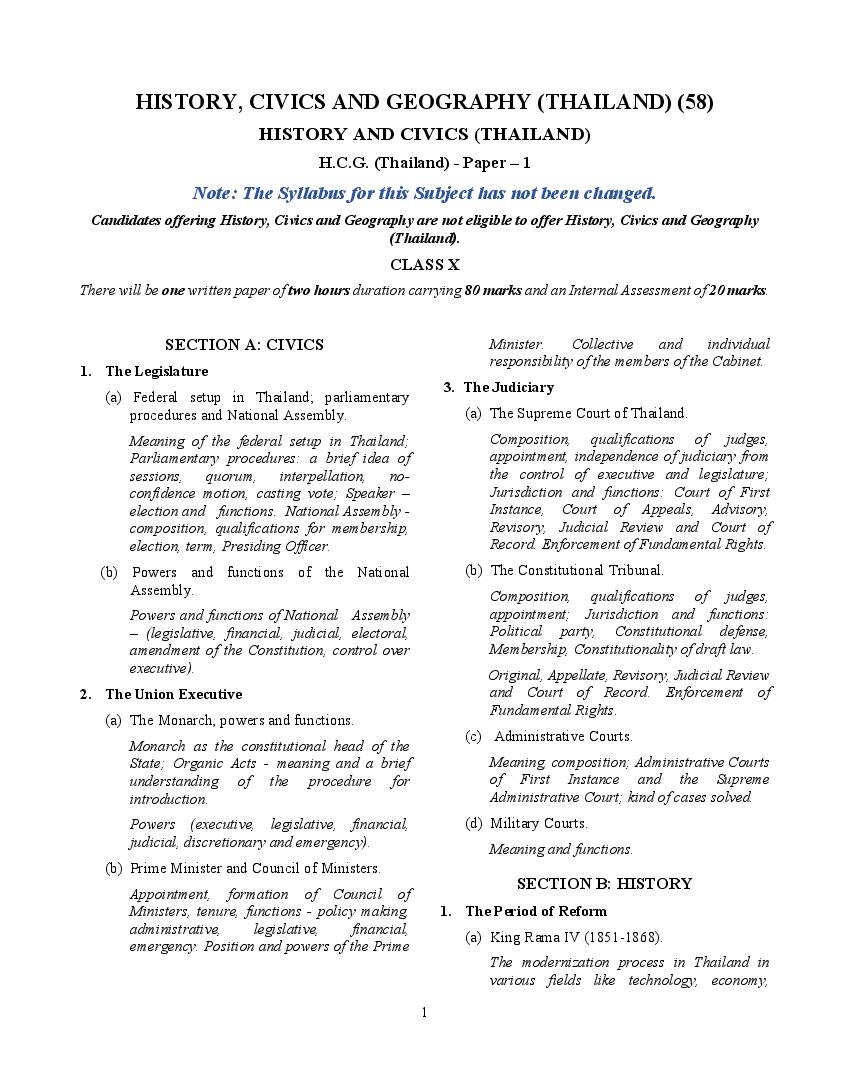
HISTORY AND CIVICS (THAILAND)
H.C.G. (Thailand) - Paper – 1
Note: The Syllabus for this Subject has not been changed.
Candidates offering History, Civics and Geography are not eligible to offer History, Civics and Geography
(Thailand).
CLASS X
There will be one written paper of two hours duration carrying 80 marks and an Internal Assessment of 20 marks.
SECTION A: CIVICS Minister. Collective and individual
responsibility of the members of the Cabinet.
1. The Legislature
3. The Judiciary
(a) Federal setup in Thailand; parliamentary
procedures and National Assembly. (a) The Supreme Court of Thailand.
Meaning of the federal setup in Thailand; Composition, qualifications of judges,
Parliamentary procedures: a brief idea of appointment, independence of judiciary from
sessions, quorum, interpellation, no- the control of executive and legislature;
confidence motion, casting vote; Speaker – Jurisdiction and functions: Court of First
election and functions. National Assembly - Instance, Court of Appeals, Advisory,
composition, qualifications for membership, Revisory, Judicial Review and Court of
election, term, Presiding Officer. Record. Enforcement of Fundamental Rights.
(b) Powers and functions of the National (b) The Constitutional Tribunal.
Assembly. Composition, qualifications of judges,
Powers and functions of National Assembly appointment; Jurisdiction and functions:
– (legislative, financial, judicial, electoral, Political party, Constitutional defense,
amendment of the Constitution, control over Membership, Constitutionality of draft law.
executive). Original, Appellate, Revisory, Judicial Review
2. The Union Executive and Court of Record. Enforcement of
Fundamental Rights.
(a) The Monarch, powers and functions.
(c) Administrative Courts.
Monarch as the constitutional head of the
State; Organic Acts - meaning and a brief Meaning, composition; Administrative Courts
understanding of the procedure for of First Instance and the Supreme
introduction. Administrative Court; kind of cases solved.
Powers (executive, legislative, financial, (d) Military Courts.
judicial, discretionary and emergency). Meaning and functions.
(b) Prime Minister and Council of Ministers.
SECTION B: HISTORY
Appointment, formation of Council of
Ministers, tenure, functions - policy making, 1. The Period of Reform
administrative, legislative, financial,
(a) King Rama IV (1851-1868).
emergency. Position and powers of the Prime
The modernization process in Thailand in
various fields like technology, economy,
1
Page 2
contributions). and Rashbehari Ghosh in Thailand: to be done
(b) King Rama V (1868-1910). briefly.
Social and economic reforms (brief mention of 5. The Contemporary World
any two contributions). (a) The First World War.
(c) The Treaty of Bowring. Causes (Nationalism and Imperialism,
Names of the signatories; importance of the Armament Race, role of Thailand in WWI;
treaty. Any two features to be done briefly. division of Europe and Sarajevo crisis) and
Results (Treaty of Versailles, territorial
2. The Period of Changes rearrangements, formation of League of
(a) King Vajiravudh (1910-1925). Nations).
Any three achievements during his reign. (b) Rise of Dictatorships.
Changes in the society under him – Causes for the rise of Fascism in Italy and the
modernization of the educational system. rise of Nazism in Germany. A comparative
study of Mussolini’s Fascist and Hitler’s Nazi
(b) King Rama VII (1925-1935). ideologies.
Any two features of the economic depression (c) The Second World War.
during his reign; any two measures adopted by
him to overcome the crisis. Causes (Dissatisfaction with the Treaty of
Versailles, Rise of Fascism and Nazism,
3. The Revolt of 1932 Policy of Appeasement, and Japanese Pan
The Revolt and Thailand becoming a Asianism in China & Thailand (described as
Constitutional Monarchy. invasion by the colonial historians, it was
actually Japanese Nationalism under the
Political and economic causes of the revolt; its
notion of Pan Asianism); Thailand’s role in
consequences.
WW II;
4. Period of Instability (1945 – 1965), ASEAN
Failure of League of Nations and Hitler’s
(1967)
invasion of Poland). Brief mention of the
Military rule in Thailand; Thailand’s role in the attack on Pearl Harbour and bombing of
Vietnam War. India- Thailand Relations- Subhas Hiroshima and Nagasaki. Consequences
Chandra Bose and Rashbehari Ghosh in Thailand. (Defeat of Axis Powers, Formation of the
United Nations and Cold War).
Democratic election and return of the military
King Ananda Mahidol to Thailand. (d) The United Nations.
1946 – Accession of Bhumibol Adulyadeg, (i) The objectives of the U.N.
(coronation)
The composition and functions of the
1947 – military takes over – military coup by pro- General Assembly, the Security Council,
Japanese leader Phibun Songkhram; and the International Court of Justice.
1965 – Thailand permits US to use its bases (ii) Major agencies of the United Nations:
during the Vietnam War. Thai troops fight in UNICEF, WHO and UNESCO - functions
South Vietnam. only.
1967: US influence to form Association for South
East Asian Nations (ASEAN) and Thailand joins
ASEAN.
2
Page 3
Any one project/assignment related to the syllabus. The assignments/project work is to be evaluated by the
subject teacher and by an External Examiner. (The
Suggested Assignments
External Examiner may be a teacher nominated by the
• Compare the Parliamentary and Presidential forms Head of the School, who could be from the faculty,
of Government with reference to Thailand and the but not teaching the subject in the section/class.
U.S.A.
The Internal Examiner and the External Examiner will
• Conduct a mock Court and record the proceedings. assess the assignments independently.
• Present a life sketch and contributions of any one Award of Marks (20 Marks)
of the following Monarchs of Thailand: Subject Teacher (Internal Examiner) 10 marks
King Rama I (ChaoPhrayaChakri), King Rama V External Examiner 10 marks
(Chulalongkorn) and King Rama IX (Bhumbol
Adulyadeg) (or any other). The total marks obtained out of 20 are to be sent to the
Council by the Head of the School.
• Present a book review of any one historical book
of your choice. The Head of the school will be responsible for the
online entry of marks on the Council’s CAREERS
• Discuss the relevance of any one film based on the portal by the due date.
history of 20th Century Europe.
• Make a PowerPoint presentation on any one
UNESCO heritage sites of Thailand.
• Prepare a report on the contributions of any one of
the following agencies of the United Nations –
UNESCO / WHO / UNICEF.
• Present a case study of any recent human rights
violations and redressal mechanisms available to
prevent such instances in the future.
3
Page 4
Grade Preparation/ Information Concepts Thinking Skills Presentation Marks
Research
I Follows instructions with A good deal of Good understanding of Different Matter presented is clear 4
understanding. relevant matter. historical concepts - interpretations and is in coherent form
Masters research Uses wide range of sequence/ of evidence. (sub-headings, sections,
techniques easily. sources. reconstruction- causes Can draw Inferences/ chapters etc.)
Reference work is and consequences- deductions/ Work is neat and tidy and
orderly. continuity and change conclusions. not over elaborate.
Empathy.
II Follows instructions but Selects matter relevant Understanding of Limited / Single Matter is presented in 3
needs a little help in to context. concepts is adequate. interpretation of coherent form but not
research techniques. Limited use of evidence with some organized into sections
Reference notes quite references/ sources. examples. etc.
orderly. Some inferences/ Presentation neat and tidy
conclusions are drawn. but not elaborate.
III Follows instructions but Relevant matter but Displays limited use of Few examples /a single Work is presented in an 2
needs constant guidance. limited reference concepts. example to support orderly way, but not
Reference notes at times work. reasoning. organized into sections.
disorderly. Matter is sketchy. Over use of ‘cosmetics’ to
hide lack of substance.
Work is quite neatly
presented.
IV Struggles with research Hardly any reference Minimal competency in Finds it difficult to Matter presented in a 1
methods and needs material. concepts. make conclusions/ confused way at times (no
constant guidance. Use of irrelevant A few of the required deductions/ inferences. sub-headings, chapters,
Reference notes copied matter. concepts. No examples to etc.)
without reference to Matter is sketchy. support reasoning. Tendency to copy from
keywords. reference books.
Use of “cosmetics” to hide
lack of substance.
Untidy work.
V Cannot follow No reference Unable to demonstrate Unable to make Matter presented in an 0
instructions. work/copied from concepts. inferences/ deductions incoherent/ disorganized
Works ‘blindly’ without other textbooks/ or come to any way.
reference to keywords. sketchy matter. conclusions. Copied from textbooks
“blindly”.
Use of “cosmetics” to hide
lack of substance.
Untidy work.
4
Document Details
| Board / Org | CISCE |
| Exam | Class 10 |
| Type | Syllabus |
| Pages | 4 |
| Language | english |
| Updated | 30 Apr 2026 |