ICSE Class 10 Question Paper 2025 Cookery
Finished viewing? Save it for later —
Download ICSE Class 10 Question Paper 2025 Cookery (PDF · 11 pages)About ICSE Class 10 Question Paper 2025 Cookery
ICSE Class 10 Question Paper 2025 Cookery is available here for free download. Published by CISCE for Class 10, this question paper can be viewed online or downloaded as a PDF (11 pages). Candidates preparing for Class 10 can use ICSE Class 10 Question Paper 2025 Cookery to understand the exam pattern, the type of questions asked, and the overall difficulty level.
Frequently Asked Questions
How can I download ICSE Class 10 Question Paper 2025 Cookery?
Open this page and click the Download button to save ICSE Class 10 Question Paper 2025 Cookery as a PDF. It is completely free on AglaSem Docs.
Is ICSE Class 10 Question Paper 2025 Cookery free to download?
Yes. ICSE Class 10 Question Paper 2025 Cookery can be viewed online and downloaded as a PDF free of cost on AglaSem Docs.
How many pages does ICSE Class 10 Question Paper 2025 Cookery have?
ICSE Class 10 Question Paper 2025 Cookery contains 11 pages, which you can read online or download together as a single PDF.
Where can I find more Class 10 study material?
You can find more Class 10 question papers, sample papers, syllabus, and answer keys on AglaSem Docs.
ICSE Class 10 Question Paper 2025 Cookery – Text
Read the full text of this question paper below — useful to quickly search, copy and reference the content online without downloading the PDF.
📄 View text version (11 pages)
Page 1
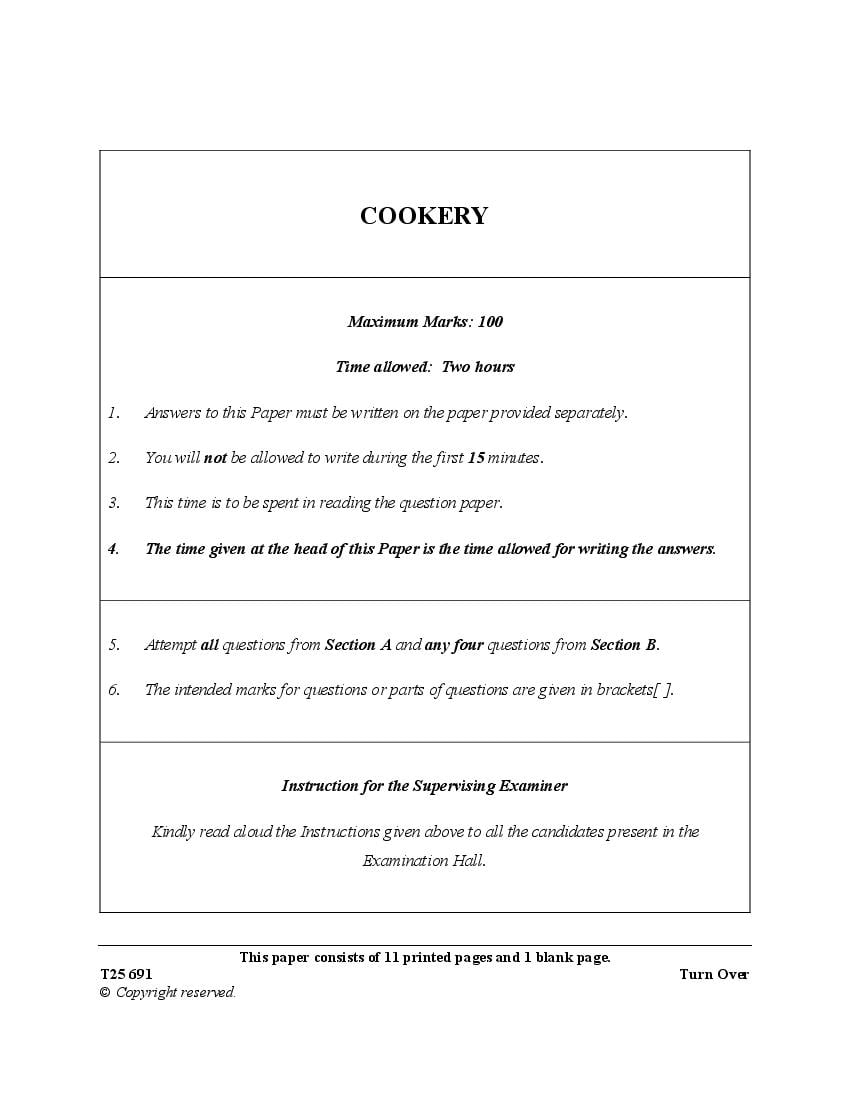
Maximum Marks: 100
Time allowed: Two hours
1. Answers to this Paper must be written on the paper provided separately.
2. You will not be allowed to write during the first 15 minutes.
3. This time is to be spent in reading the question paper.
4. The time given at the head of this Paper is the time allowed for writing the answers.
5. Attempt all questions from Section A and any four questions from Section B.
6. The intended marks for questions or parts of questions are given in brackets[ ].
Instruction for the Supervising Examiner
Kindly read aloud the Instructions given above to all the candidates present in the
Examination Hall.
This paper consists of 11 printed pages and 1 blank page.
T25 691 Turn Over
© Copyright reserved.
Page 2
(Attempt all questions from this Section.)
Question 1
Choose the correct answers to the questions from the given options. [20]
(Do not copy the questions, write the correct answers only.)
(i) Which of the following is perishable as well as a source of energy?
(a) Mango
(b) Potato
(c) Wheat flour
(d) Glucose biscuit
(ii) Which of the following statements is correct?
(a) A fresh egg has a small air cell.
(b) A fresh egg will float in water.
(c) A fresh egg should be washed to open the pores.
(d) Egg should be stored by placing its broad portion downwards.
(iii) Patients suffering from loose motions and vomiting need a __________.
(a) fluid rich diet
(b) fibre rich diet
(c) solid diet
(d) fat rich diet
T25 691 2
Page 3
(a) Accommodates double sink.
(b) Has a linear workflow.
(c) Offers good ventilation.
(d) Can accommodate extra base cabinets.
(v) Assertion (A): A five-year old, active child, needs a high carbohydrate and
protein diet.
Reason (R): A five-year old child should be given a balanced diet.
(a) Both (A) and (R) are true and (R) is the correct explanation of (A).
(b) Both (A) and (R) are true but (R) is not the correct explanation of (A).
(c) (A) is false and (R) is true.
(d) Both (A) and (R) are false.
(vi) Which of the following methods of food preservation employs high
temperature to enhance shelf life?
(a) Pickling
(b) Freezing
(c) Canning
(d) Cold storage
T25 691 3 Turn Over
Page 4
suitable dietary suggestion.
Foods rich in
Sodium
During old age, one must ___________.
(a) increase salt intake to maintain normal blood pressure
(b) restrict salt and sodium in the diet to prevent high blood pressure
(c) avoid salt but consume sodium rich food
(d) remain happy, enjoy food and avoid health problems
(viii) Identify the missing food item:
SALT OIL SUGAR ?
(a) Pickle masala
(b) Vinegar
(c) Turmeric
(d) Raw mango
T25 691 4
Page 5
Reason (R): Excess consumption of food and lack of exercise only can
make a person obese.
(a) Both (A) and (R) are true and (R) is the correct explanation of (A).
(b) Both (A) and (R) are true but (R) is not the correct explanation of (A).
(c) (A) is false and (R) is true.
(d) Both (A) and (R) are false.
(x) Food fads are:
(a) quick diet trends to lose weight
(b) diet plans
(c) false superstitions or notions about foods
(d) food related illnesses
(xi) ____________ is a bacteriostatic method of food preservation.
(a) Dehydration
(b) Blanching
(c) Canning
(d) Pasteurisation
(xii) A ‘cover’ in table setting is:
(a) table cover and table mats used on the dining table.
(b) placemats and linen used on the dining table.
(c) an individual’s place at the dining table.
(d) a transparent cover spread on food.
T25 691 5 Turn Over
Page 6
(a) Baking soda
(b) Mild soap solution
(c) Boric acid
(d) Lemon juice
(xiv) Water fetched from borewell is often muddy. If this water is to be used for
drinking and cooking, it should be:
(a) kept in a cool dry place.
(b) kept covered.
(c) boiled, filtered and kept covered.
(d) strained with a cotton cloth.
(xv) Sun dried foods will need extra care during __________ to prevent spoilage.
(a) Winter
(b) Summer
(c) Monsoon
(d) Spring
(xvi) Following is a list of breakfast ingredients. Which of these is likely to contain
sodium benzoate?
(a) Butter
(b) Eggs
(c) Bread
(d) Jam
T25 691 6
Page 7
A. Steel 1. Needs tinning
B. Aluminium 2. Needs to be seasoned before first use
C. Copper 3. Changes colour of some foods
D. Iron 4. Is neutral to food
(a) A-4, B-3, C-1, D-2
(b) A-3, B-4, C-2, D-1
(c) A-2, B-3, C-1, D-4
(d) A-1, B-3, C-4, D-2
(xviii) If walls of the kitchen are painted, the paint should be dark in colour.
(a) True
(b) False
(xix) Owing to the high mineral and fibre content, green leafy vegetables can replace
many expensive foods.
(a) True
(b) False
(xx) Consumption of stale or over fermented food may lead to:
(a) Fever
(b) Diarrhoea
(c) Typhoid
(d) Measles
T25 691 7 Turn Over
Page 8
Answer all the questions:
(i) Write two advantages of a modular kitchen over a custom-made kitchen. [2]
(ii) List two factors that can help one in selecting a good knife. [2]
(iii) While purchasing food from a wholesale market may be more economical, [2]
many people may not prefer to do so. Why?
(iv) List at least two criteria for selecting the right type of microwave proof [2]
cookware.
(v) Somesh and Suma, along with their family, have moved into a new house with [2]
a two wall kitchen. List the possible difficulties that they may face in this type
of a kitchen.
(vi) How does salt help in food preservation? Give examples of two foods that are [2]
preserved using salting method.
(vii) How does occupation of family members affect the meal plan of the family? [2]
(viii) Mention two precautions to be taken while storing non-perishable foods. [2]
(ix) Mention any two points that one should consider while planning storage [2]
fixtures of the kitchen.
(x) List two precautions that one should take while cleaning glass dishes. [2]
T25 691 8
Page 9
(Answer any four questions from this Section.)
Question 3
(i) What is a balanced diet? Explain five food group system as suggested by ICMR. [5]
(ii) The health of an elderly person is a matter of concern for the family. In this [5]
context elaborate:
(a) which nutrients need to be reduced in their diet and why?
(b) why is good intake of water necessary for them?
(iii) List any five dietary features of a meal plan for an adolescent girl. [5]
Question 4
(i) For each of the food items listed below, state one possible cause of its spoilage. [5]
Suggest a remedy to prevent the spoilage mentioned by you.
(a) Rice
(b) Butter
(c) Jam
(d) Soya chips
(e) Banana
T25 691 9 Turn Over
Page 10
(a) Preserving fresh milk for a short time before it reaches customers.
(b) Keeping fruits fresh, till consumption.
(iii) It is a regular practice by households to freeze seasonal foods. Write a short [5]
note on freezing.
Question 5
(i) Suggest five steps one must take to make the washing area of a kitchen user [5]
friendly.
(ii) State five points which should be considered while planning lighting and [5]
ventilation in the kitchen.
(iii) Write a short note on preparation centre of a kitchen. [5]
Question 6
(i) Name five small tools used in a kitchen and mention their functions. [5]
(ii) Write three points on the care for each of the following: [5]
(a) Sinks
(b) Bins
(iii) Explain the inter space relationship between the three major work centres of [5]
the kitchen.
T25 691 10
Page 11
(i) Mita decides to hire a cook at home. List any five important personal hygiene [5]
measures that Mita should request the cook to follow while cooking for her.
(ii) How do the following features affect the selection of dinnerware? Explain each [5]
feature briefly.
(a) Cost
(b) Easy to handle
(c) Safety
(d) Durability
(e) Design and aesthetics
(iii) Plasticware requires as much care as other equipment in the kitchen. List five [5]
ways to maintain plasticware used in kitchen.
Question 8
Write short notes on the following:
(i) Segregation of kitchen waste and its disposal. [5]
(ii) Convenience foods. [5]
(iii) Storage of meat and vegetables. [5]
T25 691 11
Document Details
| Board / Org | CISCE |
| Exam | Class 10 |
| Type | Question Paper |
| Pages | 11 |
| Updated | 24 Sep 2026 |