WBCHSE Class 11 Syllabus for Philosophy
Finished viewing? Save it for later —
Download WBCHSE Class 11 Syllabus for Philosophy (PDF · 3 pages)About WBCHSE Class 11 Syllabus for Philosophy
WBCHSE Class 11 Syllabus for Philosophy is available here for free download. Published by West Bengal Board for Class 11, this syllabus can be viewed online or downloaded as a PDF (3 pages). Candidates preparing for Class 11 can use WBCHSE Class 11 Syllabus for Philosophy to understand the exam pattern, the type of questions asked, and the overall difficulty level.
Frequently Asked Questions
How can I download WBCHSE Class 11 Syllabus for Philosophy?
Open this page and click the Download button to save WBCHSE Class 11 Syllabus for Philosophy as a PDF. It is completely free on AglaSem Docs.
Is WBCHSE Class 11 Syllabus for Philosophy free to download?
Yes. WBCHSE Class 11 Syllabus for Philosophy can be viewed online and downloaded as a PDF free of cost on AglaSem Docs.
How many pages does WBCHSE Class 11 Syllabus for Philosophy have?
WBCHSE Class 11 Syllabus for Philosophy contains 3 pages, which you can read online or download together as a single PDF.
Where can I find more Class 11 study material?
You can find more Class 11 question papers, sample papers, syllabus, and answer keys on AglaSem Docs.
WBCHSE Class 11 Syllabus for Philosophy – Text
Read the full text of this syllabus below — useful to quickly search, copy and reference the content online without downloading the PDF.
📄 View text version (3 pages)
Page 1
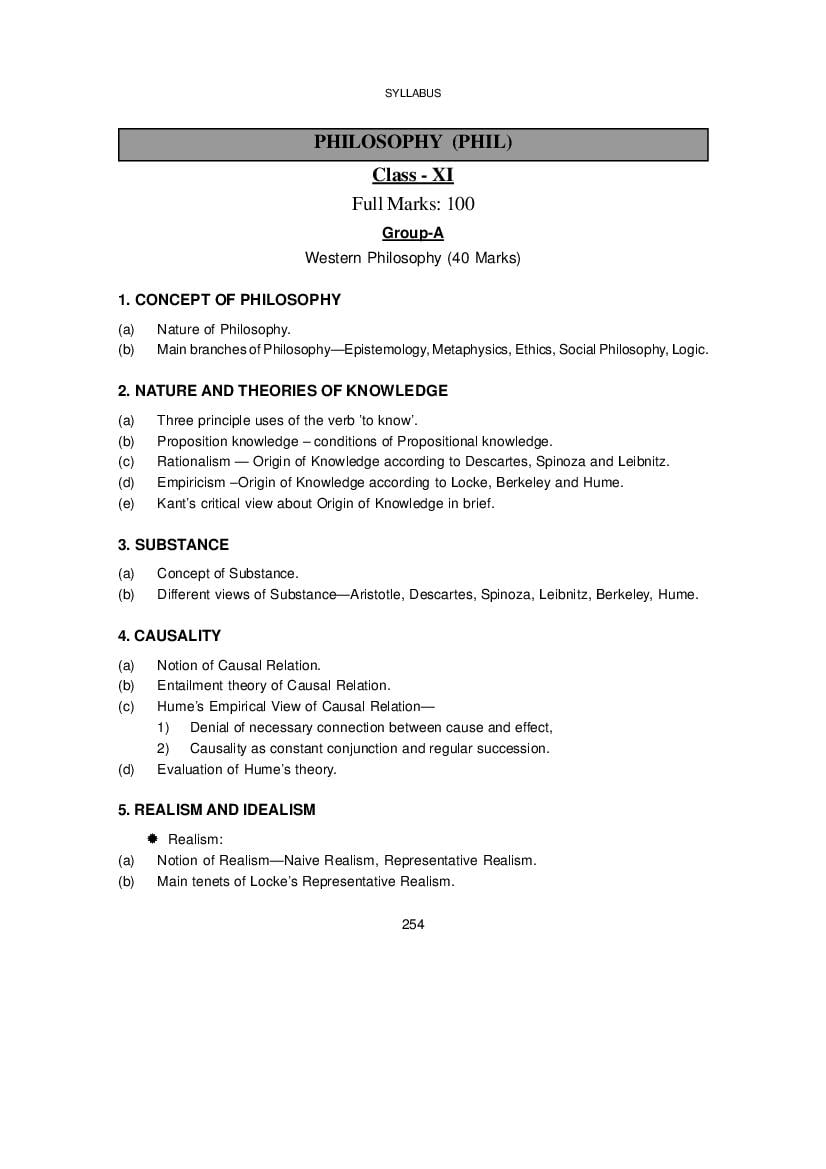
Class - XI
Full Marks: 100
Group-A
Western Philosophy (40 Marks)
1. CONCEPT OF PHILOSOPHY
(a) Nature of Philosophy.
(b) Main branches of Philosophy—Epistemology, Metaphysics, Ethics, Social Philosophy, Logic.
2. NATURE AND THEORIES OF KNOWLEDGE
(a) Three principle uses of the verb ’to know’.
(b) Proposition knowledge – conditions of Propositional knowledge.
(c) Rationalism — Origin of Knowledge according to Descartes, Spinoza and Leibnitz.
(d) Empiricism –Origin of Knowledge according to Locke, Berkeley and Hume.
(e) Kant’s critical view about Origin of Knowledge in brief.
3. SUBSTANCE
(a) Concept of Substance.
(b) Different views of Substance—Aristotle, Descartes, Spinoza, Leibnitz, Berkeley, Hume.
4. CAUSALITY
(a) Notion of Causal Relation.
(b) Entailment theory of Causal Relation.
(c) Hume’s Empirical View of Causal Relation—
1) Denial of necessary connection between cause and effect,
2) Causality as constant conjunction and regular succession.
(d) Evaluation of Hume’s theory.
5. REALISM AND IDEALISM
Realism:
(a) Notion of Realism—Naive Realism, Representative Realism.
(b) Main tenets of Locke’s Representative Realism.
254
Page 2
(a) Notion of Idealism.
(b) Berkeley’s Subjective Idealism—”Esse est percipi”—Role of yod— Evaluation of the view.
Group-B
Indian Philosophy (40 Marks)
1. NOTION OF ‘DARSHANA’
(a) Meaning of the term ‘Darshana’.
(b) Distinction in brief between the Indian Concept of ‘Darshana’ and Western Concept of
‘Philosophy’.
(c) The ‘aastika’ and ‘naastika darshana’ – Names of the different schools of Indian Philosophy.
(d) Some basic concept—Pramaa, Pramaana, Prameya, Pramaata, Purusharthas.
2. CHAARVAAKA
(a) Meaning of the term ‘Chaarvaaka’.
(b) Pratyaksa as the only Pramaana.
(c) Refutation of Anumaana and Shabda.
(d) Materialism—Four different physical elements, Svabhavavaada, Dehaatmavaada,
Sukhavaada, Rejection of Chaarvaaka Materialism.
3. BUDDHISM
(a) Main tenets of Buddhism:
1) Four Noble Truths
2) Nirvaana
3) Pratityasam utpaadavaada
4) Karmavaada
5) Kshanikvaada
6) Nairatmavaada
(b) Main theory of Soutrantaka School.
(c) Main theory of Yogaachaarvaada.
255
Page 3
(a) The different Pramaanas accepted by the Nyaaya, Definition of Pratyaksha.
(b) Sannikarsha—laukika and aloukika, Different types of Sannikarsha.
(c) Distinction in brief between Nirvikalpa and Savikalpa Pratyaksha.
(d) Definition of Anumiti, Concept of Paksha, Saadhya and hetu, Vyaapti as Sahachara Niyama,
Vyaptigraha,Pararthaanumiti. Panchavayavi Nyaaya.
5. ADVAITA VEDANTA
(a) Nature of Brahman in brief.
(b) Relation of Brahman with Jeeva(Self) and Jagata(World).
6. CONTEMPORARY INDIAN PHILOSOPHY
(a) Swaami Vivekananda: Philosophical thoughts on Karma-Yoga.
(b) Rabindranath Tagore: Philosophical thoughts on Humanism.
Group-C
Project-Work (20Marks)
1. Causality-Entailment theory, Hume’s theory.
2. Realism and Idealism.
3. Nyaaya Darshana.
4. Contemporary Indian Philosophy—Vivekanda’s Karma-Yoga, Tagore’s Humanism.
256
Document Details
| Board / Org | West Bengal Board |
| Exam | Class 11 |
| Type | Syllabus |
| Pages | 3 |
| Updated | 22 Jul 2026 |