ICSE Class 10 Syllabus 2023 Indian Languages (Revised)
Finished viewing? Save it for later —
Download ICSE Class 10 Syllabus 2023 Indian Languages (Revised) (PDF · 11 pages)About ICSE Class 10 Syllabus 2023 Indian Languages (Revised)
ICSE Class 10 Syllabus 2023 Indian Languages (Revised) is available here for free download. Published by CISCE for Class 10, this syllabus can be viewed online or downloaded as a PDF (11 pages). Candidates preparing for Class 10 can use ICSE Class 10 Syllabus 2023 Indian Languages (Revised) to understand the exam pattern, the type of questions asked, and the overall difficulty level.
Frequently Asked Questions
How can I download ICSE Class 10 Syllabus 2023 Indian Languages (Revised)?
Open this page and click the Download button to save ICSE Class 10 Syllabus 2023 Indian Languages (Revised) as a PDF. It is completely free on AglaSem Docs.
Is ICSE Class 10 Syllabus 2023 Indian Languages (Revised) free to download?
Yes. ICSE Class 10 Syllabus 2023 Indian Languages (Revised) can be viewed online and downloaded as a PDF free of cost on AglaSem Docs.
How many pages does ICSE Class 10 Syllabus 2023 Indian Languages (Revised) have?
ICSE Class 10 Syllabus 2023 Indian Languages (Revised) contains 11 pages, which you can read online or download together as a single PDF.
Where can I find more Class 10 study material?
You can find more Class 10 question papers, sample papers, syllabus, and answer keys on AglaSem Docs.
ICSE Class 10 Syllabus 2023 Indian Languages (Revised) – Text
Read the full text of this syllabus below — useful to quickly search, copy and reference the content online without downloading the PDF.
📄 View text version (11 pages)
Page 1
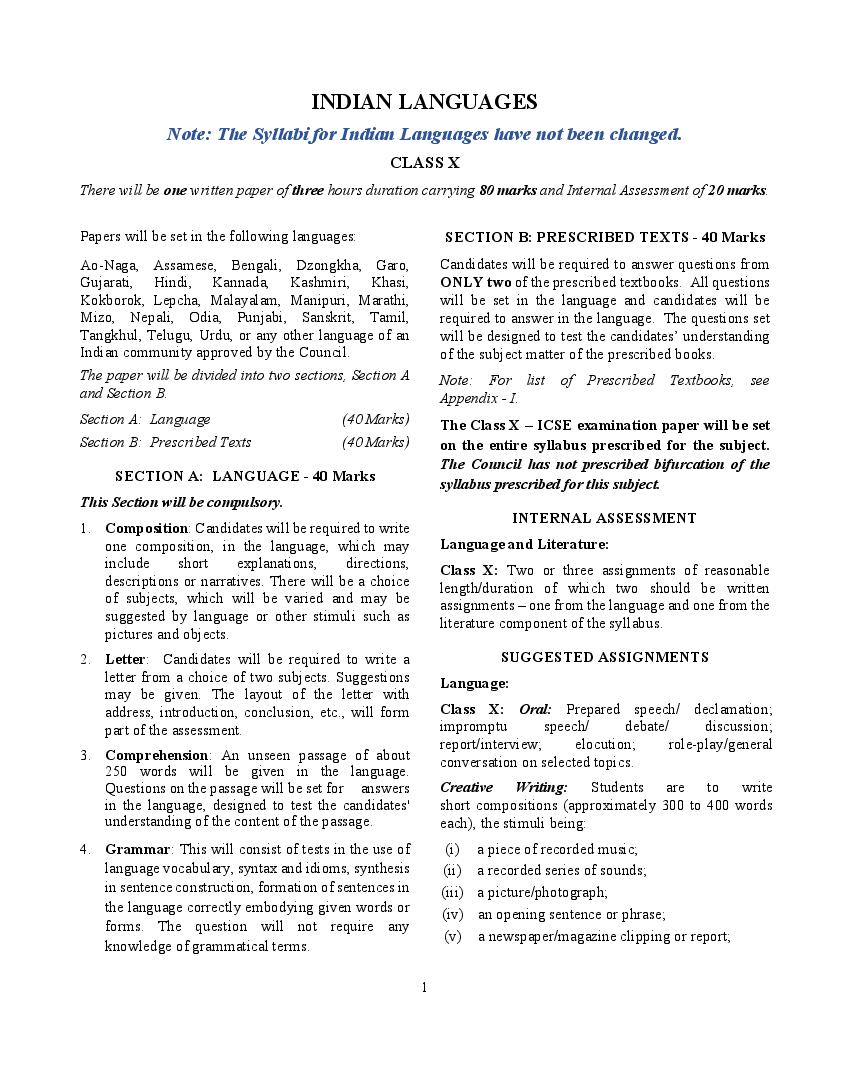
Note: The Syllabi for Indian Languages have not been changed.
CLASS X
There will be one written paper of three hours duration carrying 80 marks and Internal Assessment of 20 marks.
Papers will be set in the following languages: SECTION B: PRESCRIBED TEXTS - 40 Marks
Ao-Naga, Assamese, Bengali, Dzongkha, Garo, Candidates will be required to answer questions from
Gujarati, Hindi, Kannada, Kashmiri, Khasi, ONLY two of the prescribed textbooks. All questions
Kokborok, Lepcha, Malayalam, Manipuri, Marathi, will be set in the language and candidates will be
Mizo, Nepali, Odia, Punjabi, Sanskrit, Tamil, required to answer in the language. The questions set
Tangkhul, Telugu, Urdu, or any other language of an will be designed to test the candidates’ understanding
Indian community approved by the Council. of the subject matter of the prescribed books.
The paper will be divided into two sections, Section A Note: For list of Prescribed Textbooks, see
and Section B. Appendix - I.
Section A: Language (40 Marks) The Class X – ICSE examination paper will be set
Section B: Prescribed Texts (40 Marks) on the entire syllabus prescribed for the subject.
The Council has not prescribed bifurcation of the
SECTION A: LANGUAGE - 40 Marks syllabus prescribed for this subject.
This Section will be compulsory.
INTERNAL ASSESSMENT
1. Composition: Candidates will be required to write
one composition, in the language, which may Language and Literature:
include short explanations, directions, Class X: Two or three assignments of reasonable
descriptions or narratives. There will be a choice length/duration of which two should be written
of subjects, which will be varied and may be assignments – one from the language and one from the
suggested by language or other stimuli such as literature component of the syllabus.
pictures and objects.
2. Letter: Candidates will be required to write a SUGGESTED ASSIGNMENTS
letter from a choice of two subjects. Suggestions Language:
may be given. The layout of the letter with
address, introduction, conclusion, etc., will form Class X: Oral: Prepared speech/ declamation;
part of the assessment. impromptu speech/ debate/ discussion;
report/interview; elocution; role-play/general
3. Comprehension: An unseen passage of about conversation on selected topics.
250 words will be given in the language.
Questions on the passage will be set for answers Creative Writing: Students are to write
in the language, designed to test the candidates' short compositions (approximately 300 to 400 words
understanding of the content of the passage. each), the stimuli being:
4. Grammar: This will consist of tests in the use of (i) a piece of recorded music;
language vocabulary, syntax and idioms, synthesis (ii) a recorded series of sounds;
in sentence construction, formation of sentences in (iii) a picture/photograph;
the language correctly embodying given words or (iv) an opening sentence or phrase;
forms. The question will not require any
(v) a newspaper/magazine clipping or report;
knowledge of grammatical terms.
1
Page 2
informative or argumentative; one piece of expressive
Subject Teacher (Internal Examiner) 10 marks
writing which is descriptive and imaginative;
preparation of film/book review. External Examiner 10 marks
Literature (Prescribed Texts): The total marks obtained out of 20 are to be sent to the
Council by the Head of the school.
Class X
The Head of the school will be responsible for the
Assignments should be based on the prescribed
online entry of marks on the Council’s CAREERS
textbooks on the following lines:
portal by the due date.
(i) Character/thematic analysis.
(ii) Socio-economic, cultural, historical relevance/
background.
(iii) Summary/paraphrase.
EVALUATION
The assignments/project work are to be evaluated by
the subject teacher and by an External Examiner. (The
External Examiner may be a teacher nominated by the
Head of the school, who could be from the faculty, but
not teaching the subject in the section/class. For
example, a teacher of the language of Class VIII may
be deputed to be an External Examiner for Class X
projects in the language.)
The Internal Examiner and the External Examiner will
assess the assignments independently.
2
Page 3
(CLASS X)
Grade Content/Analysis of Idea, Expression/ Effective Structure/ Organisation Vocabulary/ Use of Originality/ Marks
Thought/ Feeling. Expression of Idea of Material Words, Phrases Imaginative/
Innovative
I The candidate analyses the ideas, The candidate expresses The work is very well The use of vocabulary The work is 4
feelings and experiences the ideas, thoughts and structured with a sense of exhibits a high level of imaginative,
effectively. feelings effectively. introduction, body, middle competence in handling interesting and
Reasoning is logical and and conclusion, language. engrossing.
effective. paragraphing and
appropriate sentence
construction.
II The candidate analyses the ideas, The candidate expresses The work is very well The vocabulary exhibits The candidate's 3
feelings and experiences with the ideas, thoughts and structured with some sense competence of word work is quite
well-defined explanations, feelings well and with of conclusion and of usage; correctness of interesting and
reasoning is logical and clarity. paragraph lengths. grammar and spelling. engrossing.
persuasive.
III The candidate analyses the ideas, The candidate expresses The work is fairly well The candidate uses The candidate 2
feelings and experiences with a the ideas, thoughts and structured; straightforward demonstrates the
fair degree of detail and feelings fairly well and candidate follows simple vocabulary and fairly ability to sustain the
explanation. Reasoning is fairly with a fair degree of paragraphing. good pattern of interest of the
logical and persuasive. clarity. spellings. reader.
IV The candidate attempts to analyze The candidate expresses The work shows some The candidate's The candidate is, to 1
ideas, feelings and experiences the ideas, thoughts and understanding of vocabulary is limited some extent, able to
with simple explanation and feelings intelligibly and paragraphing and structure. and the spelling, sustain the interest
detail. Reasoning and arguments in simple language. punctuation and of the reader.
are not very convincing. grammar is sometimes
poor.
V The candidate attempts a basic The candidate is unable The candidate does not There is consistent The candidate is 0
analysis of ideas, feelings and to expresses the ideas, display an understanding of weakness in spelling, unable to sustain
experiences with few simple thoughts and feelings, structure and paragraphing. punctuation and the interest of the
explanations and few details. Is uses simple language grammar. reader.
unable to present proper and the work is not very
arguments. intelligible.
3
Page 4
(CLASS X)
Grade Fluency of Language Subject Matter Organization Vocabulary/ Understanding Gesture Marks
Delivery
I Speaks with fluency and Matter is relevant, Content is well Uses appropriate While speaking, the Uses natural and 3
has full operational rich in content and sequenced and well vocabulary and candidate emphasizes spontaneous
command over the original. organized. pronounces words the important points. gestures that are
language. correctly. not out of place.
II The candidate speaks The subject matter The content is The candidate While speaking the Uses some natural 2
with fairly good fluency is mostly relevant, satisfactorily pronounces most candidate emphasizes gestures.
and has reasonable consisting of a sequenced and well words correctly and most important points.
operational command of few original ideas. organized. uses simple
the language. vocabulary.
III The candidate speaks The subject matter The subject content is The candidate While speaking, the Uses very few 1
with poor fluency and is irrelevant and very poor and lacks pronounces many candidate emphasizes natural gestures.
does not communicate lacks originality. organisational words incorrectly and some important
except for the most basic structure. uses inappropriate points.
information. vocabulary.
IV The candidate cannot The subject matter The subject content The candidate is While speaking, the Uses no natural 0
communicate even the is negligible. comprises of mere unable to correctly candidate is unable to gestures.
most basic information. words with no pronounce most words emphasize important
structured sentences. and has a limited points.
vocabulary.
4
Page 5
WITH GRADES (CLASS X)
Grade Understanding of Text Examples from Text Understanding of Appreciation of Language, Critical Appreciation Marks
(Narrative) text- Interpretation Characterization -Personal Response
and Evaluation
I The candidate demonstrates The account is suitably The candidate The candidate appreciates and The candidate is able 4
expertise in giving an supported by relevant understands the text evaluates significant ways to effectively reflect
appropriate account of the examples from the text. with due emphasis on (structure, character, imagery) personal response
text, with well-chosen interpretation and in which writers have (critical appreciation)
reference to narrative and evaluation. achieved their effects. to the text.
situation.
II The candidate demonstrates a The account is The candidate The candidate appreciates and The candidate is able 3
high level of competence in supported by examples understands the text evaluates significant ways in to reflect a personal
giving an account of the text, from the text. with some emphasis on which writers have achieved response to the text.
with appropriate references to interpretation and their effects.
the narrative and situation. evaluation.
III The candidate demonstrates The candidate The candidate The candidate recognizes The candidate is able 2
competence in giving an understands the text recognizes some some of the significant ways in to communicate a
account of the text with some and shows a basic aspects of the text used which the writers have used personal response
reference to the narrative and recognition of the by authors to present the language. which shows
situation. theme and can support ideas. appreciation.
it by a very few
examples.
IV The candidate gives broad The candidate The candidate relates The candidate recognizes The candidate 1
account of the text with understands the basic the text to other texts differences in the way authors communicates straight
reference to the narrative and meaning of the text. studied. write. forward personal
situation. response to the text.
V The candidate is unable to The candidate is unable The candidate is unable The candidate is unable to The candidate is 0
demonstrate an understanding to understand the text or to relate to the other text recognize the differences in unable to give a
of the basic events in the text. support it with any studied. the way authors write. personal view of the
examples. text studied.
5
Page 6
SECOND LANGUAGE
(Under Group I)
Candidates offering Sanskrit as a Group II subject may not opt for Sanskrit as a Group I subject.
Note: The Syllabus for this Subject has not been changed.
CLASS X
There will be one paper of three hours duration carrying 80 marks and Internal Assessment of 20 marks.
The paper will be divided into two sections, Section A and Section B.
Section A: Language (40 Marks)
Section B: Prescribed Texts (40 Marks)
SECTION A: LANGUAGE - 40 Marks I ¼d½ Loj vkSj O;atu dk lkekU; Kku vkSj mudk
mPpkj.k&LFkkuA
This section will be compulsory.
1. Composition: Candidates will be required to
¼[k½ lfU/k %
write, in the language, one short composition (i) Loj&lfU/k
which may include short explanations, directions, (ii) gy&lfU/k
descriptions or narratives. There will be a choice
of subjects which will be varied and may be (iii) folxZ&lfU/k
suggested by language or other stimuli such as ¼x½ ’k~Cn :i %
pictures or objects. (i) iqfYyax&jke] gfj] xq:] fir``] xks] Hkor~] fo}l~]
2. Letter: Candidates will be required to write a jktu~] dfju~A
letter from a choice of two subjects. Suggestions (ii) L=hfyax&jek] unh] /ksuq] o/kw] okp~] lfjr~~ ekr`A
may be given. The layout of the letter with
address, introduction, conclusion, etc., will form (iii) uiqlad fyax&x`g] okfj] nf/k] e/kq] txr~]
part of the assessment. ukeu~] eul~A
3. Comprehension: An unseen passage will be (iv) loZuke&loZ] rn~] ;n~] fde~] ;q"en~] vLen~A
given in Sanskrit. Questions in the language will
(v) ,d ls nl rd la[;kokpd ’k~Cn lHkh fyaxksa
be set for answers in the language, designed to test
the candidates’ understanding of the content of the esaA
passage. ¼?k½ /kkrq :i %
4. Grammar: In addition to the grammar topics (i) fu/kkZfjr ydkj&yV~ y`V] y³~] yksV~ ,oa
listed below, questions will also be set from the fof/kfyaxA
grammar topics covered in the prescribed text
books. These will include tests in vocabulary, (ii) bu ydkjksa esa uhps fy[kh /kkrqvksa ds ijLeSin]
syntax and idiom, synthesis in sentence vkReusin ,oa mHk;in ds :iA
construction, formation of sentences in the (iii) ijLeSin&Hkw] iB~] ik] xe~] gl~] LFkk] ft] u’k~]
language correctly embodying given words or vl~] th] ’kd~] b"k~] izPNA
forms.
(iv) vkReusin&yHk~] o`/k~] tu~] ;kp~] lso~A
(v) mHk;in&uh] n~k] xzg] Kk] d`A
¼M½ dkjdksa dk lekU; KkuA
6
Page 7
cgqozhfgA The teacher shall set and mark specific work assigned
¼[k½ dkjd rFkk miin foHkfä;k¡ to candidates over the two years.
¼x½ izR;; EVALUATION
(i) d`nUr&d~Rok] rqequ] Dr ¼ä½] rO;r~] vuh;j] The assignments/project work are to be evaluated by
äorqA the subject teacher and by an External Examiner.
(ii) rf)r&erqi] bd] Ro] ry~A (The External Examiner may be a teacher nominated
(iii) L=h izR;; &Vki~] Mhi~A by the Head of the school, who could be from the
faculty, but not teaching the subject in the
SECTION B: PRESCRIBED TEXTS - 40 Marks
section/class. For example, a teacher of Sanskrit of
Candidates will be required to answer questions from Class VIII may be deputed to be an External Examiner
ONLY two of the prescribed textbooks. All questions for Class X, Sanskrit projects.) The Internal Examiner
will be set in the language and candidates will be and the External Examiner will assess the assignments
required to answer in the language. The questions set independently.
will be designed to test the candidates’ understanding Award of Marks (20 Marks)
of the subject matter of the prescribed books.
Subject Teacher (Internal Examiner) 10 marks
Note: For list of Prescribed Textbooks, see
External Examiner 10 marks
Appendix - I.
The total marks obtained out of 20 are to be sent to the
Council by the Head of the school.
The Head of the school will be responsible for the
online entry of marks on the Council’s CAREERS
portal by the due date.
7
Page 8
Grade Content/Analysis of Idea, Expression/ Effective Structure/ Organisation of Vocabulary/ Use of Originality/ Marks
Thought/ Feeling. Expression of Idea Material Words, Phrases Imaginative/
Innovative
I The candidate analyses the ideas, The candidate expresses The work is very well The use of vocabulary The work is 4
feelings and experiences the ideas, thoughts and structured with a sense of exhibits a high level of imaginative,
effectively. feelings effectively. introduction, body, middle competence in handling interesting and
Reasoning is logical and and conclusion, language. engrossing.
effective. paragraphing and
appropriate sentence
construction.
II The candidate analyses the ideas, The candidate expresses The work is very well The vocabulary exhibits The candidate's 3
feelings and experiences with the ideas, thoughts and structured with some sense competence of word work is quite
well defined explanations, feelings well and with of conclusion and of usage; correctness of interesting and
reasoning is logical and clarity. paragraph lengths. grammar and spelling. engrossing.
persuasive.
III The candidate analyses the ideas, The candidate expresses The work is fairly well The candidate uses The candidate 2
feelings and experiences with a the ideas, thoughts and structured; straightforward demonstrates the
fair degree of detail and feelings fairly well and Candidate follows simple vocabulary and fairly ability to sustain the
explanation. Reasoning is fairly with a fair degree of paragraphing. good pattern of interest of the
logical and persuasive. clarity. spellings. reader.
IV The candidate attempts to analyze The candidate expresses The work shows some The candidate's The candidate is, to 1
ideas, feelings and experiences the ideas, thoughts and understanding of vocabulary is limited some extent, able to
with simple explanation and feelings intelligibly and paragraphing and structure. and the spelling, sustain the interest
detail. Reasoning and arguments in simple language. punctuation and of the reader.
are not very convincing. grammar is sometimes
poor.
V The candidate attempts a basic The candidate is unable The candidate does not There is consistent The candidate is 0
analysis of ideas, feelings and to expresses the ideas, display an understanding of weakness in spelling, unable to sustain
experiences with few simple thoughts and feelings, structure and paragraphing. punctuation and the interest of the
explanations and few details. Is uses simple language grammar. reader.
unable to present proper and the work is not very
arguments. intelligible.
8
Page 9
Grade Fluency of Language Subject Matter Organization Vocabulary/ Understanding Gesture Marks
Delivery
I Speaks with fluency and Matter is relevant, Content is well Uses appropriate While speaking, the Uses natural and 3
has full operational rich in content and sequenced and well vocabulary and candidate emphasizes spontaneous
command over the original. organized. pronounces words the important points. gestures that are
language. correctly. not out of place.
II The candidate speaks The subject matter The content is The candidate While speaking the Uses some natural 2
with fairly good fluency is mostly relevant, satisfactorily pronounces most candidate emphasizes gestures.
and has reasonable consisting of a sequenced and well words correctly and most important points.
operational command of few original ideas. organized. uses simple
the language. vocabulary.
III The candidate speaks The subject matter The subject content is The candidate While speaking, the Uses very few 1
with poor fluency and is irrelevant and very poor and lacks pronounces many candidate emphasizes natural gestures.
does not communicate lacks originality. organisational words incorrectly and some important
except for the most basic structure. uses inappropriate points.
information. vocabulary.
IV The candidate cannot The subject matter The subject content The candidate is While speaking, the Uses no natural 0
communicate even the is negligible. comprises of mere unable to correctly candidate is unable to gestures.
most basic information. words with no pronounce most words emphasize important
structured sentences. and has a limited points.
vocabulary.
9
Page 10
Grade Understanding/ Recall Vocabulary Context/ Correlation to Other Marks
Comprehension Main Idea, Areas
Central Theme
I The candidate accurately The candidate recalls all the The candidate uses appropriate The candidate clearly 3
understands the central idea of the important points made (written/ and correct vocabulary while understands the context and can
passage as well as the relevant verbal). recalling the points made. widely correlate the passage to
points in the selected passage/ the other areas.
talk.
II The candidate gives ideas fairly The candidate recalls some of the The candidate uses correct but The candidate can moderately 2
close to the central / main idea of important points made (written/ simple vocabulary while understand the context of the
the passage as well as understand verbal). recalling the points made. passage and can moderately
some of the relevant points heard correlate the passage to the other
in the selected passage/ talk. areas.
III The candidate cannot fully The candidate recalls very few of The candidate makes various The candidate can only faintly 1
comprehend the passage and the important points made errors in vocabulary while understand the context of the
gives only a few ideas related to (written/verbal). recalling the points made. passage and relate it to the other
the central theme of the passage. areas.
IV The candidate is neither able to The candidate is unable to recall The candidate uses incorrect The candidate is unable to 0
understand the central/main idea the important points made vocabulary while recalling the understand the context of the
of the passage; nor able to (written/verbal) points made. passage and is unable to correlate
understand relevant points heard the passage to the other areas.
in the passage/talk.
10
Page 11
Grade Understanding of Text Examples from Text Understanding of Appreciation of Language, Critical Appreciation Marks
(Narrative) text- Interpretation Characterization -Personal Response
and Evaluation
I The candidate demonstrates The account is suitably The candidate The candidate appreciates and The candidate is able to 4
expertise in giving an supported by relevant understands the text evaluates significant ways effectively reflect
appropriate account of the examples from the text. with due emphasis on (structure, character, imagery) personal response
text, with well-chosen interpretation and in which writers have (critical appreciation)
reference to narrative and evaluation. achieved their effects. to the text.
situation.
II The candidate demonstrates a The account is The candidate The candidate appreciates and The candidate is able to 3
high level of competence in supported by examples understands the text evaluates significant ways in reflect a personal
giving an account of the text, from the text. with some emphasis on which writers have achieved response to the text.
with appropriate references to interpretation and their effects.
the narrative and situation. evaluation.
III The candidate demonstrates The candidate The candidate The candidate recognizes The candidate is able to 2
competence in giving an understands the text recognizes some some of the significant ways communicate a
account of the text with some and shows a basic aspects of the text used in which the writers have used personal response,
reference to the narrative and recognition of the by authors to present the language. which shows
situation. theme and can support ideas. appreciation.
it by a very few
examples.
IV The candidate gives broad The candidate The candidate relates The candidate recognizes The candidate 1
account of the text with understands the basic the text to other texts differences in the way authors communicates
reference to the narrative and meaning of the text. studied. write. straightforward
situation. personal response to the
text.
V The candidate is unable to The candidate is unable The candidate is unable The candidate is unable to The candidate is unable 0
demonstrate an to understand the text to relate to the other recognize the differences in to give a personal view
understanding of the basic or support it with any text studied. the way authors write. of the text studied.
events in the text. examples.
11
Document Details
| Board / Org | CISCE |
| Exam | Class 10 |
| Type | Syllabus |
| Pages | 11 |
| Updated | 30 Apr 2026 |