ICSE Class 10 Syllabus 2023 Mass Media And Communication (Revised)
Finished viewing? Save it for later —
Download ICSE Class 10 Syllabus 2023 Mass Media And Communication (Revised) (PDF · 4 pages)About ICSE Class 10 Syllabus 2023 Mass Media And Communication (Revised)
ICSE Class 10 Syllabus 2023 Mass Media And Communication (Revised) is available here for free download. Published by CISCE for Class 10, this syllabus can be viewed online or downloaded as a PDF (4 pages). Candidates preparing for Class 10 can use ICSE Class 10 Syllabus 2023 Mass Media And Communication (Revised) to understand the exam pattern, the type of questions asked, and the overall difficulty level.
Frequently Asked Questions
How can I download ICSE Class 10 Syllabus 2023 Mass Media And Communication (Revised)?
Open this page and click the Download button to save ICSE Class 10 Syllabus 2023 Mass Media And Communication (Revised) as a PDF. It is completely free on AglaSem Docs.
Is ICSE Class 10 Syllabus 2023 Mass Media And Communication (Revised) free to download?
Yes. ICSE Class 10 Syllabus 2023 Mass Media And Communication (Revised) can be viewed online and downloaded as a PDF free of cost on AglaSem Docs.
How many pages does ICSE Class 10 Syllabus 2023 Mass Media And Communication (Revised) have?
ICSE Class 10 Syllabus 2023 Mass Media And Communication (Revised) contains 4 pages, which you can read online or download together as a single PDF.
Where can I find more Class 10 study material?
You can find more Class 10 question papers, sample papers, syllabus, and answer keys on AglaSem Docs.
ICSE Class 10 Syllabus 2023 Mass Media And Communication (Revised) – Text
Read the full text of this syllabus below — useful to quickly search, copy and reference the content online without downloading the PDF.
📄 View text version (4 pages)
Page 1
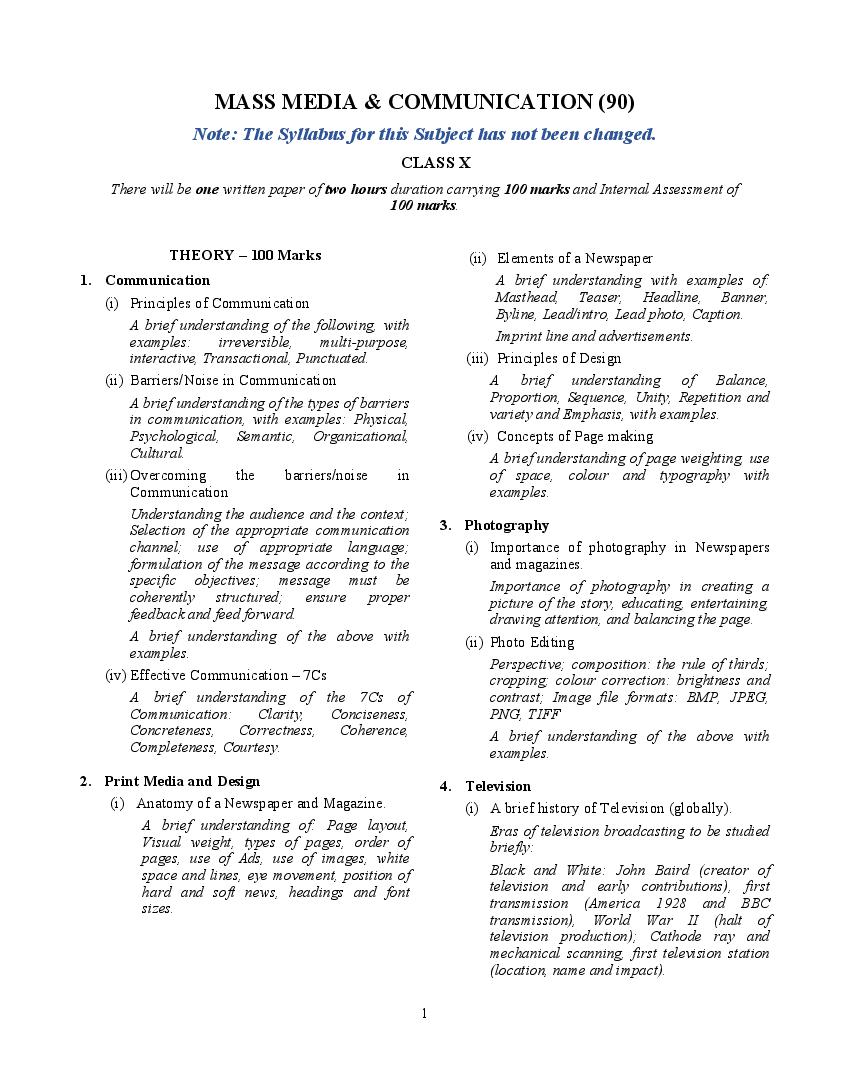
Note: The Syllabus for this Subject has not been changed.
CLASS X
There will be one written paper of two hours duration carrying 100 marks and Internal Assessment of
100 marks.
THEORY – 100 Marks (ii) Elements of a Newspaper
1. Communication A brief understanding with examples of:
(i) Principles of Communication Masthead, Teaser, Headline, Banner,
Byline, Lead/intro, Lead photo, Caption.
A brief understanding of the following, with
examples: irreversible, multi-purpose, Imprint line and advertisements.
interactive, Transactional, Punctuated. (iii) Principles of Design
(ii) Barriers/Noise in Communication A brief understanding of Balance,
A brief understanding of the types of barriers Proportion, Sequence, Unity, Repetition and
in communication, with examples: Physical, variety and Emphasis, with examples.
Psychological, Semantic, Organizational, (iv) Concepts of Page making
Cultural. A brief understanding of page weighting, use
(iii) Overcoming the barriers/noise in of space, colour and typography with
Communication examples.
Understanding the audience and the context;
Selection of the appropriate communication 3. Photography
channel; use of appropriate language; (i) Importance of photography in Newspapers
formulation of the message according to the and magazines.
specific objectives; message must be Importance of photography in creating a
coherently structured; ensure proper picture of the story, educating, entertaining,
feedback and feed forward. drawing attention, and balancing the page.
A brief understanding of the above with (ii) Photo Editing
examples.
Perspective; composition: the rule of thirds;
(iv) Effective Communication – 7Cs cropping; colour correction: brightness and
A brief understanding of the 7Cs of contrast; Image file formats: BMP, JPEG,
Communication: Clarity, Conciseness, PNG, TIFF
Concreteness, Correctness, Coherence, A brief understanding of the above with
Completeness, Courtesy. examples.
2. Print Media and Design 4. Television
(i) Anatomy of a Newspaper and Magazine. (i) A brief history of Television (globally).
A brief understanding of: Page layout, Eras of television broadcasting to be studied
Visual weight, types of pages, order of briefly:
pages, use of Ads, use of images, white
space and lines, eye movement, position of Black and White: John Baird (creator of
hard and soft news, headings and font television and early contributions), first
sizes. transmission (America 1928 and BBC
transmission), World War II (halt of
television production); Cathode ray and
mechanical scanning, first television station
(location, name and impact).
1
Page 2
impact), Baird’s improvement (use of
Definition; types: consumer oriented and
scanning disks), Peter Goldmark
trade oriented; uses of Sales Promotion.
(introduction of electromechanical system),
first colour programs (early program types, (v) New ways of Advertising.
impact), compact television (success and
Cross promotions, covert advertising and
impact).
merchandise.
Digital: Switch from analog to digital (initial
reception and impact), HDTV, NTSC and (vi) Public Relations.
PAL (Brief understanding, resolutions and Definition; Role of Public relations: build a
distinction). brand image, prepare feedback which allows
for improvement, generate goodwill, evaluate
(ii) Characteristics of Television.
and monitor media tools, aid in advertising
An understanding of television as a medium: and sales promotion, crisis management.
audio-visual medium; live medium; mass (vii) Difference between Public relations and
medium; domestic medium; transitory Advertising.
medium and expensive medium.
A brief understanding.
(iii) Types of Television.
A brief understanding of different types such Note: Case studies may be used to develop a
as: better understanding of the above concepts.
− CRT, Plasma, LCD, LED and OLED, INTERNAL ASSESSMENT – 100 Marks
− SD, HD & UHD Candidates will be required to do a minimum of four
− Smart TV assignments during the year, as assigned by the
teacher.
(iv) Television Broadcasting in India.
Suggested list of assignments:
Television broadcasting in India from 1959
1. Create a documentary on the evolution of
to present times to be done briefly.
cameras. The documentary must include
(v) Types of Television Broadcasting narration, at least one interview, still images of
A brief understanding of different types of the sample cameras, footage of various cameras
television broadcasting such as: terrestrial, in action and samples of the photographs created
cable, satellite/DTH, IPTV and online by each camera. Total screen time not including
broadcasting. credits must be at least ten minutes. This may be
done individually or as a team.
5. Integrated Marketing Communications- IMC 2. Create a power point presentation with the goal
(i) A brief understanding of IMC; benefits of of trying to sell a product. Slides must be neat
IMC. and properly formatted. The presentation must
explain what the product is, why the consumer
Self-explanatory.
should buy it, why it is better than the
(ii) Direct Marketing. competition and how to get hold of it. The
Definition of direct marketing; Marketing presentation must have at least one video clip.
Mix – 4 Ps: a brief understanding of Product, 3. Create a Blog about your city. The blog must
Price, Promotion and Place. contain both recent as well as old images.
(iii) Internet Marketing. Changes in the city over the years, popular sites,
population density, cost of living, general living
Definition; Internet as an IMC tool; conditions and future prospects must be
Interactivity; Advantages and disadvantages mentioned. The blog must contain at least 600
of internet marketing. words. Any free blog site may be used to create
this, but the blog must be available for online
viewing.
2
Page 3
page must contain one main story and two human habits of people in your neighbourhood/school.
interest stories. The second page must contain Get at least 25 survey forms filled. Analyse the
advertisement as well as economic information data and present your findings.
such as the stock market and home loans. The
third must contain a sports section. The final
EVALUATION
page must contain an entertainment section
including celebrity gossip, movie reviews, The assignments/project works are to be evaluated
games, jokes and puzzles. Images must be by the subject teacher and by an External Examiner.
balanced across the page. All stories must have The External Examiner may be a teacher nominated
heading, and sub-headings are suggested. The by the Head of the school, who could be from the
newspaper may be in grey scale for the sake of faculty, but not teaching the subject in the
convenience as well as printed on an A4 sheet. section/class. For example, a teacher of Mass
5. Create a Radio program. The total duration of the Media & Communication of Class XI may be
program should be within 20 to 30 minutes. The deputed to be an External Examiner for Class X
program must contain a jingle, at least three projects.
advertisements, no more than 10 minutes’ worth The Internal Examiner and the External Examiner
of songs, a short interview with a teacher/student will assess the assignments independently.
authority, song requests and at least one public Award of marks (100 Marks)
service announcement. All songs played during
the program must be of the same genre and care Subject Teacher (Internal Examiner): 50 marks
must be taken to avoid mature content. External Examiner : 50 marks
6. Design and distribute questionnaires (survey) to The total marks obtained out of 100 are to be sent to
selected students of lower classes. Statistical data the Council by the Head of the school.
must be collected based on average happiness of The Head of the school will be responsible for entry
students per class, favourite subject, largest class, of marks on the Council’s online portal by the due
average marks per class, number of students who date.
prefer academics, number of students who prefer
extra-curricular activities, percentage of students
who live far from school and percentage of each
faith followed. This data will then be presented in
the form of a series of pie charts. There must be
20 students in the test group and no more than
three must be of the same class.
3
Page 4
Criteria Preparation Procedure Observation Inference Presentation Marks
Grade I Excellent choice of Originality and relevance; Proper format followed, Information fitted correctly Methodical, precise 4 marks
Topic, good research, creative, rational and understandable to all to format; work indicates and clear expression; for each
visually pleasing (or structured thinking; good ages, correct flow of understanding, good neat and tidy criterion
audio), proper format questionnaire. image and audio. comprehension of subject. presentation; optimum
followed. Images and text neat and utilisation of skills.
clear.
Grade II Relevant choice of Originality and structured Able to follow format, Can format and grasp Work neat and tidy 3 marks
topic; Relevant audio thinking; adequate but not precisely; able information correctly; and clearly presented; for each
and visual; adequate framing of questions; to grasp information; subject matter shows methodical and criterion
research. good insight. independent survey. adequate comprehension. appropriate techniques
Images and text are in used.
correct format.
Grade III Adequate choice of Records information Assistance required in Requires some assistance to Reasonably clear but 2 marks
topic; some idea of correctly but lacks presenting, recording relate data to audio/visual work disorganized in for each
what to study; some originality; independent and arranging subject display; able to arrange places; untidy criterion
information gathered. framing of questions. matter; can conduct images and text. fonts/borders used,
survey. mild clutter.
Grade IV Topic selected but Unable to create or edit a Tends to make mistakes Assistance required in order Sequence of work 1 mark
continuous assistance project; requires in organizing data; to grasp the relevant and acceptable but not for each
required for collection assistance to prepare some ability to conduct validity of information; very neat; poor criterion
of information. questionnaire. survey. Mistakes in tends to make errors. presentation.
Audio and visuals are editing.
substandard.
Grade V Lack of perception of Not able to comprehend Faulty survey and Cannot process results; Presentation untidy 0 marks
the subject and concept of a topic; unable mistakes in data; not faulty conclusions in spite of and disorganised; for each
objective; lack of to prepare questionnaire able to proceed even assistance provided. effort and initiative criterion
effort. even with assistance; no with assistance. lacking.
video or audio collected.
4
Document Details
| Board / Org | CISCE |
| Exam | Class 10 |
| Type | Syllabus |
| Pages | 4 |
| Language | english |
| Updated | 30 Apr 2026 |