Goa Board Class 10 Question Paper Mar 2019 Basic Cookery English CWSN
Finished viewing? Save it for later —
Download Goa Board Class 10 Question Paper Mar 2019 Basic Cookery English CWSN (PDF · 5 pages)About Goa Board Class 10 Question Paper Mar 2019 Basic Cookery English CWSN
Goa Board Class 10 Question Paper Mar 2019 Basic Cookery English CWSN is available here for free download. Published by Goa Board for Class 10, this question paper can be viewed online or downloaded as a PDF (5 pages). Candidates preparing for Class 10 can use Goa Board Class 10 Question Paper Mar 2019 Basic Cookery English CWSN to understand the exam pattern, the type of questions asked, and the overall difficulty level.
Frequently Asked Questions
How can I download Goa Board Class 10 Question Paper Mar 2019 Basic Cookery English CWSN?
Open this page and click the Download button to save Goa Board Class 10 Question Paper Mar 2019 Basic Cookery English CWSN as a PDF. It is completely free on AglaSem Docs.
Is Goa Board Class 10 Question Paper Mar 2019 Basic Cookery English CWSN free to download?
Yes. Goa Board Class 10 Question Paper Mar 2019 Basic Cookery English CWSN can be viewed online and downloaded as a PDF free of cost on AglaSem Docs.
How many pages does Goa Board Class 10 Question Paper Mar 2019 Basic Cookery English CWSN have?
Goa Board Class 10 Question Paper Mar 2019 Basic Cookery English CWSN contains 5 pages, which you can read online or download together as a single PDF.
Where can I find more Class 10 study material?
You can find more Class 10 question papers, sample papers, syllabus, and answer keys on AglaSem Docs.
Goa Board Class 10 Question Paper Mar 2019 Basic Cookery English CWSN – Text
Read the full text of this question paper below — useful to quickly search, copy and reference the content online without downloading the PDF.
📄 View text version (5 pages)
Page 1
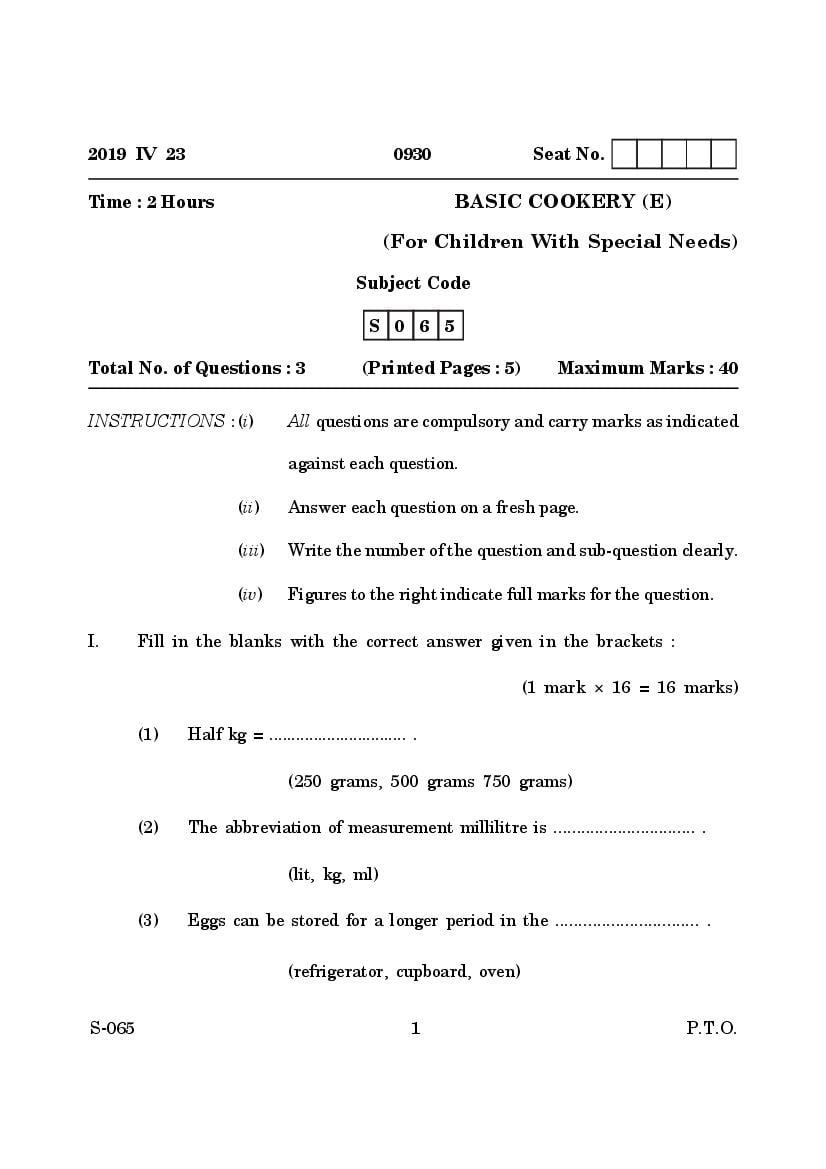
Time : 2 Hours BASIC COOKERY (E)
(For Children With Special Needs)
Subject Code
S 0 6 5
Total No. of Questions : 3 (Printed Pages : 5) Maximum Marks : 40
INSTRUCTIONS : (i) All questions are compulsory and carry marks as indicated
against each question.
(ii) Answer each question on a fresh page.
(iii) Write the number of the question and sub-question clearly.
(iv) Figures to the right indicate full marks for the question.
I. Fill in the blanks with the correct answer given in the brackets :
(1 mark × 16 = 16 marks)
(1) Half kg = ............................... .
(250 grams, 500 grams 750 grams)
(2) The abbreviation of measurement millilitre is ............................... .
(lit, kg, ml)
(3) Eggs can be stored for a longer period in the ............................... .
(refrigerator, cupboard, oven)
S-065 1 P.T.O.
Page 2
(badam, pistachio, cashew)
(5) To stay healthy we should eat ............................... food.
(fried, junk, nutritious)
(6) Lunch is had between ............................... .
(9 pm to 10 pm, 7 am to 9 am, 1 pm to 2 pm)
(7) It is important that we drink at least ............................... glasses of water
every day.
(8, 2, 1)
(8) Meals have to be eaten every ............................... hours at regular
intervals.
(3 to 4, 5 to 6, 8 to 10)
(9) Sugar and jaggery are ............................... ingredients.
(perishable, non-perishable, semi-perishable)
(10) Cumin is also known as ............................... in India.
(mustard, jeera, haldi)
S-065 2
Page 3
(rotis, rice, chapatis)
(12) We need to weigh and measure ................................... correctly to prevent
wastage of food.
(tools, equipment, ingredients)
(13) Cereals are a rich source of ............................... .
(Vitamin C, carbohydrates, fat)
(14) Eggs provide us with ............................... .
(protein, fibre, water)
(15) We get ............................... from milk and milk products.
(calcium, fibre, Vitamin C)
(16) We should try and use ....................................... amount of oil while
cooking.
(maximum, minimum, huge)
S-065 3 P.T.O.
Page 4
(1 mark × 16 = 16 marks)
(1) Meat and poultry does not need refrigeration.
(2) Dry beans and pulses are perishable ingredients and needs to be kept
in a refrigerator.
(3) Butter and curds are milk products.
(4) Wheat and rice are examples of cereals.
(5) Vegetables are high in fat, sugar and carbohydrates.
(6) It is ideal to consume lot of sugar.
(7) Nuts provide us with vitamin A and B, fibre and iron.
(8) Refined flour is also known as atta in India.
(9) Sautéing means deep frying food in lot of oil.
(10) Good breakfast consists of biscuits and chips.
(11) Usually a vegetable soup is consumed at dinner as it is nutritious and
light.
(12) We should not consume a lot of sweets like ice cream and chocolates
in our daily diet.
(13) We should have a salad at least once a day.
S-065 4
Page 5
(15) 1 teaspoon is equivalent to 5 grams.
(16) 1 dozen eggs are equal to 30 eggs.
III. Answer the following questions in brief : (2 marks × 4 = 8 marks)
(1) Write down any 2 tips for healthy eating.
(2) What is perishable ingredient? Give 2 examples.
(3) Write down any 2 health benefits of grains and cereals.
(4) Why is steamed food healthier than fried food.
S-065 5 P.T.O.
Document Details
| Board / Org | Goa Board |
| Exam | Class 10 |
| Type | Question Paper |
| Pages | 5 |
| Updated | 30 Apr 2026 |