WBCHSE Class 11 Syllabus for Psychology
Finished viewing? Save it for later —
Download WBCHSE Class 11 Syllabus for Psychology (PDF · 5 pages)About WBCHSE Class 11 Syllabus for Psychology
WBCHSE Class 11 Syllabus for Psychology is available here for free download. Published by West Bengal Board for Class 11, this syllabus can be viewed online or downloaded as a PDF (5 pages). Candidates preparing for Class 11 can use WBCHSE Class 11 Syllabus for Psychology to understand the exam pattern, the type of questions asked, and the overall difficulty level.
Frequently Asked Questions
How can I download WBCHSE Class 11 Syllabus for Psychology?
Open this page and click the Download button to save WBCHSE Class 11 Syllabus for Psychology as a PDF. It is completely free on AglaSem Docs.
Is WBCHSE Class 11 Syllabus for Psychology free to download?
Yes. WBCHSE Class 11 Syllabus for Psychology can be viewed online and downloaded as a PDF free of cost on AglaSem Docs.
How many pages does WBCHSE Class 11 Syllabus for Psychology have?
WBCHSE Class 11 Syllabus for Psychology contains 5 pages, which you can read online or download together as a single PDF.
Where can I find more Class 11 study material?
You can find more Class 11 question papers, sample papers, syllabus, and answer keys on AglaSem Docs.
WBCHSE Class 11 Syllabus for Psychology – Text
Read the full text of this syllabus below — useful to quickly search, copy and reference the content online without downloading the PDF.
📄 View text version (5 pages)
Page 1
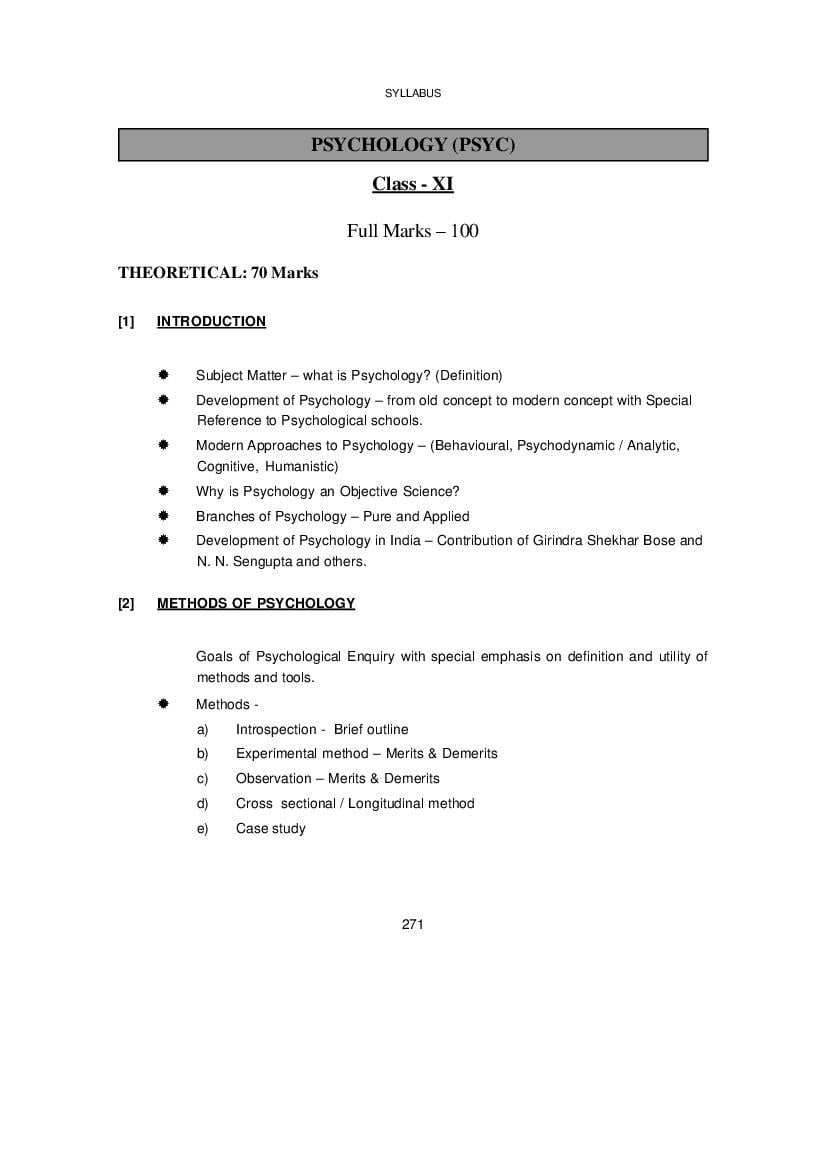
Class - XI
Full Marks – 100
THEORETICAL: 70 Marks
[1] INTRODUCTION
Subject Matter – what is Psychology? (Definition)
Development of Psychology – from old concept to modern concept with Special
Reference to Psychological schools.
Modern Approaches to Psychology – (Behavioural, Psychodynamic / Analytic,
Cognitive, Humanistic)
Why is Psychology an Objective Science?
Branches of Psychology – Pure and Applied
Development of Psychology in India – Contribution of Girindra Shekhar Bose and
N. N. Sengupta and others.
[2] METHODS OF PSYCHOLOGY
Goals of Psychological Enquiry with special emphasis on definition and utility of
methods and tools.
Methods -
a) Introspection - Brief outline
b) Experimental method – Merits & Demerits
c) Observation – Merits & Demerits
d) Cross sectional / Longitudinal method
e) Case study
271
Page 2
a) Tests – Definition, Characteristics and Types, any two examples
b) Interview – Definition, characteristics, Types, Merits and Demerits
c) Questionnaires – Definition, Characteristics and Types, Merits and Demerits,
any two examples
[3] BIOLOGICAL BASES OF BEHAVIOR
Introduction for relation between body and mind with special Reference to human
behaviour
Neuron – Structure, Types and Functions with diagrams, Concept of Synapse
Nervous System –
a) Definition and Types of Nervous System(C.N.S., A.N.S., P.N.S.)
b) Brain – Structure, Parts and Area Localization of brain with special reference
to Cerebral Cortex, Diagram of Brain
c) Spinal Cord – Structure of Spinal Cord (mention different segments), Functions
(mention Reflex Action)
Endocrine System – Role of Endocrine System in human behaviour, Hyper and
Hypo Secretion of endocrine glands
[4] DEVELOPMENT
What is development – Relation between Growth, Maturation, Development and
Evolution
Critical Periods of Development – Short discussion of different stages (Physical
and mental changes ), special reference to Adolescence Period
Factors influencing development – Heredity and Environment
[5] SENSORY PROCESSES
What is sensation? – Definition
Human senses –
a) Special senses – Eye, Ear, Nose, Tongue
272
Page 3
c) Other – Kinaesthetic / Vestibular
d) Attributes of sensation
e) Relation between sensation and Perception
[6] PERCEPTUAL PROCESS
What is Perception? – Definition
Natural / Characteristics of Perception
Form Perception – Laws of organization, Concept of Figure – Ground Relationship
Depth and Distance Perception – Binocular cues and Monocular cues
Movement Perception – Concept of Real and Apparent motion
Illusion – What is illusion? – Definition, Types - with special notes on Mullerlyer
illusion
Attention – Definition, characteristics, types (voluntary, involuntary, non-voluntary),
factors that determine attention or conditions of attention subjective and objective
[7] LEARNING
Definition and characteristics of learning
Theories-
a) Trial and Error (Thorndike) – Experiment, laws (Primary and Secondary),
Importance of the theory and criticism.
b) Classical conditioning (Pavlov) – Experiment, principles, importance of the
theory with criticism.
c) Operant conditioning (Skinner) - Experiment, principles, importance of the
theory with criticism.
d) Insight (Kohler) - Experiment, Importance of the theory with criticism.
Difference between classical and operant conditioning
Concept of learning by Indian Philosopher – Swami Vivekananda and Rabindranath
Tagore
273
Page 4
Definition
Factors involved in Memory – Learning, Retention, Recall and Recognition
Process involved in memory – Encoding, Storage, Retrieval
Interaction Processing theory (Attkinson and Shiffrin Model) - Sensory Memory,
Short-term memory, long-term memory
Concept of Immediate memory span and capacity of memorization.
Forgetting – Definition, Causes, Improvement / Training of Memory
[9] MOTIVATION
Definition
Motivation cycle
Human Needs – Definition, Types – Primary and Secondary
Maslow’s theory of Need Hierarchy
Physiological mechanisms of motivation with special reference to Hypothalamus.
[10] EMOTION
Definition and characteristics
Relation between feeling, emotion and instinct
Basic emotion – Fear, Anger, Love (Nature and Bodily Expressions)
Theories of Emotion (Concept and criticism )
a) James and Sauge
b) Canaon and Bard
c) Schachter and Singer
274
Page 5
PRACTICAL 30 MARKS
Problem – 10 Marks
Lab. Notebook – 05 Marks
Viva voce – 05 Marks
Project – 10 Marks
[1] SENSORY PROCESS (EXPERIMENT)
Negative After Image using Red and Blue colour stimulus
[2] LEARNING AND MEMORY (EXPERIMENT)
a) Experiment on Immediate Memory span using digits as stimulus. Use both visual
and auditory methods.
b) Compare the rate of learning of two subjects and interpret the results (use non-
sense syllabus by visual or auditory presentation)
c) Determine the effect of meaning on memorizing capacity.
[3] BIOLOGICAL BASES OF BEHAVIOUR (PROJECT)
Fill work on brain or spinal cord (Structure, Functions and Diagram)
275
Document Details
| Board / Org | West Bengal Board |
| Exam | Class 11 |
| Type | Syllabus |
| Pages | 5 |
| Updated | 22 Jul 2026 |