ICSE Class 10 Question Paper 2025 Economics Applications
Finished viewing? Save it for later —
Download ICSE Class 10 Question Paper 2025 Economics Applications (PDF · 15 pages)About ICSE Class 10 Question Paper 2025 Economics Applications
ICSE Class 10 Question Paper 2025 Economics Applications is available here for free download. Published by CISCE for Class 10, this question paper can be viewed online or downloaded as a PDF (15 pages). Candidates preparing for Class 10 can use ICSE Class 10 Question Paper 2025 Economics Applications to understand the exam pattern, the type of questions asked, and the overall difficulty level.
Frequently Asked Questions
How can I download ICSE Class 10 Question Paper 2025 Economics Applications?
Open this page and click the Download button to save ICSE Class 10 Question Paper 2025 Economics Applications as a PDF. It is completely free on AglaSem Docs.
Is ICSE Class 10 Question Paper 2025 Economics Applications free to download?
Yes. ICSE Class 10 Question Paper 2025 Economics Applications can be viewed online and downloaded as a PDF free of cost on AglaSem Docs.
How many pages does ICSE Class 10 Question Paper 2025 Economics Applications have?
ICSE Class 10 Question Paper 2025 Economics Applications contains 15 pages, which you can read online or download together as a single PDF.
Where can I find more Class 10 study material?
You can find more Class 10 question papers, sample papers, syllabus, and answer keys on AglaSem Docs.
ICSE Class 10 Question Paper 2025 Economics Applications – Text
Read the full text of this question paper below — useful to quickly search, copy and reference the content online without downloading the PDF.
📄 View text version (15 pages)
Page 1
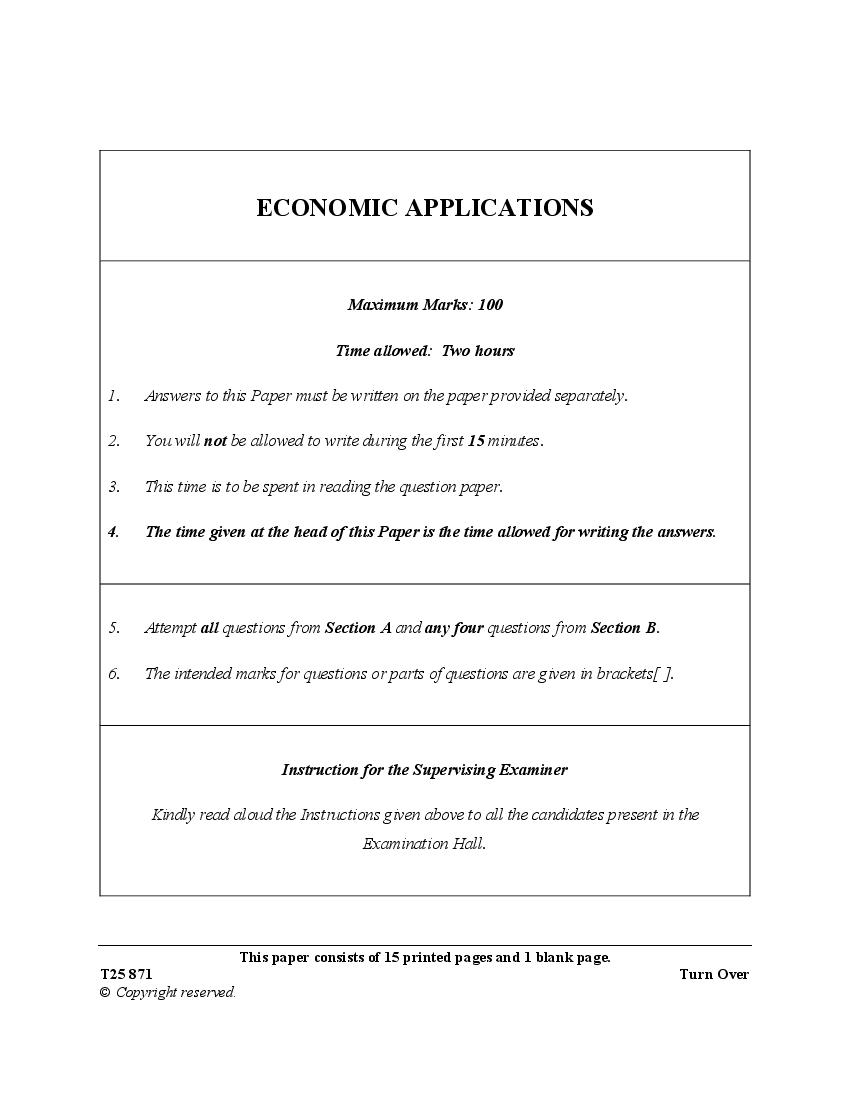
Maximum Marks: 100
Time allowed: Two hours
1. Answers to this Paper must be written on the paper provided separately.
2. You will not be allowed to write during the first 15 minutes.
3. This time is to be spent in reading the question paper.
4. The time given at the head of this Paper is the time allowed for writing the answers.
5. Attempt all questions from Section A and any four questions from Section B.
6. The intended marks for questions or parts of questions are given in brackets[ ].
Instruction for the Supervising Examiner
Kindly read aloud the Instructions given above to all the candidates present in the
Examination Hall.
This paper consists of 15 printed pages and 1 blank page.
T25 871 Turn Over
© Copyright reserved.
Page 2
(Attempt all questions from this Section.)
Question 1 [20]
Choose the correct answers to the questions from the given options.
(Do not copy the questions, write the correct answers only.)
(i) Assertion (A): Festivals have a major economic impact on local and regional
economies by increasing business activity specially in areas
such as retail, tourism and entertainment.
Reason (R): Festivals stimulate increased consumer spending in sectors like
retail, hospitality and transportation, thereby boosting local
business and creating job opportunities.
(a) (A) is true and (R) is false.
(b) (A) is false and (R) is true.
(c) Both (A) and (R) are true and (R) is the correct explanation of (A).
(d) Both (A) and (R) are true and (R) is not the correct explanation of (A).
(ii) An inferior good for which demand falls with a fall in price is called:
(a) Normal good
(b) Giffen good
(c) Complementary good
(d) Substitute good
T25 871 2
Page 3
(a) as complementary goods
(b) as inferior goods
(c) as substitute goods
(d) as unrelated goods
(iv) Observe the image given below and identify the Division of labour:
(a) Horizontal Division of labour
(b) Simple Division of labour
(c) Vertical Division of labour
(d) Partial Division of labour
T25 871 3 Turn Over
Page 4
of a country is known as:
(a) Migration
(b) Urbanisation
(c) Industrialisation
(d) Civilisation
(vi) Match the following:
1. Prices offered by the fashion P. Perfectly Competitive Market
industry depend on the services
provided for their uniqueness.
2. Central Government is the sole Q. Monopoly Market
buyer of defense equipment.
3. Concession in Railway Tickets R. Monopolistically Competitive
for senior citizens as compared Market
to normal passengers.
4. The sellers have to quote the S. Monopsony Market
market price which usually
remains uniform.
(a) 1-S, 2-Q, 3-P, 4-R
(b) 1-Q, 2-R, 3-S, 4-P
(c) 1-R, 2-P, 3-Q, 4-S
(d) 1-R, 2-S, 3-Q, 4-P
T25 871 4
Page 5
any country is important.
(a) Money
(b) Real
(c) Fixed
(d) Sunk
(viii) As a result of a 5% increase in price, the demand for commodity X increases by
12%. The price elasticity of demand (ed) for the commodity will be:
(a) ed < 1
(b) ed > 1
(c) ed = 1
(d) ed = ∞
(ix) Name the function of an entrepreneur as shown in the picture given below.
(a) Innovation
(b) Planning
(c) Delegation
(d) Risk bearing
T25 871 5 Turn Over
Page 6
that area. This reduces productivity of land. How will this affect the supply curve
of rice of that region?
(a) Downward movement along the supply curve
(b) Supply curve shifts to the leftward side
(c) Upward movement along the supply curve
(d) Supply curve shifts to the rightward side
(xi) Assertion (A): Indirect taxes can be made progressive.
Reason (R): More excise duty imposed on producing luxury items and
exempting taxes on necessary items.
(a) (A) is true and (R) is false.
(b) (A) is false and (R) is true.
(c) Both (A) and (R) are true and (R) is the correct explanation of (A).
(d) Both (A) and (R) are true and (R) is not the correct explanation of (A).
(xii) Which of the following is an impact of a decrease in Cash Reserve Ratio on
loanable funds?
(a) Loanable funds will increase
(b) Loanable funds will decrease
(c) Loanable funds remain unchanged
(d) Banks will impose restrictions on loans
T25 871 6
Page 7
(a) Tata Industrial Group
(b) Steel Authority of India
(c) Hindustan Unilever
(d) Bharti Airtel
(xiv) Assertion (A): The policy of converting public ownership of an asset to private
ownership is Privatisation.
Reason (R): There is no sale of shares of Public Sector Undertaking.
(a) (A) is true and (R) is false.
(b) (A) is false and (R) is true.
(c) Both (A) and (R) are true and (R) is the correct explanation of (A).
(d) Both (A) and (R) are true and (R) is not the correct explanation of (A).
(xv) Mr. Krishnan purchases 1 litre of milk per day when it is priced at ₹35 per litre.
On arrival of his guests, he purchases 8 litres of milk. Choose the correct impact
on demand:
(a) Increase in demand
(b) Increase in quantity demanded
(c) Decrease in demand
(d) Decrease in quantity demanded
T25 871 7 Turn Over
Page 8
(a) there are many sellers.
(b) all goods are close substitutes.
(c) all goods are differentiated.
(d) there is only one seller.
(xvii) Observe the relationship of the first pair of words and complete the second pair.
2 – 3% per annum is Creeping Inflation, 10 – 20% per annum is __________.
(a) Walking Inflation
(b) Running Inflation
(c) Hyper Inflation
(d) Galloping Inflation
(xviii) Any medium of exchange, enforced by law is known as:
(a) Legal Tender Money
(b) Credit Money
(c) Fiduciary Money
(d) Full bodied Money
T25 871 8
Page 9
(a) Demand
(b) Supply
(c) Want
(d) Price
(xx) Name an instrument of state intervention.
(a) Monetary Policy
(b) Agricultural Policy
(c) Industrial Policy
(d) Trade Policy
Question 2
(i) Calculate elasticity of demand on the basis of the following data: [2]
Price (Rs.) Quantity (kg)
6 10
4 15
(ii) ‘Land is heterogeneous in nature.’ Explain. [2]
T25 871 9 Turn Over
Page 10
the effect of technical advancement on the supply curve.
(iv) ‘The Indian Railways said that there is no proposal yet to restore concessions [2]
offered to certain categories of people in ticket fares after the facility was stopped
due to Coronavirus Pandemic.’
— Economic Times, August 06, 2021
(a) The Indian Railways is an example of which form of market?
(b) State the feature of market highlighted in the above extract.
(v) Prepare a hypothetical individual demand schedule. [2]
Question 3
(i) State any two differences between land and labour. [2]
(ii) How do commercial banks utilise their surplus fund? [2]
(iii) What is meant by Capital Formation? [2]
(iv) State any two merits of direct taxes. [2]
(v) Mention any two adverse impacts of construction of dwelling units on the [2]
ecosystem.
T25 871 10
Page 11
(Answer any four questions from this Section.)
Question 4
(i) (a) Who is an entrepreneur? [7]
(b) Explain any three roles of an entrepreneur as a factor of production in
ensuring economic development.
(ii) (a) State the Law of Supply. [8]
(b) Complete the following market supply schedule and give a graphical
representation of the same.
Market Supply Schedule of Firm A and B
Price per unit Quantity supplied (kgs) by Market Supply
(₹) Firm A Firm B (kgs)
5 3 5 ?
6 6 9 ?
7 8 12 ?
8 9 14 ?
(c) State one point of difference between stock and supply.
Question 5
(i) (a) What is Elasticity of Supply? [7]
(b) Explain graphically the following:
1. Relatively Elastic Supply
2. Unitary Elastic Supply
3. Perfectly Elastic Supply
T25 871 11 Turn Over
Page 12
(a) State the concept depicted in the image above. Define the market to which
it belongs.
(b) Explain briefly the concept identified by you in (a) above.
Question 6
(i) (a) Which of the following is not associated with Fiscal policy? [7]
1. Public revenue
2. Public expenditure
3. Public debt
4. Open market operations
(b) “Public Sector Units made a commendable contribution to the Indian
economy in the early phase of planned development.” In this context
explain briefly any three contributions of PSUs to the Indian economy.
(ii) Distinguish between Contraction of Demand and Decrease in Demand. [8]
T25 871 12
Page 13
(i) [7]
(a) Which type of tax is indicated in the above graph?
(b) State any three points of distinction between Progressive Taxation and
Degressive Taxation.
(ii) Read the extract and answer the questions that follow: [8]
India and Taiwan are reportedly close to finalising a deal for the far eastern
country to host as many as one lakh Indian workers. This comes close on the
heels of another reported move that Israel is considering bringing in a large
number of Indian workers too.
Source: Moneycontrol.com, November 13, 2023
(a) Which characteristic of labour has been highlighted through the above news
report?
(b) What is meant by Efficiency of Labour?
(c) Explain any two advantages of division of labour.
T25 871 13 Turn Over
Page 14
(i) (a) State any one difference between Savings Account and Current Account. [7]
(b) State how money acts as:
1. Medium of Exchange
2. Transfer of Value
3. Maximisation of Utility
(ii) (a) What is meant by ‘land use pattern’? [8]
(b) Identify the agricultural practice shown in the image given below. Explain
any three adverse effects of it on ecosystem.
T25 871 14
Page 15
(i) Read the extract given below and answer the questions: [7]
The objective of the Reserve Bank of India Occasional Papers is to publish high
quality research produced by the staff of the Reserve Bank of India on a broad
array of issues of interest to a large audience including academics and policy
makers. The papers selected for publications are subject to intense review by
internal and external referees.
— Reserve Bank of India, 2003
(a) State the type of Credit control method described in the above extract.
(b) Define Central Bank.
(c) Why is Central Bank referred to as a Banker’s Bank?
(d) State any one difference between the Central Bank and Commercial Bank.
(ii) (a) What is meant by Qualitative Method of Credit Control? [8]
(b) State any two differences between Quantitative and Qualitative Credit
Control Policy.
(c) Explain the following credit control instruments:
1. Regulation of margin requirements
2. Credit Rationing
T25 871 15
Document Details
| Board / Org | CISCE |
| Exam | Class 10 |
| Type | Question Paper |
| Pages | 15 |
| Updated | 24 Sep 2026 |