CBSE Class 12 Applied Physics Question Paper 2020
Finished viewing? Save it for later —
Download CBSE Class 12 Applied Physics Question Paper 2020 (PDF · 5 pages)About CBSE Class 12 Applied Physics Question Paper 2020
CBSE Class 12 Applied Physics Question Paper 2020 is available here for free download. Published by CBSE for Class 12, this question paper can be viewed online or downloaded as a PDF (5 pages). Candidates preparing for Class 12 can use CBSE Class 12 Applied Physics Question Paper 2020 to understand the exam pattern, the type of questions asked, and the overall difficulty level.
Frequently Asked Questions
How can I download CBSE Class 12 Applied Physics Question Paper 2020?
Open this page and click the Download button to save CBSE Class 12 Applied Physics Question Paper 2020 as a PDF. It is completely free on AglaSem Docs.
Is CBSE Class 12 Applied Physics Question Paper 2020 free to download?
Yes. CBSE Class 12 Applied Physics Question Paper 2020 can be viewed online and downloaded as a PDF free of cost on AglaSem Docs.
How many pages does CBSE Class 12 Applied Physics Question Paper 2020 have?
CBSE Class 12 Applied Physics Question Paper 2020 contains 5 pages, which you can read online or download together as a single PDF.
Where can I find more Class 12 study material?
You can find more Class 12 question papers, sample papers, syllabus, and answer keys on AglaSem Docs.
CBSE Class 12 Applied Physics Question Paper 2020 – Text
Read the full text of this question paper below — useful to quickly search, copy and reference the content online without downloading the PDF.
📄 View text version (5 pages)
Page 1
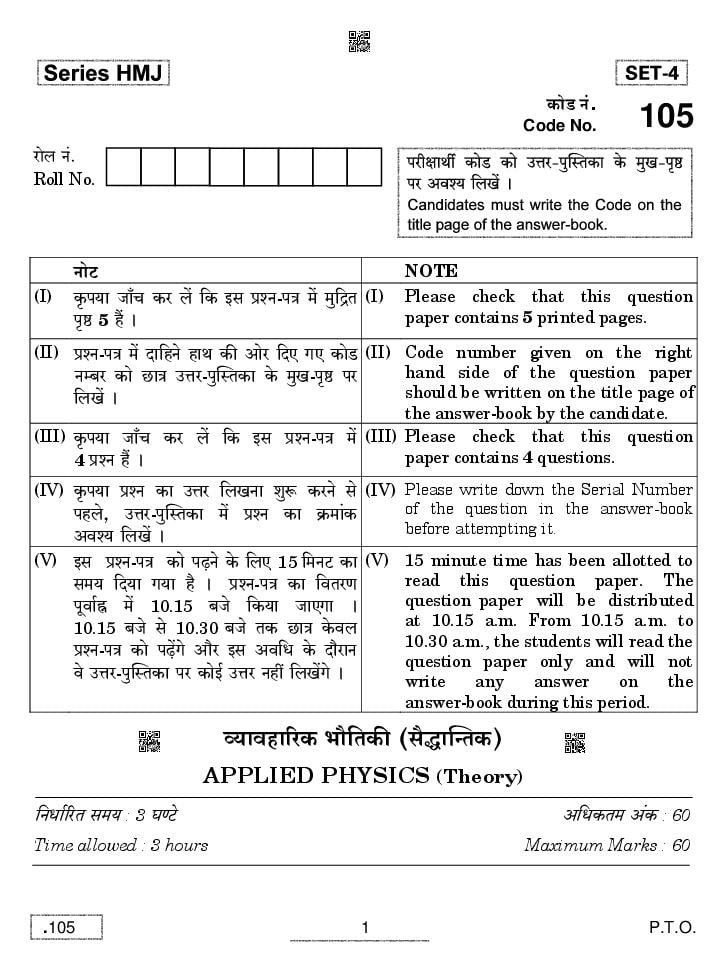
Code No. 105
amob Z§.
Roll No.
ZmoQ> NOTE
(I) H¥$n`m Om±M H$a b| {H$ Bg àíZ-nÌ _o§ _w{ÐV (I) Please check that this question
n¥ð> 5 h¢ & paper contains 5 printed pages.
(II) àíZ-nÌ _| Xm{hZo hmW H$s Amoa {XE JE H$moS (II) Code number given on the right
>Zå~a H$mo N>mÌ CÎma-nwpñVH$m Ho$ _wI-n¥ð> na hand side of the question paper
{bI| & should be written on the title page of
the answer-book by the candidate.
(III) H¥$n`m Om±M H$a b| {H$ Bg àíZ-nÌ _| (III) Please check that this question
>4 àíZ h¢ & paper contains 4 questions.
(IV) H¥$n`m àíZ H$m CÎma {bIZm ewê$ H$aZo go (IV) Please write down the Serial Number
nhbo, CÎma-nwpñVH$m _| àíZ H$m H«$_m§H$ of the question in the answer-book
before attempting it.
Adí` {bI| &
(V) Bg àíZ-nÌ H$mo n‹T>Zo Ho$ {bE 15 {_ZQ >H$m (V) 15 minute time has been allotted to
g_` {X`m J`m h¡ & àíZ-nÌ H$m {dVaU read this question paper. The
nydm©• _| 10.15 ~Oo {H$`m OmEJm & question paper will be distributed
10.15 ~Oo go 10.30 ~Oo VH$ N>mÌ Ho$db at 10.15 a.m. From 10.15 a.m. to
10.30 a.m., the students will read the
àíZ-nÌ H$mo n‹T>|Jo Am¡a Bg Ad{Y Ho$ Xm¡amZ question paper only and will not
do CÎma-nwpñVH$m na H$moB© CÎma Zht {bI|Jo & write any answer on the
answer-book during this period.
ì`mdhm[aH$ ^m¡{VH$s (g¡ÕmpÝVH$)
APPLIED PHYSICS (Theory)
{ZYm©[aV g_` : 3 KÊQ>o A{YH$V_ A§H$ : 60
Time allowed : 3 hours Maximum Marks : 60
.105 1 P.T.O.
Page 2
1. (a) {dÚwV²-joÌ H$s Vrd«Vm H$mo n[a^m{fV H$s{OE & BgH$m Eg.AmB©. _mÌH$ {b{IE &
EH$ {~ÝXþ Amdoe Ho$ H$maU CËnÞ {dÚwV²-joÌ H$s Vrd«Vm H$m gyÌ {b{IE & EH$
50 C Ho$ Amdoe go 50 go_r Xÿar na {dÚwV²-joÌ H$s Vrd«Vm H$s JUZm H$s{OE & 5
(b) g§Ym[aÌ Š`m hmoVm h¡ ? EH$ g§Ym[aÌ _| g§{MV D$Om© Ho$ {bE gyÌ ì`wËnÞ H$s{OE & 5
AWdm
VrZ g§Ym[aÌm| H$mo loUr~Õ H«$_ _| bJmZo H$mo Xem©Zo Ho$ {bE EH$ {MÌ ~ZmBE & O~
VrZ g§Ym[aÌm| H$mo loUr~Õ _| Omo‹S>m OmVm h¡, Vmo CZH$s ewÕ Ym[aVm Ho$ {bE gyÌ
{b{IE & 2 F, 3 F d 6 F Ho$ VrZ g§Ym[aÌm| H$mo loUr~Õ H«$_ _| Omo‹S>m J`m
h¡ & ewÕ Ym[aVm kmV H$s{OE & 5
(c) Jm°g à_o` H$mo n[a^m{fV H$s{OE & Bg à_o` H$m à`moJ EH$ ImoIbo Amdo{eV
MmbH$ Ho$ AÝXa {dÚwV²-joÌ H$s Vrd«Vm kmV H$aZo Ho$ {bE H$s{OE & 5
2. (a) Mwå~H$s` joÌ H$mo n[a^m{fV H$s{OE & Mwå~H$s` joÌ H$s Vrd«Vm H$m Eg.AmB©.
_mÌH$ {b{IE & EH$ grYo Ymamdmhr MmbH$ Ho$ H$maU CËnÞ hmoZo dmbr Mwå~H$s`
joÌ H$s Vrd«Vm Ho$ {bE gyÌ {b{IE & MmbH$ H$s gVh na Mwå~H$s` joÌ H$m _mZ
Š`m hmoJm ? 5
(b) Mwå~H$s` joÌ _| J{V_mZ EH$ Amdoe na bJZo dmbm ~b {H$Z-{H$Z H$maUm| go
à^m{dV hmoVm h¡ ? ~b Ho$ {bE gyÌ {b{IE & CZ n[apñW{V`m| H$mo {b{IE O~
Amdoe na (i) A{YH$V_, Am¡a (ii) Ý`yZV_ ~b bJVm h¡ & 5
AWdm
Mwå~H$s` A{^dmh KZËd d Mwå~H$erbVm nXm| H$mo n[a^m{fV H$s{OE & BZH$m
Eg.AmB©. _mÌH$ {b{IE & Cg nXmW© H$m Zm_ {b{IE {OgH$s Mwå~H$erbVm
A{YH$ hmo & 5
(c) EH$ Ymamdmhr d¥ÎmmH$ma Hw$ÊS>br Ho$ Ho$ÝÐ na Mwå~H$s` joÌ H$s Vrd«Vm Ho$ {bE
ì`§OH$ ì`wËnÞ H$s{OE & 5
.105 2
Page 3
1. (a) Define electric field intensity. Give its SI unit. Write the formula
for electric field intensity due to a point charge. Calculate the
electric field intensity at a distance of 50 cm from a charge of
50 C. 5
(b) What is a capacitor ? Derive a formula for the energy stored in a
capacitor. 5
OR
Draw a figure showing the combination of three capacitors in
series. Write the formula for the net capacitance when three
capacitors are connected in series. Three capacitors of 2 F, 3 F
and 6 F are connected in series. Find the net capacitance. 5
(c) Define Gauss theorem. Apply this theorem to find the electric field
intensity inside a hollow charged conductor. 5
2. (a) Define magnetic field. Write the SI unit of magnetic field intensity.
Write the formula for the magnetic field intensity due to a straight
current-carrying conductor. What is the value of the magnetic field
at the surface of the conductor ? 5
(b) What are the factors that affect the force on a charge moving in a
magnetic field ? Write the formula for the force. State the cases
when the charge will experience (i) maximum, and (ii) minimum
force. 5
OR
Define the terms Magnetic flux density and Permeability. Write
their SI units. Write the name of a substance having large
permeability. 5
(c) Derive an expression for the magnetic field intensity at the centre
of a current-carrying circular coil. 5
.105 3 P.T.O.
Page 4
{b{IE & 5
(b) ao{S>`mo g_ñWm{ZH$ Š`m hmoVo h¢ ? Xmo ao{S>`mo g_ñWm{ZH$m| Ho$ Zm_ {b{IE d àË`oH$
H$m EH$-EH$ Cn`moJ {b{IE & 5
AWdm
{d{H$aU ˜Vao Š`m hmoVo h¢ ? Xmo {d{H$aU ˜Vam| Ho$ Zm_ {b{IE & {d{H$aU ˜Vam| go
h_ IwX H$mo H¡$go ~Mm gH$Vo h¢ ? 5
(c) Zm{^H$s` [aEoŠQ>a Ho$ {gÕmÝV, aMZm d H$m`©àUmbr H$mo g_PmBE & 5
4. (a) AY©MmbH$ Š`m hmoVo h¢ ? Ge d Si H$s AmpÊdH$ g§aMZm Xr{OE & AY©MmbH$m| H$s
MmbH$Vm Vmn_mZ ~‹T>Zo na {H$g àH$ma à^m{dV hmoVr h¡ ? 5
(b) p-n O§ŠeZ H$m àVrH$-{M• ~ZmBE & AJ«{X{eH$ ~m`g _| p-n O§ŠeZ H$m
{dÚwV²-n[anW ~ZmBE & AJ«{X{eH$ ~m`g _| p-n O§ŠeZ H$s H$m`©àUmbr
g_PmBE & 5
AWdm
{Xï>H$mar Š`m hmoVm h¡ ? nyU©Va§J {Xï>H$mar Ho$ ê$n _| p-n O§ŠeZ H$s H$m`©àUmbr
g_PmBE & 5
(c) n-p-n Q´>m§{µOñQ>a H$m àVrH$-{M• ~ZmBE & C{MV ~m`qgJ H$m à`moJ H$aVo hþE
n-p-n Q´>m§{µOñQ>a H$m {dÚwV²-n[anW ~ZmBE d Q´>m§{µOñQ>a {H«$`m (n-p-n Q´>m§{µOñQ>a H$s)
H$s ì`m»`m H$s{OE & 5
.105 4
Page 5
between them. 5
(b) What are radio-isotopes ? Write the name of two radio-iostopes and
write one use of each. 5
OR
What are radiation hazards ? Name two radiation hazards. How
can we protect ourselves from radiation hazards ? 5
(c) Explain the principle, construction and working of a nuclear
reactor. 5
4. (a) What are semiconductors ? Give the atomic structure of Ge and Si.
How is the conductivity of semiconductors affected by rise in
temperature ? 5
(b) Draw the symbol of p-n junction. Draw a circuit diagram of
p-n junction in forward biasing. Explain the working of a p-n
junction in forward biasing. 5
OR
What is a rectifier ? Explain the working of a p-n junction as a
full-wave rectifier. 5
(c) Draw a symbol of an n-p-n transistor. Draw a circuit diagram of
n-p-n transistor with proper biasing and explain transistor action. 5
.105 5 P.T.O.
Document Details
| Board / Org | CBSE |
| Exam | Class 12 |
| Type | Question Paper |
| Pages | 5 |
| Updated | 22 Jul 2026 |