NCERT Solutions Class 8 Maths Chapter 6 We Distribute Yet Things Multiply
Finished viewing? Save it for later —
Download NCERT Solutions Class 8 Maths Chapter 6 We Distribute Yet Things Multiply (PDF · 97 pages)About NCERT Solutions Class 8 Maths Chapter 6 We Distribute Yet Things Multiply
NCERT Solutions Class 8 Maths Chapter 6 We Distribute Yet Things Multiply is available here for free download. Published by NCERT for Class 8, this solution can be viewed online or downloaded as a PDF (97 pages). Candidates preparing for Class 8 can use NCERT Solutions Class 8 Maths Chapter 6 We Distribute Yet Things Multiply to understand the exam pattern, the type of questions asked, and the overall difficulty level.
Frequently Asked Questions
How can I download NCERT Solutions Class 8 Maths Chapter 6 We Distribute Yet Things Multiply?
Open this page and click the Download button to save NCERT Solutions Class 8 Maths Chapter 6 We Distribute Yet Things Multiply as a PDF. It is completely free on AglaSem Docs.
Is NCERT Solutions Class 8 Maths Chapter 6 We Distribute Yet Things Multiply free to download?
Yes. NCERT Solutions Class 8 Maths Chapter 6 We Distribute Yet Things Multiply can be viewed online and downloaded as a PDF free of cost on AglaSem Docs.
How many pages does NCERT Solutions Class 8 Maths Chapter 6 We Distribute Yet Things Multiply have?
NCERT Solutions Class 8 Maths Chapter 6 We Distribute Yet Things Multiply contains 97 pages, which you can read online or download together as a single PDF.
Where can I find more Class 8 study material?
You can find more Class 8 question papers, sample papers, syllabus, and answer keys on AglaSem Docs.
NCERT Solutions Class 8 Maths Chapter 6 We Distribute Yet Things Multiply – Text
Read the full text of this solution below — useful to quickly search, copy and reference the content online without downloading the PDF.
📄 View text version (60 pages)
Page 1
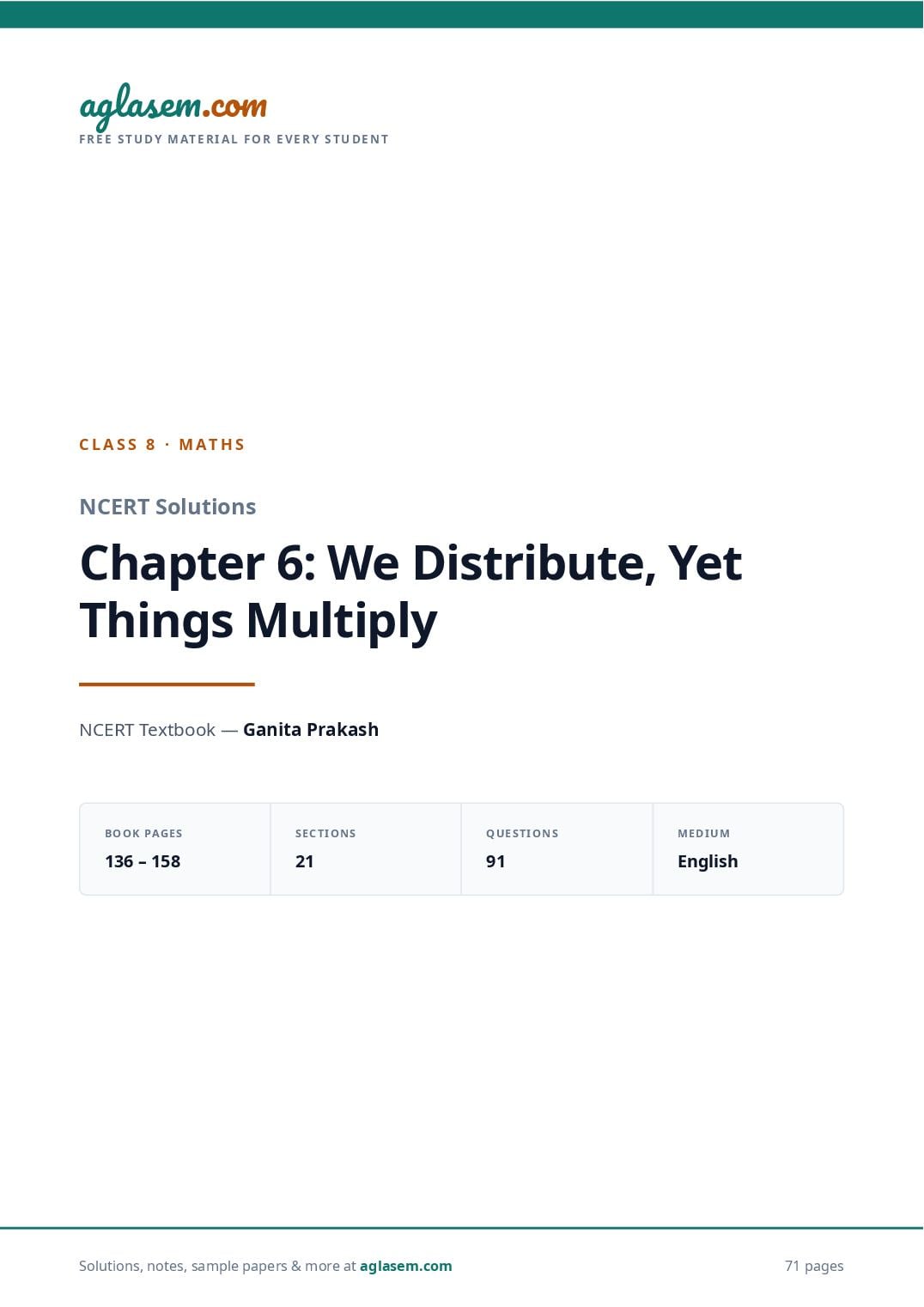
C L A S S 8 · M AT H S
NCERT Solutions
Chapter 6: We Distribute, Yet
Things Multiply
NCERT Textbook — Ganita Prakash
BOOK PAGES SECTIONS QUESTIONS MEDIUM
136 – 158 21 91 English
Solutions, notes, sample papers & more at 82 pages
Page 2
CLASS 8 · MATHS · GANITA PRAKASH
NCERT Solutions — Chapter 6: We Distribute, Yet
Things Multiply
Chapter 6 of Ganita Prakash Grade 8 (Part I) takes one property — distributivity, a(b + c) = ab + ac — and
squeezes an entire chapter out of it: how a product changes when its factors move, the three squaring
identities, quick ways to multiply by 11 and 101, and several number patterns that turn out to be the same
identity in disguise.
TEXTBOOK BOOK PAGES
Ganita Prakash (Class 8) 136 – 158
SECTIONS QUESTIONS
21 91
MEDIUM
English
In-text Questions — Page 136
6.1 Some Properties of Multiplication — Increments in Products
Q1 By how much does the product increase if the first number (23) is increased by 1?
The product increases by 27, the second number.
23 × 27 = 621
24 × 27 = 648
Increase = 648 – 621 = 27
Distributivity says the same thing without any multiplying:
(23 + 1) × 27 = 23 × 27 + 1 × 27
= 23 × 27 + 27
Page 1 of 82
Page 3
Why it happens: 24 × 27 means twenty-four 27s. Twenty-three of them make 23 ×
27; the twenty-fourth is one extra 27. Adding 1 to the first factor adds one more copy
of the second factor.
Q2 What if the second number (27) is increased by 1?
Then the product increases by 23, the first number.
23 (27 + 1) = 23 × 27 + 23 × 1
= 621 + 23 = 644
Check: 23 × 28 = 644 ✓
Why it happens: this is the identity a (b + c) = ab + ac with a = 23, b = 27, c = 1.
Twenty-three rows of 28 dots is twenty-three rows of 27 dots with one extra dot in
every row — that is 23 extra dots.
Q3 How about when both numbers are increased by 1?
The product increases by 27 + 23 + 1 = 51.
(23 + 1)(27 + 1) = (23 + 1) 27 + (23 + 1) 1
= 23 × 27 + 27 + 23 + 1
= 621 + 51 = 672
Check: 24 × 28 = 672 ✓
Why it happens: raising the first factor adds a whole extra row (27 dots), raising the
second adds a whole extra column (23 dots), and the single corner dot where the
new row meets the new column gets counted once more — that is the “+ 1”.
Page 2 of 82
Page 4
Q4 Do you see a pattern that could help generalise our observations to the product of
any two numbers?
Yes. Write the two numbers as a and b. Then
a (b + 1) = ab + a
(a + 1) b = ab + b
(a + 1)(b + 1) = ab + a + b + 1
Putting 23 for a and 27 for b gives exactly the three increases above: 23, 27 and 51.
Tip: the general statement is worth more than the three answers, because it works
for every pair of numbers at once — including negative ones. Later in the chapter it
grows into Identity 1: (a + m)(b + n) = ab + mb + an + mn.
In-text Questions — Page 138
6.1 Some Properties of Multiplication
Q1 How do we expand this? [(a + 1) (b + 1)]
Treat the whole bracket (a + 1) as a single term and distribute the second bracket over it.
(a + 1)(b + 1) = (a + 1) b + (a + 1) 1
= (ab + b) + (a + 1)
= ab + a + b + 1
So the increase in the product ab is a + b + 1.
Why it happens: distributivity does not care what the “single number” a stands for
— it can itself be a bracket. Using it once splits the second bracket, using it again
splits the first, and every term of one bracket has then met every term of the other.
Page 3 of 82
Page 5
Class 8 Maths Chapter 6 We Distribute, Yet Things Multiply
a g l AglaSem · NCERT Solutions
co m
m.
What would we get if we had expanded (a + 1) (b + 1) by first taking (b + 1) as a
e
Q2
m l as
.co
single term? Try it?
a g
se m
g l a
a
The same answer — which is the point of trying it.
com
e m . ag
as
(a + 1)(b + 1) = a (b + 1) + 1 (b + 1)
= (ab + a) + (b + 1) a g l
m
= ab + a + b + 1
co
em.
m l as
.co g
Test at a = 5, b = 4: LHS = 6 × 5 = 30, RHS = 20 + 5 + 4 + 1 = 30 ✓
em a
a s
a gl Why it happens: multiplication is commutative, so (a + 1)(b + 1) and (b + 1)(a + 1) are
the same product. Whichever bracket you break up first, you end up adding the four
m a s
.co agl
products a×b, a×1, 1×b and 1×1.
se m
g l a
a
Q3 What happens when one of the numbers in a product is increased by 1 and the
co m
.
other is decreased by 1? Will there be any change in the product?
e m
m l as
.co a g
em is a change, and it is b – a – 1.
a s
gl
There
a
se m
(a + 1)(b – 1) = (a + 1) b – (a + 1) 1
com g l a
m . a
ase
= ab + b – a – 1
agl
With a = 23, b = 27:
co m
m .
m as e
.=co621 + 3 = 624 ✓ l
24 × 26 = 23 × 27 + 27 – 23 – 1
a g
se m
g l a
a c
m .
m
Why it happens: the change is b – a – 1, not zero. So the product goes up when b is
a s e
m . co
bigger than a by at least 2, stays the same when b = a + 1, and goes down when b ≤
e agl
l as
a. Adding 1 to a factor and taking 1 off the other is not a fair swap.
g
a
co m
m .
m ase
.co
a g l Page 4 of 82
Page 6
Check it yourself: 9 × 11 = 99 but 10 × 10 = 100; here a = 9, b = 11, so the change is
11 – 9 – 1 = +1.
Q4 Will the product always increase? Find 3 examples where the product decreases.
No. The change is b – a – 1, so the product decreases whenever b ≤ a.
A, B AB (A + 1)(B – 1) CHANGE B – A – 1
a = 5, b = 3 15 6 × 2 = 12 3 – 5 – 1 = –3
a = 7, b = 7 49 8 × 6 = 48 7 – 7 – 1 = –1
a = 10, b = 3 30 11 × 2 = 22 3 – 10 – 1 = –8
Why it happens: you gain a whole column of b dots but lose a whole row of a dots,
and the corner dot is lost as well. When the row you lose is at least as long as the
column you gain, the total falls.
Q5 What happens when a and b are negative integers? Check by substituting different
values for a and b in each of the above cases. For example, a = –5, b = 8; a = –4, b = –5;
etc.
Nothing changes — the expressions stay correct, because integers also obey distributivity: x (y +
z) = xy + xz for any integers x, y, z.
A, B AB (A + 1)(B + 1) AB + A + B + 1
–5, 8 –40 –4 × 9 = –36 –40 – 5 + 8 + 1 = –36 ✓
–4, –5 20 –3 × –4 = 12 20 – 4 – 5 + 1 = 12 ✓
And for (a + 1)(b – 1) = ab + b – a – 1 with a = –5, b = 8: –4 × 7 = –28, while –40 + 8 + 5 – 1 = –28 ✓
Page 5 of 82
Page 7
Why it happens: an identity is a statement about expressions, not about counting
dots. Once the letter-numbers are allowed to be any integers, the dot picture is only
a memory aid — the guarantee comes from distributivity, which integers satisfy.
Tip: notice that with a = –5, b = 8 the “increase” a + b + 1 = 4 is positive, but with a = –
4, b = –5 it is –8. The word increase is just a name for the change; the change can be
negative.
In-text Questions — Page 139
6.1 Some Properties of Multiplication — Identity 1
Q1 By how much will the product of two numbers change if one of the numbers is
increased by m and the other by n?
The two numbers become a + m and b + n, and the product changes by an + bm + mn.
(a + m)(b + n) = (a + m) b + (a + m) n
= ab + mb + an + mn
Identity 1: (a + m)(b + n) = ab + mb + an + mn
Subtracting the old product ab leaves the change: an + bm + mn.
Page 6 of 82
Page 8
b columns n columns
rows ab an
rows mb mn
An (a + m) by (b + n) array of dots splits into four blocks. Their counts ab, an, mb, mn are the four
terms of Identity 1.
Why it happens: the product is the sum of the product of each term of (a + m) with
each term of (b + n). That is all “expanding a bracket” ever means, and it is just
distributivity used twice.
In-text Questions — Page 140
6.1 Some Properties of Multiplication — Using Identity 1
Q1 Can you see how this identity can be used when one or both numbers are
decreased?
Yes — a decrease is an increase by a negative number, so no new identity is needed.
Page 7 of 82
Page 9
(a + 1)(b – 1) = (a + 1)(b + (–1))
Take m = 1, n = –1 in Identity 1:
ab + (1) × b + a × (–1) + (1) × (–1)
= ab + b – a – 1
This is exactly the expression found earlier by direct expansion.
Why it happens: the rules for multiplying integers (positive × negative = negative,
negative × negative = positive) put the right sign on every one of the four terms
automatically. So one identity covers four cases: both up, both down, and either one
up with the other down.
Q2 Use Identity 1 to find how the product changes when (i) one number is decreased by
2 and the other increased by 3; (ii) both numbers are decreased, one by 3 and the
other by 4. Verify the answers by finding the products without converting the
subtractions to additions.
(i) Take m = –2, n = 3.
(a – 2)(b + 3) = ab + (–2)b + 3a + (–2)(3)
= ab + 3a – 2b – 6
Direct check, keeping the subtraction: (a – 2)(b + 3) = a(b + 3) – 2(b + 3) = ab + 3a – 2b – 6 ✓
(ii) Take m = –3, n = –4.
(a – 3)(b – 4) = ab + (–3)b + (–4)a + (–3)(–4)
= ab – 4a – 3b + 12
Direct check: (a – 3)(b – 4) = a(b – 4) – 3(b – 4) = ab – 4a – 3b + 12 ✓
Check it yourself: put a = 10, b = 10. (i) 8 × 13 = 104 and 100 + 30 – 20 – 6 = 104. (ii) 7
× 6 = 42 and 100 – 40 – 30 + 12 = 42.
Page 8 of 82
Page 10
Class 8 Maths Chapter 6 We Distribute, Yet Things Multiply
a g l AglaSem · NCERT Solutions
co m
m.
Expand (i) (a – u) (b + v), (ii) (a – u) (b – v).
e
Q3
m l as
.co a g
a
s em
a gl each term of the first bracket by each term of the second, letting the sign rules do the
Multiply
work.
co m
em
. ag
a s
(i) (a – u)(b + v) = a·b + a·v + (–u)·b + (–u)·v
= ab – ub + av – uv agl
co m
em.
m l as
.co
(ii) (a – u)(b – v) = a·b + a·(–v) + (–u)·b + (–u)(–v)
a g
se m
= ab – ub – av + uv
g l a
a
Test (ii) at a = 7, u = 2, b = 9, v = 3: LHS = 5 × 6 = 30; RHS = 63 – 18 – 21 + 6 = 30 ✓
om a s
e
. c
maway” pieces, ub and av, overlap in the corner agl
s
Why it happens: in (ii) both “taken
a
a islremoved twice. Adding + uv back puts it in once — the
rectangle uv, so that corner g
same bookkeeping that will later give (a – b)² = a² – 2ab + b².
co m
m .
as e
om
Q4 .cExample 1: Expand 3a⁄2 (a – b + 1⁄5). a g l
a s em
l
ag ANSWER
se m
com
Distributivity is not limited to two terms inside a bracket — every term gets multiplied.
g l a
m . a
ase
agl
3a⁄2 (a – b + 1⁄5) = (3a⁄2 × a) – (3a⁄2 × b) + (3a⁄2 × 1⁄5)
co m
Now simplify each term using exponent notation:
m .
as e
com× a = 3⁄2 × (a × a) = 3⁄2 a²
.3a⁄2 a g l
se m
g l a
a 3a⁄2 × b = 3⁄2 × (a × b) = 3⁄2 ab
c
m .
3a⁄2 × 1⁄5 = (3⁄2 × 1⁄5) a = 3⁄10 a
m a s e
m . co agl
l a se
3a⁄2 (a – b + 1⁄5) = 3⁄2ag
a² – 3⁄2 ab + 3⁄10 a
co m
m .
m ase
.co
a g l Page 9 of 82
Page 11
Test at a = 2, b = 1: LHS = 3 × (2 – 1 + 0.2) = 3.6; RHS = 6 – 3 + 0.6 = 3.6 ✓
Tip: the three terms have different letter-numbers (a², ab, a), so they are unlike
terms and the expression is already in its simplest form.
In-text Questions — Page 141
6.1 Some Properties of Multiplication — Like Terms
Q1 Can any two terms be added to get a single term? For example, can 3⁄2 a² and 3⁄10 a be
added to get a single term?
No. Two terms can be combined into one only when they are like terms — that is, when they
have exactly the same letter-numbers.
3⁄2 a² has the letter part a × a
3⁄10 a has the letter part a
a × a ≠ a, so they are unlike terms
Test at a = 4: 3⁄2 × 16 = 24 and 3⁄10 × 4 = 1.2, giving 25.2. There is no single number k with k a² =
25.2 or k a = 25.2 for every a — at a = 10 the sum would be 153, not 25.2 scaled.
Why it happens: adding like terms works because of distributivity read backwards:
2ab + 3ab = (2 + 3) ab. You can only pull a common factor out if both terms actually
contain it. a² and a share the factor a, so 3⁄2 a² + 3⁄10 a = a(3⁄2 a + 3⁄10) — but that is a
product of two things, not a single term.
Q2 Example 2: Expand (a + b) (a + b).
(a + b)(a + b) = (a + b) a + (a + b) b
= a × a + b × a + ab + b × b
= a² + ba + ab + b²
Page 10 of 82
Page 12
Since ba = ab, the middle two are like terms:
ba + ab = ab + ab = 2ab
(a + b)(a + b) = a² + 2ab + b²
Test at a = 3, b = 5: LHS = 8 × 8 = 64; RHS = 9 + 30 + 25 = 64 ✓
Why it happens: the four products are a·a, a·b, b·a and b·b. Two of them are the
same because multiplication is commutative — that single fact is the whole reason a
square of a sum has a “2ab” in the middle rather than two separate terms.
Q3 Example 3: Expand (a + b) (a² + 2ab + b²).
(a + b)(a² + 2ab + b²) = (a + b)a² + (a + b) × 2ab + (a + b)b²
= (a × a²) + ba² + (a × 2ab) + (b × 2ab) + ab² + (b × b²)
Simplify each term:
a × a² = a³ (a × a × a)
ba² = a²b
a × 2ab = 2 × a × a × b = 2a²b
b × 2ab = 2 × a × b × b = 2ab²
b × b² = b³
= a³ + a²b + 2a²b + 2ab² + ab² + b³
Now collect the like terms:
Page 11 of 82
Page 13
a²b + 2a²b = (1 + 2) a²b = 3a²b
ab² + 2ab² = (1 + 2) ab² = 3ab²
(a + b)(a² + 2ab + b²) = a³ + 3a²b + 3ab² + b³
Test at a = 2, b = 1: LHS = 3 × (4 + 4 + 1) = 27; RHS = 8 + 12 + 6 + 1 = 27 ✓
Did you know? Since a² + 2ab + b² is itself (a + b)², this shows (a + b)³ = a³ + 3a²b +
3ab² + b³. The coefficients 1, 3, 3, 1 are the next row after 1, 2, 1.
Figure it Out — Page 142
Page 12 of 82
Page 14
6.1 Some Properties of Multiplication
Q1 Observe the multiplication grid below. Each number inside the grid is formed by
multiplying two numbers. If the middle number of a 3 × 3 frame is given by the
expression pq, as shown in the figure, write the expressions for the other numbers
in the grid.
× 1 2 3 4 5 6 7 8 9 10
1 1 2 3 4 5 6 7 8 9 10
2 2 4 6 8 10 12 14 16 18 20
3 3 6 9 12 15 18 21 24 27 30
4 4 8 12 16 20 24 28 32 36 40
5 5 10 15 20 25 30 35 40 45 50
6 6 12 18 24 30 36 42 48 54 60
7 7 14 21 28 35 42 49 56 63 70
8 8 16 24 32 40 48 56 64 72 80
9 9 18 27 36 45 54 63 72 81 90
10 10 20 30 40 50 60 70 80 90 100
The multiplication grid, page 142. The nine framed numbers are the 3 × 3 frame.
3×5 3×6 3×7
4×5 4×6 4×7
5×5 5×6 5×7
pq
Page 13 of 82
Page 15
Class 8 Maths Chapter 6 We Distribute, Yet Things Multiply
a g l AglaSem · NCERT Solutions
The same nine numbers written as products (left), and the blank frame whose middle
co m
em.
number is pq (right).
m l as
m.co a g
l a se
ag
In the frame shown, the middle entry is 4 × 6 = 24, so p is the row number and q is the column
co m
. ag
number of the centre. The row above is p – 1 and the row below is p + 1; the column to the left is
em
as
q – 1 and to the right is q + 1.
a g l
COLUMN Q – 1 COLUMN Q COLUMN Q + 1
co m
m.
ROW P – 1 (p – 1)(q – 1) (p – 1) q (p – 1)(q + 1)
m pa
l se
ROW P
.co ag
p (q – 1) pq (q + 1)
se m
g l a
a
ROW P + 1 (p + 1)(q – 1) (p + 1) q (p + 1)(q + 1)
m a s
agl
Check against the printed frame, where p = 4 and q = 6:
m .co
l a se
g
3 × 5 = 15 3 × 6 = 18 3 × 7 = 21
4 × 5 = 20
a 4 × 6 = 24 4 × 7 = 28
co m
5 × 5 = 25 5 × 6 = 30
m
5 × 7 = 35
.
m as e
.co a g l
s e m it happens: in a multiplication grid the entry in row i and column j is i × j.
Why
agla Moving one step up or down changes only the row factor by 1; moving one step left
or right changes only the column factor by 1. That is why every neighbour of pq is
se m
one of the products in the table.
com g l a
m . a
ase
agl
Try This: expand the two diagonal pairs. Down-diagonal: (p – 1)(q – 1) × (p + 1)(q + 1);
up-diagonal: (p – 1)(q + 1) × (p + 1)(q – 1). Both equal (p² – 1)(q² – 1), so the two
co m
.
diagonal products of the frame are always equal.
e m
m l as
.co a g
a s em
agl Q2 Expand the following products. (i) (3 + u) (v – 3) (ii) 2⁄3 (15 + 6a) (iii) (10a + b) (10c + d)
.c
m
(iv) (3 – x) (x – 6) (v) (–5a + b) (c + d) (vi) (5 + z) (y + 9)
m a s e
e m . co agl
as
a g l
Each term of the first bracket multiplies each term of the second; the integer sign rules fix the
signs.
co m
m .
m ase
.co
a g l Page 14 of 82
Page 16
(i) (3 + u)(v – 3) = 3v – 9 + uv – 3u
= uv + 3v – 3u – 9
(ii) 2⁄3 (15 + 6a) = 2⁄3 × 15 + 2⁄3 × 6a
= 10 + 4a
(iii) (10a + b)(10c + d) = 100ac + 10ad + 10bc + bd
(iv) (3 – x)(x – 6) = 3x – 18 – x² + 6x
= –x² + 9x – 18
(v) (–5a + b)(c + d) = –5ac – 5ad + bc + bd
(vi) (5 + z)(y + 9) = 5y + 45 + yz + 9z
Spot checks: (i) at u = 1, v = 4: 4 × 1 = 4 and 4 + 12 – 3 – 9 = 4 ✓. (iv) at x = 2: 1 × (–4) = –4 and –4 +
18 – 18 = –4 ✓.
Did you know? Part (iii) is the whole of two-digit multiplication. A two-digit number
with digits a, b is 10a + b, so (10a + b)(10c + d) = 100ac + 10(ad + bc) + bd —
hundreds, tens and units of the usual written method.
Q3 Find 3 examples where the product of two numbers remains unchanged when one
of them is increased by 2 and the other is decreased by 4.
Set the change to zero and solve.
Page 15 of 82
Page 17
(a + 2)(b – 4) = ab
ab – 4a + 2b – 8 = ab
2b = 4a + 8
b = 2a + 4
So any pair in which the second number is 4 more than twice the first will work.
A B = 2A + 4 AB (A + 2)(B – 4)
1 6 6 3×2=6 ✓
2 8 16 4 × 4 = 16 ✓
3 10 30 5 × 6 = 30 ✓
Why it happens: raising the first factor by 2 gains 2b, lowering the second by 4 loses
4a, and the corner loses another 8. The product survives only when the gain 2b
exactly pays for the loss 4a + 8.
Q4 Expand (i) (a + ab – 3b²) (4 + b), and (ii) (4y + 7) (y + 11z – 3).
(i) Break up the second bracket:
(a + ab – 3b²)(4 + b) = 4(a + ab – 3b²) + b(a + ab – 3b²)
= 4a + 4ab – 12b² + ab + ab² – 3b³
= 4a + 5ab + ab² – 12b² – 3b³
(4ab and ab are like terms: 4ab + ab = 5ab.)
(ii)
(4y + 7)(y + 11z – 3) = 4y(y + 11z – 3) + 7(y + 11z – 3)
= 4y² + 44yz – 12y + 7y + 77z – 21
= 4y² + 44yz – 5y + 77z – 21
Page 16 of 82
Page 18
(–12y and 7y are like terms: –12y + 7y = –5y.)
Test (ii) at y = 1, z = 1: LHS = 11 × 9 = 99; RHS = 4 + 44 – 5 + 77 – 21 = 99 ✓
Q5 Expand (i) (a – b) (a + b), (ii) (a – b) (a² + ab + b²) and (iii) (a – b)(a³ + a²b + ab² + b³), Do
you see a pattern? What would be the next identity in the pattern that you see? Can
you check it by expanding?
(i) (a – b)(a + b) = a² + ab – ab – b² = a² – b²
(ii) (a – b)(a² + ab + b²)
= a³ + a²b + ab² – a²b – ab² – b³ = a³ – b³
(iii) (a – b)(a³ + a²b + ab² + b³)
= a⁴ + a³b + a²b² + ab³ – a³b – a²b² – ab³ – b⁴ = a⁴ – b⁴
The pattern: multiplying (a – b) by the sum of all products a^i b^j whose degrees add to n – 1
gives an – bn. The next identity is therefore
(a – b)(a⁴ + a³b + a²b² + ab³ + b⁴) = a⁵ – b⁵
Check by expanding:
a(a⁴ + a³b + a²b² + ab³ + b⁴) = a⁵ + a⁴b + a³b² + a²b³ + ab⁴
–b(a⁴ + a³b + a²b² + ab³ + b⁴) = –a⁴b – a³b² – a²b³ – ab⁴ – b⁵
Adding: a⁵ – b⁵ ✓
Numerical test at a = 3, b = 2: LHS = 1 × (81 + 54 + 36 + 24 + 16) = 211; RHS = 243 – 32 = 211 ✓
Page 17 of 82
Page 19
Why it happens: every middle term appears twice — once with a + sign from the “a”
half and once with a – sign from the “–b” half — so the whole middle cancels in pairs
(this is called telescoping). Only the very first term a·a⁴ and the very last (–b)·b⁴
survive.
In-text Questions — Page 143
Fast Multiplications Using the Distributive Property
MATH TALK
Q1 Use the following multiplications to find the product of a number with 11 in a single
step. (a) 3874 × 11 (b) 5678 × 11
Split 11 as 10 + 1 and distribute.
(a) 3874 × 11 = 3874 (10 + 1) = 38740 + 3874 = 42614
(b) 5678 × 11 = 5678 (10 + 1) = 56780 + 5678 = 62458
Watch the digits in (a). Writing the number as dcba = 3874:
38740 dcba0
+ 3874 + dcba
42614 d, (c + d), (b + c), (a + b), a
Why it happens: multiplying by 10 shifts every digit one place to the left. Adding the
original number back therefore lands digit a under digit b, digit b under digit c, and
so on — so each column of the sum is a pair of neighbouring digits. For 3874: 4, 7 + 4
= 11, 8 + 7 = 15, 3 + 8 = 11, 3, which after carrying gives 42614.
In-text Questions — Page 144
Page 18 of 82
Page 20
Class 8 Maths Chapter 6 We Distribute, Yet Things Multiply
a g l AglaSem · NCERT Solutions
Fast Multiplications Using the Distributive Property
co m
em.
m as
MATH TALK
.co a g l
a s em a general rule to multiply a number (of any number of digits) by 11 and
gl
Describe
a
Q1
write the product in one line.
com
m . ag
l a se
agCarry as usual.
Rule. Write the units digit as it is. Then, moving left, write the sum of each pair of neighbouring
digits. Finally write the leading digit.
co m
For … d c b a:
e m.
m l as
.co
units digit → a
a g
a s emdigit → a + b
gl
tens
a hundreds digit → b + c
m a s
.co agl
thousands digit → c + d
se m
next digit → d
g l a
a
product = d | (c + d) | (b + c) | (a + b) | a (with carries)
co m
m .
Worked line for 3874 × 11, right to left:
m as e
.co a g l
s e m
a
STEP DIGITS ADDED WRITTEN SO FAR
agl
1 4 4
se m
com g l a
. a
2 7 + 4 = 11 → write 1, carry 1 14
e m
g l as 6, carry 1
8 + 7 + 1 = 16 → write
a
3 614
4 3 + 8 + 1 = 12 → write 2, carry 1 2614
co m
m .
e
3+1=4
as
5 42614
m l
.co a g
m Why it happens: N × 11 = N × 10 + N, and the shift by one place makes every column
l a se
ag
c
of that addition a pair of adjacent digits of N. Nothing about the length of N is used,
m .
so the rule works for a number of any size.
m a s e
e m . co agl
g l as
a
com
m .
m ase
.co
a g l Page 19 of 82
Page 21
Q2 Evaluate (i) 94 × 11, (ii) 495 × 11, (iii) 3279 × 11, (iv) 4791256 × 11.
(i) 9 | 9 + 4 | 4 = 9 | 13 | 4 → carry 1 → 1034
(ii) 4 | 4 + 9 | 9 + 5 | 5 = 4 | 13 | 14 | 5 → 5445
(iii) 3 | 3 + 2 | 2 + 7 | 7 + 9 | 9 = 3 | 5 | 9 | 16 | 9 → 36069
(iv) 4 | 4+7 | 7+9 | 9+1 | 1+2 | 2+5 | 5+6 | 6
= 4 | 11 | 16 | 10 | 3 | 7 | 11 | 6 → 52703816
Long-hand checks: 94 × 11 = 940 + 94 = 1034 ✓; 495 × 11 = 4950 + 495 = 5445 ✓; 3279 × 11 =
32790 + 3279 = 36069 ✓; 4791256 × 11 = 47912560 + 4791256 = 52703816 ✓
Tip: do the carries from the right, exactly as in ordinary addition — in (iii) the 16
gives 6 with a carry of 1 into the 9, making it 10, which gives 0 with a further carry.
Q3 Can we come up with a similar rule for multiplying a number by 101?
Yes — for exactly the same reason.
N × 101 = N (100 + 1) = N × 100 + N
Multiplying by 100 shifts every digit two places, so in the addition each column pairs digits that
are two places apart instead of adjacent.
Why it happens: the only thing that changes from the 11 rule is the size of the shift.
Whenever the multiplier is 10k + 1, the rule becomes “add digits that are k places
apart”.
Page 20 of 82
Page 22
Q4 Multiply 3874 by 101.
3874 × 101 = 3874 (100 + 1) = 387400 + 3874 = 391274
Written as a column sum with dcba = 3874:
387400 dcba00
+ 3874 + dcba
391274 d, c, (b + d), (a + c), b, a
Q5 Use this to multiply 3874 × 101 in one line.
Read off the digits d = 3, c = 8, b = 7, a = 4 and apply the pattern d | c | (b + d) | (a + c) | b | a.
3 | 8 | (7 + 3) | (4 + 8) | 7 | 4
= 3 | 8 | 10 | 12 | 7 | 4
carry: … 12 → 2 carry 1; 10 + 1 = 11 → 1 carry 1; 8 + 1 = 9
= 391274
Check: 387400 + 3874 = 391274 ✓
Q6 What could be a general rule to multiply a number by 101 and write the product in
one line? Extend this rule for multiplication by 1001, 10001, …
By 101: copy the last two digits, then in each further place write the sum of the digit there and
the digit two places to its right; finish with the leading two digits. In symbols, dcba × 101 = d | c
| (b + d) | (a + c) | b | a.
By 1001: the shift is three places, so pair digits three apart:
Page 21 of 82
Page 23
dcba × 1001 = dcba (1000 + 1) = dcba000 + dcba
= d | c | b | (a + d) | c | b | a
By 10001: the shift is four places. For a four-digit dcba the two blocks do not overlap at all:
dcba × 10001 = dcba0000 + dcba = dcba dcba
Why it happens: in every case the multiplier is 10k + 1, so the product is “the
number shifted k places” plus “the number”. Whether the two copies overlap, and by
how much, depends only on how k compares with the number of digits.
Tip: the same idea handles 10k – 1. Since 99 = 100 – 1 and 999 = 1000 – 1, we get N ×
99 = N00 – N and N × 999 = N000 – N.
Q7 Use this to find (i) 89 × 101, (ii) 949 × 101, (iii) 265831 × 1001, (iv) 1111 × 1001, (v) 9734
× 99 and (vi) 23478 × 999.
(i) 89 × 101 = 8900 + 89 = 8989 (two-digit number simply repeats)
(ii) 949 × 101 = 94900 + 949 = 95849
Digit rule: 9 | 4 | (9 + 9) | 4 | 9 = 9 | 4 | 18 | 4 | 9 → 95849 ✓
(iii) 265831 × 1001 = 265831000 + 265831 = 266096831
(iv) 1111 × 1001 = 1111000 + 1111 = 1112111
(v) 9734 × 99 = 9734 (100 – 1) = 973400 – 9734 = 963666
Page 22 of 82
Page 24
(vi) 23478 × 999 = 23478 (1000 – 1) = 23478000 – 23478 = 23454522
Did you know? Brahmagupta (628 CE) called these shortcuts iṣṭa-guṇana —
“multiplication by a chosen (convenient) number”. Sridharacharya (750 CE) and
Bhaskaracharya (Lilavati, 1150 CE) discuss them too. Every one of them is
distributivity: break the multiplier into parts that are easy to handle.
In-text Questions — Page 145
6.2 Special Cases of the Distributive Property — Square of the Sum of Two Numbers
MATH TALK
Q1 The area of a square of sidelength 60 units is 3600 sq. units (60²) and that of a
square of sidelength 5 units is 25 sq. units (5²). Can we use this to find the area of a
square of sidelength 65 units?
Yes, but 3600 + 25 is not enough — two rectangles are missing.
65² = (60 + 5)² = 60² + 5² + 2 × (60 × 5)
= 3600 + 25 + 600
= 4225 sq. units
Page 23 of 82
Page 25
Class 8 Maths Chapter 6 We Distribute, Yet Things Multiply
a g l AglaSem · NCERT Solutions
co m
e m.
m l as
.co 60 a g 5
a sem
agl
com
e m . ag
g l as
a
m
60² = 3600 m .co
60
a se
300
. com a g l
m
ase
agl
m a s
m .co agl
l a se
a g
co m
5 60 × 5 = 300 m .
25
m as e
.co a g l
se m
g l a
a
se m
com g l a
.
A square of side 65 cut into a 60-square, a 5-square and two 60 × 5 rectangles.
m a
ase
The same thing by distributivity: agl
com
(60 + 5)(60 + 5) = 60 × 60 + 5 × 60 + 60 × 5 + 5 × 5
m .
m as e
.co
= 60² + 2 × (60 × 5) + 5²
a g l
se m
g l a
a c
Why it happens: stretching a square in both directions adds a strip along the right, a
m .
m a s e
agl
strip along the bottom, and the little corner square where the two strips meet. The
. co
e m
two strips are the “2ab”; forgetting them is the commonest mistake in this chapter.
g l as
a
co m
m .
m ase
.co
a g l Page 24 of 82
Page 26
Q2 Can you find the areas of the four parts in the figure above?
60 5
60 × 5
60 60²
5 5 × 60 5²
Page 145 — a square of side 65 split into four parts, 60 + 5 along each side.
PART DIMENSIONS AREA (SQ. UNITS)
Large square 60 × 60 3600
Right rectangle 60 × 5 300
Bottom rectangle 5 × 60 300
Small square 5×5 25
Total 65 × 65 4225
3600 + 300 + 300 + 25 = 4225 ✓
Page 25 of 82
Page 27
Q3 What if we write 65² as (30 + 35)² or (52 + 13)²? Draw the figures and check the area
that you get.
60 5
60 × 5
60 60²
5 5 × 60 5²
The worked figure on page 145 — the square of side 65 split as 60 + 5.
The cut is in a different place, but the four pieces still add up to 4225.
(30 + 35)² = 30² + 35² + 2 × (30 × 35)
= 900 + 1225 + 2100 = 4225 ✓
Page 26 of 82
Page 28
(52 + 13)² = 52² + 13² + 2 × (52 × 13)
= 2704 + 169 + 1352 = 4225 ✓
30 35
900 1050
1050 1225
65² split as (30 + 35)². The four areas 900, 1050, 1050 and 1225 again total 4225.
Why it happens: the square has one area, however you slice it. So every split gives a
different-looking sum with the same total — which is exactly why (a + b)² = a² + 2ab +
b² holds for all a and b, not just for 60 and 5.
Page 27 of 82
Page 29
Q4 If a and b are any two integers, is (a + b)² always greater than a² + b²? If not, when is
it greater?
No, not always. The difference between the two is the cross term.
(a + b)² – (a² + b²) = 2ab
CASE 2AB CONCLUSION
a, b same sign (both + or both –) positive (a + b)² > a² + b²
a = 0 or b = 0 zero (a + b)² = a² + b²
a, b opposite signs negative (a + b)² < a² + b²
Examples: a = 3, b = 4 → 49 > 25. a = –3, b = –4 → 49 > 25. a = 3, b = –4 → 1 < 25. a = 5, b = 0 → 25
= 25.
Why it happens: for whole numbers a rectangle of area ab is really there twice, so
the square of the sum must be bigger. When the signs disagree the two rectangles
carry a minus sign and eat into the total instead.
Q5 Use Identity 1A to find the values of 104², 37². (Hint: Decompose 104 and 37 into
sums or differences of numbers whose squares are easy to compute.)
104² = (100 + 4)²
= 100² + 2 × 100 × 4 + 4²
= 10000 + 800 + 16
= 10816
Page 28 of 82
Page 30
Class 8 Maths Chapter 6 We Distribute, Yet Things Multiply
a g l AglaSem · NCERT Solutions
co m
e m.
37² = (30 + 7)²
m l as
.co
= 900 + 2 × 30 × 7 + 49
m a g
l a se
g
= 900 + 420 + 49
a= 1369
com
m . ag
l a se
Check it yourself: 37 can also be split as 40 – 3, which needs Identity 1B: 1600 – 240
agChoose whichever split makes the two squares
+ 9 = 1369 — the same answer.
easiest.
co m
em.
m l as
.co a g
semQuestions — Page 146
In-text
a
agl
6.2 Special Cases of the Distributive Property — Identity 1A
m a s
m.co
Use Identity 1A to write the expressions for the following. (i) (m + 3)² (ii) (6 + p)²
agl
se
Q1
g l a
ANSWER a
Identity 1A: (a + b)² = a² + 2ab + b².
co m
m .
m as e
.co
(i) (m + 3)² with a = m, b = 3
a g l
a s e=mm² + 2 × m × 3 + 3²
a gl
m
= m² + 6m + 9
a se
. com a g l
(ii) (6 + p)² with a = 6, b = p las
em
= 6² + 2 × 6 × p + p²
ag
co m
= 36 + 12p + p²
m .
as e
. co(i)mat m = 4: 7² = 49 and 16 + 24 + 9 = 49 ✓ a g l
sem
Test
a
agl c
m .
m a s e
co agl
Expand (6x + 5)².
.
Q2
e m
g l as
a
Using the distributive property
co m
m .
m ase
.co
a g l Page 29 of 82
Page 31
(6x + 5)² = (6x + 5)(6x + 5)
= (6x × 6x) + (5 × 6x) + (6x × 5) + 5 × 5
= (6x)² + 2(6x × 5) + 5²
= 36x² + 60x + 25
Using the identity
(6x + 5)² = (6x)² + 5² + 2 × (6x × 5)
= 36x² + 25 + 60x
Test at x = 1: 11² = 121 and 36 + 60 + 25 = 121 ✓
Tip: if you cannot remember the identity, just multiply the two brackets out. The
identity is a shortcut for the distributive property, never a replacement for it.
Q3 Expand (3j + 2k)² using both the identity and by applying the distributive property.
Using Identity 1A with a = 3j and b = 2k:
(3j + 2k)² = (3j)² + 2(3j)(2k) + (2k)²
= 9j² + 12jk + 4k²
Using the distributive property
(3j + 2k)(3j + 2k) = 3j(3j + 2k) + 2k(3j + 2k)
= 9j² + 6jk + 6jk + 4k²
= 9j² + 12jk + 4k²
Test at j = 1, k = 1: 5² = 25 and 9 + 12 + 4 = 25 ✓
Page 30 of 82
Page 32
Why it happens: in Identity 1A the letters a and b stand for whole terms, not just
single letters. Here a = 3j, so a² = (3j)² = 9j², and the cross term is 2 × 3j × 2k = 12jk.
Q4 Can we use 60² (=3600) and 5² (=25) to find the value of (60 – 5)² or 55²?
Yes. Draw a square of side 55 sitting inside a square of side 60.
Start with 60² and take away the two 60 × 5 rectangles along two sides. That removes the little 5
× 5 corner twice, so add it back once.
(60 – 5)² = 60² – (60 × 5) – (5 × 60) + 5²
= 3600 – 300 – 300 + 25
= 3025 sq. units
Page 31 of 82
Page 33
60
55² = 3025 300
300
counted twice
The 5 × 5 corner lies in both removed strips, so it must be added back once.
Why it happens: the two strips overlap. Subtracting them one after the other
subtracts the overlap twice, and the “+ b²” in Identity 1B is precisely the repair. Check:
55 × 55 = 3025 ✓
In-text Questions — Page 147
Page 32 of 82
Page 34
6.2 Special Cases of the Distributive Property — Identity 1B
Q1 We have seen what (a + b)² gives when expanded. What is the expansion of (a – b)²?
Multiply the bracket by itself, using the distributive property.
(a – b)² = (a – b) × (a – b)
= a² – ba – ab + b²
= a² – 2ab + b²
Identity 1B: (a – b)² = a² + b² – 2ab
Test at a = 9, b = 4: LHS = 5² = 25; RHS = 81 + 16 – 72 = 25 ✓
Why it happens: the four products are a·a, a·(–b), (–b)·a and (–b)(–b). Two of them
are –ab, giving –2ab; the last is +b² because a negative times a negative is positive.
This is the algebraic twin of the picture on page 146: subtract two strips, add the
corner back.
Q2 We can also use the expansion of (a + b)² to find the expansion of (a – b)². Think how.
Hint: (a – b)² = (a + (–b))².
A subtraction is an addition of the opposite, so Identity 1A already covers it.
(a – b)² = (a + (–b))²
= a² + (–b)² + 2 × a × (–b)
= a² + b² – 2ab
The only two things used are (–b)² = b² and a × (–b) = –ab.
Why it happens: Identity 1A was proved for any numbers a and b, so we are free to
put –b in place of b. Getting a second identity out of the first by substitution —
rather than by starting again — is one of the real economies algebra offers.
Page 33 of 82
Page 35
Class 8 Maths Chapter 6 We Distribute, Yet Things Multiply
a g l AglaSem · NCERT Solutions
co m
m.
Find the general expansion of (a – b)² using geometry, as we did for 55².
e
Q3
m l as
.co a g
a
s em
agl a square of side a. Mark off a square of side (a – b) inside it, in one corner.
Draw
co m
. ag
Area of the big square = a²
em
Remove the strip along the right: a × b
g l as
Remove the strip along the bottom: b × a
a
co m
m.
The corner b × b has now gone twice, so add it back:
m as e
.co
(a – b)² = a² – ab – ba + b² = a² – 2ab + b²
a g l
se m
g l a
a
a s
.acom b agl
m
ase
agl
co m
m .
ase
. com a g l
a s em
agl a (a – b)² b(a–b)
se m
com g l a
m . a
ase
agl
co m
m .
e
.co
m b(a – b)
ag las
b²
a sem
agl c
m .
m a s e
e m . co agl
g l as
a
co m
m .
m ase
.co
a g l Page 34 of 82
Page 36
The square of side a splits into (a – b)², two strips of b(a – b) and the corner b². Since 2b(a – b) + b² =
2ab – b², the shaded square is a² – 2ab + b².
Reading the picture the other way round: a² = (a – b)² + 2b(a – b) + b², and expanding 2b(a – b) =
2ab – 2b² gives (a – b)² = a² – 2ab + b² again.
Q4 Use the identity (a – b)² to find the values of (a) 99² and (b) 58².
(a) 99² = (100 – 1)²
= 100² + 1² – 2 × 100 × 1
= 10000 + 1 – 200
= 9801
(b) 58² = (60 – 2)²
= 60² + 2² – 2 × 60 × 2
= 3600 + 4 – 240
= 3364
Tip: the split to look for is “a round number, minus a small number”. Squaring 99 or
58 straight out takes a full multiplication; this way it is two easy squares and one
doubling.
Q5 Expand the following using both Identity 1B and by applying the distributive
property (i) (b – 6)² (ii) (–2a + 3)² (iii) (7y – 3⁄4 z)²
(i) (b – 6)²
Identity 1B: b² + 6² – 2 × b × 6 = b² – 12b + 36
Distributive: (b – 6)(b – 6) = b² – 6b – 6b + 36 = b² – 12b + 36 ✓
Page 35 of 82
Page 37
(ii) (–2a + 3)² — read it as (3 – 2a)²
Identity 1B: 3² + (2a)² – 2 × 3 × 2a = 4a² – 12a + 9
Distributive: (–2a + 3)(–2a + 3) = 4a² – 6a – 6a + 9 = 4a² – 12a + 9 ✓
(iii) (7y – 3⁄4 z)²
Identity 1B: (7y)² + (3⁄4 z)² – 2 × 7y × 3⁄4 z
= 49y² – 21⁄2 yz + 9⁄16 z²
Distributive: 7y(7y – 3⁄4 z) – 3⁄4 z(7y – 3⁄4 z)
= 49y² – 21⁄4 yz – 21⁄4 yz + 9⁄16 z² = 49y² – 21⁄2 yz + 9⁄16 z² ✓
Test (ii) at a = 1: (–2 + 3)² = 1 and 4 – 12 + 9 = 1 ✓
Tip: in (ii) the square makes the sign of the whole bracket irrelevant — (–2a + 3)² and
(2a – 3)² are equal, because (–x)² = x².
In-text Questions — Page 148
Investigating Patterns — Patterns 1 and 2
TRY THIS
Q1 Take a pair of natural numbers. Calculate the sum of their squares. Can you write
twice this sum as a sum of two squares? Try this with other pairs of numbers. Have
you figured out a pattern?
Yes — and the two new squares are built from the sum and the difference of the pair.
Page 36 of 82
Page 38
PAIR A, B A² + B² 2(A² + B²) (A + B)² + (A – B)²
2, 1 5 10 3² + 1² = 10 ✓
3, 1 10 20 4² + 2² = 20 ✓
5, 3 34 68 8² + 2² = 68 ✓
6, 5 61 122 11² + 1² = 122 ✓
7, 4 65 130 11² + 3² = 130 ✓
Pattern: 2(a² + b²) = (a + b)² + (a – b)².
Q2 Do the identities below help in explaining the observed pattern? [(a + b)² = a² + 2ab +
b² and (a – b)² = a² – 2ab + b²]
Yes — adding them proves the pattern in one line.
(a + b)² + (a – b)² = (a² + 2ab + b²) + (a² – 2ab + b²)
Collect like terms: a² + a² = 2a², b² + b² = 2b², and 2ab – 2ab = 0.
2(a² + b²) = (a + b)² + (a – b)²
Test at a = 6, b = 5: 2(36 + 25) = 122 and 11² + 1² = 122 ✓
Why it happens: the cross terms are equal in size but opposite in sign, so they
destroy each other. Adding the two identities is like adding the two square pictures:
the strips of one fill exactly the gaps of the other.
Did you know? Because the proof uses only the two identities, it holds for negative
numbers and fractions too — try a = 1⁄2, b = 1⁄3: 2(1⁄4 + 1⁄9) = 13⁄18, and (5⁄6)² + (1⁄6)² = 25⁄36 +
1⁄36 = 26⁄36 = 13⁄18 ✓
Page 37 of 82
Page 39
Q3 Here is a related pattern. Try to describe the pattern using algebra to determine if
the pattern always holds. [9 × 9 – 1 × 1 = 10 × 8; 8 × 8 – 6 × 6 = 14 × 2; 7 × 7 – 2 × 2 = 9 ×
5; 10 × 10 – 4 × 4 = 14 × 6]
Read each line as a difference of two squares and look at the numbers on the right.
LINE A, B A+B A–B
9² – 1² = 10 × 8 9, 1 10 8
8² – 6² = 14 × 2 8, 6 14 2
7² – 2² = 9 × 5 7, 2 9 5
10² – 4² = 14 × 6 10, 4 14 6
So the guess is a² – b² = (a + b)(a – b). Expanding settles it:
(a + b)(a – b) = a² – ab + ba – b²
ab + (–ab) = 0, so
Identity 1C: (a + b)(a – b) = a² – b²
It is a true identity, so the pattern always holds. You had already met it in Figure it Out 5 (i).
Why it happens: as with Pattern 1, the two middle products are the same size with
opposite signs and cancel. This is why a difference of squares can always be turned
into a product — and that is what makes 397 × 403 or 45 × 55 so quick.
Q4 Use Identity 1C to calculate 98 × 102, and 45 × 55.
Look for the number midway between the two factors.
98 × 102 = (100 – 2)(100 + 2)
= 100² – 2²
= 10000 – 4 = 9996
Page 38 of 82
Page 40
Class 8 Maths Chapter 6 We Distribute, Yet Things Multiply
a g l AglaSem · NCERT Solutions
co m
e m.
45 × 55 = (50 – 5)(50 + 5)
m l as
= 50² – 5²
m .co a g
l a se
g
= 2500 – 25 = 2475
a
. com
Tip: the trick works whenever the two numbers are equally far from a round number.
ag
a s em is b.
Their midpoint is a, and half their difference
agl
co m
m.
Show that (a + b) × (a – b) = a² – b² geometrically.
e
Q5
m l as
.co a g
a s em
a l with a square of side a and cut out a square of side b from one corner. The area left is a² –
gStart
b², and it is an L-shape.
m a s
.co agl
Cut the L into two rectangles and slide one against the other:
se m
Rectangle 1: a wide, (a – b) tall
l a
ag
Rectangle 2: b wide, (a – b) tall
m
Placing Rectangle 2 beside Rectangle 1 makes a single rectangle of width a + b and height a – b.
. co
e m
m l as
.co a g
a s em a
agl
a+b
se m
com g l a
a × (a – b)
m . a
ase
agl
a–b a × (a – b)
→
co m
(a–b) × b cut out
m .
m as e
.co a g l
se m
g l a
a c
m .
m
The L-shaped region of area a² – b² is re-cut into one rectangle measuring (a + b) by (a – b).
a s e
m . co agl
l a se
a² – b² = area of the La=g(a + b)(a – b)
co m
m .
m ase
.co
a g l Page 39 of 82
Page 41
Why it happens: cutting and sliding never changes area. Both rectangles have the
same height a – b, so they fit side by side exactly, and their widths a and b add to a +
b.
In-text Questions — Page 149
Investigating Patterns — Sridharacharya's method
Q1 Why is this identity true? [a² = (a + b) (a – b) + b²]
It is Identity 1C rearranged. Start from
(a + b)(a – b) = a² – b²
and add b² to both sides:
(a + b)(a – b) + b² = a² – b² + b²
a² = (a + b)(a – b) + b²
This turns a squaring into a multiplication of two numbers that are usually much friendlier.
SQUARE CHOICE OF B WORKING ANSWER
31² b=1 32 × 30 + 1 961
197² b=3 200 × 194 + 9 38809
48² b=2 50 × 46 + 4 2304
Why it happens: choose b so that a + b (or a – b) becomes a multiple of 10. The
awkward square is then traded for an easy product plus a tiny square.
Sridharacharya (750 CE) used exactly this.
Figure it Out — Page 149
Page 40 of 82
Page 42
Investigating Patterns
MATH TALK
Q1 Which is greater: (a – b)² or (b – a)²? Justify your answer.
Neither — they are always equal.
b – a = –(a – b)
so (b – a)² = (–(a – b))² = (a – b)²
Or expand both and compare:
(a – b)² = a² – 2ab + b²
(b – a)² = b² – 2ba + a² = a² – 2ab + b²
The two expansions are the same expression, so the two are equal for every a and b.
Test at a = 3, b = 7: (3 – 7)² = 16 and (7 – 3)² = 16 ✓
Why it happens: squaring destroys sign information — (–x)² = x². Two numbers that
differ only in sign always have the same square, and a – b and b – a differ only in
sign.
Q2 Express 100 as the difference of two squares.
Use Identity 1C backwards: a² – b² = (a + b)(a – b), so we need two factors of 100 whose product
is 100.
a + b = first factor, a – b = second factor
a and b are whole numbers only if the two factors have the same parity
(their sum 2a and difference 2b must be even)
Page 41 of 82
Page 43
FACTOR PAIR OF 100 SAME PARITY? A, B RESULT
50 × 2 both even ✓ a = 26, b = 24 26² – 24² = 676 – 576 = 100
10 × 10 both even ✓ a = 10, b = 0 10² – 0² = 100
100 × 1, 20 × 5, 25 × 4 mixed ✗ — no whole-number answer
100 = 26² – 24² (and trivially 100 = 10² – 0²)
Why it happens: from a + b = m and a – b = n we get a = (m + n)⁄2 and b = (m – n)⁄2.
Those are whole numbers only when m and n are both even or both odd. Since 100
is even but not a multiple of 4 in an odd × odd way, only the 50 × 2 and 10 × 10 splits
survive.
Q3 Find 406², 72², 145², 1097², and 124² using the identities you have learnt so far.
406² = (400 + 6)² — Identity 1A
= 160000 + 2 × 400 × 6 + 36
= 160000 + 4800 + 36 = 164836
72² = (70 + 2)² — Identity 1A
= 4900 + 280 + 4 = 5184
145² = (150 – 5)² — Identity 1B
= 22500 + 25 – 1500 = 21025
1097² = (1100 – 3)² — Identity 1B
= 1210000 + 9 – 6600 = 1203409
Page 42 of 82
Page 44
124² = (120 + 4)² — Identity 1A
= 14400 + 960 + 16 = 15376
Check it yourself: 145² can also be done Sridharacharya's way: 145² = 150 × 140 + 5²
= 21000 + 25 = 21025 ✓
Q4 Do Patterns 1 and 2 hold only for counting numbers? Do they hold for negative
integers as well? What about fractions? Justify your answer.
They hold for all of them. Both patterns were proved by expanding brackets, and expanding
uses only distributivity and commutativity — rules that integers and fractions obey just as
counting numbers do.
Pattern 1: 2(a² + b²) = (a + b)² + (a – b)²
A, B 2(A² + B²) (A + B)² + (A – B)²
–3, –5 2(9 + 25) = 68 (–8)² + 2² = 68 ✓
–4, 6 2(16 + 36) = 104 2² + (–10)² = 104 ✓
1⁄2, 1⁄3 2(1⁄4 + 1⁄9) = 13⁄18 (5⁄6)² + (1⁄6)² = 13⁄18 ✓
Pattern 2: a² – b² = (a + b)(a – b)
A, B A² – B² (A + B)(A – B)
–7, 3 49 – 9 = 40 (–4)(–10) = 40 ✓
2⁄3, 1⁄3 4⁄9 – 1⁄9 = 1⁄3 1 × 1⁄3 = 1⁄3 ✓
Why it happens: nowhere in the proofs did we say “a is a counting number”. Once a
statement is proved from the rules of arithmetic alone, it is true in every number
system where those rules hold — which is what makes an identity so much stronger
than a list of checked examples.
Mind the Mistake, Mend the Mistake — Page 150
Page 43 of 82
Page 45
Class 8 Maths Chapter 6 We Distribute, Yet Things Multiply
a g l AglaSem · NCERT Solutions
6.3 Mind the Mistake, Mend the Mistake — (i) check each simplification, (ii) explain what went wrong, (iii)
co m
e m.
write the correct expression
m l as
m .co a g
Q1
l a se
–3p (–5p + 2q) = –3p + 5p – 2q = p – 2q
a g
co m
m .
Mistake. The factor –3p was not multiplied into the bracket at all — its sign was simply spread
e ag
l as
over the two terms.
a g
m
–3p (–5p + 2q) = (–3p)(–5p) + (–3p)(2q)
co
= 15p² – 6pq
em.
m l as
m .co
Correct: 15p² – 6pq
a g
l a se
g
a Test at p = 1, q = 1: –3(–5 + 2) = 9, and 15 – 6 = 9 ✓ (the printed answer p – 2q gives –1 ✗)
m a s
m .co
Why it happens: distributivity says a(b + c) = ab + ac — every term inside gets
agl
l a se
multiplied by the whole outside factor, letters and all, not just touched by its sign.
a g
co m
m .
e
2(x – 1) + 3 (x + 4) = 2x – 1 + 3x + 4 = 5x + 3
as
Q2
m l
.co a g
a s em
gl
a Mistake. The 2 and the 3 were multiplied into the first term of each bracket but not the second.
se m
2(x – 1) + 3(x + 4) = 2x – 2 + 3x + 12.co
m g l a
em a
a s
agl
= 5x + 10
co m
.
Test at x = 1: 2(0) + 3(5) = 15, and 5 + 10 = 15 ✓ (the printed answer gives 8 ✗)
em
m l as
.co a g
Tip: when you distribute, count the terms — a bracket with two terms must produce
m two products.
l a se
ag
.c
s e m
m a
e m . co agl
g l as
a
co m
m .
m ase
.co
a g l Page 44 of 82
Page 46
Q3 y + 2 (y + 2) = (y + 2)² = y² + 4y + 4
Mistake. y + 2(y + 2) is a sum, not a product; “y” and “2” were wrongly gathered into a factor (y +
2).
y + 2(y + 2) = y + 2y + 4
= 3y + 4
Test at y = 1: 1 + 2(3) = 7, and 3 + 4 = 7 ✓ (the printed answer gives 9 ✗)
Why it happens: in y + 2(y + 2) the multiplication by 2 happens first; the lone y is
added afterwards. Reading it as (y + 2) × (y + 2) changes the order of operations.
Q4 (5m + 6n)² = 25m² + 36n²
Mistake. The cross term is missing — squaring a sum is not squaring each part.
(5m + 6n)² = (5m)² + 2(5m)(6n) + (6n)²
= 25m² + 60mn + 36n²
Test at m = 1, n = 1: 11² = 121, and 25 + 60 + 36 = 121 ✓ (the printed answer gives 61 ✗)
Why it happens: the area picture on page 145 shows two rectangles of 5m × 6n
sitting between the two squares. Dropping them is the same as pretending a square
of side 11 is just a 5-square plus a 6-square.
Q5 (– q + 2)² = q² – 4q + 4
No mistake — this is correct.
Page 45 of 82
Page 47
(–q + 2)² = (–q)² + 2(–q)(2) + 2²
= q² – 4q + 4 ✓
Test at q = 3: (–3 + 2)² = 1, and 9 – 12 + 4 = 1 ✓
Tip: (–q + 2) and (q – 2) differ only in sign, so their squares agree — you may expand
whichever form you find easier.
Q6 3a (2b × 3c) = 6ab × 9ac = 54a²bc
Mistake. The distributive property is multiplication over addition. Inside the bracket here there
is a product, not a sum, so nothing may be distributed.
3a (2b × 3c) = 3a × 6bc
= 18abc
Test at a = b = c = 1: 3 × (2 × 3) = 18, and 18abc = 18 ✓ (the printed answer gives 54 ✗)
Why it happens: writing 3a into both factors multiplies by 3a twice over, which
triples-and-triples instead of tripling once. Compare: 2 × (3 × 4) = 24, not (2 × 3) × (2 ×
4) = 48.
Q7 1⁄2 (10s – 6) + 3 = 5s – 3 + 3 = 5s
No mistake — this is correct.
1⁄2 (10s – 6) + 3 = 5s – 3 + 3
= 5s ✓
Test at s = 2: 1⁄2 (20 – 6) + 3 = 7 + 3 = 10, and 5 × 2 = 10 ✓
Page 46 of 82
Page 48
Tip: both terms inside the bracket were halved, and the “+3” outside was left alone
— exactly right.
Q8 5w² + 6w = 11w²
Mistake. w² and w are unlike terms, so their coefficients cannot be added.
5w² + 6w is already in simplest form.
(If you wish, factorise: 5w² + 6w = w(5w + 6).)
Test at w = 2: 20 + 12 = 32, while 11w² = 44 ✗
Why it happens: collecting terms is distributivity backwards: 5w² + 6w² = (5 + 6)w².
That step needs the same letter part in both terms. Here one term has w × w and the
other only w.
Q9 2a³ + 3a³ + 6a²b + 6ab² = 5a³ + 12a²b²
Mistake. 2a³ and 3a³ were combined correctly, but 6a²b and 6ab² are unlike terms and were
wrongly merged into 12a²b².
2a³ + 3a³ = 5a³ ✓
6a²b + 6ab² cannot be added
Correct: 5a³ + 6a²b + 6ab²
Test at a = 1, b = 2: LHS = 2 + 3 + 12 + 24 = 41; correct form = 5 + 12 + 24 = 41 ✓ (the printed
answer gives 5 + 48 = 53 ✗)
Tip: a²b means a × a × b; ab² means a × b × b. Same letters, different counts —
different terms. You can still factorise: 5a³ + 6ab(a + b).
Page 47 of 82
Page 49
Q10 (x + 2)(x + 5) = (x + 2)x + (x + 2)5 = x² + 2x + 5x + 10 = x² + 7x + 10
No mistake — this is correct, and it is a model of how to set the work out.
(x + 2)(x + 5) = (x + 2)x + (x + 2)5
= x² + 2x + 5x + 10
= x² + 7x + 10 ✓
Test at x = 1: 3 × 6 = 18, and 1 + 7 + 10 = 18 ✓
Tip: this is Identity 1 with a = x, m = 2, b = x, n = 5: ab + mb + an + mn = x² + 2x + 5x +
10.
Q11 (a + 2) (b + 4) = ab + 8
Mistake. Only the first-with-first and last-with-last products were taken; the two cross products
are missing.
(a + 2)(b + 4) = ab + 4a + 2b + 8
Correct: ab + 4a + 2b + 8
Test at a = 1, b = 1: 3 × 5 = 15, and 1 + 4 + 2 + 8 = 15 ✓ (the printed answer gives 9 ✗)
Why it happens: Identity 1 has four terms because a rectangle cut both ways has
four pieces. Two of them, 4a and 2b, are the strips — the same ones that go missing
in question 4.
Q12 ab² + a²b + a²b² = ab (a + b + ab)
No mistake — this is correct. Check by expanding again:
Page 48 of 82
Page 50
Class 8 Maths Chapter 6 We Distribute, Yet Things Multiply
a g l AglaSem · NCERT Solutions
co m
e m.
ab(a + b + ab) = ab × a + ab × b + ab × ab
m l as
.co
= a²b + ab² + a²b² ✓
m a g
l a se
a g
Test at a = 2, b = 3: LHS = 18 + 12 + 36 = 66; RHS = 6(2 + 3 + 6) = 6 × 11 = 66 ✓
. com
Why it happens: every one of the three terms contains at least one a and at least
ag
a s
one b, so ab can be taken out of each.emTaking a common factor out is distributivity
read from right to left. agl
co m
em.
om
In-text Questions
c
— Page 150
g l as
m . a
s e
gla TALK
6.4 This Way or That Way, All Ways Lead to the Bay
aMATH
m a s
Q1
em
.co
Observe the pattern in the figure below. Draw the next figure in the sequence. How agl
a s
agl of circles in Step k.
many circles does it have? How many total circles are there in Step 10? Write an
expression for the number
co m
m .
m 1 2 3
as e
.co a g l
se m
g l a
a
...... m
a se
.com a g l
m
ase
agl
co m
.
Steps 1, 2 and 3 of the circle pattern, page 150.
e m
m l as
.co a g
a s emANSWER
agl
.c
m
Counting the printed figures: Step 1 has 3 circles, Step 2 has 8, Step 3 has 15.
m a s e
co agl
The next figure (Step 4) is a 5 by 5 block of circles with one corner circle missing — 24 circles.
m .
as e
a g l
co m
m .
m ase
.co
a g l Page 49 of 82
Page 51
Step 4: a 5 × 5 square of circles with the corner one missing — 25 – 1 = 24 circles.
Expression for Step k. Each figure is a (k + 1) by (k + 1) square with one circle removed:
Step k = (k + 1)² – 1 = k² + 2k + 1 – 1 = k² + 2k
STEP K 1 2 3 4 10
k² + 2k 3 8 15 24 120
Step 10 has 10² + 2 × 10 = 120 circles.
Why it happens: the figure grows by adding one row and one column each time, so
its “full square” side goes 2, 3, 4, 5, … — that is k + 1 at Step k — and exactly one
circle is always missing from the corner.
In-text Questions — Page 152
Page 50 of 82
Page 52
6.4 This Way or That Way, All Ways Lead to the Bay
Q1 Use this formula to find the number of circles in Step 15.
Number of circles at Step k = k² + 2k
At k = 15: 15² + 2 × 15
= 225 + 30
= 255 circles
Cross-check with the other three methods, all at k = 15:
METHOD EXPRESSION VALUE AT K = 15
1 (k + 1)² – 1 256 – 1 = 255
2 k² + 2 × k 225 + 30 = 255
3 k × (k + 1) + k 240 + 15 = 255
4 k × (k + 2) 15 × 17 = 255
Why it happens: the four expressions look different because they describe four
different ways of seeing the picture, but each simplifies to k² + 2k. Equal expressions
must give equal values at every k — that is what “equal expressions” means.
Page 51 of 82
Page 53
Q2 Consider the pattern made of square tiles in the picture below.
1 2 3
......
Steps 1, 2 and 3 of the square-tile pattern, page 152.
Each figure is a square frame of tiles — a large square with a smaller square hole cut out of the
middle.
STEP OUTER SQUARE HOLE TILES
1 3×3 1×1 9–1=8
2 4×4 2×2 16 – 4 = 12
3 5×5 3×3 25 – 9 = 16
Page 52 of 82
Page 54
Step 3: a 5 × 5 square of tiles with a 3 × 3 hole — 25 – 9 = 16 tiles.
Tip: at Step n the hole is n × n and the outer square is (n + 2) × (n + 2), because the
frame is one tile thick all round.
In-text Questions — Page 153
Page 53 of 82
Page 55
Class 8 Maths Chapter 6 We Distribute, Yet Things Multiply
a g l AglaSem · NCERT Solutions
6.4 This Way or That Way, All Ways Lead to the Bay
co m
e m.
m as
MATH TALK
.co a g l
a s emmany square tiles are there in each figure?
gl
How
a
Q1
co m
. ag
1 2 3
e m
g l as
a ......
co m
em.
m l as
.co g
Steps 1, 2 and 3 of the square-tile pattern, page 152.
m a
l a se
g
a ANSWER
m a s
m .coSEEN AS A DIFFERENCE OF SQUARES agl
se
FIGURE NUMBER OF TILES
g l a
Step 1 8
a 3² – 1²
Step 2 12 4² – 2²
co m
m .
as e
com l
Step 3 16 5² – 3²
. a g
m
ase
agl
The counts go up by 4 each time: 8, 12, 16, …
se m
m sequence? What about Step 10?
cothe
How many are there in Step 4 .of g l a
Q2
em a
a s
agl
co m
m .
Step 4: 6² – 4² = 36 – 16 = 20 tiles
as e
com10: 12² – 10² = 144 – 100 = 44 tiles
.Step a g l
se m
g l a
a c
Identity 1C makes both instant:
m .
m a s e
e m . co agl
g l as
a
co m
m .
m ase
.co
a g l Page 54 of 82
Page 56
(n + 2)² – n² = ((n + 2) + n)((n + 2) – n)
= (2n + 2) × 2 = 4n + 4
Step 4: 4 × 4 + 4 = 20 ✓ Step 10: 4 × 10 + 4 = 44 ✓
Q3 Write an algebraic expression for the number of tiles in Step n. Share your methods
with the class. Can you find more than one method to arrive at the answer?
Several ways of seeing the frame, all landing on the same expression.
WAY OF SEEING IT EXPRESSION SIMPLIFIED
Big square minus hole (n + 2)² – n² 4n + 4
Four sides of length n + 1, no overlap 4(n + 1) 4n + 4
Two full rows + two short columns 2(n + 2) + 2n 4n + 4
Four sides of n tiles + four corners 4n + 4 4n + 4
Number of tiles at Step n = (n + 2)² – n² = 4n + 4 = 4(n + 1)
Check: n = 1 → 8 ✓, n = 2 → 12 ✓, n = 3 → 16 ✓, n = 10 → 44 ✓
Why it happens: the “four sides of length n + 1” view explains the neat answer. Walk
round the frame and give each corner tile to the side on its left; every side then owns
n + 1 tiles and nothing is double-counted.
Page 55 of 82
Page 57
Q4 Find the area of the (interior) shaded region in the figure below. All four rectangles
have the same dimensions.
m
n
Four equal rectangles set round a square, page 153.
Two students see it two ways, and both are right.
Tadang's method. The whole figure is a square of side (m + n), and the four rectangles each
measure m by n.
Shaded area = (m + n)² – 4mn
Yusuf's method. The shaded part is itself a square. Along the top edge the big side m + n is
covered by one rectangle's short side m followed by its long side n; the shaded square starts
where that m ends and stops where the next rectangle's m begins, so its side is (m + n) – m – m
= n – m.
Page 56 of 82
Page 58
Shaded area = (n – m)²
m
(n – m)²
n
Four equal m × n rectangles set in a pinwheel round a square hole of side n – m.
Area of the shaded region = (m + n)² – 4mn = (n – m)²
Page 57 of 82
Page 59
Q5 By expanding both expressions, check that (m + n)² – 4mn = (n – m)².
(m + n)² – 4mn = (m² + 2mn + n²) – 4mn
= m² – 2mn + n²
(n – m)² = n² – 2nm + m²
= m² – 2mn + n²
The two expansions are the same expression, so the two methods agree — as they must, since
they measure one region.
Test at m = 3, n = 7: (10)² – 4 × 21 = 100 – 84 = 16, and (7 – 3)² = 16 ✓
Did you know? Rearranged, this says (m + n)² – (n – m)² = 4mn, another special case
of Identity 1C: the difference of those two squares is (2n)(2m).
Page 58 of 82
Page 60
Class 8 Maths Chapter 6 We Distribute, Yet Things Multiply
a g l AglaSem · NCERT Solutions
co m
m.
Find out the area of the region with slanting lines in the figure. All three rectangles
e
Q6
m l as
.co
have the same dimensions (Fig. 1).
a g
se m
g l a x
a
com
e m . ag
g l as
y a
co m
em.
m l as
m .co a g
l a se
a g
m a s
m .co agl
l a se
a g
co m
m .
m as e
.co a g l
se m
g l a
a
se m
com Fig. 1 g l a
m . a
ase
agl
Fig. 1, page 153 — three equal rectangles.
co m
m .
m as e
.co a g l
a s emANSWER
agl Each of the three rectangles measures x by y. The slanting region lies between the top and
.c
bottom bars, on either side of the middle bar.
s e m
m a
m . co
Anusha's method. ABCD is the square of side x lying between the two bars; EFGH is the middle
e agl
bar, x tall and y wide.
g l as
a
co m
m .
m ase
.co
a g l Page 59 of 82
Document Details
| Board / Org | NCERT |
| Exam | Class 8 |
| Type | Solution |
| Pages | 97 |
| Language | english |
| Updated | 13 Oct 2026 |