CBSE Class 12 Question Paper 2025 Design
Finished viewing? Save it for later —
Download CBSE Class 12 Question Paper 2025 Design (PDF · 16 pages)About CBSE Class 12 Question Paper 2025 Design
CBSE Class 12 Question Paper 2025 Design is available here for free download. Published by CBSE for Class 12, this question paper can be viewed online or downloaded as a PDF (16 pages). Candidates preparing for Class 12 can use CBSE Class 12 Question Paper 2025 Design to understand the exam pattern, the type of questions asked, and the overall difficulty level.
Frequently Asked Questions
How can I download CBSE Class 12 Question Paper 2025 Design?
Open this page and click the Download button to save CBSE Class 12 Question Paper 2025 Design as a PDF. It is completely free on AglaSem Docs.
Is CBSE Class 12 Question Paper 2025 Design free to download?
Yes. CBSE Class 12 Question Paper 2025 Design can be viewed online and downloaded as a PDF free of cost on AglaSem Docs.
How many pages does CBSE Class 12 Question Paper 2025 Design have?
CBSE Class 12 Question Paper 2025 Design contains 16 pages, which you can read online or download together as a single PDF.
Where can I find more Class 12 study material?
You can find more Class 12 question papers, sample papers, syllabus, and answer keys on AglaSem Docs.
CBSE Class 12 Question Paper 2025 Design – Text
Read the full text of this question paper below — useful to quickly search, copy and reference the content online without downloading the PDF.
📄 View text version (16 pages)
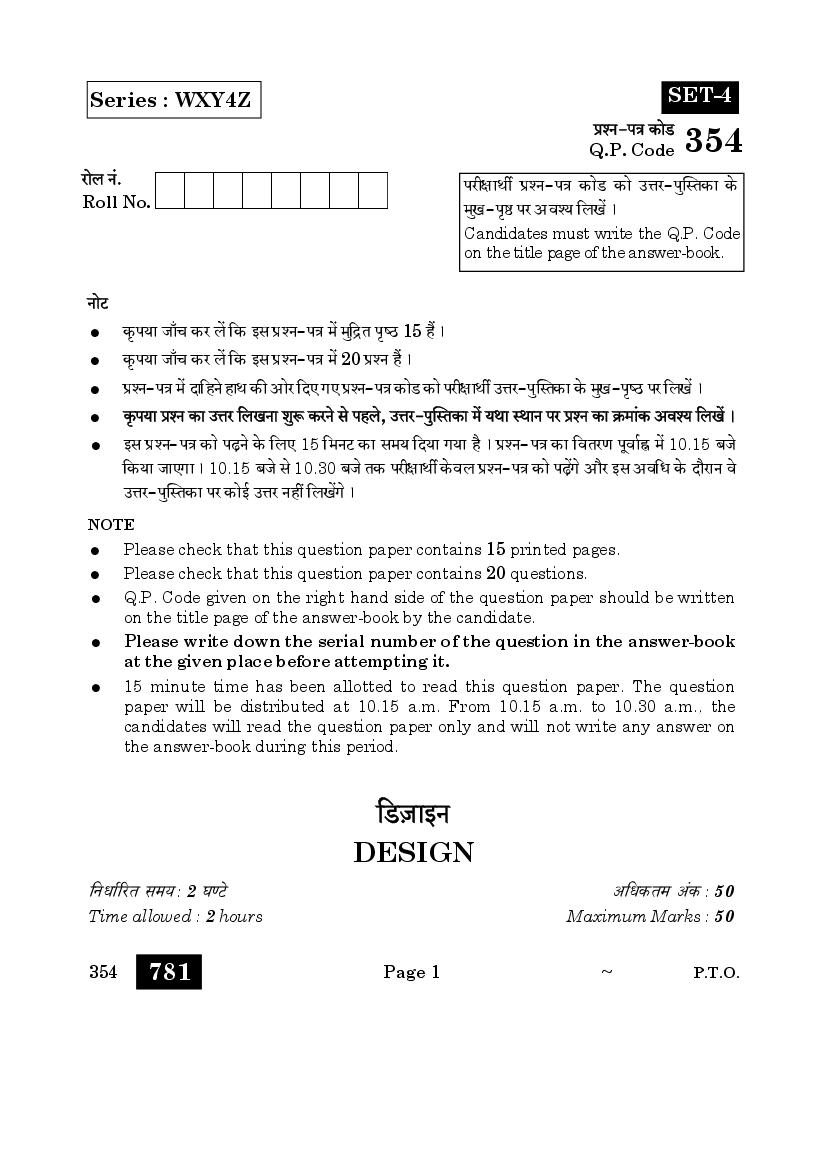
Page 1
Q.P. Code 354
- -
Roll No. -
Candidates must write the Q.P. Code
on the title page of the answer-book.
= - 15
= - 20
= - - - -
=
= - 15 - 10.15
10.15 10.30 -
-
NOTE
= Please check that this question paper contains 15 printed pages.
= Please check that this question paper contains 20 questions.
= Q.P. Code given on the right hand side of the question paper should be written
on the title page of the answer-book by the candidate.
= Please write down the serial number of the question in the answer-book
at the given place before attempting it.
= 15 minute time has been allotted to read this question paper. The question
paper will be distributed at 10.15 a.m. From 10.15 a.m. to 10.30 a.m., the
candidates will read the question paper only and will not write any answer on
the answer-book during this period.
DESIGN
{ZYm©[aV g‘¶ : 2 KÊQ>o A{YH$V‘ A§H$ : 50
Time allowed : 2 hours Maximum Marks : 50
354 781 Page 1 ~ P.T.O.
Page 2
(ii) - 20 - - -
(iii) - -
(iv) (5 + 15) = 20 () 2
(5 + 10) = 15
(v)
(vi) - : (24 )
(1) 5
(2)
(3)
(4)
(5) /
(vii) - : (26 )
(1) 15
(2) 10
(3)
(4)
(5) /
–
1. 6 4 : 4 1=4
(i)
(1)
(ii)
?
(A) +; (B) +T
(C) +D (D) +’1 (1)
354 Page 2 ~
Page 3
(i) Please read the instructions carefully.
(ii) This question paper consists of 20 questions in two sections : Section – A
& Section – B.
(iii) Section – A has Objective Type Questions whereas Section – B contains
Subjective Type Questions.
(iv) Out of the given (5 + 15 =) 20 questions, a candidate has to answer
(5 + 10 =) 15 questions in the allotted (maximum) time of 2 hours.
(v) All questions of a particular section must be attempted in the correct order.
(vi) Section – A : Objective Type Questions (24 Marks)
(1) This Section has 5 questions.
(2) It is mandatory for every student to complete all the questions as
per instructions.
(3) There is no negative marking.
(4) Do as per the instructions given.
(5) Marks allotted are mentioned against each question/part.
(vii) Section – B : Subjective Type Questions (26 Marks)
(1) This Section has 15 questions.
(2) A candidate has to do 10 questions.
(3) There is no negative marking.
(4) Do as per the instructions given.
(5) Marks allotted are mentioned against each question/part.
SECTION – A
(Objective Type Questions)
1. Answer any 4 out of the given 6 questions on Employability Skills : 4 1=4
(i) Personality affects all aspects of an individual’s performance. Enlist
any two personality traits. (1)
(ii) What is the shortcut key to insert current date in a cell ?
(A) Ctrl+; (B) Ctrl+T
(C) Ctrl+D (D) Ctrl+’1 (1)
354 Page 3 ~ P.T.O.
Page 4
(A) (B)
(C) (D) (1)
(iv) _____ ,
,
(A) (B)
(C) (D) (1)
(v) _____
(A) (B)
(C) (D) (1)
(vi) ?
(A) - (B)
(C) (D) (1)
2. 6 5 : 5 1=5
(i)
(A) (B)
(C) (D) (1)
(ii) _____
(A) (B)
(C) (D) (1)
(iii) COSHH ?
(A)
(B)
(C)
(D) (1)
354 Page 4 ~
Page 5
(A) Sender (B) Receiver
(C) Decoder (D) Driver (1)
(iv) _____ is the term used to denote proper management of a natural
resource to prevent its exploitation, destruction or degradation.
(A) Survival (B) Conservation
(C) Nature (D) Sustainability (1)
(v) _____ is a process of developing a business plan, launching and
running a business using innovation to meet customer needs and to
make a profit.
(A) Business Studies (B) Market Research
(C) Entrepreneurship (D) Business mind (1)
(vi) _____ is a state of feeling upset, annoyed and hopeless in achieving
our goals.
(A) Low self-esteem (B) Neuroticism
(C) Stress (D) Personality disorder (1)
2. Answer any 5 out of the given 6 questions : 5 1=5
(i) This stage of design is dedicated to understand user needs &
objectives.
(A) Test (B) Prototype
(C) Define (D) Empathy (1)
(ii) _____ is the twisting together of strands of fibers.
(A) Combing (B) Spinning
(C) Weaving (D) Knitting (1)
(iii) Why COSHH assessments are carried out ?
(A) To assess the cost
(B) To assess the materials used for product
(C) To assess the health hazards if chemicals are produced while
making a product
(D) To assess the structure of chemicals. (1)
354 Page 5 ~ P.T.O.
Page 6
?
(A) (B)
(C) (D) (1)
(v) _____
(A) (B)
(C) (D) (1)
(vi) _____
(A) (B)
(C) (D) (1)
3. 6 5 : 5 1=5
(i) _____
(A) (B)
(C) (D) (1)
(ii) “ ( ) ” ‘’
?
(A) (B)
(C) (D) (1)
(iii) (ILO)
(A) (B)
(C) (D) (1)
354 Page 6 ~
Page 7
ask him to add design details in the image. Which software will he
use to edit that image ?
(A) In design (B) Cad pro
(C) Microsoft Excel (D) Photoshop (1)
(v) In law of _____, we automatically fill in gap between elements to
perceive a complete image.
(A) Closure (B) Common region
(C) Proximity (D) Simplicity (1)
(vi) _____ materials are those materials that are made of polymers that
are joined by chemical bonds, acquiring a slightly cross linked
structure.
(A) Thermoplastic (B) Elastomer
(C) Thermoset (D) Polyethylene (1)
3. Answer any 5 out of the given 6 questions : 5 1=5
(i) Formaldyhyde and resin can cause _____ to workers.
(A) Heart attack (B) Muscular disorder
(C) Blindness (D) Asthma (1)
(ii) State famous for its marquetry work, which is called ‘Sadeli’ by local
people.
(A) Kashmir (B) Gujarat
(C) Kerala (D) Punjab (1)
(iii) What is the full form of ILO ?
(A) Indian Labour Organisation
(B) Indian Labour Law Organisation
(C) International Labour Law Organisation
(D) International Labour Organisation (1)
354 Page 7 ~ P.T.O.
Page 8
(A) (B)
(C) (D) (1)
(v) _____
(A) (B)
(C) (D) - (1)
(vi)
(A) (B)
(C) (D) (1)
4. 6 5 : 5 1=5
(i)
(A) (B)
(C) (D) (1)
(ii)
(A) – – (B) – –
(C) – – (D) – – (1)
354 Page 8 ~
Page 9
(A) Rolling (B) Forging
(C) Extrusion (D) Swaging (1)
(v) _____ is a method of textile production in which two sets of yarns are
interloped.
(A) Weaving (B) Felting
(C) Knitting (D) Non-woven (1)
(vi) This research tool is very popular among researchers as this is an
easy way to get user input and validation very early without
requiring a lot of preparation.
(A) Shadowing (B) Focus group
(C) Card sorting (D) Survey (1)
4. Answer any 5 out of the given 6 questions : 5 1=5
(i) This phase of design thinking is all about experimentation and
turning ideas into tangible products.
(A) Prototype (B) Test
(C) Define (D) Ideate (1)
(ii) Identify the correct order of weaving process.
(A) Battening – Shedding – Picking
(B) Shedding – Battening – Picking
(C) Shedding – Picking – Battening
(D) Picking – Shedding – Battening (1)
354 Page 9 ~ P.T.O.
Page 10
(A) (B)
(C) (D) () (1)
(iv) _____
(A) (B)
(C) (D) (1)
(v)
?
(A) (B)
(C) (D) (1)
(vi) ?
(A) (B)
(C) (D) (1)
5. 6 5 : 5 1=5
(i)
?
(A) (B)
(C) (D) (1)
(ii) (particle board) 1950 ?
(A) (B)
(C) (D) (1)
(iii) _____
(A) (B)
(C) (D) (1)
354 Page 10 ~
Page 11
process can result _______.
(A) Asthma (B) Cancer
(C) Hearing loss (D) Dermatitis (1)
(iv) _______ consists of adjustable arbors with motors.
(A) Shapers (B) Table saw
(C) Jointers (D) Routers (1)
(v) You have to design a water bottle for Kindergarten child. Which
factors you will keep in mind ?
(A) Usage (B) Complex Design
(C) High end Luxury Material (D) Large Capacity (1)
(vi) Which from the followings is not a benefit of using design thinking at
work ?
(A) Improves customer satisfaction
(B) Foster innovation
(C) Guarantee profit
(D) Can be applied company wide (1)
5. Answer any 5 out of the given 6 questions : 5 1=5
(i) Experimenting at the limits of your knowledge and ability is crucial
in being able to see things differently. This statement shows which
principle of design thinking ? (1)
(A) Human rule (B) Ambiguity rule
(C) Redesign rule (D) Tangibility rule
(ii) The first particle board industry was setup in late 1950 in _____.
(A) Uttar Pradesh (B) Gujarat
(C) Punjab (D) Rajasthan (1)
(iii) The _____ principle dictates that a complete outline is not necessary
to convey the same message as a partial outline.
(A) Proximity (B) Closure
(C) Continuity (D) Symmetry (1)
354 Page 11 ~ P.T.O.
Page 12
(A) (B)
(C) (D) (1)
(v) ?
(A)
(B) ,
(C)
(D) (1)
(vi) ?
(A) (B)
(C) (D) (1)
–
4 3
20-30 : 3 2=6
6. (2)
7. SMART ? (2)
8. (2)
9. - ? (2)
6 4 20-30 : 4 2=8
10.
? (2)
11. ? (2)
354 Page 12 ~
Page 13
Carothers.
(A) Polyester (B) Rayon
(C) Acetate (D) Nylon (1)
(v) What is design ?
(A) Design is merely making things pretty.
(B) Design implies intention, meaning & purpose.
(C) Design is just drawing of the product.
(D) Design creates a focal point for the user. (1)
(vi) Which software is the perfect software for image editing and creating
image compositions ?
(A) Adobe Photoshop (B) Adobe In design
(C) Cad pro (D) Microsoft Office (1)
SECTION – B
(Subjective Type Questions)
Answer any 3 out of the given 4 questions on Employability Skills. 3 2=6
Answer each question in 20-30 words :
6. Write two environmental barriers which are faced by entrepreneurs. (2)
7. What does SMART Goals means ? (2)
8. Briefly explain any two advantages of using spreadsheet. (2)
9. What is e-waste ? (2)
Answer any 4 questions out of the given 6 questions in 20-30 words each :
4 2=8
10. Brainstorming is a method for generating ideas to solve a design problem.
How ? (2)
11. What are the advantages of cold working process in metal production ? (2)
354 Page 13 ~ P.T.O.
Page 14
? (2)
13.
? (2)
14. ? (2)
15. - (2)
5 3 50-80 : 3 4 = 12
16. (4)
17. ? (1 + 3)
18. -
? (1 + 3)
19. (4)
20. ?
(2 + 2)
___________
354 Page 14 ~
Page 15
Which problems are called wicked problems ? (2)
13. Why employees of any manufacturing unit should be well trained to avoid
any hazards ? (2)
14. If you have to design a study table for a teenage girl, which factors will
you keep in mind ? (2)
15. Briefly explain the uses of Adobe – In design. (2)
Answer any 3 out of the given 5 questions in 50-80 words each : 3 4 = 12
16. Explain research tools for empathise phase of design thinking. (4)
17. What are warp & weft threads ? Briefly explain different operations of a
loom. (1+3)
18. Elaborate the term musculo-skeletal disorder. Explain the precautions
one can take to prevent this disorder. (1+3)
19. Describe the usage of the tools of Adobe Photoshop. (4)
20. What is the purpose of design thinking ? Name any four areas where
design thinking can be applied. (2+2)
______________
354 Page 15 ~ P.T.O.
Page 16
Document Details
| Board / Org | CBSE |
| Exam | Class 12 |
| Type | Question Paper |
| Pages | 16 |
| Updated | 24 Sep 2026 |