ICSE Class 10 Question Paper 2025 English Paper 2
Finished viewing? Save it for later —
Download ICSE Class 10 Question Paper 2025 English Paper 2 (PDF · 12 pages)About ICSE Class 10 Question Paper 2025 English Paper 2
ICSE Class 10 Question Paper 2025 English Paper 2 is available here for free download. Published by CISCE for Class 10, this question paper can be viewed online or downloaded as a PDF (12 pages). Candidates preparing for Class 10 can use ICSE Class 10 Question Paper 2025 English Paper 2 to understand the exam pattern, the type of questions asked, and the overall difficulty level.
Frequently Asked Questions
How can I download ICSE Class 10 Question Paper 2025 English Paper 2?
Open this page and click the Download button to save ICSE Class 10 Question Paper 2025 English Paper 2 as a PDF. It is completely free on AglaSem Docs.
Is ICSE Class 10 Question Paper 2025 English Paper 2 free to download?
Yes. ICSE Class 10 Question Paper 2025 English Paper 2 can be viewed online and downloaded as a PDF free of cost on AglaSem Docs.
How many pages does ICSE Class 10 Question Paper 2025 English Paper 2 have?
ICSE Class 10 Question Paper 2025 English Paper 2 contains 12 pages, which you can read online or download together as a single PDF.
Where can I find more Class 10 study material?
You can find more Class 10 question papers, sample papers, syllabus, and answer keys on AglaSem Docs.
ICSE Class 10 Question Paper 2025 English Paper 2 – Text
Read the full text of this question paper below — useful to quickly search, copy and reference the content online without downloading the PDF.
📄 View text version (12 pages)
Page 1
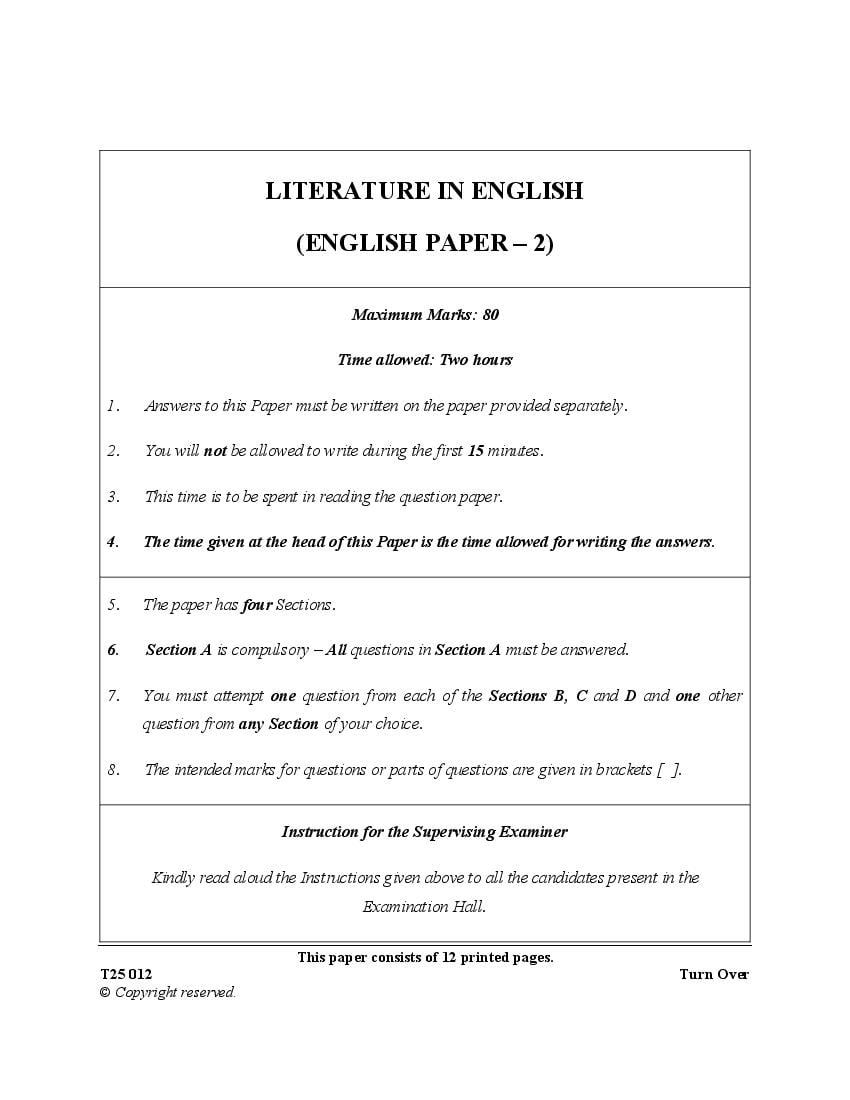
(ENGLISH PAPER – 2)
Maximum Marks: 80
Time allowed: Two hours
1. Answers to this Paper must be written on the paper provided separately.
2. You will not be allowed to write during the first 15 minutes.
3. This time is to be spent in reading the question paper.
4. The time given at the head of this Paper is the time allowed for writing the answers.
5. The paper has four Sections.
6. Section A is compulsory – All questions in Section A must be answered.
7. You must attempt one question from each of the Sections B, C and D and one other
question from any Section of your choice.
8. The intended marks for questions or parts of questions are given in brackets [ ].
Instruction for the Supervising Examiner
Kindly read aloud the Instructions given above to all the candidates present in the
Examination Hall.
This paper consists of 12 printed pages.
T25 012 Turn Over
© Copyright reserved.
Page 2
(Attempt all questions from this Section.)
Question 1
Choose the correct answers to the questions from the given options. [16]
(Do not copy the questions, write ONLY the correct answers.)
(i) What does Antony describe as, ‘thou bleeding piece of earth,’?
(a) Caesar’s robe that was stained with his blood
(b) The blood-soaked spot on which Caesar lies
(c) The bloodied pedestal on which Caesar fell
(d) Caesar’s lifeless body covered in blood
(ii) When Brutus says, ‘ambition’s debt is paid’, he means that ___________.
(a) Caesar’s greed for power and possession had resulted in his death
(b) Caesar had left seventy-five drachmas for every citizen of Rome
(c) Mark Antony would be permitted to speak at Caesar’s funeral
(d) The conspirators would be punished for assassinating Caesar
(iii) After Antony’s speech following Caesar's assassination, the angry mob kills
____________.
(a) Cinna the conspirator
(b) Cinna the poet
(c) Decius Brutus
(d) Cicero
T25 012 2
Page 3
barren-spirited fellow;’ he refers to ___________.
(a) Octavius
(b) Lucilius
(c) Lucius
(d) Lepidus
(v) Who were the members of the Second Triumvirate, formed to rule over
Rome after Caesar’s assassination?
(a) Julius Caesar, Crassus, Pompey
(b) Marcus Brutus, Caius Cassius, Casca
(c) Mark Antony, Octavius Caesar, Lepidus
(d) Octavius Caesar, Julius Caesar, Mark Antony
(vi) Which of the following words best describes Cassius’s mood when he says:
‘Come, Antony, and young Octavius, come,
Revenge yourselves alone on Cassius,’
(a) anxious
(b) regretful
(c) fearful
(d) frustrated
(vii) In the poem, ‘Haunted Houses’, what does the speaker see at his fireside that
the stranger cannot?
(a) the speaker only sees what is physically present
(b) the stranger can see the spirits while the speaker cannot
(c) the speaker sees both the present and the past
(d) the stranger sees both the present and the future
T25 012 3 Turn Over
Page 4
(a) The lions that ramped and roared
(b) King Francis who loved a royal sport
(c) The nobles who filled the benches
(d) The beauteous lively dame
(ix) Select the option that shows the correct relationship between Statements (1)
and (2) from Maya Angelou’s poem, ‘When Great Trees Fall’:
Statement 1: When great trees fall, the world is left permanently
unstable.
Statement 2: In the poem, the natural world is depicted as reacting with
fear and uncertainty when great trees fall.
(a) (1) is false, but (2) is true.
(b) Both (1) and (2) are false.
(c) (1) is true, but (2) is false.
(d) Both (1) and (2) are true.
(x) The poem, A Considerable Speck, expresses Frost’s ___________.
(a) love for the little organism
(b) respect for intelligent life
(c) indifference to the tiny creature
(d) anger at the mite’s escape
T25 012 4
Page 5
following line from the poem, ‘The Power of Music’?
And in the sky the feathered fly turn turtle while
They’re winging,
(a) You’re one month on in the middle of May
(b) Rainbow-tinted circles of light
(c) And life is too much like a pathless wood
(d) The wind lies asleep in the arms of the dawn
(xii) In the short story, ‘With the Photographer’, the narrator asks the
photographer, “Is it me?” because ___________.
(a) He is delighted with the photographer’s skill
(b) He looks very handsome in the photograph
(c) He is unable to recognise his own face
(d) He is ashamed of how he looks in the picture
(xiii) In the short story, ‘The Elevator’, which of the following does Martin’s
father NOT do when Martin expresses his fear of the elevator?
(a) He dismisses Martin’s concerns
(b) He encourages Martin to use the stairs
(c) He tells Martin to grow up and be brave
(d) He watches TV and ignores Martin’s fear
T25 012 5 Turn Over
Page 6
short story, ‘The Pedestrian’:
1. One night, as he was nearing home, he was stopped by a police car.
2. Since his answers were considered odd and unacceptable, he was
forced to enter the car and taken away.
3. Leonard Mead loved to walk through the empty streets at night.
4. A metallic voice from the car asked him a series of questions.
(a) 2, 1, 3, 4
(b) 1, 3, 4, 2
(c) 3, 1, 4, 2
(d) 4, 1, 2, 3
(xv) Where was Adjoa born?
(a) Nigeria
(b) Ghana
(c) Ethiopia
(d) Kenya
(xvi) Why did M. Hamel have to leave the school after forty years of service?
(a) He was not allowed to teach French any longer
(b) He had grown tired of his job as a schoolteacher
(c) He was thought to be too strict in his ways
(d) He wanted to retire and take up farming
T25 012 6
Page 7
(Answer one or more questions from this Section.)
DRAMA
(Julius Caesar by William Shakespeare)
Question 2
Read the extract from ‘Julius Caesar’ Act 3, Scene 2, given below and answer the
questions that follow:
Antony: Friends, Romans, countrymen, lend me your ears;
I come to bury Caesar, not to praise him.
The evil that men do lives after them,
The good is oft interred with their bones;
So let it be with Caesar. The noble Brutus
Hath told you Caesar was ambitious;
If it were so, it was a grievous fault,
And grievously hath Caesar answer’d it.
Here, under leave of Brutus and the rest–
For Brutus is an honourable man;
So are they all, all honourable men–
Come I to speak in Caesar’s funeral.
(i) What does Antony say he is there for? [3]
What does he say he is not there for?
What do you think he is actually there for?
(ii) What were the three conditions that Brutus had laid down before allowing [3]
Antony to speak to the citizens of Rome?
(iii) List the three arguments that Antony uses immediately after he speaks [3]
these lines to prove conclusively that Julius Caesar was not ambitious.
T25 012 7 Turn Over
Page 8
What are they? Why does he do this?
(v) Which one argument of Antony’s do you think had the greatest impact on [4]
his listeners? Give a reason to support your answer.
What were the citizens’ feelings towards Antony before he began his
speech?
How do their feelings towards him change at the end of his speech?
Question 3
Read the extract from ‘Julius Caesar’ Act 5, Scene 1, given below and answer the
questions that follow:
Cassius: Then, if we lose this battle,
You are contented to be led in triumph
Through the streets of Rome?
Brutus: No, Cassius, no: think not, thou noble Roman,
That ever Brutus will go bound to Rome;
He bears too great a mind. But this same day
Must end that work the ides of March begun;
And whether we shall meet again I know not.
Therefore our everlasting farewell take:
Forever, and forever, farewell, Cassius.
If we do meet again, why, we shall smile;
If not, why then, this parting was well made.
(i) Why does Brutus say, ‘No, Cassius, no’? [3]
What conditions may force Brutus to go bound to Rome?
Brutus says, ‘And whether we shall meet again I know not.’ What do these
words imply?
T25 012 8
Page 9
begun’?
How was ‘that work’ begun?
What political change would take place in Rome if Brutus and Cassius lose
this battle?
(iii) Earlier in this scene, Cassius had confided to Messala a strange occurrence [3]
that he had observed when his army was on its way from Sardis to Philippi.
Describe this strange occurrence.
(iv) How does Brutus die? [3]
How does his manner of dying contradict the philosophy by which he had
lived his life?
(v) At the end of the play, Antony calls Brutus, ‘the noblest Roman of them [4]
all’. Why does he say this?
What does this reveal of Antony’s character?
SECTION C
(Answer one or more questions from this Section.)
PROSE - SHORT STORIES
(Treasure Chest – A Collection of Poems and Short Stories)
Question 4
Read the following extract from William Sleater’s short story, ‘The Elevator’ and
answer the questions that follow:
Martin felt nervous when he got back to the building after school. But why
should he be afraid of an old lady? He felt ashamed of himself. He pressed
the button and stepped into the elevator, hoping that it would not stop, but
it stopped on the third floor. Martin watched the door slide open …
T25 012 9 Turn Over
Page 10
Describe this person.
(ii) Why was Martin afraid of using this elevator? [3]
(iii) What led to Martin’s fall down the stairs? [3]
What did it result in?
(iv) How does the story end? [3]
Bring out the element of horror in the ending.
(v) What was Martin’s father’s opinion of him? [4]
What does this reveal to us about his father’s character?
Question 5
Read the following extract from Alphonse Daudet’s short story, ‘The Last Lesson’
and answer the questions that follow:
“My children, this is the last lesson I shall give you. The order has come
from Berlin to teach only German in the schools of Alsace and Lorraine.
The new master comes tomorrow. This is your last French lesson. I want
you to be very attentive.”
What a thunder-clap these words were to me!
Oh, the wretches; that was what they had put up at the town-hall!
(i) What does the word, ‘that’ in the extract refer to? [3]
What other ‘bad news’ had the villagers received from the bulletin board
outside the town-hall?
(ii) How does the narrator describe the daily bustle at the start of a typical [3]
school day?
T25 012 10
Page 11
(iv) What thoughts filled the narrator’s head when he heard the above [3]
announcement?
(v) What does M. Hamel urge his listeners never to forget? [4]
M. Hamel writes a few words on the board at the end of the lesson. What
were they?
What does he hope to inspire through his words and actions on that day?
SECTION D
(Answer one or more questions from this Section.)
POETRY
(Treasure Chest – A Collection of Poems and Short Stories)
Question 6
Read the following extract from Leigh Hunt’s poem, ‘The Glove and the Lions’ and
answer the questions that follow:
And truly ‘twas a gallant thing to see that crowning show,
Valour and love, and a king above, and the royal beasts below.
(i) Describe the scene at the beginning of the poem. [3]
(ii) “Leigh Hunt uses vivid sound and visual images to describe the contest [3]
between the royal beasts in the pit.” Justify with close reference to the text.
(iii) Who was the ‘beauteous lively dame’ mentioned in the poem? [3]
What did she do?
What prompted her to do this?
T25 012 11 Turn Over
Page 12
(a) ‘smiling lips and sharp bright eyes which always seemed the same’
(b) ‘the occasion is divine’
(c) ‘Faith, gentlemen, we’re better here than there’
(v) When King Francis exclaims, “rightly done!”, what action of Count de [4]
Lorge does he applaud?
Why do you think the Count behaved the way he did?
Question 7
Read the following extract from Robert Frost’s poem, ‘A Considerable Speck’ and
answer the questions that follow:
This was no dust speck by my breathing blown,
But unmistakably a living mite
With inclinations it could call its own.
(i) What did the narrator first imagine the ‘speck’ to be? [3]
What does his use of the words ‘speck’ and ‘mite’ tell us about it?
(ii) What was the narrator doing when he spotted the speck? [3]
Which two words from the poem helped you come to this conclusion?
(iii) What made him realise that he was dealing with ‘an intelligence’? [3]
(iv) Why did the narrator conclude that the mite had feet? [3]
(v) Describe the narrator’s initial response to the speck. [4]
What did he eventually decide to do about it?
Why does he make this decision?
What does this decision reveal of his character?
T25 012 12
Document Details
| Board / Org | CISCE |
| Exam | Class 10 |
| Type | Question Paper |
| Pages | 12 |
| Updated | 24 Sep 2026 |