CBSE Class 12 Question Paper 2025 Data Science
Finished viewing? Save it for later —
Download CBSE Class 12 Question Paper 2025 Data Science (PDF · 24 pages)About CBSE Class 12 Question Paper 2025 Data Science
CBSE Class 12 Question Paper 2025 Data Science is available here for free download. Published by CBSE for Class 12, this question paper can be viewed online or downloaded as a PDF (24 pages). Candidates preparing for Class 12 can use CBSE Class 12 Question Paper 2025 Data Science to understand the exam pattern, the type of questions asked, and the overall difficulty level.
Frequently Asked Questions
How can I download CBSE Class 12 Question Paper 2025 Data Science?
Open this page and click the Download button to save CBSE Class 12 Question Paper 2025 Data Science as a PDF. It is completely free on AglaSem Docs.
Is CBSE Class 12 Question Paper 2025 Data Science free to download?
Yes. CBSE Class 12 Question Paper 2025 Data Science can be viewed online and downloaded as a PDF free of cost on AglaSem Docs.
How many pages does CBSE Class 12 Question Paper 2025 Data Science have?
CBSE Class 12 Question Paper 2025 Data Science contains 24 pages, which you can read online or download together as a single PDF.
Where can I find more Class 12 study material?
You can find more Class 12 question papers, sample papers, syllabus, and answer keys on AglaSem Docs.
CBSE Class 12 Question Paper 2025 Data Science – Text
Read the full text of this question paper below — useful to quickly search, copy and reference the content online without downloading the PDF.
📄 View text version (24 pages)
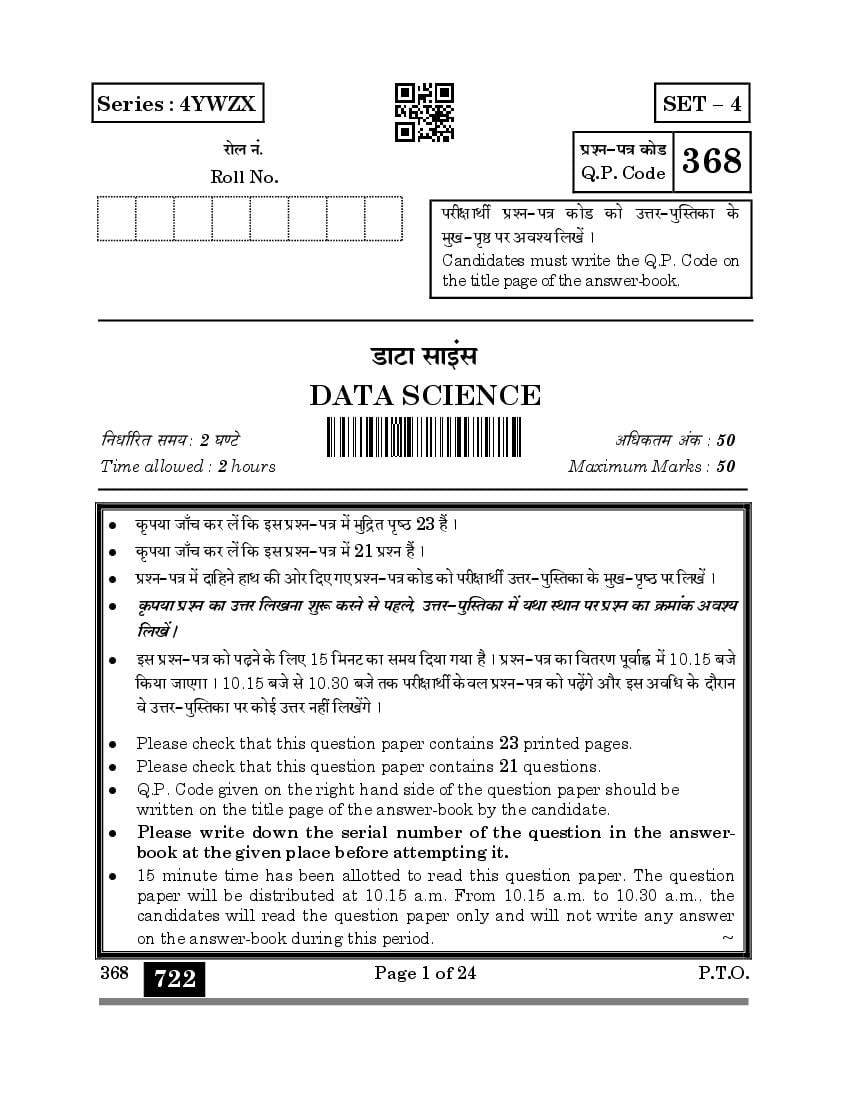
Page 1
. -
Roll No. Q.P. Code 368
- -
-
Candidates must write the Q.P. Code on
the title page of the answer-book.
DATA SCIENCE
{ZYm©[aV g‘¶ : 2 KÊQ>o A{YH$V‘ A§H$ : 50
Time allowed : 2 hours Maximum Marks : 50
● - 23
● - 21
● - - - -
● , -
● - 15 - 10.15
10.15 10.30 -
-
● Please check that this question paper contains 23 printed pages.
● Please check that this question paper contains 21 questions.
● Q.P. Code given on the right hand side of the question paper should be
written on the title page of the answer-book by the candidate.
● Please write down the serial number of the question in the answer-
book at the given place before attempting it.
● 15 minute time has been allotted to read this question paper. The question
paper will be distributed at 10.15 a.m. From 10.15 a.m. to 10.30 a.m., the
candidates will read the question paper only and will not write any answer
on the answer-book during this period. ~
368 Page 1 of 24 P.T.O.
722
Page 2
(i)
(ii) - 21 : – –
(iii) – , –
(iv) (5 + 16 =) 21 , 2 ()
(5 + 10 =) 15
(v)
(vi) – : (24 ) :
(a) 5
(b)
(c)
(d) /
(vii) – : (26 ) :
(a) 16
(b) 10
(c)
(d) /
368 Page 2 of 24 ~
Page 3
(i) Please read the instructions carefully.
(ii) This question paper consists of 21 questions in two Sections : Section – A
& Section – B.
(iii) Section – A has Objective Type Questions whereas Section – B contains
Subjective Type Questions.
(iv) Out of the given (5 + 16 =) 21 questions, a candidate has to answer
(5 + 10 =) 15 questions in the allotted (maximum) time of 2 hours.
(v) All questions of a particular section must be attempted in the correct
order.
(vi) Section – A : Objective Type Questions (24 marks) :
(a) This section has 5 questions.
(b) There is no negative marking.
(c) Do as per the instructions given.
(d) Marks allotted are mentioned against each question/part.
(vii) Section – B : Subjective Type Questions (26 marks) :
(a) This section has 16 questions.
(b) A candidate has to do 10 questions.
(c) Do as per the instructions given.
(d) Marks allotted are mentioned against each question/part.
368 Page 3 of 24 ~ P.T.O.
Page 4
( )
1. 6 4 41=4
(i) FFM :
(A) Flexible Framework Model (B) Functional Flexibility Model
(C) Focused Feedback Method (D) Five Factor Model
(ii) ?
(A)
(B) -
(C) (monetary resources)
(D)
(iii) (Active Voice)
(A) (B)
(C) (D)
(iv) (presentation) (key) :
(A) Ctrl + N (B) Ctrl + Alt + N
(C) Ctrl + M (D) Ctrl + Alt + M
(v) (motivation)
(external rewards) ?
(A) (Extrinsic)
(B) (Increment)
(C) (Intrinsic)
(D) - (Incentive-based)
(vi) (Appropriate Technology) _________
(A) - (large-scale) (B) - (small-scale)
(C) - (remote-scale) (D) - (old-scale)
368 Page 4 of 24 ~
Page 5
(Objective Type Questions)
1. Answer any 4 out of the given 6 questions on Employability Skills. 41=4
(i) With reference to describing an individual’s personality, FFM stands
for :
(A) Flexible Framework Model (B) Functional Flexibility Model
(C) Focused Feedback Method (D) Five Factor Model
(ii) Which of the following is a barrier that entrepreneurs may face while
running their ventures ?
(A) Availability of skilled labours
(B) Self-confidence
(C) Unavailability of monetary resources on time
(D) Risk taking capability
(iii) Identify the active voice sentence from the following :
(A) The game was won by the home team.
(B) The report is being written by the manager.
(C) The manager is writing the report.
(D) The homework was done by the student.
(iv) The shortcut key to add a new slide in a presentation is :
(A) Ctrl + N (B) Ctrl + Alt + N
(C) Ctrl + M (D) Ctrl + Alt + M
(v) Which term is used for motivation that comes from within an
individual rather than external rewards ?
(A) Extrinsic motivation (B) Increment motivation
(C) Intrinsic motivation (D) Incentive-based motivation
(vi) With respect to green jobs, an Appropriate technology is the
_________ technology that is environment friendly and suited to local
needs.
(A) large-scale (B) small-scale
(C) remote-scale (D) old-scale
368 Page 5 of 24 ~ P.T.O.
Page 6
(i) :
, (user data)
(ii) (histogram) ?
(A) (Univariate Analysis)
(B) (Bivariate Analysis)
(C) (Multivariate Analysis)
(D) (Clustering)
(iii) (algorithm) decision trees
(predictions)
(A) (Classification algorithm)
(B) - (K-means clustering)
(C) (Random Forest algorithm)
(D) - (K-nearest neighbour algorithm)
(iv) K-Nearest Neighbours (K-NN) algorithm ?
(A) (Lazy learning) (parametric learning)
(B) (Eager learning) - (non-parametric
learning)
(C) (Lazy learning) - (non-parametric
learning)
(D) (Eager learning) (parametric learning)
368 Page 6 of 24 ~
Page 7
(i) State whether the following statement is True or False :
In terms of data privacy, companies are considered the sole owners of
user data.
(ii) The following histogram represents :
(A) Univariate Analysis (B) Bivariate Analysis
(C) Multivariate Analysis (D) Clustering
(iii) Name the algorithm which makes predictions based on the outcomes
of several decision trees.
(A) Classification algorithm
(B) K-means clustering
(C) Random Forest algorithm
(D) K-nearest neighbour algorithm
(iv) Which characteristics describe K-Nearest Neighbours (K-NN)
algorithm ?
(A) Lazy learning and parametric learning
(B) Eager learning and non-parametric learning
(C) Lazy learning and non-parametric learning
(D) Eager learning and parametric learning
368 Page 7 of 24 ~ P.T.O.
Page 8
?
(A) (Classification)
(B) (Clustering)
(C) (Linear Regression)
(D) (Decision Tree)
(vi)
, (recommendation engines)
?
(A) (Supervised Learning)
(B) (Unsupervised Learning)
(C) (Reinforcement Learning)
(D) (Natural Language Processing)
3. 6 5 51=5
(i) CCPA :
(A) California Consumer Privacy Act
(B) Children’s Consumer Privacy Act
(C) California Consumer Public Act
(D) Children’s Consumer Public Act
(ii) (missing data)
?
1.
2. (missing values)
3. (variable) (mean) (mode)
4.
5. (random value)
(A) 1 2 (B) 2 3
(C) 3 4 (D) 4 5
368 Page 8 of 24 ~
Page 9
between rainfall and crop growth and the amount of crop growth for
a certain level of rainfall ?
(A) Classification (B) Clustering
(C) Linear Regression (D) Decision Tree
(vi) A website selling products uses recommendation engines to predict
what products a customer is likely to purchase. This functionality is
achieved through :
(A) Supervised Learning (B) Unsupervised Learning
(C) Reinforcement Learning (D) Natural Language Processing
3. Answer any 5 out of the given 6 questions. 51=5
(i) CCPA stands for :
(A) California Consumer Privacy Act
(B) Children’s Consumer Privacy Act
(C) California Consumer Public Act
(D) Children’s Consumer Public Act
(ii) Which of the following are common techniques for handling missing
data in a dataset ?
1. Remove the entire column of data.
2. Remove the row of data with missing values.
3. Insert a value close to the mean or mode of the variable with
missing data.
4. Leave the missing data as it is.
5. Insert a random value.
(A) 1 and 2 (B) 2 and 3
(C) 3 and 4 (D) 4 and 5
368 Page 9 of 24 ~ P.T.O.
Page 10
_______
(A) (Mean) (B) (Median)
(C) (Mode) (D) RMSE
(iv) (curse of dimensionality) K-Nearest Neighbours (K-
NN) algorithm ?
(A) K-NN (input variables)
(B) K-NN
(C) K-NN
(D) K-NN (outliers)
(v) (A) : - , (RMSE
value)
(R) : RMSE value
(A) (A) (R) , (R), (A)
(B) (A) (R) , (R), (A)
(C) (A) , (R)
(D) (A) , (R)
(vi) :
(Clustering Techniques)
(instances)
368 Page 10 of 24 ~
Page 11
using the _________.
(A) Mean (B) Median
(C) Mode (D) RMSE
(iv) How does the curse of dimensionality affect the performance of the
K-Nearest Neighbours (K-NN) algorithm ?
(A) K-NN performs better with an increasing number of input
variables.
(B) K-NN struggles to predict the output accurately with an
increasing number of input variables.
(C) K-NN becomes faster with more input variables due to
increased computational power.
(D) K-NN becomes less sensitive to outliers with an increasing
number of input variables.
(v) Assertion (A) : In real-life scenarios, a small RMSE value indicates
a better model fit to the data and higher accuracy.
Reason (R) : A large RMSE value suggests that the model fits the
data well.
(A) Both (A) and (R) are true, and (R) is the correct explanation of
(A).
(B) Both (A) and (R) are true, but (R) is not the correct explanation
of (A).
(C) (A) is true, but (R) is false.
(D) (A) is false, but (R) is true.
(vi) State if the following statement is True or False :
“Clustering Techniques apply when the instances are to be divided
into natural groups.”
368 Page 11 of 24 ~ P.T.O.
Page 12
(i) (data privacy) ?
(A)
(B)
(C)
(D)
(ii) , ( ),
(analysis technique) ?
(A) (Univariate)
(B) (Zerovariate)
(C) (Multivariate)
(D) (Univariate) (Multivariate)
(iii) K-Nearest Neighbours (K-NN) ?
(A) (Objects) ,
(B) (Objects) , (random)
(C) (Objects) , (scattered)
(D) (Objects) ,
(iv) Linear regression variable ?
(A) (Categorical) (B) (Discrete)
(C) (Continuous) (D) (Binary)
368 Page 12 of 24 ~
Page 13
(i) Which of the following defines data privacy ?
(A) The right of individuals to control how their personal
information is collected and used.
(B) The obligation of organisations to collect personal information
for marketing purposes.
(C) The unrestricted sharing of personal information across
platforms.
(D) The use of personal information without consent for research
purposes.
(ii) Prediction of house prices in a city depends on factors such as the
number of bedrooms, size of the house (square footage), location and
age of the property. Which analysis technique is appropriate for this
scenario ?
(A) Univariate
(B) Zerovariate
(C) Multivariate
(D) Both Univariate and Multivariate
(iii) Which fundamental principle does the K-Nearest Neighbours (K-NN)
algorithm oparate on ?
(A) Objects that are similar tend to be located far apart.
(B) Objects that are similar tend to be located at random distances.
(C) Objects that are similar tend to be located in a scattered
manner.
(D) Objects that are similar tend to be located close to each other.
(iv) Which type of variable does linear regression predict ?
(A) Categorical (B) Discrete
(C) Continuous (D) Binary
368 Page 13 of 24 ~ P.T.O.
Page 14
:
y ~ f(x, )
x (independent variables) vector y
(dependent variable)
(A) (Linear Regression)
(B) - (Non-Linear Regression)
(C) (Correlation Regression)
(D) (Multiple Linear Regression)
(vi) (anomaly detection)
?
(A) (Structured data)
(B)
(C)
(D) (future outcomes)
5. 6 5 51=5
(i) COPPA _________ Online Privacy Protection Act.
(A) California’s (B) Children’s
(C) Center’s (D) Channel’s
(ii) (dependent variable)
(regression and classification trees)
?
(A) Regression trees (continuous) ,
classification trees (categorical)
(B) Classification trees (continuous) ,
Regression trees (categorical)
(C) Regression classification trees (continuous)
(D) Regression classification trees (categorical)
368 Page 14 of 24 ~
Page 15
y ~ f(x, )
where x is a vector of independent variables and y is the dependent
variable.
Identify the type of regression from the following.
(A) Linear Regression (B) Non-Linear Regression
(C) Correlation Regression (D) Multiple Linear Regression
(vi) What is a significant application of unsupervised learning in
anomaly detection ?
(A) Identifying patterns in structured data
(B) Classifying data points into predefined categories
(C) Detecting unusual data points
(D) Predicting future outcomes
5. Answer any 5 out of the given 6 questions. 51=5
(i) COPPA stands for _________ Online Privacy Protection Act.
(A) California’s (B) Children’s
(C) Center’s (D) Channel’s
(ii) Which statement correctly describes the use of regression and
classification trees based on the nature of the dependent variable ?
(A) Regression trees are suitable for continuous dependent
variables, while classification trees are suitable for categorical
dependent variables.
(B) Classification trees are suitable for continuous dependent
variables, while regression trees are suitable for categorical
dependent variables.
(C) Both regression and classification trees are suitable for
continuous dependent variables.
(D) Both regression and classification trees are suitable for
categorical dependent variables.
368 Page 15 of 24 ~ P.T.O.
Page 16
(A) (Cross validation) (B) (Regression)
(C) (Classification) (D) (Neural Networks)
(iv) (Linear regression) best fit line
line deviation
?
(A) Sum of Squared Errors (SSE)
(B) Mean Absolute Error (MAE)
(C) Principal Component Analysis (PCA)
(D) F-statistic (Optimise)
(v) :
(A) (Linear Regression)
(B) - (Multi-Linear Regression)
(C) (Classification)
(D) (Correlation)
(vi) K-means algorithm ?
(A) (Gradient Descent)
(B) – (Expectation-Maximisation)
(C) (Decision Trees)
(D) (Support Vector Machines)
368 Page 16 of 24 ~
Page 17
(A) Cross validation (B) Regression
(C) Classification (D) Neural Networks
(iv) When determining the line of best fit in linear regression, which
method is used to minimize the deviation of the line from the actual
data points ?
(A) Maximising the Sum of Squared Errors (SSE).
(B) Minimising the Mean Absolute Error (MAE).
(C) Using Principal Component Analysis (PCA).
(D) Optimising the F-statistic.
(v) The following graph represents :
(A) Linear Regression (B) Multi-Linear Regression
(C) Classification (D) Correlation
(vi) Which problem-solving approach does the K-means algorithm employ ?
(A) Gradient Descent (B) Expectation-Maximisation
(C) Decision Trees (D) Support Vector Machines
368 Page 17 of 24 ~ P.T.O.
Page 18
( )
5 3 20-30
32=6
6. (sentence) articles ? article
7. :
(a) ,
_________ sign
(b) - (amount) (
(Price) (Quantity) )
8. (personality disorders)
:
(a) – - , ,
(b) , (empathy)
-
9. (transportation)
10.
368 Page 18 of 24 ~
Page 19
(Subjective Type Questions)
Answer any 3 out of the given 5 questions on Employability Skills in
20-30 words each. 32=6
6. What are articles in a sentence ? Also give an example of a sentence
exhibiting the usage of article.
7. Consider the following worksheet :
(a) In a spreadsheet, every formula starts with a/an _________ sign.
(b) Write the formula to calculate the amount for Glue-stick. (Amount is
calculated as Price Quantity)
8. Identify and name the following personality disorders :
(a) A disorder characterised by intense self-doubt, a constant need for
reassurance, dependency on others for decision-making, and
avoidance of solitude.
(b) A disorder where individuals believe they are superior to others, lack
empathy, and exaggerate their own achievements.
9. Discuss green jobs in transportation.
10. Discuss any two qualities of a successful entrepreneur.
368 Page 19 of 24 ~ P.T.O.
Page 20
11. ,
- (ethical guidelines)
12. (univariate analysis) /
(bivariate analysis)
/
13. (data analysis) (cross-validation)
14. (Regression trees) (Classification trees)
15. (Root Mean Square Deviation) ?
?
16. (Text documents)
(recommendation engines)
- (content similarity)
(unsupervised learning)
5 3 50-80 3 4 = 12
17. PDP
18. (Multivariate Analysis)
19. (Decision tree methodology)
368 Page 20 of 24 ~
Page 21
11. Explain two ethical guidelines relevant to software development and data
management, emphasizing their importance in ensuring societal benefit
and responsible use of technology.
12. Name one type of chart/graph suitable for analysing a single variable
(univariate analysis) and one type for analyzing the relationship between
two variables (bivariate analysis).
13. Explain cross-validation in data analysis.
14. Mention any two points of differentiation between Regression trees and
Classification trees.
15. What is Root Mean Square Deviation ? Why it is used in data analysis ?
16. Text documents are often grouped based on their content similarity to
efficiently organize and categorise them for information retrieval systems
and recommendation engines.
Identify and define the unsupervised learning method utilized in this
context.
Answer any 3 out of the given 5 questions in 50-80 words each. 3 4 = 12
17. Expand and explain PDP.
18. Explain Multivariate Analysis in detail. Give at least one example to
support your answer.
19. List any four advantages of using a decision tree methodology.
368 Page 21 of 24 ~ P.T.O.
Page 22
(exponentially)
(a) regression model
(b) Regression model
/
(c) Regression model
21. (a) Clustering
(b) clustering
_____________
368 Page 22 of 24 ~
Page 23
income increases exponentially every month.
(a) Identify the appropriate regression model to illustrate Aarush’s score
trend.
(b) Write the formula/equation for the regression model.
(c) Draw a sample chart with dummy data depicting the above
discussed regression model.
21. (a) Define the term clustering. Support your answer with a real life
example.
(b) Name any two clustering methods.
_____________
368 Page 23 of 24 ~ P.T.O.
Page 24
Document Details
| Board / Org | CBSE |
| Exam | Class 12 |
| Type | Question Paper |
| Pages | 24 |
| Updated | 24 Sep 2026 |