WBCHSE Class 11 Syllabus for Statistics
Finished viewing? Save it for later —
Download WBCHSE Class 11 Syllabus for Statistics (PDF · 9 pages)About WBCHSE Class 11 Syllabus for Statistics
WBCHSE Class 11 Syllabus for Statistics is available here for free download. Published by West Bengal Board for Class 11, this syllabus can be viewed online or downloaded as a PDF (9 pages). Candidates preparing for Class 11 can use WBCHSE Class 11 Syllabus for Statistics to understand the exam pattern, the type of questions asked, and the overall difficulty level.
Frequently Asked Questions
How can I download WBCHSE Class 11 Syllabus for Statistics?
Open this page and click the Download button to save WBCHSE Class 11 Syllabus for Statistics as a PDF. It is completely free on AglaSem Docs.
Is WBCHSE Class 11 Syllabus for Statistics free to download?
Yes. WBCHSE Class 11 Syllabus for Statistics can be viewed online and downloaded as a PDF free of cost on AglaSem Docs.
How many pages does WBCHSE Class 11 Syllabus for Statistics have?
WBCHSE Class 11 Syllabus for Statistics contains 9 pages, which you can read online or download together as a single PDF.
Where can I find more Class 11 study material?
You can find more Class 11 question papers, sample papers, syllabus, and answer keys on AglaSem Docs.
WBCHSE Class 11 Syllabus for Statistics – Text
Read the full text of this syllabus below — useful to quickly search, copy and reference the content online without downloading the PDF.
📄 View text version (9 pages)
Page 1
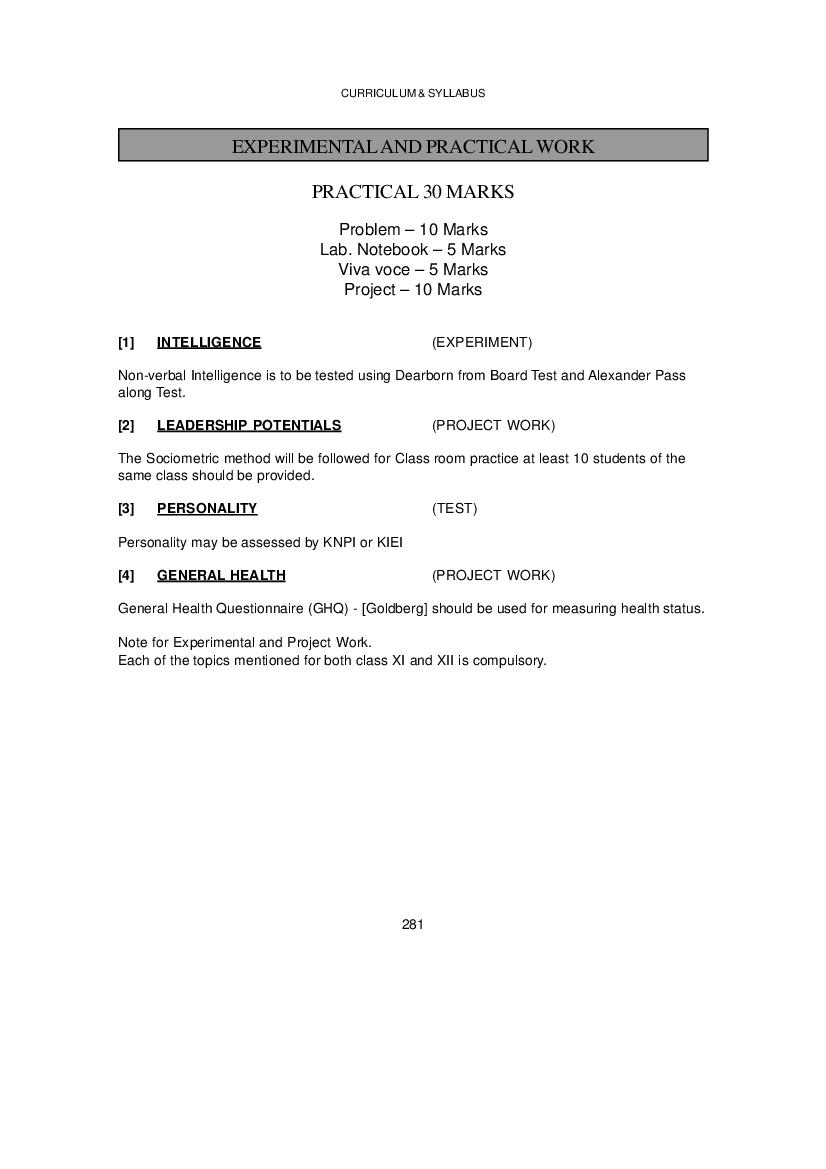
EXPERIMENTAL AND PRACTICAL WORK
PRACTICAL 30 MARKS
Problem – 10 Marks
Lab. Notebook – 5 Marks
Viva voce – 5 Marks
Project – 10 Marks
[1] INTELLIGENCE (EXPERIMENT)
Non-verbal Intelligence is to be tested using Dearborn from Board Test and Alexander Pass
along Test.
[2] LEADERSHIP POTENTIALS (PROJECT WORK)
The Sociometric method will be followed for Class room practice at least 10 students of the
same class should be provided.
[3] PERSONALITY (TEST)
Personality may be assessed by KNPI or KIEI
[4] GENERAL HEALTH (PROJECT WORK)
General Health Questionnaire (GHQ) - [Goldberg] should be used for measuring health status.
Note for Experimental and Project Work.
Each of the topics mentioned for both class XI and XII is compulsory.
281
Page 2
Class – XI
FULL MARKS – 100
Theory : 80 Marks + Project : 20 Marks
Unit 1: Introducing Sociology
What is Sociology – ‘Sociological Imagination’ – C. W. Mills; Sociological perspectives
– Functionalist, Conflict, Symbolic Interaction, Feminist & Post Modernist;
Sociological and its relationship with other social sciences (viz. Anthropology, Political
Science, Economics, Philosophy, Psychology and History)
Emergence of Sociology as an academic discipline – different forces : University
Revolution (a very brief outline)
Scientific nature of Sociology
Sociological Methods – Quantitative & Qualitative; Positivist & Interactionist methods;
Research methodology: Social research, Stages of research, Social survey,
Observation, Questionnaire, Interview
Use of statistical tools & techniques – graphical representation of statistical data –
grouping of data (pie-chart, bar-diagram, histogram, frequency polygon)
Unit 2: Basic Sociological Concepts
Society – Concept, Structure and Process
Community & Association – Concept, Interrelationship and Differences
Organization – Concept and Types
Social Groups – Typology (special reference to Primary and Secondary Groups)
Unit 3: Culture, Social Interaction and Formation of Self
Meaning and Importance
Components of Culture – Values, Norms, Beliefs, Folkways, Mores, Laws,
Language and Technology
Types of Culture – Material & Non-material Culture, Culture and Civilization,
Cultural lag, Sub- culture, Popular Culture, Folk Culture, Consumer Culture,
Culture Pluralism (a very brief outline)
282
Page 3
Socialization - Concept, Meaning, Agencies, Importance, Life Course, Socialized
vs. Unsocialized children
Socialization and Development of Personality (Cooley, Mead) – Nature vs.
Nurture debate
Socialization and Social control – Relationship and Importance
Social Conformity, Non conformity, Deviance and Delinquency (very briefly)
Crime – Concepts and Types (Gender crime, Organized crime, Cyber crime and
White
Collar crime)
Unit 4: Social Institutions
Meaning and Interrelationship among different institutions
Marriage and Family – Origin, Meaning, Features, Types, Significance – Global
trends in Marriage & Family – Cohabitation, Single Parent Family, Divorce rates,
Homosexual Family, ‘’In-Vitro” Fertilization – Kinship (in brief : Terminologies and
Importance, Descent, Lineage, Sib & Clan)
Economy – Types of Economic Systems – Means of Subsistence (in brief)
Direct Appropriation Economy
Pastoral Economy
Agricultural Economy
Handicraft Economy
Industrial Economy
Preliminary Concepts – Utility, Wealth, Property, Capital, Consumer Goods, Market
Politics – State (Definition and Significance) – Government (in brief : Concepts and
Types, viz. Democracy, Dictatorship, Federal, Unitary, Republic, Monarchy,
Presidential, Parliamentary) – Power and Authority (Nature and Differences)
Religion, Magic and Science – Basic Concepts, Relationship and Differences
Education – Meaning & Concepts, Functions of Education
Health, Illness & Ageing – Concepts (A brief idea about mental health)
283
Page 4
Social Stratification – Concept, Bases of Social Inequality (Caste, Class, Race and
Gender) Marxian concept of social stratification
Social Mobility – Concept, Types (Vertical and Horizontal Mobility)
Project Work: 20 Marks
Suggested Areas for Assignment:
1) Sociological Perspectives
2) Culture, Interaction and Formation of Self (Unit 3)
3) Health, Illness and Ageing
N.B. Topics for assignment should be altered every year from the suggested areas. Two
assignments should be completed in each year. Size of the assignment should be around
500 words. Marks will be awarded jointly by the internal and external examiners on the
basis of the written assignments and viva-voce.
References :
Browne, Ken (2008), An Introduction to Sociology, 3rd. ed. UK. Polity
Giddens. Anthony, Sociology, 5th & 6th, Edition Polity
Pullinger, (2011), Sociological Thinking, Rawat Publications
Alexander, J.C. & Thompson, K (2008) A Contemporary Introduction to sociology -
"Culture and Society in Transition", USA, Paradigm Publishers
Newman, David, M(2008). "Sociology; Exploring the Architecture of Everyday Life"
USA, Pine Forge Press
Bryman, A lan, (2008) Social Research Methods, Oxford
Baker, Theresa, (1972) Social Statistics, Tata McGraw Hill
Elifson and others, (1997), "Fundamentals of Social Statistics", Mc Graw Hill
284
Page 5
Class – XII
FULL MARKS: 100
Theory : 80 marks + Project : 20 marks
Unit I: Sociology in India
Development of Sociology in India; Different perspectives in studying Indian Society; Indological,
Historical, Structural-Functional, Dialectical, Subaltern.
Unit II: Indian Society: Structure and Process
a) Society in Pre-British India: Socio-economic and cultural conditions of Indian Society.
b) Processes of Social Change in India: Brahminization, Sanskritization, Westernization,
Modernization, Secularization, Globalization and Liberalization.
Unit III: Changes in Social Structure
a) FAMILY: Indian Joint Family; Changes in structure and functions of family; Recent
trends in family pattern.
b) RURAL AND URBAN COMMUNITIES: Changes in economy and Land Ownership
Pattern; Rural class structure and Urban class structure.
c) CASTE AND TRIBE: Changes in Caste system: Role of Vivekananda, Gandhi,
Ambedkar to Caste system; Caste-Class continuum; Caste in Literature; Tribes in
transition.
d) RELIGION: Views of Vivekananda, Maulana Abul Kalam Azad, Rishi Aurobindo;
Religion in the present day society.
e) EDUCATION: Views of Vidyasagar, Rabindranath, Gandhi, Gokhale; Education &
Modernization.
Unit IV: Contemporary Social Issues
a) Population, Poverty. Illiteracy and Unemployment: Concepts and their interrelations
(in brief); Consequences and Remedies.
b) Communalism, secularism, Regionalism and Terrorism: Causes and consequences
(in brief).
c) Corruption: Concept; Recent Legislations.
285
Page 6
Movements.
e) Environment: Ecology-Man and Environment; Crises and Responses (Movements);
Legislations.
f) Mass-Media: Concept; Role of mass-media in social life (both positive and negative).
Project Work: (20 marks)
Suggested Areas for Assignment
1) Recent trends in family pattern
2) Caste in Literature
3) Corruption: Recent Legislations
4) Women Movements
5) Environmental Issues
6) Role of mass-media in social life
N.B. Topics for assignment should be altered every year from the suggested areas. Two
assignments should be completed in each year. Size of the assignment should be around 500
words. Marks will be awarded jointly by the internal and external examiners on the basis of the
written assignments and viva-voce.
References :
Browne, Ken (2008), An Introduction to Sociology, 3rd. ed. UK. Polity
Giddens. Anthony, Sociology, 5th & 6th, Edition Polity
Pullinger, (2011), Sociological Thinking, Rawat Publications
Alexander, J.C. & Thompson, K (2008) A Contemporary Introduction to sociology -
"Culture and Society in Transition", USA, Paradigm Publishers
Newman, David, M(2008). "Sociology; Exploring the Architecture of Everyday Life"
USA, Pine Forge Press
Bryman, A lan, (2008) Social Research Methods, Oxford
Baker, Theresa, (1972) Social Statistics, Tata McGraw Hill
Elifson and others, (1997), "Fundamentals of Social Statistics", Mc Graw Hill
286
Page 7
Class –XI
Full Marks - 100
THEORY (Full Marks –70)
Descriptive Statistics
Introduction: Meaning and definition of statistics, Nature of statistics, Importance and Scope of
statistics, Relation with some allied subjects, Uses of statistics, Misuses of statistics.
Types of data: Primary and Secondary data, Time series and Cross-sectional data, Ordinal and
Nominal data, Quantitative and Qualitative data, Discrete and Continuous data. Illustration with
examples.
Collection of data: Designing a questionnaire and a schedule.
Scrutiny of data: Checking internal consistency and detection of errors in recording.
Presentation of data: Tabular presentation and diagrammatic presentation of data. Line diagram
(Simple line diagram, ratio chart, multiple-axis-chart, multiple line diagram.). Bar diagram
(Horizontal bar diagram, Vertical bar diagram, Multiple bar diagram, Divided bar diagram.) Pie
diagram.
Frequency distributions, cumulative frequency distributions and their graphical representations.
{Column diagram, Step diagram (discrete variable), Histogram, Frequency polygon, Ogive}.
Measures of Central Tendency: Mean, Median, Mode.
Measures of Dispersion: Range, Mean deviation, Standard deviation, Coefficient of variation.
Quantiles and Percentiles, Quartile deviation.
Moments: Raw and Central moments up to fourth order and their conversions.
Measures of Skewness and Kurtosis: Different measures based on moments and quantiles.
(associated inequalities involving b and b coefficients.)
i 2
Mathematics
Inequalities: Some fundamental inequalities such as the square of a real quantity is non-negative,
A.M.e” G.M.e” H.M. for a set of positive quantities, Cauchy-Schwarz’s inequality – this topic must
be extended to this limit.
287
Page 8
Concept of (mod n). Prime and Composite number. Fermat’s number and Fermat’s theorem
(without proof). Different forms of nth degree polynomial relating to three interpolation formulae
as per syllabus. Remainder Theorem. Roots of nth degree equation. Relations connecting the
roots and coefficients with simple examples.
Differencing: Concept of ‘Delta’-operator required for interpolation.
Simple interpolation: Newton’s forward, backward and Lagrange’s interpolation formulae.
(Derivation of error terms is excluded)
Probability
Random Experiment: Sample Space, Notion of events and operations with events.
Definition of Probability: Classical and Relative-frequency approach to Probability, limitations of
classical definition, axiomatic definition (statement only).
Theorem of Total Probability. Bonferroni’s inequality. Boole’s inequality.
Compound Probability, Conditional Probability and Bayes’ theorem.
Statistical Independence of events (no. of events not more than three) and problem sums.
Application of statistics
Index Number:
Definition of Index Number. Types of Index Number: Price, Quantity and Value indices.
Construction of Price Index Number and its uses. Various price index formulae; (Laspeyres’,
Paasche’s, Edgeworth-Marshall and Fisher). Tests of consistency (Time Reversal test and Factor
Reversal test).
Population Statistics:
Introduction; Vital events, Sources of Data on Vital events, Rates and Ratios of Vital events.
Measurements of Mortality: Crude Death Rate, Specific Death Rate, Standardized Death Rate.
Measurements of Fertility: Crude Birth Rate, General Fertility Rate, Age Specific Fertility Rate,
Total Fertility Rate.
Measurement of Population Growth: Crude Rate of Natural Increase and Vital Index.
Complete Life Table: Description and its uses.
288
Page 9
PRACTICAL (Full Marks –30)
(Problems: 18; Laboratory Note Book: 4; VIVA- Voce: 4; Project Work: 4)
List of Problem Sets
1. Tabular Representation of data.
2. Diagrammatic Representation of Data. (Non-Frequency type)
3. Construction of Frequency distribution and Graphical Representation.(Univariate
data only ,both discrete and continuous)
4. Measures of Central Tendency.(Problems involving Open-end classes, Missing
frequencies, Pooling of two sets of data, Checking, empirical relations etc. are also
to be included.)
5. Measures of Dispersion. (Problems involving Open-end classes, Missing frequencies,
Pooling of two sets of data, Checking, empirical relations etc. are also to be included.)
6. Moments and Measures of Skewness & Kurtosis. (Verification of inequalities between
b1 and b2 is desirable.)
7. Interpolation: Newton’s Forward, Backward and Lagrange’s Formula.
8. Different types of Index Number.
9. Mortality Rates, Fertility Rates and Life Table.
10. Project Work : It will be based on Descriptive Statistics
289
Document Details
| Board / Org | West Bengal Board |
| Exam | Class 11 |
| Type | Syllabus |
| Pages | 9 |
| Updated | 22 Jul 2026 |