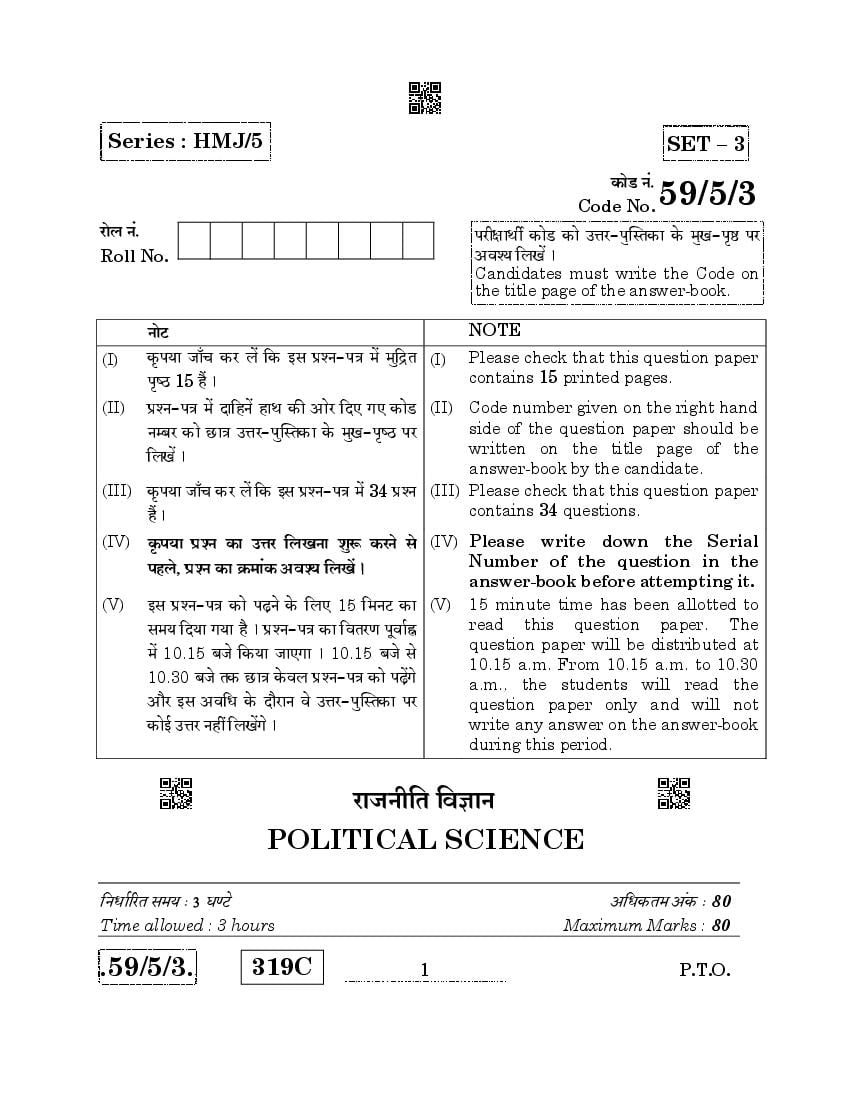
CBSE Class 12 Political Science Question Paper 2020 Set 59-5-3
Finished viewing? Save it for later —
Download CBSE Class 12 Political Science Question Paper 2020 Set 59-5-3 (PDF · 16 pages)About CBSE Class 12 Political Science Question Paper 2020 Set 59-5-3
CBSE Class 12 Political Science Question Paper 2020 Set 59-5-3 is available here for free download. Published by CBSE for Class 12, this question paper can be viewed online or downloaded as a PDF (16 pages). Candidates preparing for Class 12 can use CBSE Class 12 Political Science Question Paper 2020 Set 59-5-3 to understand the exam pattern, the type of questions asked, and the overall difficulty level.
Frequently Asked Questions
How can I download CBSE Class 12 Political Science Question Paper 2020 Set 59-5-3?
Open this page and click the Download button to save CBSE Class 12 Political Science Question Paper 2020 Set 59-5-3 as a PDF. It is completely free on AglaSem Docs.
Is CBSE Class 12 Political Science Question Paper 2020 Set 59-5-3 free to download?
Yes. CBSE Class 12 Political Science Question Paper 2020 Set 59-5-3 can be viewed online and downloaded as a PDF free of cost on AglaSem Docs.
How many pages does CBSE Class 12 Political Science Question Paper 2020 Set 59-5-3 have?
CBSE Class 12 Political Science Question Paper 2020 Set 59-5-3 contains 16 pages, which you can read online or download together as a single PDF.
Where can I find more Class 12 study material?
You can find more Class 12 question papers, sample papers, syllabus, and answer keys on AglaSem Docs.
CBSE Class 12 Political Science Question Paper 2020 Set 59-5-3 – Text
Read the full text of this question paper below — useful to quickly search, copy and reference the content online without downloading the PDF.
📄 View text version (16 pages)
Page 1
.
Code No. 59/5/3
. - -
Roll No.
Candidates must write the Code on
the title page of the answer-book.
NOTE
(I) - (I) Please check that this question paper
15 contains 15 printed pages.
(II) - (II) Code number given on the right hand
- - side of the question paper should be
written on the title page of the
answer-book by the candidate.
(III) - 34 (III) Please check that this question paper
contains 34 questions.
(IV) (IV) Please write down the Serial
, Number of the question in the
answer-book before attempting it.
(V) - 15 (V) 15 minute time has been allotted to
- read this question paper. The
question paper will be distributed at
10.15 10.15
10.15 a.m. From 10.15 a.m. to 10.30
10.30 - a.m., the students will read the
- question paper only and will not
write any answer on the answer-book
during this period.
POLITICAL SCIENCE
80
Time allowed : 3 hours Maximum Marks : 80
.59/5/3. 319C 1 P.T.O.
Page 2
(i) - – , , ,
(ii) - 1 20 1
20
(iii) - 21 23 2
40
(iv) - 24 27 4
100
(v) - 28 30
5 150
31
(vi) - 32 34 6
150
(vii)
(viii) - , - , -
:-:
(ix) , ,
–
1.
(a)
(b)
(c)
(d) 1
.59/5/3. 2
Page 3
Read the following instructions very carefully and strictly follow them :
(i) This question paper comprises five sections – A, B, C, D and E.
All questions are compulsory.
(ii) Section A – Q. no. 1 to 20 are very short-answer type questions carrying 1
mark each. They are required to be answered in one word or one sentence
each but not exceeding 20 words.
(iii) Section B – Q. no. 21 to 23 are short-answer type questions carrying 2
marks each. Answers to them should not exceed 40 words each.
(iv) Section C – Q. no. 24 to 27 are long-answer type questions carrying 4
marks each. Answers to them should not exceed 100 words each.
(v) Section D – Q. no. 28 to 30 are two passage based questions and one
picture OR cartoon based question carrying 5 marks each. Answers to them
should not exceed 150 words each.
Question No. 31 is a map question that includes identification of important
places on the basis given information. Write its answers in your answer-
book.
(vi) Section E – Question No. 32 to 34 are long answer type questions carrying
6 marks each. Answer to them should not exceed 150 words each.
(vii) Answer should be brief and to the point and the above word limit be
adhered to as far as possible.
(viii) There is no overall choice in the question paper. However, an internal
choice has been provided in 1 question of one mark, 1 question of four
marks and 3 questions of six marks. Only one of the choices in such
questions is to be attempted.
(ix) However, separate instructions are given with each section and
question, wherever necessary.
SECTION – A
1. Choose the correct option that has significantly contributed to the process
of ‘Globalization’.
(a) Fear of war
(b) Security threats
(c) Advancement of technology
(d) Achievements of the United Nations 1
.59/5/3. 3 P.T.O.
Page 4
3. -
“ 2002
” 1
4. 1
5. , ?
1
6. 2½=1
7.
_______ _______ ½+½=1
8. , ½+½=1
9. ?
(a)
(b)
(c)
(d) 1
10.
________ ________
½+½=1
1917 ________ ________
2½=1
11. ? 1
.59/5/3. 4
Page 5
3. Correct and rewrite the following statement in your answer book.
“India signed and ratified the Kyoto Protocol in 2002 and was compelled
to meet the requirements of the Kyoto Protocol because the emission of
green house gases in India was not significant”. 1
4. Explain the main objective of the United Nations. 1
5. In your opinion, which one of the following is better for India and why ?
Working against the Hegemon or Working with the Hegemon. 1
6. Name any two new member countries of the European Union. 2½=1
7. Fill in the blanks to make the given sentence meaningful.
Internet is an example of Global ________ ________. ½+½=1
8. Identify any two fields in which the Soviet Union lagged behind the West. ½ + ½ = 1
9. Which one of the following was NOT a consequence of disintegration of
the USSR ?
(a) Many new states emerged.
(b) Russia emerged as a new superpower.
(c) Power relations in world politics changed.
(d) The capitalist system emerged as the winner. 1
10. Complete the following sentence in a meaningful way.
The second world war ended when the United States dropped two atomic
bombs on the Japanese cities of _____ and _____. ½+½=1
OR
The Russian Revolution of 1917 was inspired by the ideals of ________ as
opposed to capitalism and the need for an ________ society. 2½=1
11. Who is considered to be the proponent of Bahujan Empowerment and
Founder of Bahujan Samaj Party ? 1
.59/5/3. 5 P.T.O.
Page 6
13. 1977 , ..
? 1
14. 1
15.
1
16. 1967 -
? 1
17. - (1962) , ?
(a)
(b)
(c)
(d) 1
18. - ,
? 1
19. ?
(a) (b)
(c) . (d) .. 1
20. 1951 2½ =1
–
21. ‘A’ ‘B’ 4½=2
‘A’ ‘B’
(i) (a)
(ii) . (b)
(iii) (c) .
(iv) (d) ..
.59/5/3. 6
Page 7
13. Why did the Janata Party government appoint a Commission of Inquiry
headed by Justice J.C. Shah in May 1977 ? 1
14. Analyse the root cause of the fall of the government headed by Morarji
Desai. 1
15. Highlight any one reason for India being more friendly with USSR during
the cold war period. 1
16. What main objective did Indira Gandhi want to achieve by launching a
series of initiatives under the Ten Point Programme in 1967 ? 1
17. Which one of the following statements related to the Indo-China war (1962)
is correct ?
(a) China could not cross the line of control.
(b) The Soviet Union remained neutral during the conflict.
(c) The Soviet Union helped China against India.
(d) The Chinese forces did not withdraw their troops back to earlier position. 1
18. According to the guidelines of the Second Five Year Plan, how did the
government try to protect the domestic industries ? 1
19. Which one of the following leaders played an important role in the
integration of princely states with India ?
(a) Jawaharlal Nehru
(b) Sardar Vallabhbhai Patel
(c) C. Rajagopalachari
(d) B.R. Ambedkar 1
20. Name any two important leaders of the Bharatiya Jana Sangh formed in
1951. 2½ =1
SECTION – B
21. Match correctly the following in Column ‘A’ with those in Column ‘B’. 4 ½ = 2
Column ‘A’ Column ‘B’
(i) The first Prime Minister of the Janata (a) Rammanohar Lohia
Party Government
(ii) The President of India elected after (b) Morarji Desai
the death of Dr. Zakir Hussain
(iii) The leader who had been the former (c) K. Kamraj
Chief Minister of Tamil Nadu and
then the President of Congress Party
(iv) The socialist leader best known for his (d) V.V. Giri
sharp attacks on Nehru.
.59/5/3. 7 P.T.O.
Page 8
23. - 4½=2
–
24. “ ”
41=4
25. 41=4
1+3=4
26. 1962 ?
41=4
27. 1989 4
–
28.
‘ ’
,
–
(i)
(ii) ?
(iii) 2+2+1=5
.59/5/3. 8
Page 9
countries. 1+1=2
23. Name any four countries that followed the policy of Non-alignment. 4½=2
SECTION – C
24. “European Union is a highly influential regional organization.” Justify the
statement with any four suitable arguments. 41=4
25. Describe any four features of the Congress party. 41=4
OR
Name any two founder leaders of the Swatantra Party. Describe any three
economic policies of this party. 1+3=4
26. How did China war of 1962 dirt India’s image at home and abroad.
Explain any four points. 41=4
27. Analyse the changes that took place during a long phase of coalition
politics in India since 1989. 4
SECTION – D
28. Study the passage given below carefully and answer the questions that follow :
The UN is an imperfect body, but without it the world would be
worse off. Given the growing connections and links between societies and
issues – what we often call ‘interdependence’ – it is hard to imagine how
more than seven billion people would live together without an
organization such as the UN. Technology promises to increase planetary
interdependence, and, therefore, the importance of the UN will only
increase. Peoples and governments will have to find ways of supporting
and using the UN and other international organisations in ways that are
consistent with their own interests and the interests of the international
community more broadly.
(i) Identify any two limitations of the United Nations that make it an
imperfect body.
(ii) How would the world be worse off, if there were no United Nations ?
Explain.
(iii) Give any one example of planetary interdependence. 2+2+1=5
.59/5/3. 9 P.T.O.
Page 10
(a) ?
(b)
(c)
? 1+2+2=5
: 29 :
(29.1) ,
?
(29.2)
(29.3)
1+2+2=5
30.
,
18
(i) ?
(ii)
(iii) ? 1+2+2=5
.59/5/3. 10
Page 11
(a) What is the significance of bicycles in a large country like China ?
(b) Highlight the message being given by the symbols shown in the two
wheels of the bicycle.
(c) Show with the help of any two examples how China has opened its
economy to other countries. 1+2+2=5
Note : The following questions are for the visually impaired candidates
only in lieu of question number 29.
(29.1) What measure was adopted by China to overcome the shortage of
foreign exchange under its earlier model of economy ?
(29.2) Highlight any two reasons for China to open its economy to other
countries.
(29.3) Highlight any two reforms made by China to grow its economy.
1+2+2=5
30. Read the given passage carefully and answer the questions that follow :
The opposition to Emergency could keep the Janata Party together
only for a while. Its critics felt that the Janata Party lacked direction,
leadership, and a common programme. The Janata Party Government
could not bring about a fundamental change in policies from those
pursued by the Congress. The Janata Party split and the government
which was led by Morarji Desai lost its majority in less than 18 months.
Another government headed by Charan Singh was formed on the
assurance of the support of the Congress party.
(i) In which year did the Janata Party government come to power ?
(ii) Analyse any two reasons responsible for the split of the Janata Party.
(iii) Why could the Charan Singh government remain in power for just
about four months only ? 1+2+2=5
.59/5/3. 11 P.T.O.
Page 12
A , B , C , D E
, ,
(i)
(ii)
(iii)
(iv)
(v)
(i) ,
(ii) 1963
(iii)
(iv) ( ) , ,
(v) 1957 51=5
.59/5/3. 12
Page 13
In the given political outline map of India, five states have been marked
as (A), (B), (C), (D) and (E). Identify these states on the basis of
information given below and write their correct names in your answer
book along with the respective serial number of the information used and
the concerned alphabet given in the map as per the following format.
Sr. No. of the Information used Concerned Alphabet Name of the State
(i)
(ii)
(iii)
(iv)
(v)
(i) The State from which Haryana was carved out.
(ii) The State which was created in 1963.
(iii) The State from which Jharkhand was carved out.
(iv) The State which was formed by separating Telugu speaking areas
from Madras (now Tamil Nadu).
(v) The State where the Communist Party Government was formed in
1957. 51=5
.59/5/3. 13 P.T.O.
Page 14
( ) :
(31.1) 1967 -
(31.2) 1952 ?
(31.3) ?
(31.4)
(31.5) ? 51=5
–
32. 1972 () (
) 4 1½ = 6
4 1½ = 6
33.
? 32=6
1979 1985
6
34. 6
61=6
_____________
.59/5/3. 14
Page 15
only in lieu of Qn. 31 (Map Question) :
(31.1) Name the State where the Congress Party could not win majority
in 1967 Assembly elections.
(31.2) Which State was formed in December 1952 ?
(31.3) From which State was Jharkhand carved out ?
(31.4) Name the State which had been earlier part of Andhra Pradesh.
(31.5) Lal-Denga was the leader of which Indian State ? 51=5
SECTION – E
32. Explain any four reforms proposed by the report brought out by The
United Nations Conference on Trade and Development (UNCTAD) in
1972 titled ‘Towards a New Trade Policy for Development’. 4 1½ = 6
OR
Explain any four issues of tension and conflicts in the former Soviet
Republics. 4 1½ = 6
33. Do you agree that popular movements go a long way in strengthening
democracy ? Justify your answer by giving any three suitable arguments.
32=6
OR
The Assam Movement from 1979 to 1985 is the best example of the
movements against ‘outsiders’. Support the statement with suitable
arguments. 6
34. Describe India’s stand on global environmental issues. 6
OR
Describe any six consequences of globalization. 61=6
_____________
.59/5/3. 15 P.T.O.
Page 16
Document Details
| Board / Org | CBSE |
| Exam | Class 12 |
| Type | Question Paper |
| Pages | 16 |
| Updated | 22 Jul 2026 |