AHSEC HS 2nd Year Syllabus 2026 Biology
Finished viewing? Save it for later —
Download AHSEC HS 2nd Year Syllabus 2026 Biology (PDF · 7 pages)About AHSEC HS 2nd Year Syllabus 2026 Biology
AHSEC HS 2nd Year Syllabus 2026 Biology is available here for free download. Published by Assam Board for Class 12, this syllabus can be viewed online or downloaded as a PDF (7 pages). Candidates preparing for Class 12 can use AHSEC HS 2nd Year Syllabus 2026 Biology to understand the exam pattern, the type of questions asked, and the overall difficulty level.
Frequently Asked Questions
How can I download AHSEC HS 2nd Year Syllabus 2026 Biology?
Open this page and click the Download button to save AHSEC HS 2nd Year Syllabus 2026 Biology as a PDF. It is completely free on AglaSem Docs.
Is AHSEC HS 2nd Year Syllabus 2026 Biology free to download?
Yes. AHSEC HS 2nd Year Syllabus 2026 Biology can be viewed online and downloaded as a PDF free of cost on AglaSem Docs.
How many pages does AHSEC HS 2nd Year Syllabus 2026 Biology have?
AHSEC HS 2nd Year Syllabus 2026 Biology contains 7 pages, which you can read online or download together as a single PDF.
Where can I find more Class 12 study material?
You can find more Class 12 question papers, sample papers, syllabus, and answer keys on AglaSem Docs.
AHSEC HS 2nd Year Syllabus 2026 Biology – Text
Read the full text of this syllabus below — useful to quickly search, copy and reference the content online without downloading the PDF.
📄 View text version (6 pages)
Page 1
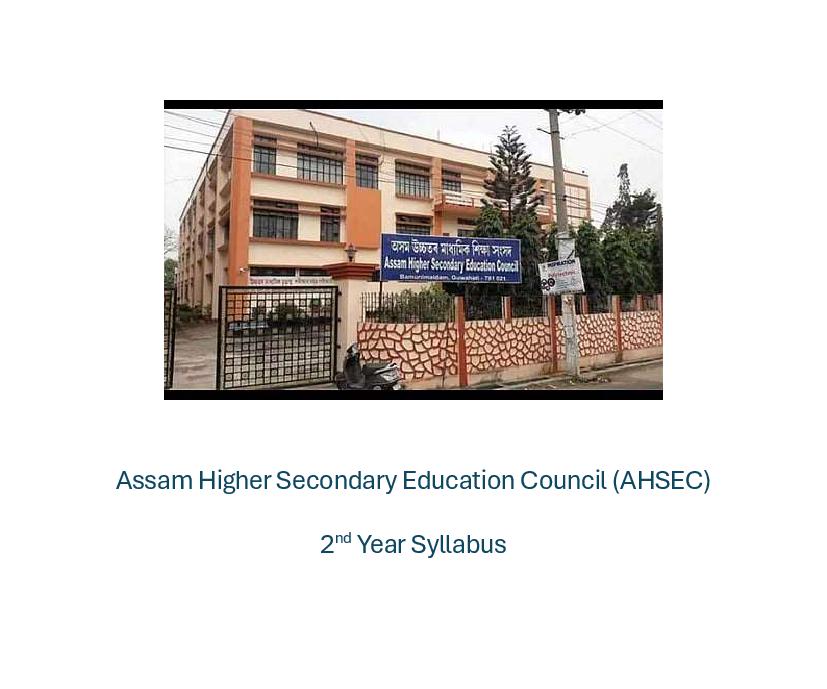
2nd Year Syllabus
Page 2
The present syllabus reinforces the ideas introduced in the lower classes while the students learn new
concepts besides getting an exposure to contemporary areas of the subject. The syllabus also aims at empha-
sizing on the underlying principles which are common to both animals and plants as well as highlighting the
relationship of biology with other areas of knowledge. The format of the syllabus allows a simple, clear,
consequential flow of concepts without any jarring jumps. The syllabus also stresses on the connection of the
study of Biology to real life problems, use of biological discoveries/innovations in everyday life– in environ-
ment, industry, health and agriculture. The updated syllabus also focuses on reducing the curriculum load while
ensuring that ample opportunities and scope for learning and appreciating basic concepts of the subject
continue to be available within its framework.
The prescribed syllabus is expected to
Promote understanding of basic principles of biology
encourage learning of emerging knowledge and its relevance to individual and society
Promote rational/specific attitude to issues related to population, environment and development
Enhance awareness about environmental issues and problems and the appropriate solutions
Create awareness amongst the learners about variations amongst the living, and developing respect for
the diversities and to appreciate that the most complex biological phenomena are also built on essen-
tially simple processes.
It is expected that the students would get an exposure to various branches of Biology in the syllabus in
a more contextual and friendly manner as they study its various units.
BIOLOGY
REVISED SYLLABUS FOR HIGHER SECONDARY FINALYEAR COURSE
One Paper (Theory) Marks-70 Time: 3 Hours
Unitwise Distribution of Marks and Periods
GROUP-A: BOTANY Marks Periods
Unit-VI: Sexual Reproduction (Chapter-1) 05 17
Unit-VII: Genetics and Evolution (Chapter-6) 05 13
Unit-VIII: Biology in Human Welfare (Chapter-8) 04 10
Unit-IX: Biotechnology and its application(Chapter-9&10) 12 30
Unit-X: Ecology (Chapter-12&14) 09 (03 marks compulsory 20
from chapter 14)
GROUP-B: ZOOLOGY
Unit-VI: Reproduction (Chapter-2&3) 08 20
Unit-VII: Genetics and Evolution (Chapter-4&5) 12 35
Unit-VIII: Biology in Human Welfare(Chapter-7) 05 12
Unit-IX: Biotechnology and its application 01 01
(Chapter-10: Only transgenic animals)
Unit-X: Ecology (Chapter-11,13&14) 09 (03 marks compulsory 22
from chapter 14)
Total 70 180
Page 3
Syllabi for H.S. Final Year
Unitwise Distribution of Course contents :
Unit-VI : Reproduction :
Chapter 1 : Sexual Reproduction in Flowering Plants : (i) Flower-An organ of sexual reproduction
of Angiosperms;
(ii) Pre-fertilization: Structures and Events; (iii) Double Fertilization; (iv) Post-fertilization: Struc-
tures and Events; (v) Apomisix and Polyembryony.
Chapter 2 : Human reproduction : (i) The Male Reproductive System; (ii) The Female Reproductive
System; (iii) Gametogenesis; (iv) Menstrual Cycle; (v) Fertilization and Implantation; (vi) Preg-
nancy and Embryonic Development; (vii) Parturition and Lactation.
Chapter 3 : Reproductive Health : (i) Reproductive Health-Problems and Strategies; (ii) Population
Stabilization and Birth Control; (iii) Medical Termination of Pregnancy; (iv) Sexually
Transmitted infection; (v) Infertility and Assisted Reproductive Technology
Unit-VII : Genetics and Evolution
Chapter 4 : Principles of Inheritance and Variation : (i) Mendel’s Laws of Inheritance; (ii) Inheritance of One
Gene; (iii) Inheritance of Two Genes; Chromosomal Theory of Inheritance; Linkage and
recombination (iv) Sex Determination; (v) Mutation; (vi) Genetic Disorders.
Chapter 5 : Molecular Basis of Inheritance : (i) The DNA; (ii) The Search for Genetic Material; (iii)
RNAWorld; (iv) Replication; (v) Transcription; (vi) Genetic Code; (vii) Translation; (viii) Regu-
lation of Gene Expression; (ix) Human Genome Project; (x) DNA Fingerprinting.
Chapter 6 : Evolution : (i) Origin of Life; (ii) Evolution of Life Formes- A Theory; (iii) Evidences for Evo-
lution; (iv)Adaptive Radiation; (v) Biological Evolution; (vi) Mechanism of Evolution; (vii) Hardy-
Weinberg Principle; (viii) A brief account of Evolution; (ix) Origin and Evolution of Man.
Unit-VIII : Biology in Human Welfare
Chapter 7 : Human Health and Diseases : (i) Common Diseases in Humans; Typhoid, Pneumonia,
Common Cold, Malaria, Amaebiasis, Ascariasis, Elephantiasis, Ringworm (ii) Immunity;
(iii) AIDS; (vi) Cancer; (v) Drugs and Alcohol Abuse.
Chapter 8: Microbes in Human Welfare : (i) Microbes in Household Products; (ii) Microbes in Indus-
trial Products; (iii) Microbes in Sewage Treatment; (iv) Microbes in Production of Biogas; (v)
Microbes as Biocontrol Agents; (vi) Microbes as Biofertilisers.
Unit-IX : Biotechnology
Chapter 9 : Biotechnology; Principles and Processes :
(i) Principles of Biotechnology; (ii) Tools of recombinant DNA Technology; (iii) Processes of
Recombinant DNATechnology.
Chapter 10: Biotechnology and its Application :
(i) Biotechnological Applications in Agriculture;
(ii) Biotechnological Applications in Medicine;
(iii) Transgenic Animals; (iv) Ethical Issues.
(iv) Ethical issues
Page 4
Syllabi for H.S. Final Year
Unit-X : Ecology
Chapter 11 : Organisms and Populations : (i) Organism and its Environment; (ii) Populations- Population
Attributes; Population Growth and Population Interactions.
Chapter 12 : Ecosystems : (i) Ecosystem- Structure and Function; (ii) Productivity; (iii) Decomposition;
(v) Energy Flow; (v) Ecological Pyramids;
Chapter 13 : Biodiversity and Conservation : (i) Biodiversity; (ii) Biodiversity Conservation; (iii) National
Park and Sanctuaries of Assam with special reference to conservation of endangered
species.
Chapter 14 : Bioresources of Assam : (i) Medicinal (Sarpagandha, Neem, Tulsi, Cinchona and Atropa)
Timber Yielding (Teak, Sal, Sissoo, Gomari, Hollong) Plants; (ii) Sericogenic Re-sources
(Muga and Eri)
SYLLABUS FOR BOTANY PRACTICAL
Total: Marks-15
(Practical Performance: 12)
(Practical Record book: 03)
1. Study of the reproductive parts of different flowers.
2. Study of flowers adapted to pollination by different agencies (wind, insect).
3. Study of percentage of pollen germination on a slide.
4. To study pollen tube growth on the stigma.
5. To study fruits and seeds of any common fruit (e.g. legume) at different stages of development.
6. To study mitosis in onion root tips (preparation).
7. To study meiosis in onion buds (permanent slide)
8. Exercise on controlled pollination– emasculation, tagging and bagging.
9. To study the pH and water holding capacity of soil. Correlate with the kinds of plants found in them.
10. Study plants found in dry conditions. Comment ‘on their adaptations/ ecosystems.
11. To study plants of aquatic conditions. Comment on their adaptations/ ecosystems.
12. Study of plant population density by quadrat method.
13. Study of plant population frequency by quadrat method.
14. To study analogous and homologous organs in various plants.
15. Preparation of a practical record book
Page 5
SYLLABUS FOR ZOOLOGY PRACTICAL
Total: Marks-15
(Practical Performance: 12)
(Practical Record book: 03)
1. Study and identify stages of gamete development in T.S. of testis and T.S. of ovary of mammal.
2. Study of T.S. of blastula stage of mammal through permanent slide.
3. Study of Mendelian inheritance using seeds of different colours/ size of any plant.
4. Prepare pedigree charts for genetic traits such as rolling of tongue, haemophilia, and
colourblindness.
5. To identify common ‘disease causing organisms’like Ascaris, Entamoeba, Plasmodium, Microsporum.
Comment on the symptoms of the disease that they cause.
6. Collect and study soil from different sites and study them for texture and moisture content.
7. Study of animals found in dry conditions. Comment on their adaptations.
8. Study of animals of aquatic conditions. Comment on their adaptations.
9. Collect water from different water bodies around you and study them for pH, clarity and presence of
any living organisms.
10. Study the amount of suspended particulate matter in air at the two widely different sites.
11. To study analogous and homologous organs in various animals.
12. Preparation of a practical Record Book.
***
Prescribed Books:
1.•Biology, (English) Published by NCERT.
2.•Jiva Bigyan, (Assamese) Published by ASSEB DIV-II.
Page 7
Notes
Model Papers Class 6 Notes
Sample Papers Class 7 Notes
Half Yearly Sample Papers Class 8 Notes
Class 9 Notes
Important Resources
Class 10 Notes
Periodic Table
Class 11 Notes
Writing Skills / Formats
Maps of India / World Class 12 Notes
Books and Solutions
NCERT Books
NCERT Book Solutions
HC Verma Chapter Wise Solutions
RD Sharma Solutions
CGBSE Solutions
Document Details
| Board / Org | Assam Board |
| Exam | Class 12 |
| Type | Syllabus |
| Pages | 7 |
| Updated | 24 Sep 2026 |