NCERT Solutions Class 8 Maths Chapter 10 Proportional Reasoning 2
Finished viewing? Save it for later —
Download NCERT Solutions Class 8 Maths Chapter 10 Proportional Reasoning 2 (PDF · 43 pages)About NCERT Solutions Class 8 Maths Chapter 10 Proportional Reasoning 2
NCERT Solutions Class 8 Maths Chapter 10 Proportional Reasoning 2 is available here for free download. Published by NCERT for Class 8, this solution can be viewed online or downloaded as a PDF (43 pages). Candidates preparing for Class 8 can use NCERT Solutions Class 8 Maths Chapter 10 Proportional Reasoning 2 to understand the exam pattern, the type of questions asked, and the overall difficulty level.
Frequently Asked Questions
How can I download NCERT Solutions Class 8 Maths Chapter 10 Proportional Reasoning 2?
Open this page and click the Download button to save NCERT Solutions Class 8 Maths Chapter 10 Proportional Reasoning 2 as a PDF. It is completely free on AglaSem Docs.
Is NCERT Solutions Class 8 Maths Chapter 10 Proportional Reasoning 2 free to download?
Yes. NCERT Solutions Class 8 Maths Chapter 10 Proportional Reasoning 2 can be viewed online and downloaded as a PDF free of cost on AglaSem Docs.
How many pages does NCERT Solutions Class 8 Maths Chapter 10 Proportional Reasoning 2 have?
NCERT Solutions Class 8 Maths Chapter 10 Proportional Reasoning 2 contains 43 pages, which you can read online or download together as a single PDF.
Where can I find more Class 8 study material?
You can find more Class 8 question papers, sample papers, syllabus, and answer keys on AglaSem Docs.
NCERT Solutions Class 8 Maths Chapter 10 Proportional Reasoning 2 – Text
Read the full text of this solution below — useful to quickly search, copy and reference the content online without downloading the PDF.
📄 View text version (38 pages)
Page 1
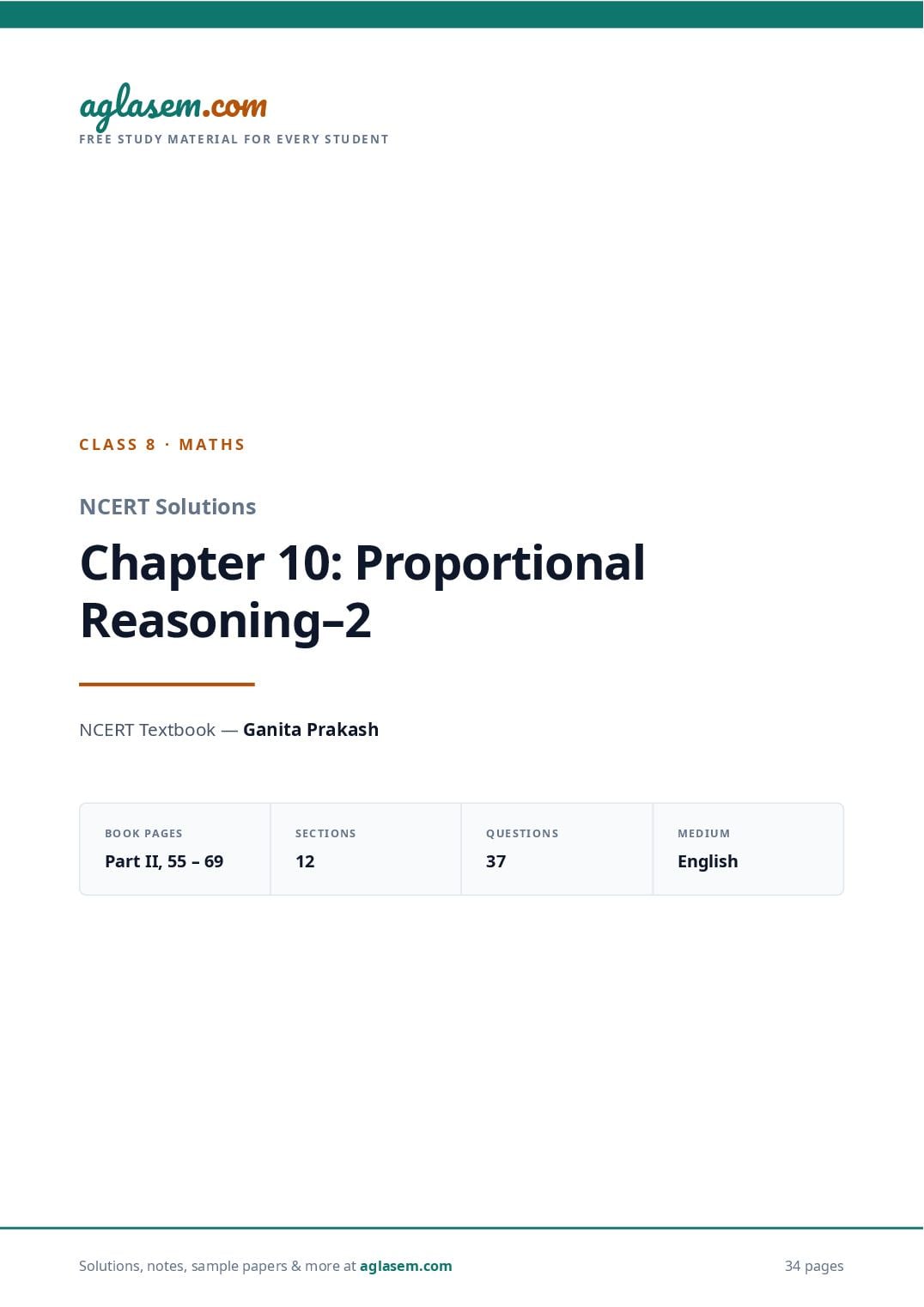
C L A S S 8 · M AT H S
NCERT Solutions
Chapter 10: Proportional
Reasoning–2
NCERT Textbook — Ganita Prakash
BOOK PAGES SECTIONS QUESTIONS MEDIUM
Part II, 55 – 69 12 37 English
Solutions, notes, sample papers & more at 37 pages
Page 2
CLASS 8 · MATHS · GANITA PRAKASH
NCERT Solutions — Chapter 10: Proportional
Reasoning–2
Chapter 3 of Ganita Prakash Part II picks up proportional reasoning where Part I left it. It stretches ratios to
three, four or more terms, reads the scale (RF) printed on a map, cuts a whole into a given ratio to build a
pie chart, and then turns the idea around to meet inverse proportion — where the two quantities still
change by the same factor, but in opposite directions.
TEXTBOOK BOOK PAGES
Ganita Prakash (Class 8) Part II, 55 – 69
SECTIONS QUESTIONS
12 37
MEDIUM
English
In-text Questions — Page 55
Section 3.1 Proportionality — A Quick Recap
Q1 Viswanath made idlis by mixing 6 cups of rice with 3 cups of urad dal, while Puneet
made idlis by mixing 4 cups of rice with 2 cups of urad dal. If cooked in the same
way, would their idlis taste the same?
Yes — the two batters are mixed in the same proportion.
Viswanath’s mixture = 6 : 3 Puneet’s mixture = 4 : 2
Cross-multiplication: 6 × 2 = 12
3 × 4 = 12
The two products are equal, so 6 : 3 :: 4 : 2
Both reduce to 2 : 1 — twice as much rice as urad dal.
Why it happens: Taste depends on the proportion of rice to urad dal, not on how
much batter is made. Viswanath used 9 cups in all and Puneet 6 cups, but in both
mixtures every 2 cups of rice is matched by 1 cup of dal. Scaling a recipe up or down
by a common factor leaves the proportion untouched.
Page 1 of 37
Page 3
Tip: The book adds a fair condition — “if all the other ingredients are proportional
too”. Same salt, same soaking, same fermenting time. Only then does equal
proportion mean equal taste.
In-text Questions — Page 56
Section 3.2 Ratios in Maps
Q1 Have you noticed that in many maps there is a ratio given, usually in the lower
right corner of the map? It usually contains 1 and a very large number, such as 1 :
60,00,000. What does RF 1 : 60,00,000 mean? What does it indicate? Can you guess?
72°E 74°E 76°E 78°E 80°E 82°E 84°E 86°E
18°N N 18°N
Vishakhapatnam
Hyderabad
16°N 16°N
14°N ARABIAN B AY O F 14°N
Tirupati
SEA BENGAL
Chennai
Mangaluru Bengaluru
12°N Mysuru LEGEND 12°N
Kannur Puducherry CITY
Coimbatore
10°N 10°N
Kochi Madurai
Thiruvananthapuram
8°N Map not to scale R F = 1 : 60,00,000 8°N
72°E 74°E 76°E 78°E 80°E 82°E 84°E 86°E
The map printed with this question on page 56, with its ratio in the lower-right corner.
It is the map’s scale: one unit of length on the paper stands for 60,00,000 of the same units on
the ground.
Page 2 of 37
Page 4
1 cm on the map → 60,00,000 cm on the ground
1 mm on the map → 60,00,000 mm on the ground
1 inch on the map → 60,00,000 inches on the ground
Why it happens: An RF compares a length with a length, so the units cancel and the
ratio has no unit at all. That is exactly why the same number works whichever ruler
you pick up. It is called a Representative Fraction because it can also be written as the
fraction 1/60,00,000.
A bigger second term (1 : 1,00,00,000) squeezes more ground onto the sheet, so the map
shows a larger area in less detail.
A smaller second term (1 : 50,000) is a close-up — a city map — with much more detail.
The distance you get is the geographical (straight-line) distance, not the road distance.
Roads bend, so a road is always longer.
Q2 Convert 60,00,000 cm to kilometres. (It is 60 km. Verify this.)
Divide twice — once to reach metres, once to reach kilometres.
60,00,000 cm ÷ 100 = 60,000 m
60,000 m ÷ 1000 = 60 km
Why it happens: 1 m = 100 cm and 1 km = 1000 m, so 1 km = 1,00,000 cm. Then
60,00,000 ÷ 1,00,000 = 60 in one step. So the scale 1 : 60,00,000 can be read as the
handy sentence “1 cm on the map = 60 km on the ground”.
Page 3 of 37
Page 5
Class 8 Maths Chapter 10 Proportional Reasoning–2
a g l AglaSem · NCERT Solutions
co m
m.
Using the map above, can you find the geographical distance between Bengaluru
se
Q3
o m l a
and Chennai? Also, find the geographical distance between Mangaluru and
g on the map. Then,
m .c [Hint: Use a ruler to find the distance between the cities
Chennai. a
l a se the ratio given on the map to find the actual geographical distance.]
use
a g
com
72°E 74°E 76°E 78°E 80°E 82°E 84°E 86°E
18°N
e m . N 18°N
ag
a s
agl
Vishakhapatnam
Hyderabad
16°N 16°N
co m
e m.
m l as
.co a g
14°N ARABIAN B AY O F 14°N
Tirupati
se m
l a
SEA BENGAL
a g
Chennai
Mangaluru Bengaluru
12°N Mysuru LEGEND 12°N
s
Puducherry
m a
Kannur CITY
m
Coimbatore
.co agl
l a se
g
10°N 10°N
a
Kochi Madurai
m
.co
Thiruvananthapuram
8°N Map not to scale R F = 1 : 60,00,000 8°N
a s em
comThe map on page 56. Measure between the city dots, thenaguse the ratio printed on the
72°E 74°E 76°E 78°E 80°E 82°E 84°E 86°E
. l
e m
g l as map.
a
se m
com g l a
m . a
e
l s two dots, then multiply by the scale.
athe
a g
Measure the straight line joining
co m
.
Ground distance = (map distance in cm) × 60 km
em
m l as
.co a g
emabout 4.9 cm from Mangaluru to Chennai.
On the map printed in the book, a ruler gives about 2.4 cm from Bengaluru to Chennai and
a s
agl
.c
PAIR OF CITIES MAP DISTANCE × 60 KM ACTUAL STRAIGHT-LINE DISTANCE
s e m
m a
Bengaluru – Chennai
e m . co agl
as
about 2.4 cm about 145 km about 290 km
Mangaluru – Chennai
a g l
about 4.9 cm about 295 km about 590 km
co m
m .
m as e
.co
a g l Page 4 of 37
Page 6
Why the two columns disagree: Look at the bottom-left corner of the map — it
says “Map not to scale”. The picture has been reduced to fit the textbook page, so on
the printed page 1 cm actually stands for about 120 km, not 60 km. Every answer
read off this page therefore comes out about half the true distance. The method is
correct; the printed scale is not. You can see the method is sound from the ratio: 4.9
÷ 2.4 ≈ 2.05, and the real distances 590 ÷ 290 ≈ 2.03 — the map’s shape is faithful
even though its scale label is not.
Check it yourself: Use the latitude–longitude grid printed on the map instead.
Bengaluru and Chennai are about 2.7° of longitude apart near 13°N, and one degree
of longitude there is about 108 km — giving roughly 290 km. Then measure the
same two cities on an atlas map that carries its own scale and see the two answers
agree.
In-text Questions — Page 57
Sections 3.2 Ratios in Maps · 3.3 Ratios with More than 2 Terms
TRY THIS
Q1 Try to find the distances between the same two pairs of cities with different maps
that have different scales (ratios). Do they all give the same geographical distance,
approximately?
Yes — every correctly drawn map gives roughly the same ground distance, even though the
ruler readings are all different.
SCALE (RF) 1 CM STANDS BENGALURU–CHENNAI GROUND
FOR MEASURES DISTANCE
1 : 60,00,000 60 km about 4.8 cm about 290 km
1: 120 km about 2.4 cm about 290 km
1,20,00,000
1 : 30,00,000 30 km about 9.7 cm about 290 km
Page 5 of 37
Page 7
Why it happens: The ground distance is fixed by geography, so it is the constant
here. Map length × scale factor = ground distance. When the scale factor doubles,
the length on paper halves — the two change by opposite factors and their product
stays 290 km. This is the very first inverse relationship in the chapter, met before it is
named in Section 3.6.
Tip: The answers will not match to the last kilometre. Ruler markings, the thickness
of the printed dots, and the way a round Earth is flattened onto a flat sheet all add
small errors. “Approximately the same” is the honest claim.
Q2 Map Making Activity: Guide students to make a sketch of their classroom with an
accurate scale (ratio of 1 : 50). They should mark the location of various objects in
the classroom like the teacher’s desk, blackboard, fans and lights, according to
scale. Students can use appropriate symbols to represent different objects like fans,
lights, tables, chairs, and so on.
At 1 : 50, every 50 cm of the real classroom becomes 1 cm on your sheet.
1 cm on the sketch = 50 cm on the floor
So 1 m (= 100 cm) on the floor = 2 cm on the sketch
Measure the room and its objects with a metre scale or measuring tape, then divide every
length by 50:
OBJECT REAL SIZE SIZE ON THE SKETCH
Classroom floor 8m×6m 16 cm × 12 cm
Blackboard 3 m long 6 cm long
Teacher’s desk 1.5 m × 0.75 m 3 cm × 1.5 cm
Student bench 1 m × 0.3 m 2 cm × 0.6 cm
Door 0.9 m wide 1.8 cm wide
Draw the outline of the room first, then place each object at its measured distance from a
wall — position must be to scale as well as size.
Page 6 of 37
Page 8
A fan or a light has no useful floor size, so mark it with a symbol and explain the symbols in
a legend, exactly as the map on page 56 explains its red dot as CITY.
Write “Scale 1 : 50” in a corner. A drawing without its scale cannot be measured by anyone
else.
Why it happens: Every length shrinks by the same factor of 50, so all ratios inside
the room survive. A desk twice as long as another is still twice as long on paper. That
is what makes a scale drawing trustworthy — and it is the same reason the shapes
on a map keep their form.
Q3 Puneet has only 2 red chillies in his kitchen. But he wants to make spice mix powder
that tastes the same as Viswanath’s spice mix powder. How much of the other
ingredients should Puneet use to make his spice mix powder?
Halve every ingredient, because the chillies have been halved.
Viswanath — coriander : chillies : toor dal : fenugreek = 8 : 4 : 2 : 1
Puneet has 2 chillies, and 2 = 4 × ½
So multiply every term by ½:
8 × ½ = 4 spoons of coriander seeds
4 × ½ = 2 red chillies
2 × ½ = 1 spoon of toor dal
1 × ½ = 0.5 spoon of fenugreek seeds
4 : 2 : 1 : 0.5, and 8 : 4 : 2 : 1 :: 4 : 2 : 1 : 0.5
Why it happens: A four-term ratio is a statement about all the pairs at once. If only
the chillies were halved, the coriander-to-chilli ratio would jump from 2 : 1 to 4 : 1
and the powder would taste quite different. Multiplying every term by the same
factor is the only change that leaves all these internal ratios alone.
Check it yourself: 8/4 = 4/2 = 2/1 = 1/0.5 = 2. One common factor, four times over —
that is the test the book states as a/p = b/q = c/r = d/s.
Page 7 of 37
Page 9
In-text Questions — Page 58
Section 3.3 Ratios with More than 2 Terms
Q1 What is the total volume of this purple paint? (Red : Blue : White :: 2 : 3 : 5, with 4
litres of red, 6 litres of blue and 10 litres of white.)
Add the three amounts.
4 + 6 + 10 = 20 litres
Why it happens: There is a quicker route that does not need the individual amounts
at all. The ratio 2 : 3 : 5 has 2 + 3 + 5 = 10 parts in total, and white is 5 of them —
exactly half the mixture. So if the white paint is 10 litres, the whole batch must be 20
litres.
Tip: Adding the terms of a ratio to get the “number of parts in the whole” is the
single most useful move in this chapter. It is what Section 3.4 turns into a formula.
Figure it Out — Page 60
Section 3.4 Dividing a Whole in a Given Ratio
MATH TALK
Q1 A cricket coach schedules practice sessions that include different activities in a
specific ratio — time for warm-up/cool-down : time for batting : time for bowling :
time for fielding :: 3 : 4 : 3 : 5. If each session is 150 minutes long, how much time is
spent on each activity?
Add the terms, find the value of one part, then multiply back.
Page 8 of 37
Page 10
Class 8 Maths Chapter 10 Proportional Reasoning–2
a g l AglaSem · NCERT Solutions
co m
e m.
Number of parts = 3 + 4 + 3 + 5 = 15
m l as
.co
One part = 150 ÷ 15 = 10 minutes
m a g
l a se
g
Warm-up/cool-down = 3 × 10 = 30 minutes
aBatting = 4 × 10 = 40 minutes
com
. ag
Bowling = 3 × 10 = 30 minutes
e m
Fielding = 5 × 10 = 50 minutes
g l as
a
m
Check: 30 + 40 + 30 + 50 = 150 minutes. ✓
co
se m.
o m l a
Why it happens: The ratio does not say how long anything lasts — it says how the
g of 10 minutes each
m .c are shared. Cutting the session into 15 equal parts a
se handing out 3, 4, 3 and 5 of them is exactly what the formula 150 × 3/15, 150 ×
150 minutes
g l a
and
a 4/15, … is doing.
om a s
. c
m — 5 parts out of 15, that is one-third of the
Tip: Fielding gets the largest sliceehere agl
a s
whole session.
agl
co m
m .
o m l a se
A school library has books in different languages in the following ratio — no. of
.cOdiya books : no. of Hindi books : no. of English books a::g3 : 2 : 1. If the library has 288
Q2
se m Odiya books, how many Hindi and English books does it have?
g l a
a
se m
cis.omSo find the value of one part from that term. a
. a g l
em
Here the whole is not given — one term
a s
agl
Odiya = 3 parts = 288 books
co m
.
One part = 288 ÷ 3 = 96 books
em
m l as
.co
Hindi = 2 parts = 2 × 96 = 192 books
a g
a s em English = 1 part = 96 books
agl
.c
Total in the library = 288 + 192 + 96 = 576 books.
s e m
m a
e m . co agl
g l as
a
com
m .
m ase
.co
a g l Page 9 of 37
Page 11
Why it happens: This is the mirror image of Q1. There the whole was known and the
parts unknown; here one part is known and the whole is unknown. Both are solved
by the same single number — the size of one part. Once you have it, every term of
the ratio can be filled in by multiplication.
Check it yourself: 288 : 192 : 96, divided throughout by their HCF 96, gives back 3 : 2
: 1.
Q3 I have 100 coins in the ratio — no. of ₹10 coins : no. of ₹5 coins : no. of ₹2 coins : no.
of ₹1 coins :: 4 : 3 : 2 : 1. How much money do I have in coins?
The ratio counts coins, not rupees — so divide the 100 coins first, and only then work out the
money.
Number of parts = 4 + 3 + 2 + 1 = 10
One part = 100 ÷ 10 = 10 coins
COIN PARTS NUMBER OF COINS VALUE
₹10 4 40 ₹400
₹5 3 30 ₹150
₹2 2 20 ₹40
₹1 1 10 ₹10
Total 10 100 coins ₹600
Why it happens: The number of coins is in the ratio 4 : 3 : 2 : 1, but the money is in
the ratio 400 : 150 : 40 : 10, which is not 4 : 3 : 2 : 1. Each count has been multiplied
by a different value (10, 5, 2, 1), so the proportion is destroyed. A ratio only survives
multiplication by the same factor.
Page 10 of 37
Page 12
Q4 Construct a triangle with sidelengths in the ratio 3 : 4 : 5. Will all the triangles
drawn with this ratio of sidelengths be congruent to each other? Why or why not?
Choose any convenient unit — say 1 unit = 1 cm — and the sides become 3 cm, 4 cm and 5 cm.
1. Draw the longest side AB = 5 cm.
2. With A as centre and radius 4 cm, draw an arc.
3. With B as centre and radius 3 cm, draw another arc cutting the first at C.
4. Join AC and BC. Triangle ABC has sides 3 : 4 : 5.
Sides 3 : 4 : 5 Sides 4.5 : 6 : 7.5, still 3 : 4 : 5
7.5 cm
4.5 cm
5 cm
3 cm
4 cm 6 cm
Same ratio, same shape, different size — similar but not congruent.
No, they will not all be congruent.
Why it happens: The ratio fixes only the shape. Taking 1 unit = 1.5 cm gives sides 4.5
cm, 6 cm and 7.5 cm — still in the ratio 3 : 4 : 5, since 4.5 : 6 : 7.5 divided by 1.5 is 3 : 4
: 5. Its three angles are equal to those of the first triangle, but every side is 1.5 times
as long, so it cannot be placed exactly on top of the first one. Congruence needs the
sides to be equal, not merely proportional. Triangles like these, with equal angles
and proportional sides, are called similar.
Page 11 of 37
Page 13
Did you know? Any triangle with sides in the ratio 3 : 4 : 5 is right-angled, because 3²
+ 4² = 9 + 16 = 25 = 5². By the Baudhāyana–Pythagoras theorem of the previous
chapter, the angle opposite the longest side is 90°. This is why a knotted 3–4–5 rope
is still used by masons to set out a right angle on site.
Q5 Can you construct a triangle with sidelengths in the ratio 1 : 3 : 5? Why or why not?
No. Such a triangle cannot exist, whatever unit you choose.
Let the sides be 1 unit, 3 units and 5 units.
Sum of the two shorter sides = 1 + 3 = 4 units
Longest side = 5 units
4 < 5 — the two shorter sides together are still shorter than the longest side.
Sides in the ratio 1 : 3 : 5
1 3
gap
5
1 + 3 = 4, which is less than 5
The two shorter sides, laid flat against the longest side, together fall short of it — so their ends can
never meet above it.
Page 12 of 37
Page 14
Why it happens: In any triangle, the sum of any two sides must be greater than the
third — the straight route from one end of the base to the other can never be longer
than a bent route between the same two points. Draw the base 5 units long and
swing the two short sides inwards: their tips fall 1 unit apart and no vertex is formed.
Compare this with Q4, where 3 + 4 = 7 > 5, so the arcs do cross.
Try This: The angle ratio 1 : 3 : 5 does work — it gives 20°, 60° and 100° (Example 5).
Ratios of angles only have to add to 180°; ratios of sides must also pass the triangle
inequality.
In-text Questions — Page 61
Page 13 of 37
Page 15
Class 8 Maths Chapter 10 Proportional Reasoning–2
a g l AglaSem · NCERT Solutions
Section 3.5 A Slice of the Pie
co m
em.
m l as
.co
How do we mark the different slices of the pie chart?
a g
em
Q1
a s
agl GRADE A B C D E
com
Students 12 10 8 6 4
e m . ag
la s
ag
Grade Distribution (40 students)
E
co m
e m.
m l as
.co A
a g
a s em 4 D
ag l 12
6
m a s
m .co agl
l a se
a g 8
10
co m
C
m .
m as e
.co a g l
m
ase
B
agl
m
The pie chart of grades shown on page 60, drawn from the table above.
a se
. com a g l
m
ase
agl
Give each grade an angle at the centre in proportion to the number of students who scored it.
co m
m .
as e
com A : B : C : D : E = 12 : 10 : 8 : 6 : 4 l
Whole circle = 360° stands for all 40 students
.Students a g
se m
g l a
a So divide 360° in the ratio 12 : 10 : 8 : 6 : 4
c
m .
m a s e
e m . co agl
g l as
a
co m
m .
m as e
.co
a g l Page 14 of 37
Page 16
GRADE STUDENTS SHARE OF THE WHOLE ANGLE AT THE CENTRE
A 12 12/40 × 360° 108°
B 10 10/40 × 360° 90°
C 8 8/40 × 360° 72°
D 6 6/40 × 360° 54°
E 4 4/40 × 360° 36°
Total = 108 + 90 + 72 + 54 + 36 = 360°. ✓
Why it happens: A pie chart works because the whole circle already is a whole —
360° of it. Sharing those 360° in the ratio of the data means the size of a slice you
see is exactly the share of students it stands for. The eye compares areas without any
arithmetic, which is why the chart can be read at a glance.
Tip: The angles must add to 360°. If yours do not, one of them is wrong — check
before you pick up the protractor.
Q2 Can we reduce this ratio to its simplest form?
Yes — divide every term by the HCF of all the terms.
12 : 10 : 8 : 6 : 4
HCF of 12, 10, 8, 6 and 4 = 2
Divide throughout by 2: 6 : 5 : 4 : 3 : 2
Sum of terms = 6 + 5 + 4 + 3 + 2 = 20
One part = 360° ÷ 20 = 18°
Grade A = 6 × 18° = 108°, B = 5 × 18° = 90°, C = 72°, D = 54°, E = 36°
Page 15 of 37
Page 17
Why it happens: Reducing works for a ratio with many terms exactly as it does for
two terms, because dividing every term by the same number leaves all the internal
ratios unchanged. And it makes the arithmetic lighter: 360 ÷ 20 = 18 is easier to work
with than 360 ÷ 40 = 9 applied to two-digit counts. Notice the angles come out the
same either way — as they must.
Check it yourself: 6 : 5 : 4 : 3 : 2 cannot be reduced further, since the HCF of 6, 5, 4, 3
and 2 is 1.
Figure it Out — Page 62
Section 3.5 A Slice of the Pie
Q1 A group of 360 people were asked to vote for their favourite season from the three
seasons — rainy, winter and summer. 90 liked the summer season, 120 liked the
rainy season, and the rest liked the winter. Draw a pie chart to show this
information.
First find the missing count, then turn each count into an angle.
Winter = 360 − 90 − 120 = 150 people
Summer = 90/360 × 360° = 90°
Rainy = 120/360 × 360° = 120°
Winter = 150/360 × 360° = 150°
Total = 90° + 120° + 150° = 360° ✓
Page 16 of 37
Page 18
Rainy — 120
Winter — 150
90°
120° Summer — 90
150°
Favourite season of 360 people. Winter takes the largest slice.
To draw it: mark a centre O, draw a circle and one radius OA. Measure 120° from OA for rainy,
then 150° from that new radius for winter; the 90° that remains is summer. Label and colour the
slices.
Why it happens: With exactly 360 people surveyed, the arithmetic collapses to a
lucky shortcut — one person = one degree, since 360/360 = 1. That is only a
coincidence of this question. With 40 students the earlier example needed 9° per
student, and with 50 people it would be 7.2° per person.
Q2 Draw a pie chart based on the following information about viewers’ favourite type
of TV channel: Entertainment — 50%, Sports — 25%, News — 15%, Information —
10%.
Here the data is already given as a share of the whole, so multiply each percentage by 360°.
Page 17 of 37
Page 19
Angle = percentage/100 × 360° = percentage × 3.6°
Entertainment = 50 × 3.6° = 180° (half the circle)
Sports = 25 × 3.6° = 90° (a quarter)
News = 15 × 3.6° = 54°
Information = 10 × 3.6° = 36°
Total = 180° + 90° + 54° + 36° = 360° ✓
Entertainment 50%
36° Sports 25%
54° News 15%
180° Information 10%
90°
Viewers’ favourite type of TV channel.
Why it happens: A percentage is already a ratio to 100, so 50 : 25 : 15 : 10 is the ratio
of the four groups. Dividing 360° in that ratio needs 360 ÷ 100 = 3.6° for each 1%.
Notice that the number of viewers is never mentioned and is never needed — a pie
chart shows proportions, not totals.
Tip: The percentages add to 50 + 25 + 15 + 10 = 100, so nothing is missing. If they
had added to less than 100, the leftover would be an “Others” slice.
Page 18 of 37
Page 20
Class 8 Maths Chapter 10 Proportional Reasoning–2
a g l AglaSem · NCERT Solutions
co m
m.
Prepare a pie chart that shows the favourite subjects of the students in your class. You
se
Q3
o m l a
data of the number of students for each subject shown in the table (each student shou
m .c Then write these numbers in the table and constructaga pie chart. (Subjects: La
subject).
l a se
Education, Vocational Education, Social Science, Physical Education, Maths, Science)
a g
SUBJECT LANGUAGE ARTS VOCATIONAL SOCIAL PHYSICAL M
co m EDUCATION
. ag
EDUCATION SCIENCE EDUCATION
e m
Number
g l as
of a
Students
co m
em.
m l as
m .co a g
l a se
g
This is a survey of your own class, so your numbers will be your own. Here is the method,
a worked out on a sample class of 40 students.
m a s
m .co
Angle for a subject = (number of students choosing it) ÷ (total students) × 360° agl
l a se
a
For 40 students, one student = 360° ÷ 40 = 9°
g
co m ANGLE
SUBJECT NUMBER OF STUDENTS WORKING
m .
m as e
.co
Language 6
a g l6 × 9° 54°
s m
eArts
gl a
a
Education 3 3 × 9° 27°
Vocational Education 2 2 × 9° 18°
se m
com g l a
m . a
ase
Social Science 5 5 × 9° 45°
Physical Education ag8l 8 × 9° 72°
m
.co
Maths 9 9 × 9° 81°
se m
com
Science
l a
7 7 × 9° 63°
.Total a g
e m
as
agl
40 360°
.c
Now draw a circle, mark one radius, and lay off 54°, 27°, 18°, 45°, 72°, 81° and 63° one after
s e m
m a
co agl
another with a protractor. Label and colour each slice.
m .
as e
a g l
co m
m .
m ase
.co
a g l Page 19 of 37
Page 21
Why it happens: Two rules keep the chart honest. Each student must choose exactly
one subject, otherwise the counts would add to more than the class strength and
the slices would not fill the circle. And the angles must add to 360°, which is a useful
arithmetic check on your table before you draw anything.
Check it yourself: If your class has 45 students, one student is 360° ÷ 45 = 8°. If it
has 36, one student is 10°. When the total does not divide 360 exactly, round the
angles to the nearest degree and adjust the largest slice so that the total is still 360°.
In-text Questions — Page 63
Section 3.6 Inverse Proportions
MATH TALK
Q1 Can we represent this problem with the following statement of proportionality —
30 : 60 :: 3 : x ? Will the travel time increase or decrease as the speed of the
motorcycle increases?
No, that statement is wrong here. As the speed increases, the travel time decreases.
If we wrongly wrote 30 : 60 :: 3 : x, the rule of three would give
x = (60 × 3) ÷ 30 = 6 hours — longer than the motorcycle took
But a car at 60 km/h cannot take more time than a motorcycle at 30 km/h!
The correct statement keeps the product fixed:
speed × time = distance
30 × 3 = 60 × x
x = 90 ÷ 60 = 1.5 hours
Page 20 of 37
Page 22
Why it happens: Writing a : b :: c : d assumes the two quantities rise and fall
together. Speed and time do not: the distance from Lucknow to Kanpur is fixed at 90
km, so every extra km/h eats into the time. Doubling the speed from 30 to 60 halves
the time from 3 hours to 1.5 hours. The two quantities still change by the same
factor — 2 and ½ — but in opposite directions, which is what makes this an inverse
proportion.
Tip: Before setting up any proportion, ask yourself a single question: if this quantity
gets bigger, does the other get bigger or smaller? Bigger together → divide (keep the
quotient fixed). One bigger, one smaller → multiply (keep the product fixed).
In-text Questions — Page 64
Section 3.6 Inverse Proportions
Q1 Does it decrease by the same rate (or factor)?
Yes. Whatever factor multiplies the speed, its inverse multiplies the time.
Walking → bicycle: speed 5 → 15, that is × 3
Time 18 → 6, that is ÷ 3
The speed grew 3 times; the time shrank to one-third.
Why it happens: The journey from Lucknow to Kanpur is the same 90 km whichever
way you travel. Since speed × time must keep giving 90, tripling one factor forces the
other to become a third of itself — nothing else can leave the product unchanged.
Q2 Check if this is the case for the other modes of transport.
It holds for every pair in the table.
Page 21 of 37
Page 23
CHANGE SPEED (KM/H) TIME (HOURS) FACTORS
Bicycle → motorcycle 15 → 30 6→3 × 2 and ÷ 2
Motorcycle → car 30 → 60 3 → 1.5 × 2 and ÷ 2
Walk → car 5 → 60 18 → 1.5 × 12 and ÷ 12
Bicycle → car 15 → 60 6 → 1.5 × 4 and ÷ 4
And the product is the same every time:
5 × 18 = 90 15 × 6 = 90 30 × 3 = 90 60 × 1.5 = 90
So xy = 90, where the constant k is the distance from Lucknow to Kanpur.
Why it happens: The book states the test as x₁/x₂ = y₂/y₁ — notice how the
subscripts swap sides. For walking and the car: 5/60 = 0.08333… and 1.5/18 =
0.08333… too. That swap is the algebraic signature of an inverse proportion, and it
comes straight from x₁y₁ = x₂y₂.
Figure it Out — Page 65
Section 3.6 Inverse Proportions
Q1 Which of these are in inverse proportion? (i) x: 40, 80, 25, 16 and y: 20, 10, 32, 50. (ii)
x: 40, 80, 25, 16 and y: 20, 10, 12.5, 8. (iii) x: 30, 90, 150, 10 and y: 15, 5, 3, 45.
Test each column by multiplying x by y. If every product is the same constant, the pair is in
inverse proportion.
TABLE PRODUCTS X × Y INVERSE PROPORTION?
(i) 40×20 = 800, 80×10 = 800, 25×32 = 800, 16×50 = 800 Yes, k = 800
(ii) 40×20 = 800, 80×10 = 800, 25×12.5 = 312.5, 16×8 = 128 No
(iii) 30×15 = 450, 90×5 = 450, 150×3 = 450, 10×45 = 450 Yes, k = 450
(i) and (iii) are in inverse proportion; (ii) is not.
Page 22 of 37
Page 24
Why (ii) fails: Its first two columns do keep the product 800, so the first pairs look
promising. But in the last two columns the numbers behave quite differently — 25 →
12.5 and 16 → 8 are simply halvings, with x and y falling together. A single table
cannot be inverse in one part and direct in another, so (ii) is neither. Checking only
two columns would have led you astray; the constant product must hold for every
column.
Tip: For a direct proportion you divide (x/y must be constant); for an inverse
proportion you multiply (xy must be constant). In (i), 40/20 = 2 but 25/32 is not 2 —
so it is certainly not direct.
Q2 Fill in the empty cells if x and y are in inverse proportion. x: 16, 12, __, 36 and y: 9, __,
48, __.
Find the constant from the one complete column, then use it everywhere.
The first column is complete: k = 16 × 9 = 144
x = 12 → y = 144 ÷ 12 = 12
y = 48 → x = 144 ÷ 48 = 3
x = 36 → y = 144 ÷ 36 = 4
X 16 12 3 36
Y 9 12 48 4
Check: 16 × 9 = 144, 12 × 12 = 144, 3 × 48 = 144, 36 × 4 = 144. ✓
Why it happens: An inverse proportion is fully described by the single number k in
xy = k. Once k is known, one member of a pair determines the other, because y = k/x.
Knowing one complete column is therefore enough to fill in the whole table — you
never need a second one.
In-text Questions — Page 66
Page 23 of 37
Page 25
Class 8 Maths Chapter 10 Proportional Reasoning–2
a g l AglaSem · NCERT Solutions
Section 3.6 Inverse Proportions
co m
e m.
m as
MATH TALK
.co a g l
a s em to complete 5/3 units of work, it takes them 1 hour if they work together.
gl
Therefore,
a
Q1
How much time will it take them to complete 1 unit of work?
co m
em . ag
g l as
They do 5/3 units in one hour, so one unit takes less than an hour.
a
5/3 units → 1 hour
co m
em.
co=m3/5 × 60 = 36 minutes as
1 unit → 1 ÷ 5/3 = 1 × 3/5 = 3/5 hour
. a g l
m
ase
3/5 hour
agl
s
Why it happens: Ram alone does 1 unit in an hour and Shyam does 2/3 of a unit in
m a
.co
an hour, so together they do 1 + 2/3 = 5/3 units every hour. Working out how much is
em agl
a s
done in one hour is what makes the two rates addable — you cannot add “1 hour”
l can add the shares of work done in the same hour.
agyou
and “1.5 hours” directly, but
co m
Check it yourself: In 3/5 hour Ram finishes 1 × 3/5 = 3/5 of the job and Shyam
m .
m as e
.co
finishes 2/3 × 3/5 = 2/5 of it. Together 3/5 + 2/5 = 1, the whole job. ✓
a g l
se m
g l a
a
Is the quantity of work and time taken to complete it directly or inversely
se m
a
Q2
proportional?
. com a g l
m
ase
agl
Directly proportional — for a fixed working rate, twice the work takes twice the time.
co m
m .
m as e
.co l
Working together, they finish 5/3 units in 1 hour.
a g
a s em So 5/3 : 1 :: 1 : x, and by the rule of three
agl
c
x = (1 × 1) ÷ 5/3 = 3/5 hour
m .
m a s e
e m . co agl
g l as
a
co m
m .
m ase
.co
a g l Page 24 of 37
Page 26
Why it happens: This is the place where the two ideas of the chapter are easiest to
confuse, so it is worth being exact about what is being held fixed.
Here the pair of workers is fixed, so their rate is fixed at 5/3 units per hour. Then
work = rate × time, and work ÷ time stays at 5/3. Work and time rise together —
direct.
In Example 3 the road was fixed, and the number of workers changed. More
workers, fewer days — inverse, with workers × days constant.
The same word “work” appears in both, so the label cannot be read off the
vocabulary. Ask instead which quantity is being kept constant: a fixed rate gives a
direct proportion, a fixed total job gives an inverse one.
Tip: A quick reality check settles it. If they had cut vegetables for 2 hours instead of
1, would they have cut more or less? More — twice as much. Quantities that grow
together are directly proportional.
Figure it Out — Pages 67–68
Section 3.6 Inverse Proportions
MATH TALK
Q1 Which of the following pairs of quantities are in inverse proportion? (i) The number
of taps filling a water tank and the time taken to fill it. (ii) The number of painters
hired and the days needed to paint a wall of fixed size. (iii) The distance a car can
travel and the amount of petrol in the tank. (iv) The speed of a cyclist and the time
taken to cover a fixed route. (v) The length of cloth bought and the price paid at a
fixed rate per metre. (vi) The number of pages in a book and the time required to
read it at a fixed reading speed.
In each case, ask what is being held fixed, and whether the second quantity grows or shrinks
when the first grows.
Page 25 of 37
Page 27
WHAT STAYS FIXED IF THE FIRST GROWS… TYPE
(i) taps, time the volume of the tank time falls Inverse
(ii) painters, days the area of the wall days fall Inverse
(iii) distance, petrol km per litre petrol needed rises Direct
(iv) speed, time the length of the route time falls Inverse
(v) cloth, price the rate per metre price rises Direct
(vi) pages, reading time pages read per hour time rises Direct
Inverse: (i), (ii) and (iv). Direct: (iii), (v) and (vi).
Why it happens: Look at what the fixed quantity is in each row. In (i), (ii) and (iv) the
fixed thing is the whole job — one tankful, one wall, one route — so it must be
shared out, and more sharers means less each: the product stays constant. In (iii), (v)
and (vi) the fixed thing is a rate — km per litre, rupees per metre, pages per hour —
so each extra unit adds its own fixed amount: the quotient stays constant. That
single question, “is a total fixed or is a rate fixed?”, decides every one of these six
without any calculation.
Tip: Beware of (vi). Reading looks like work, and work problems are often inverse —
but here the reading speed is fixed and it is the book that grows. A longer book
takes proportionally longer to read.
Q2 If 24 pencils cost ₹120, how much will 20 such pencils cost?
Fewer pencils cost less, so this is a direct proportion.
Cost of 1 pencil = 120 ÷ 24 = ₹5
Cost of 20 pencils = 20 × 5 = ₹100
Or with the rule of three, 24 : 20 :: 120 : x, so x = (20 × 120) ÷ 24 = 2400 ÷ 24 = ₹100.
Page 26 of 37
Page 28
Why it happens: The rate — ₹5 per pencil — does not change when you buy fewer.
So cost ÷ number stays at 5: 120/24 = 5 and 100/20 = 5. Had this been inverse, the
answer would have been 120 × 24 ÷ 20 = ₹144, which would mean 20 pencils cost
more than 24. Checking whether the answer moves in a sensible direction catches
that kind of slip at once.
Q3 A tank on a building has enough water to supply 20 families living there for 6 days.
If 10 more families move in there, how long will the water last? What assumptions
do you need to make to work out this problem?
More families share the same water, so the days must fall — an inverse proportion.
Total families now = 20 + 10 = 30
families × days = constant
20 × 6 = 30 × x
x = 120 ÷ 30 = 4 days
The constant 120 is the store of water measured in family-days — enough for one family for 120
days, or 30 families for 4.
Why it happens: The tank holds a fixed amount of water. Nothing the families do
adds to it, so the only question is how fast the fixed store is drawn down. Half as
many days for one-and-a-half times as many families: 30 ÷ 20 = 1.5, and 6 ÷ 1.5 = 4.
Page 27 of 37
Page 29
Assumptions we have made:
Every family uses the same amount of water each day, and the new families use
as much as the old ones.
Daily use does not change — nobody starts saving water because the tank is
filling up more slowly.
The tank is not refilled during these days, and there is no leakage or overflow.
All the families have the same number of members — otherwise a “family” is not
a fair unit to count in.
Real life rarely obeys all four. That is why the answer is a good estimate rather than a
guarantee.
Q4 Fill in the average number of hours each living being sleeps in a day by looking at
the charts. Select the appropriate hours from this list : 15, 2.5, 20, 8, 3.5, 13, 10.5, 18.
Each ring stands for one full day of 24 hours, and the blue arc is the sleeping time. Convert an
angle to hours in one step.
Whole circle = 360° = 24 hours
So 1 hour = 360° ÷ 24 = 15°, and hours = angle ÷ 15°
Page 28 of 37
Page 30
Class 8 Maths Chapter 10 Proportional Reasoning–2
a g l AglaSem · NCERT Solutions
m
.co
LIVING BEING (AS PRINTED, LEFT BLUE ARC FRACTION OF THE HOURS OF
em
com as
TO RIGHT) DAY SLEEP
. a g l
m
ase
Giraffe a little over one- 2.5/24 2.5
agl
tenth
Elephant a small wedge 3.5/24 3.5
co m
m . ag
se
Human child 120°, one-third 8/24 = 1/3 8
l a
Dog ag just under half 10.5/24 10.5
Cat just over half 13/24
co
13
m
e m.
m l as
.co
Squirrel 225°, five- 15/24 = 5/8 15
a g
em
eighths
a s
a glSnake (python) 270°, three-
quarters
18/24 = 3/4 18
m a s
.co agl
Bat 300°, five-sixths 20/24 = 5/6 20
a s em
Every number in the given list is g l exactly once, which is a useful check.
aused
c o m
Why it happens: Read the easy landmarks first and the rest fall into place. The
snake’s ring is exactly three-quarters blue, and 3/4 of 24 is 18. Them .
s e human child’s is
.
one-third,
gla be 13 rather than
com giving 8. The cat’s is a little more than half, so itamust
m while the dog’s is a little less than half, so 10.5. Ordering the eight rings from
e10.5,
g l as least blue to most blue matches the ordered list 2.5, 3.5, 8, 10.5, 13, 15, 18, 20 term
a
by term.
se m
com g l a
m . a
ase
agl
Did you know? Large grazing animals such as the giraffe and the elephant must
spend most of the day eating and staying alert, so they sleep very little. Bats sleep
almost the whole day and hunt at night. To turn any of these back into an angle,
co m
multiply by 15°: the bat’s 20 hours is 20 × 15° = 300°.
m .
m as e
.co a g l
se m
g l a
a c
m .
m a s e
e m . co agl
g l as
a
com
m .
m as e
.co
a g l Page 29 of 37
Page 31
Q5 The pie chart on the right shows the result of a survey carried out to find the modes
of transport used by children to go to school. Study the pie chart and answer the
following questions. (i) What is the most common mode of transport? (ii) What
fraction of children travel by car? (iii) If 18 children travel by car, how many children
took part in the survey? How many children use taxis to travel to school? (iv) By
which two modes of transport are equal numbers of children travelling?
Walk
Bus
90°
120°
60°
60°
Cycle
Two-wheeler
Car
The pie chart printed beside this question on page 68.
The chart marks four angles — Bus 120°, Walk 90°, Cycle 60° and Two-wheeler 60°. The Car slice
is unmarked, so find it from the total.
Car = 360° − (120° + 90° + 60° + 60°) = 360° − 330° = 30°
Page 30 of 37
Page 32
Bus 120° — 72
Two-wheeler 60° — 36
90°
120° Car 30° — 18
Cycle 60° — 36
60° Walk 90° — 54
60°
The five slices, with the Car slice worked out as 30°.
(i) The bus, with the largest slice of 120° — a third of all the children.
(ii) Fraction travelling by car:
30°/360° = 1/12
(iii) If 1/12 of the children is 18, then
Total children = 18 × 12 = 216
Taxi: the chart has no slice for taxis, so 0 children use a taxi.
The full survey then reads:
Page 31 of 37
Page 33
MODE ANGLE FRACTION CHILDREN
Bus 120° 1/3 72
Walk 90° 1/4 54
Cycle 60° 1/6 36
Two-wheeler 60° 1/6 36
Car 30° 1/12 18
Total 360° 1 216
(iv) Cycle and two-wheeler — both slices are 60°, so 36 children use each.
Why it happens: A pie chart shows only proportions, never counts. The single extra
fact “18 children travel by car” is what fixes the size of the survey: it tells us that 30°
stands for 18 children, so 1° stands for 0.6 of a child and 360° stands for 216. The
taxi question is a fair trap — an absent slice means an absent category, not a small
one.
Q6 Three workers can paint a fence in 4 days. If one more worker joins the team, how
many days will it take them to finish the work? What are the assumptions you need
to make?
The fence is fixed, so workers and days are inversely proportional.
workers × days = constant
3×4=4×x
x = 12 ÷ 4 = 3 days
The constant 12 is the size of the job in worker-days: painting this fence is 12 days of work for
one person.
Why it happens: The number of workers rose by a factor of 4/3, so the time falls by
the inverse factor 3/4, and 4 × 3/4 = 3 days. Notice that the days did not fall by one
just because one worker was added — inverse proportion works by multiplying
factors, not by adding or subtracting.
Page 32 of 37
Page 34
Assumptions we have made:
All four workers paint at the same rate, and each works the same hours per day.
They can all work at once without getting in each other’s way, and there is
enough paint and equipment for four.
The work can be divided freely — no part of the fence has to wait for another part
to dry first.
Q7 It takes 6 hours to fill 2 tanks of the same size with a pump. How long will it take to
fill 5 such tanks with the same pump?
The same pump filling more tanks needs more time — a direct proportion.
Time for 1 tank = 6 ÷ 2 = 3 hours
Time for 5 tanks = 5 × 3 = 15 hours
Why it happens: Here the pump is fixed, so its rate is fixed, and the job is what
grows. That makes time ÷ number of tanks constant: 6/2 = 3 and 15/5 = 3. Contrast
this with Q6, where the job was fixed and the workers grew — that was inverse.
Same story of pumps and tanks, opposite kind of proportion, decided entirely by
which quantity is held still.
Tip: Question 10 also has pumps and a tank, but there the tank is fixed and the
number of pumps changes. Read what is fixed before you decide.
Q8 A given set of chairs are arranged in 25 rows, with 12 chairs in each row. If the
chairs are rearranged with 20 chairs in each row, how many rows does this new
arrangement have?
The set of chairs does not change, so rows × chairs per row stays constant.
Page 33 of 37
Page 35
Class 8 Maths Chapter 10 Proportional Reasoning–2
a g l AglaSem · NCERT Solutions
co m
e m.
Total chairs = 25 × 12 = 300
m l as
.co
25 × 12 = x × 20
m a g
l a se
g
x = 300 ÷ 20 = 15 rows
a
. com
Why it happens: Rows and chairs per row are the two sides of a rectangle of chairs
ag
m at 300. Making each row longer by a
whose area — the total number — isefixed
s
a
a l
factor of 20/12 = 5/3 makes thegnumber of rows shrink by the inverse factor 3/5: 25 ×
3/5 = 15. This is the clearest picture of inverse proportion in the whole exercise,
because you can literally see the rectangle change shape while keeping its area.
co m
se m.
o m l a
gNot every
Check.cit yourself: 15 × 20 = 300 chairs, the same as before. ✓
a
se m
g l a
rearrangement works, though — with 8 chairs per row you would need 37.5 rows,
a which is impossible. The number of chairs in a row must divide 300.
m a s
em
.co agl
a s
Q9
a gl each of 45 minutes duration. How long is each period,
A school has 8 periods a day,
if the school has 9 periods a day, assuming that the number of school hours per day
stays the same?
co m
m .
m as e
.co a g l
se m
a
The school day is fixed in length, so periods and their duration are inversely proportional.
ag l
Total teaching time = 8 × 45 = 360 minutes (6 hours)
se m
com g l a
m. a
ase
8 × 45 = 9 × x
agl
x = 360 ÷ 9 = 40 minutes
co m
m .
Why it happens: The question itself supplies the constant — “the number of school
o m l a se
hours per day stays the same”. Six hours must be cut into 9 pieces instead of 8, so
m ag factor 9/8, so the length
.ceach piece is shorter. The number of periods grew by the
l a se
ag falls by 8/9: 45 × 8/9 = 40 minutes.
.c
s e m
m a
e m . co agl
g l as
a
co m
m .
m ase
.co
a g l Page 34 of 37
Page 36
Q10 A small pump can fill a tank in 3 hours, while a large pump can fill the same tank in
2 hours. If both pumps are used together, how long will the tank take to fill?
Times cannot be added, so work with what each pump does in one hour.
Small pump in 1 hour = 1/3 of the tank
Large pump in 1 hour = 1/2 of the tank
Together in 1 hour = 1/3 + 1/2 = 2/6 + 3/6 = 5/6 of the tank
Time for the whole tank = 1 ÷ 5/6 = 6/5 = 1.2 hours = 1 hour 12 minutes
Why it happens: This is Example 6 in the disguise of pumps. Adding 3 and 2 to get 5
hours would be nonsense — two pumps together must be faster than either alone,
so the answer must be less than 2 hours. What can be added is the fraction of the
tank each pump fills in the same hour, because those are shares of one and the
same job. Once the combined rate 5/6 tank per hour is known, the time is its
reciprocal, since rate and time for a fixed job are inversely proportional.
Check it yourself: In 1.2 hours the small pump fills 1.2 × 1/3 = 0.4 of the tank and
the large one fills 1.2 × 1/2 = 0.6. Together 0.4 + 0.6 = 1 whole tank. ✓
Q11 A factory requires 42 machines to produce a given number of toys in 63 days. How
many machines are required to produce the same number of toys in 54 days?
The same number of toys in fewer days needs more machines — inverse proportion.
machines × days = constant
42 × 63 = x × 54
2646 = 54x
x = 2646 ÷ 54 = 49 machines
Page 35 of 37
Page 37
Why it happens: The job is fixed at 2646 machine-days. The time was cut by the
factor 54/63 = 6/7, so the number of machines must rise by the inverse factor 7/6: 42
× 7/6 = 49. Doing it that way is quicker than the long division, and it shows the
answer must be more than 42 before you calculate anything.
Tip: Cancel before multiplying. 42 × 63 ÷ 54 = 42 × (63 ÷ 54) = 42 × 7/6 = 7 × 7 = 49.
Q12 A car takes 2 hours to reach a destination, travelling at a speed of 60 km/h. How
long will the car take if it travels at a speed of 80 km/h?
The destination does not move, so the distance is the constant and speed and time are inversely
proportional.
Distance = 60 × 2 = 120 km
60 × 2 = 80 × x
x = 120 ÷ 80 = 1.5 hours = 1 hour 30 minutes
Why it happens: The speed rose by the factor 80/60 = 4/3, so the time falls by the
inverse factor 3/4: 2 × 3/4 = 1.5 hours. The car saves half an hour. This is exactly the
Lucknow-to-Kanpur situation of Section 3.6, with 120 km in place of 90 km as the
constant k in the relation xy = k.
Check it yourself: 80 × 1.5 = 120 km, the same journey. ✓
Chapter at a glance
Two ratios a : b and c : d are proportional when a × d = b × c. A ratio may have many terms:
8 : 4 : 2 : 1 says that whatever multiplies one term multiplies all of them.
The RF (Representative Fraction) on a map, such as 1 : 60,00,000, is a ratio between two
lengths, so it carries no unit — 1 cm on the map stands for 60,00,000 cm, that is 60 km, of
straight-line ground distance.
To divide a quantity x in the ratio a : b : c : …, add the terms and give each part its share: x ×
a/(a + b + c + …), x × b/(a + b + c + …), and so on.
Page 36 of 37
Page 38
A pie chart divides 360° in the ratio of the data. Since 360° stands for the whole, each
category gets an angle proportional to its count — one degree per person when 360 people
are surveyed.
Directly proportional quantities keep their quotient fixed: x₁/y₁ = x₂/y₂ = k. Inversely
proportional quantities keep their product fixed: x₁y₁ = x₂y₂ = k.
Whether a pair is direct or inverse is decided by the situation, not by a rule to memorise —
ask what stays fixed. Fixed rate per item → direct. Fixed total job or fixed distance →
inverse.
Quick revision
IDEA WHAT IT SAYS HOW TO USE IT QUICK EXAMPLE
Proportional a : b :: c : d when a × d = b × c Cross-multiply and compare 6 : 3 and 4 : 2 → 6 × 2 =
ratios the two products 12 = 3 × 4
Ratio with many a : b : c : d :: p : q : r : s when Find the factor from the one 8 : 4 : 2 : 1 halved is 4 : 2
terms a/p = b/q = c/r = d/s term you know, apply it to all : 1 : 0.5
Representative 1 : n means 1 unit on the map Measure with a ruler, then 1 : 60,00,000 → 1 cm =
Fraction = n of the same units on the multiply by the scale 60 km
ground
Dividing a whole x in the ratio a : b : c gives x × Add the terms, divide x by 150 min in 3 : 4 : 3 : 5 →
a/(a+b+c), and so on the sum, multiply back 30, 40, 30, 50 min
Pie chart angle Angle = (part ÷ whole) × 360° Convert each count to an 12 of 40 students →
angle, then draw with a 12/40 × 360° = 108°
protractor
Direct proportion Both change by the same d = bc/a — the rule of three 5 workers move 4500
factor; x/y stays constant bricks → 20 move 18000
Inverse One changes by n, the other by x₁y₁ = x₂y₂ 20 workers × 4 days =
proportion 1/n; xy stays constant 10 workers × 8 days
The constant k In xy = k, k is the fixed thing Name k before you calculate Speed × time = distance
in the story (90 km)
Work in 1 hour If a job takes t hours, 1/t of it is Add the one-hour shares, 1/3 + 1/2 = 5/6 → tank
done in an hour then invert fills in 6/5 = 1.2 h
Triangle from a Angles: divide 180°. Sides: Ratios fix the shape, not the Sides 3 : 4 : 5 work; 1 : 3
ratio check a + b > c size : 5 do not
Page 37 of 37
Document Details
| Board / Org | NCERT |
| Exam | Class 8 |
| Type | Solution |
| Pages | 43 |
| Language | english |
| Updated | 13 Oct 2026 |