ICSE Class 10 Question Paper 2025 Hindustani Music
Finished viewing? Save it for later —
Download ICSE Class 10 Question Paper 2025 Hindustani Music (PDF · 11 pages)About ICSE Class 10 Question Paper 2025 Hindustani Music
ICSE Class 10 Question Paper 2025 Hindustani Music is available here for free download. Published by CISCE for Class 10, this question paper can be viewed online or downloaded as a PDF (11 pages). Candidates preparing for Class 10 can use ICSE Class 10 Question Paper 2025 Hindustani Music to understand the exam pattern, the type of questions asked, and the overall difficulty level.
Frequently Asked Questions
How can I download ICSE Class 10 Question Paper 2025 Hindustani Music?
Open this page and click the Download button to save ICSE Class 10 Question Paper 2025 Hindustani Music as a PDF. It is completely free on AglaSem Docs.
Is ICSE Class 10 Question Paper 2025 Hindustani Music free to download?
Yes. ICSE Class 10 Question Paper 2025 Hindustani Music can be viewed online and downloaded as a PDF free of cost on AglaSem Docs.
How many pages does ICSE Class 10 Question Paper 2025 Hindustani Music have?
ICSE Class 10 Question Paper 2025 Hindustani Music contains 11 pages, which you can read online or download together as a single PDF.
Where can I find more Class 10 study material?
You can find more Class 10 question papers, sample papers, syllabus, and answer keys on AglaSem Docs.
ICSE Class 10 Question Paper 2025 Hindustani Music – Text
Read the full text of this question paper below — useful to quickly search, copy and reference the content online without downloading the PDF.
📄 View text version (11 pages)
Page 1
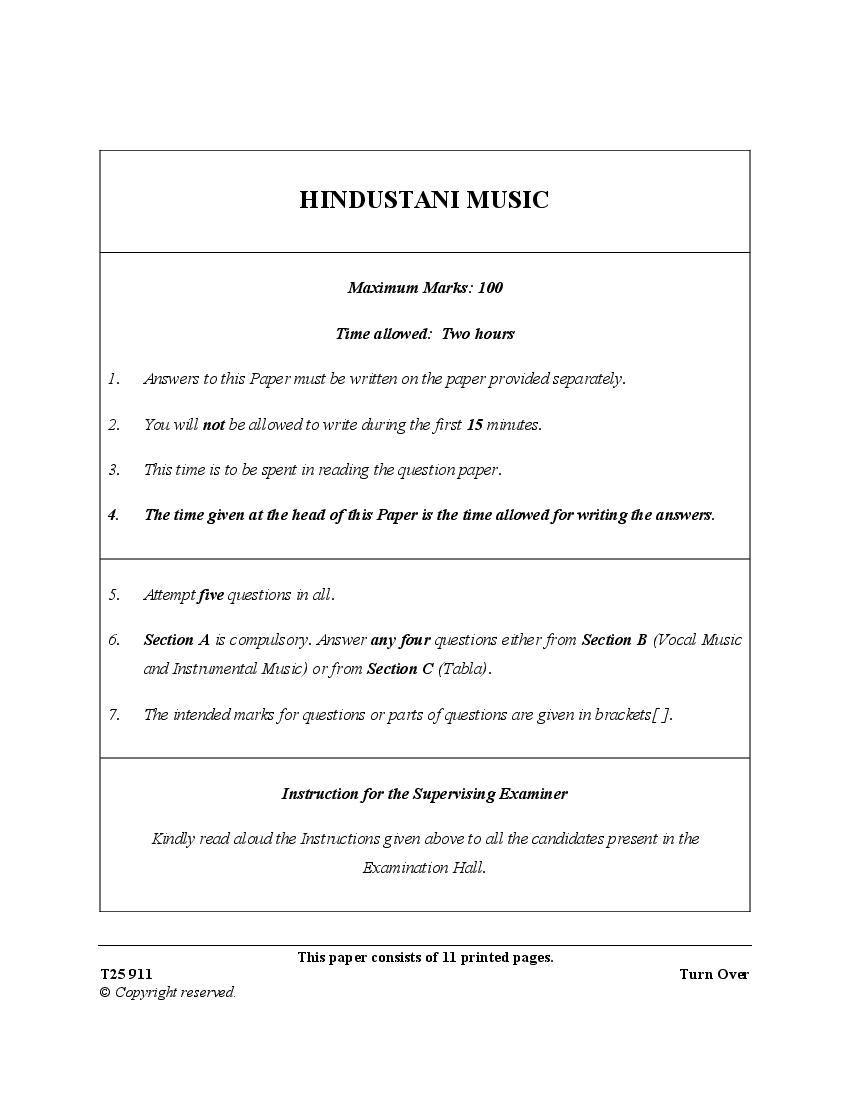
Maximum Marks: 100
Time allowed: Two hours
1. Answers to this Paper must be written on the paper provided separately.
2. You will not be allowed to write during the first 15 minutes.
3. This time is to be spent in reading the question paper.
4. The time given at the head of this Paper is the time allowed for writing the answers.
5. Attempt five questions in all.
6. Section A is compulsory. Answer any four questions either from Section B (Vocal Music
and Instrumental Music) or from Section C (Tabla).
7. The intended marks for questions or parts of questions are given in brackets[ ].
Instruction for the Supervising Examiner
Kindly read aloud the Instructions given above to all the candidates present in the
Examination Hall.
This paper consists of 11 printed pages.
T25 911 Turn Over
© Copyright reserved.
Page 2
(Answer all questions from this Section.)
Question 1
Choose the correct answers to the questions from the given options. [20]
(Do not copy the questions, write the correct answers only.)
(i) Which of the following pairs of taals have two Vibhags?
(a) Kaharwa, Dadra
(b) Jhaptaal, Ektaal
(c) Tilwada, Dhamar
(d) Teentaal, Jhaptal
(ii) In which style of singing is Chartaal used?
(a) Bhajan
(b) Dhrupad
(c) Khayal
(d) Thumri
(iii) Pandit Bhimsen Joshi is associated with:
(a) Vocal
(b) Sitar
(c) Tabla
(d) Flute
T25 911 2
Page 3
A. Teentaal 1. 0
B. Khali 2. 16
C. Sam 3. 8
D. Keharwa 4. ×
Choose the correct answer from the options given below:
(a) A-2, B-1, C-4, D-3
(b) A-2, B-3, C-4, D-1
(c) A-2, B-1, C-3, D-4
(d) A-3, B-1, C-4, D-2
(v) The Sam for Teentaal is on __________ matra.
(a) 1st
(b) 7th
(c) 9th
(d) 2nd
(vi) Thah laya is half of Dugun laya.
(a) True
(b) False
(vii) In taal notation system, the Sam is denoted as __________.
(a) 0
(b) ×
(c) +
(d) #
T25 911 3 Turn Over
Page 4
(a) Chartaal
(b) Teentaal
(c) Sooltaal
(d) Dadra
(ix) __________ instrument is NOT used for Raag improvisation.
(a) Tabla
(b) Flute
(c) Sitar
(d) Violin
(x) Identify the following musicians:
(a) Pt. Ravishankar and Ustad Bismillah Khan
(b) Pt. Kishan Maharaj and Pt. Jagannath
(c) Pt. Hariprasad Chourasia and Ustad Zakir Hussain
(d) Pt. Nikhil Banerjee and Ustad Shahid Parvez
T25 911 4
Page 5
(a) True
(b) False
(xii) ___________ instrument is used for providing rhythmic accompaniment to
khayal.
(a) Tabla
(b) Pakhawaj
(c) Dholak
(d) Manjeera
(xiii) Identify the pair of taals having twelve beat time cycle and six vibhaghs:
(a) Chartaal, Ektaal
(b) Teentaal, Kaherwa
(c) Jhaptaal, Teentaal
(d) Dadra, Roopak
(xiv) A taal having eight matras and two divisions is called:
(a) Ektaal
(b) Kaherwa
(c) Jhoomra
(d) Deepchandi
(xv) Sam is the first beat of each taal.
(a) True
(b) False
T25 911 5 Turn Over
Page 6
(a) Chartaal
(b) Teentaal
(c) Jhaptaal
(d) Dadra
(xvii) Mohan is a Dhrupad singer. He is performing a Dhrupad in Raag Malkauns.
The Dhrupad bol has four swars in one beat. In which laya is Mohan singing?
(a) Ekgun
(b) Tigun
(c) Chaugun
(d) Dugun
(xviii) Assertion(A): Taal Dadra and Kaherwa are used in light music.
Reason(R): Tilwada is played only in Vilambit laya.
(a) (A) and (R) both are correct.
(b) (A) is incorrect and (R) is correct.
(c) (A) and (R) both are incorrect.
(d) (A) is correct and (R) is incorrect.
(xix) Dadra has seven matras.
(a) True
(b) False
T25 911 6
Page 7
(a) Violin and Tabla
(b) Sitar and Pakhawaj
(c) Mandolin and Mridang
(d) Sarangi and Dholak
SECTION B (80 Marks)
(For candidates offering Vocal / Instrumental Music excluding Tabla)
(Attempt any four questions from this Section.)
Question 2
In Hindustani Music we follow Raag Jati system. Many Raags belongs to Audav-Audav [20]
Jati. Answer the following in reference to Audav-Audav Jati Raag:
(i) Name the Raag and its main notes.
(ii) Write a Khayal / Gat in a Raag of Audav Jati. (Only Sthai)
(iii) Write a short description of the Raag.
(iv) Write two Taans.
T25 911 7 Turn Over
Page 8
Write short notes on any four of the following terms: [20]
(i) Soot
(ii) Chaugun
(iii) Meend
(iv) Khatka
(v) Tappa
(vi) Thumri
(vii) Sound
(viii) Poorvang
Question 4
Give a brief account of the life and contribution of Amir Khusro. [20]
Question 5
Draw a well-labelled diagram of your musical instrument and describe the utility of each [20]
part.
Question 6
Identify the note combination and name each raga. [20]
(i) Re Pa Ma Pa Ga Re, Ma Ma Pa
(ii) Ga Pa Dha Pa Ga Re Sa
(iii) Dha Ni Dha Ma Ga Sa
|
(iv) Pa-Ma-Ga-Re, Ṇi-Re-Sa
(v) Re Ma Pa, Ni Dha Pa, Dha Ma Ga Re, GaṆi Sa
T25 911 8
Page 9
Compare and contrast between any one of the following pairs. [20]
(i) Khayal – Dhrupad
(ii) Bageshwari – Malkauns
Question 8
Explain the following terms: [20]
(i) Naad and its kinds (volume, pitch, timbre).
(ii) Shruti and placement of 7 swars.
SECTION C (80 Marks)
(For candidates offering Tabla)
(Attempt any four questions from this Section.)
Question 9
Explain Taal Jaati System. [20]
Question 10
Explain any two of the following terms giving example. [20]
(i) Kayada
(ii) Uthan
(iii) Rela
(iv) Palta
T25 911 9 Turn Over
Page 10
(i) Write ten Pranas of Tabla.
(ii) Explain why Lehra (Nagma) is important for a Tabla player.
Question 12
Give a brief introduction of famous Tabla player and his contribution in the field of [20]
Tabla.
Question 13
Identify the following taals and write their Theka: [20]
(i) Ta Tirkit Dhin Dhin
3
(ii) Ti Na |
0
(iii) Dhage Tirkit | Dhi Na
3 4
(iv) Dha Dha | Din Ta
X 0
(v) Dha Tin Tin Ta
0
T25 911 10
Page 11
Compare and contrast any two of the following pairs: [20]
(i) Dumdar – Bedum
(ii) Roopak – Teevra
(iii) Solo – Sangat
(iv) Tukra – Tihai
Question 15
Draw a well-labelled diagram of Tabla and describe the utility of each part. [20]
T25 911 11
Document Details
| Board / Org | CISCE |
| Exam | Class 10 |
| Type | Question Paper |
| Pages | 11 |
| Updated | 24 Sep 2026 |