ICSE Class 10 Question Paper 2025 History & Civics
Finished viewing? Save it for later —
Download ICSE Class 10 Question Paper 2025 History & Civics (PDF · 12 pages)About ICSE Class 10 Question Paper 2025 History & Civics
ICSE Class 10 Question Paper 2025 History & Civics is available here for free download. Published by CISCE for Class 10, this question paper can be viewed online or downloaded as a PDF (12 pages). Candidates preparing for Class 10 can use ICSE Class 10 Question Paper 2025 History & Civics to understand the exam pattern, the type of questions asked, and the overall difficulty level.
Frequently Asked Questions
How can I download ICSE Class 10 Question Paper 2025 History & Civics?
Open this page and click the Download button to save ICSE Class 10 Question Paper 2025 History & Civics as a PDF. It is completely free on AglaSem Docs.
Is ICSE Class 10 Question Paper 2025 History & Civics free to download?
Yes. ICSE Class 10 Question Paper 2025 History & Civics can be viewed online and downloaded as a PDF free of cost on AglaSem Docs.
How many pages does ICSE Class 10 Question Paper 2025 History & Civics have?
ICSE Class 10 Question Paper 2025 History & Civics contains 12 pages, which you can read online or download together as a single PDF.
Where can I find more Class 10 study material?
You can find more Class 10 question papers, sample papers, syllabus, and answer keys on AglaSem Docs.
ICSE Class 10 Question Paper 2025 History & Civics – Text
Read the full text of this question paper below — useful to quickly search, copy and reference the content online without downloading the PDF.
📄 View text version (12 pages)
Page 1
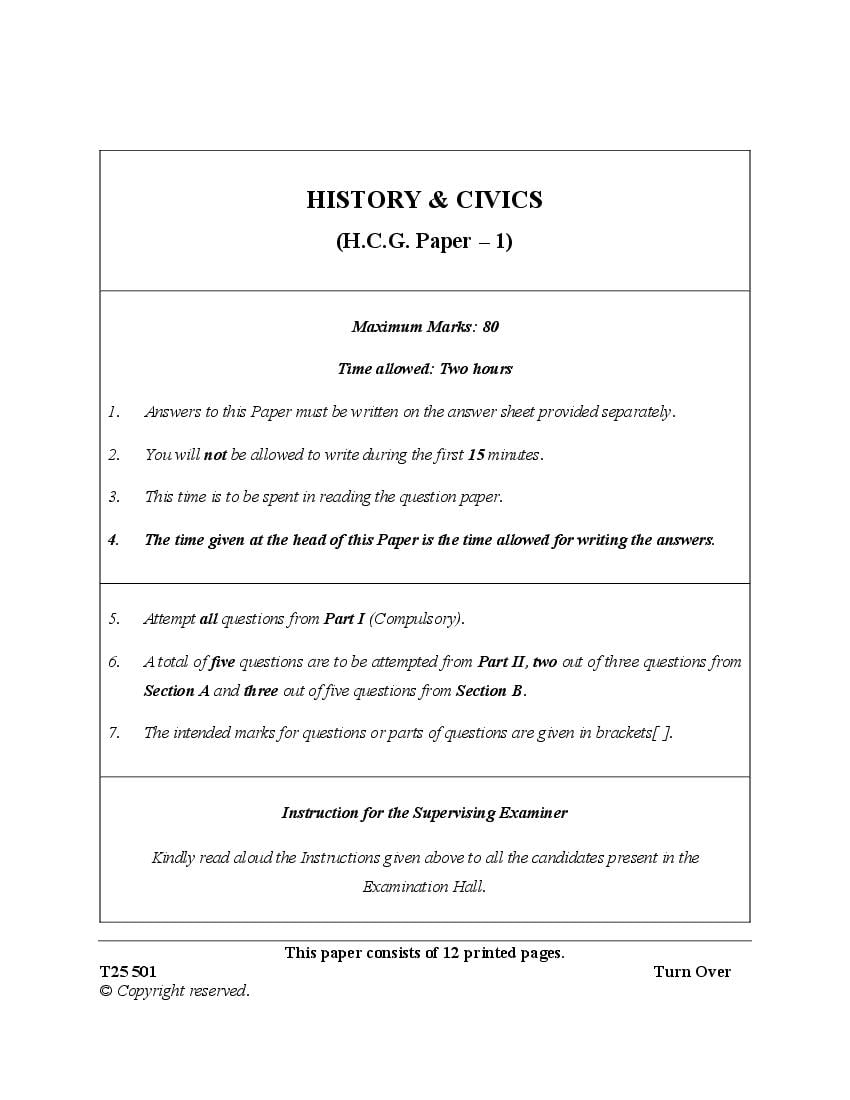
(H.C.G. Paper – 1)
Maximum Marks: 80
Time allowed: Two hours
1. Answers to this Paper must be written on the answer sheet provided separately.
2. You will not be allowed to write during the first 15 minutes.
3. This time is to be spent in reading the question paper.
4. The time given at the head of this Paper is the time allowed for writing the answers.
5. Attempt all questions from Part I (Compulsory).
6. A total of five questions are to be attempted from Part II, two out of three questions from
Section A and three out of five questions from Section B.
7. The intended marks for questions or parts of questions are given in brackets[ ].
Instruction for the Supervising Examiner
Kindly read aloud the Instructions given above to all the candidates present in the
Examination Hall.
This paper consists of 12 printed pages.
T25 501 Turn Over
© Copyright reserved.
Page 2
(Attempt all questions from this Part.)
Question 1
Select the correct answers to the questions from the given options. [16]
(Do not copy the questions, write the correct answer only).
(i) The Council of Ministers is collectively responsible to the ___________.
(a) Lok Sabha
(b) President
(c) Rajya Sabha
(d) Prime Minister
(ii) Given below are details of a few Indian Citizens.
Age (In
Person Description
years)
W 25 Is a famous journalist
X 45 Is an industrialist
Y 35 Has declared insolvency
Z 50 Has taken citizenship of another country
Select the one who is eligible to be a member of the Rajya Sabha.
(a) X
(b) W
(c) Y
(d) Z
T25 501 2
Page 3
Advisory Jurisdiction : Advice the President : : Judicial Review : __________
(a) Review its own judgements.
(b) Review the judgements of the High Court.
(c) Review the laws passed by the Parliament.
(d) Review the administration of the Government.
(iv) Observe the given picture. In case of a similar unruly situation in the Lok
Sabha, choose the action that may be taken by the Speaker.
(a) adjourn the house for lack of quorum.
(b) dissolve the Lok Sabha.
(c) adjourn the house for lack of discipline.
(d) disqualify the members under Anti-defection law.
T25 501 3 Turn Over
Page 4
(a) the Lok Sabha will be dissolved.
(b) the House will discuss a matter of urgent public importance.
(c) the President ends the session.
(d) the Government will fall.
(vi) Which emergency will be declared by the President if the security of the Nation
is under threat?
(a) General Emergency
(b) Financial Emergency
(c) Constitutional Emergency
(d) President’s Rule
(vii) Read the statements given below and select the option that shows the correct
relationship between (A) and (R).
Assertion (A): Lord Curzon partitioned Bengal in 1905.
Reason (R): The Nationalists felt that the British wanted to divide the
Hindus and the Muslims.
(a) (A) is true and (R) is false.
(b) (R) is true but (A) is false.
(c) Both (A) and (R) are independent of each other.
(d) (A) is the reason for (R).
T25 501 4
Page 5
He introduced the Subsidiary Alliance to expand the British control over India.
(a) Lord Dalhousie
(b) Lord Canning
(c) Lord Wellesley
(d) Lord Curzon
(ix) Identify the odd one out of the following Assertive Nationalists Leaders.
(a) Bipin Chandra Pal
(b) Lala Lajpat Rai
(c) Dadabhai Naoroji
(d) Bal Gangadhar Tilak
(x) Who among the following is MOST associated with this picture?
(a) Jyotiba Phule
(b) Raja Ram Mohan Roy
(c) Swami Dayanand Saraswati
(d) Aurobindo Ghosh
T25 501 5 Turn Over
Page 6
P. Was the Supreme Commander of INA
Q. Signed the Lucknow Pact
R. Led the Quit India Movement
S. Founded the Forward Bloc
(a) P and Q
(b) Q and R
(c) P and S
(d) R and S
(xii) The market of a small industrial town X has been dominated by many products
of foreign companies. The local residents decide to save the Indian industries
by helping them increase their sales. Which method of the Assertive
Nationalists must they follow to become self-reliant?
(a) Passive Resistance
(b) National Education
(c) Swadeshi
(d) Revivalism
(xiii) Which of the following is NOT an objective of the United Nations
Organisation?
(a) Disarm
(b) Disengage
(c) Decolonise
(d) Develop
T25 501 6
Page 7
picture?
(a) UNESCO
(b) UNICEF
(c) WHO
(d) ILO
(xv) Which of the following is a common cause for the rise of dictatorship?
(a) Faith in Democracy
(b) Economic Crisis
(c) Freedom of Press
(d) Political Stability
T25 501 7 Turn Over
Page 8
(a) Imperialism
(b) Aggressive Nationalism
(c) Armament Race
(d) Sarajevo Crisis
Question 2
(i) Mention any two powers of the Prime Minister with reference to the Cabinet. [2]
(ii) Imagine you are an Early Nationalist leader. Mention any two methods you [2]
would follow to fight against the British.
(iii) Mention any two factors that led to the formation of the Muslim League. [2]
(iv) Mention any two objectives of the Forward Bloc. [2]
(v) Mention any two ways in which the Treaty of Versailles affected the German [2]
Military Force.
(vi) What is meant by the term Non-Alignment? [2]
(vii) When a judicial system is correctly calibrated, the law is applied by judges [2]
fearlessly, without favour or fear and with respect. That is why judicial security
of tenure is so fundamental. It is also why judges must be properly paid without
any interference from the Executive or Legislature.
— (The Need for Independent Judiciary) UNODC
From the passage, deduce and mention any two ways in which the Constitution
ensures the independence of the Judiciary.
T25 501 8
Page 9
SECTION A (20 Marks)
(Attempt any two questions from this Section.)
Question 3
The Parliament of India comprises the President and the two houses. With reference to
the Indian Parliament, answer the following questions:
(i) Mention any three circumstances under which the Parliament can make laws [3]
on subjects in the state list.
(ii) Explain the following terms: [3]
(a) Question Hour
(b) Quorum
(c) No Confidence Motion
(iii) When can the term of the Lok Sabha be extended? [4]
Mention any three powers of the Lok Sabha which show its superiority over
the Rajya Sabha.
Question 4
The Executive Power of the country is vested in the President and Vice President. With
reference to this answer the following questions:
(i) Explain the impeachment process through which the Parliament can remove [3]
the President from power.
(ii) Mention any three powers of the Vice President in her/his role as the Chairman [3]
of the Rajya Sabha.
T25 501 9 Turn Over
Page 10
(a) Any two Financial Powers
(b) Any two Executive Powers
Question 5
The High Courts of India are the highest courts of appeal in each state. With reference
to the High Courts of India, answer the following questions:
(i) What is meant by the term Original Jurisdiction of the High Court? Mention [3]
any two cases which fall under this jurisdiction.
(ii) Mention any two advantages of the Lok Adalat. Mention any one difference [3]
between the Sessions Court and the Court of the District Judge.
(iii) Explain the following with reference to the High Court: [4]
(a) Revisory Jurisdiction
(b) Court of Record
SECTION B (30 Marks)
(Attempt any three questions from this Section.)
Question 6
The Revolt of 1857 was conscious beginning of the independence struggle against the
British. With reference to this, answer the following questions:
(i) What was the Doctrine of Lapse? Who introduced it? [3]
(ii) The British Government interfered in the social and religious matters of the [3]
Indians. Mention any three socio religious causes to justify this statement.
(iii) Mention any four military causes which led to this Revolt. [4]
T25 501 10
Page 11
The oppresive British colonial rule led to the growth of nationalism in India. With
reference to this, answer the following questions:
(i) The repressive policies of Lord Lytton became a catalyst to the growth of [3]
nationalism. Mention any three of his repressive policies to justify this statement.
(ii) Mention any three ways in which the Press promoted nationalism. [3]
(iii) Who presided over the second session of the Indian National Congress? [4]
Mention any three objectives of the Congress.
Question 8
Look at the given picture and answer the questions that follows:
— The Times of India, April 2019
(i) Identify the above incident. Which Gandhian movement did it lead to? Which [3]
incident led to the suspension of that movement?
(ii) Mention any three repressive provisions of the Rowlatt Act. [3]
(iii) Mention the following: [4]
(a) Any two causes of the Quit India Movement.
(b) Any two causes of the Civil Disobedience Movement.
T25 501 11 Turn Over
Page 12
Read the passage given and answer the following questions:
In an effort to secure resources for its expanding industries, Japan invaded the northern
Chinese province of Manchuria. Although many Western nations protested the Japanese
action, most members of the League of Nations, including Canada, opposed any form of
military intervention to defend Chinese sovereignty.A League of Nations commission,
headed by the British diplomat Lord Lytton, was dispatched to Manchuria to investigate.
— Loyal Edmonton Regiment Museum
(i) How did the incident being described above become a cause for the Second [3]
World War?
(ii) Mention any three reasons for Hitler’s attack on Poland. [3]
(iii) Mention any four reasons for the failure of the League of Nations. [4]
Question 10
The organs and the agencies of the United Nation Organisation work towards the
development of the world. With reference to this answer the following questions:
(i) What is the composition of the General Assembly? [3]
(ii) Mention any three functions of the International Court of Justice. [3]
(iii) Give the full form of UNICEF. Mention any three of its functions. [4]
T25 501 12
Document Details
| Board / Org | CISCE |
| Exam | Class 10 |
| Type | Question Paper |
| Pages | 12 |
| Updated | 29 Aug 2026 |