HBSE Class 11 Sample Paper 2026 Answers Mathematics
Finished viewing? Save it for later —
Download HBSE Class 11 Sample Paper 2026 Answers Mathematics (PDF · 12 pages)About HBSE Class 11 Sample Paper 2026 Answers Mathematics
HBSE Class 11 Sample Paper 2026 Answers Mathematics is available here for free download. Published by Haryana Board for Class 11, this answer key can be viewed online or downloaded as a PDF (12 pages). Candidates preparing for Class 11 can use HBSE Class 11 Sample Paper 2026 Answers Mathematics to understand the exam pattern, the type of questions asked, and the overall difficulty level.
Frequently Asked Questions
How can I download HBSE Class 11 Sample Paper 2026 Answers Mathematics?
Open this page and click the Download button to save HBSE Class 11 Sample Paper 2026 Answers Mathematics as a PDF. It is completely free on AglaSem Docs.
Is HBSE Class 11 Sample Paper 2026 Answers Mathematics free to download?
Yes. HBSE Class 11 Sample Paper 2026 Answers Mathematics can be viewed online and downloaded as a PDF free of cost on AglaSem Docs.
How many pages does HBSE Class 11 Sample Paper 2026 Answers Mathematics have?
HBSE Class 11 Sample Paper 2026 Answers Mathematics contains 12 pages, which you can read online or download together as a single PDF.
Where can I find more Class 11 study material?
You can find more Class 11 question papers, sample papers, syllabus, and answer keys on AglaSem Docs.
HBSE Class 11 Sample Paper 2026 Answers Mathematics – Text
Read the full text of this answer key below — useful to quickly search, copy and reference the content online without downloading the PDF.
📄 View text version (12 pages)
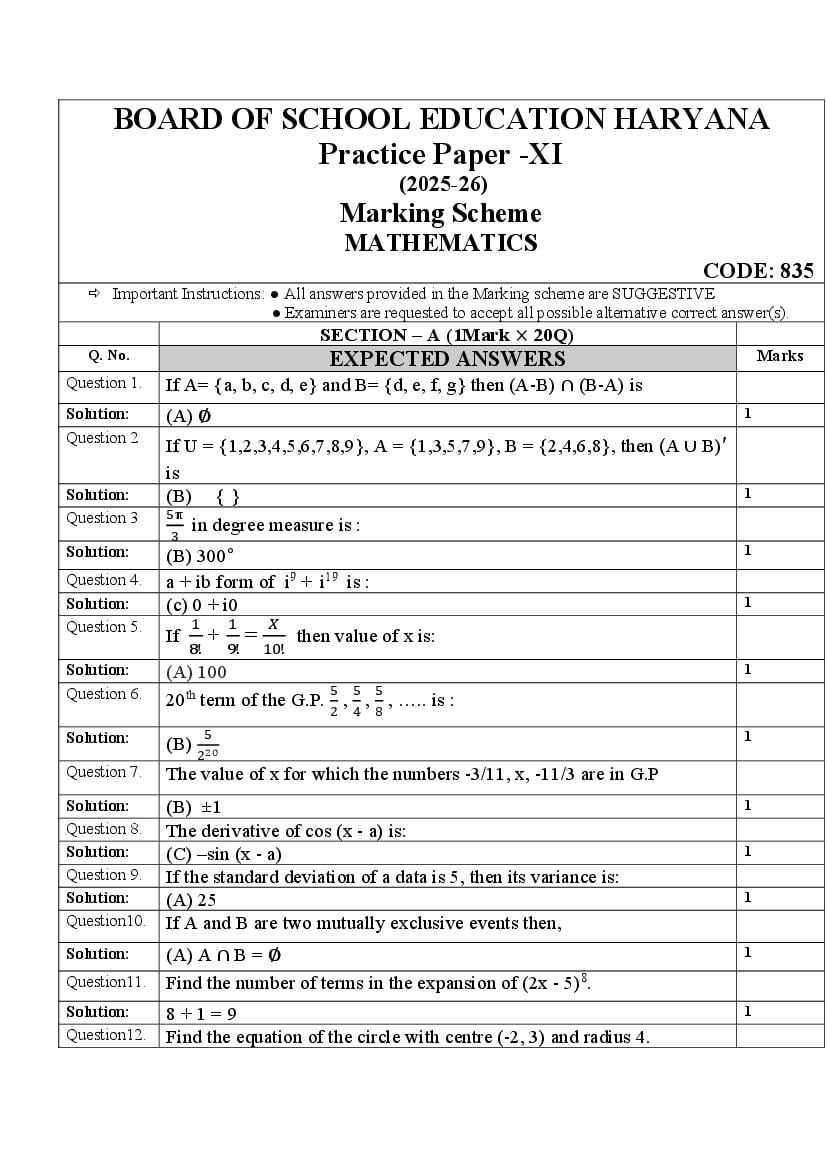
Page 1
Practice Paper -XI
(2025-26)
Marking Scheme
MATHEMATICS
CODE: 835
Important Instructions: ● All answers provided in the Marking scheme are SUGGESTIVE
● Examiners are requested to accept all possible alternative correct answer(s).
SECTION – A (1Mark × 20Q)
Q. No. EXPECTED ANSWERS Marks
Question 1. If A= {a, b, c, d, e} and B= {d, e, f, g} then (A-B) ∩ (B-A) is
Solution: (A) ∅ 1
Question 2
If U = {1,2,3,4,5,6,7,8,9}, A = {1,3,5,7,9}, B = {2,4,6,8}, then (A ∪ B)′
is
Solution: (B) { } 1
Question 3 5π
in degree measure is :
3
Solution: (B) 300° 1
Question 4. a + ib form of i9 + i19 is :
Solution: (c) 0 + i0 1
Question 5. 1 1 𝑋
If + = then value of x is:
8! 9! 10!
Solution: (A) 100 1
Question 6. 5 5 5
20th term of the G.P. 2 , 4 , 8 , ….. is :
Solution: 5 1
(B) 220
Question 7. The value of x for which the numbers -3/11, x, -11/3 are in G.P
Solution: (B) ±1 1
Question 8. The derivative of cos (x - a) is:
Solution: (C) –sin (x - a) 1
Question 9. If the standard deviation of a data is 5, then its variance is:
Solution: (A) 25 1
Question10. If A and B are two mutually exclusive events then,
Solution: (A) A ∩ B = ∅ 1
Question11. Find the number of terms in the expansion of (2x - 5)8.
Solution: 8+1=9 1
Question12. Find the equation of the circle with centre (-2, 3) and radius 4.
Page 2
Question13. 4x+3
Write the value of lim x − 2 .
x →4
Solution: 4x+3 4.(4)+3 19 1
lim x − 2 = = 2
x →4 4−2
Question14. If v is the variance and 𝜎 is the standard deviation, then what is the
relation between v and 𝜎 .
Solution: v2 = 𝜎 1
Question15. Fill in the blank to make the statement true, ∅' ∩ A = ………….
Solution: ∅' ∩ A = U 1
Question16. tan (A - B) is equal to …………….. .
Solution: tanA−tanB 1
tan (A - B) = 1 + tanA.tanB
Question17. nCr =
n!
(n−r )!
. (True/ False)
Solution: False 1
Question18. If a bag has only red balls, the probability of picking a blue ball is 1.
(True/ False)
Solution: False 1
Question19. Assertion (A): Let A={1,2} and B={3,4}.Then, number of relations
from A to B is 16.
Reason (R): If n (A) = p and n (B) = q, then number of relations from
A to B is 2pq .
Solution: (A) Both Assertion (A) and Reason (R) are true and Reason (R) is the 1
correct explanation of the Assertion (A)
Question20. Assertion (A): The point (3, 0, -5) lies on the XZ plane.
Reason(R):The coordinates of a point P(x, y, z) in XZ plane are (0, 0, z).
Solution: (C) Assertion (A) is true and Reason (R) is false. 1
SECTION – B (2Marks × 5Q)
Question21. List all te subsets of the set { -1, 0 , 1 }.
Solution: Let A = { -1, 0 , 1 }
So, all the subsets of the set A are ∅,{-1},{0},{1},{-1,0},{0,1},{-1, 1},
2
{-1, 0, 1}
Question22. Find the multiplicative inverse of √5 + 3i.
Solution: 1
Multiplicative Inverse of √5 + 3i =
√5 + 3i
1 √5− 3i
M.I. = × 1
√5 + 3i √5− 3i
√5− 3i
= (√5)2 − (3i)2
√5− 3i
= 5 − 9i2
Page 3
= = − 1
5+ 9 14 14
OR Express ( 1 – i )4 in the form of a + ib.
Question22.
Solution: Given ( 1 – i )4
= (1 – i )2.( 1 – i )2
1
= (1 + i2 – 2i).( 1 + i2 – 2i)
= (1 –1 – 2i). ( 1 –1 – 2i)
= (– 2i). (– 2i)
= 4i2
= -4+i0 1
Question23. 3(x−2) 5(2−x)
Solve the inequality ≤ .
5 3
Solution: 3(x−2) 5(2−x)
We have ≤
5 3
9(x -2) ≤ 25(2 – x)
9x - 18 ≤ 50 – 25x 1
9x + 25x ≤ 18 + 50
34x ≤ 68
x≤2
x ∈ [2, ∝ ) 1
Question24. Find the 10th term of a G.P. whose 3rd term is 24 and 6th term is 192.
Solution: We have, a3 = ar2 = 24 …(1)
𝟏
a6 = ar5 = 192 …(2)
𝟐
Dividing (2) by (1), we have
r3 =8
𝟏
r=2 𝟐
a(2)2 = 24
𝟏
a=6 𝟐
⸫ a10 = a.r9 = 6.(2)9
𝟏
a12 = 6. (512) = 3072
𝟐
Question25. Find the equation of the parabola with vertex at (0,0) and focus at (0, 2).
Solution: Since the vertex is at (0,0) and the focus is at (0, 2) which lies on y-axis.
Y-axis is the axis of the parabola.
Page 4
a=2 𝟐
x2 = 4(2)y 𝟏
𝟐
x2 = 8y 𝟏
𝟐
𝟏
𝟐
OR Find the equation of the ellipse, whose vertices are (0, ±13) and foci
Question25. are (0, ±5).
Solution: Since the vertices are on y-axis, the major axis is along the y-axis.
x2 y2
So equation of ellipse is of the form b2 + a2 = 1
Given that a = semi major axis = 13, and c = ±5 from foci (0, ±5) 1
And the relation c 2 = a2 − b2 , gives
52 = 132 − b2 i.e. b2 = 144
x2 y2
Therefore, the equation of the ellipse is 25 + 144 = 1 1
SECTION – C (3Marks × 6Q)
Question26. If U ={1,2,3,4,5,6,7,8,9}, A = {2,4,6,8} and B = {2,3,5,7}.Verify that (A
∪ B)'= A' ∩ B'.
Solution: 𝟏
Here A ∪ B = {2,3,4,5,6,7,8} 𝟐
∴ (A ∪ B)' = {1,9} 1
Now
1
A' = {1,3,5,7,9} and B' = {1,4,6,8,9}
∴ A' ∩ B' = {1,9} 𝟏
(A ∪ B)'= A' ∩ B' 𝟐
Question27. Find the domain and Range of the function √4 − x 2 .
Solution: Here y = √4 − x 2
y will have real values if 4 − x 2 ≥ 0
⇒ x2 − 4 ≤ 0
⇒ (x-2) (x + 2) ≤ 0
⇒ -2 ≤ x ≤ 2 ⇒ x ∈ [ -2, 2]
Domain = [-2, 2] 𝟏
𝟏
𝟐
Also, y2 = 4 – x2
⇒ x2 = 4 – y2
⇒ x = ± √4 − y 2
Clearly x is defined when 4 - y² ≥ 0 i.e., when y² - 4 ≤ 0
⇒ (y-2)(y + 2) ≤ 0
⇒ -2 ≤ y ≤ 2 ⇒ у є [-2, 2]
Page 5
negative values.
⸫ y ∈ [0, 2] for all x ∈ [-2, 2] 𝟏
𝟏
𝟐
⸫ Range = [0, 2].
Question28. 3 4
Expand: (x 2 + x ) ; x ≠ 0
Solution: 3 4 3 0 3 1 3 2
(x 2 + x ) = 4C0 (x 2 )4 (x) + 4C1 (x 2 )3 (x) + 4C2 (x 2 )2 (x) + 4C3
3 3 3 4
(x 2 )1 ( ) + 4C4 (x 2 )0 ( ) 𝟏
𝟏
x x 𝟐
3 9 27 81
= x 8 + 4.(x 6 ) (x) + 6.(x 4)
(x2 ) + 4.(x 2 ) ( x3 ) + 1.(1)( x4 )
108 81 𝟏
= x 8 + 12x 5 + 54 x 2 + x + x4 𝟏
𝟐
OR Which is larger (1.01)1000000 or 10,000?
Question28.
Solution: (1.01)1000000 = (1+ .01)1000000
𝟏
𝟐
= 1000000C0 (1)1000000 (. 01)0 + 1000000C1 (. 01)1 + other positive terms
1𝟏𝟐
= 1 + 100000 × .01 + other positive terms
= 1 + 10000 + other positive terms
= 10001 + other positive terms
>10000
Hence (1.01)1000000 > 10000 1
Question29. Find the sum of the sequence 8, 88, 888, 8888, …….. to n terms.
Solution: This is not a GP., however, we can relate it to a GP. by writing the
terms as Sn = 8 + 88 + 888 + 8888 + ... to n terms
8
= 9 [ 9 + 99 + 999 + 9999 +... to n term] 1
8
= 9 [ (101 - 1) + (102 - 1) + (103 - 1) + (104 - 1) +...n terms]
8 1
= 9 [(10+102+103+...n terms) - (1+1+1+...n terms)]
It is a G.P. where a = 10 and r = 10 > 1
a(rn − 1)
⸫ Sn =
r−1
8 10(10n − 1) 8 10(10n − 1)
=9[ − n] = 9 [ − n] 1
10 − 1 9
OR If A.M. and G.M. of two positive number a and b are 10 and 8
Question 29 respectively, find the numbers.
Solution: a+b
Given that A.M. = 2 = 10 and G.M. = √a. b = 8
a + b = 20 …(1) and ab = 64 …(2) 𝟏
2 2 𝟐
Using the identity, (a – b) = (a + b) – 4ab and putting the
respective values, we have
(a – b)2 = (20)2 – 4(64)
Page 6
a – b = ±12 …(3)
Solving (1) and (3), we obtain
𝟏
a = 4 and b = 16 or a = 16 and b = 4 1𝟐
thus the number are 4, 16 or 16, 4 respectively
Question30. Find the equation of the set of the points P such that PA2 + PB2 = 2k2,
where A and B are the points (3, 4, 5) and (-1, 3, -7), respectively.
Solution: Let the coordinate of the point P be (x, y, z) .
⸫ PA = √(x − 3)2 + (y − 4)2 + (z − 5)2
PA2 = (x − 3)2 + (y − 4)2 + (z − 5)2
Now PB = √(x + 1)2 + (y − 3)2 + (z + 7)2 𝟏
1𝟐
PB2 = (x + 1)2 + (y − 3)2 + (z + 7)2
By the given condition PA2 + PB2 = 2k2, we have
(x − 3)2 + (y − 4)2 + (z − 5)2 + (x − 3)2 + (y − 4)2 + (z − 5)2 = 2k2
𝟏
2x2 + 2y2 + 2z2 – 4x – 14y + 4z = 2k2 - 109 1𝟐
Question31. In how many ways can a student choose a programme of 5 courses if 9
courses are available and 2 specific courses are compulsory for every
student?
Solution: There are 9 courses available and 5 courses are to be chosen out of 9.
Since 2 courses are compulsory for every student.
Therefore, now we have to choose 3 courses out of remaining7 courses.
This can be done in 7C3 ways 1𝟐
𝟏
7!
∴ 7C3 = (7−3)!.3!
7.6.5.4 𝟏
= 4.3.2.1. = 35 ways 1
𝟐
SECTION – D (5Marks × 4Q)
Question32. sin 5x−2 sin 3x + sin x
(i) Prove that: = tan x
cos 5x − cos x
π 5π π
(ii) Prove that: cot2 6 + cosec 6 + 3 tan2 6 = 6
Solution: (i) sin 5x−2 sin 3x + sin x
= tan x
cos 5x − cos x
sin 5x + sin x −2 sin 3x
L.H.S. = [rearranging]
cos 5x − cos x
Page 7
Using cosC - cosD = 2sin ( 2 ).sin ( 2 ) 𝟏
C+D C−D 𝟐
and sinC + sinD = 2sin( 2 ).cos( 2 ) , we have
1
2sin 3x . cos 2x − 2 sin 3x
=
− 2 sin 3x .sin 2x
𝟏
2sin 3x . (cos 2x − 1)
= 𝟐
− 2 sin 3x .sin 2x
1− cos 2x
=
sin 2x
2sin2 x
= 1
2.sin x .cos x
= tan x
L.H.S. = R. H.S.
Solution:(ii)
π 5π π
L.H.S. = cot2 6 + cosec 6 + 3 tan2 6
π π π
=> = ( cot 6 )2 + cosec (π − 6 ) + 3 (tan 6 )2
We have,
π 1 1
= ( √3 )2 + cosec 6 + 3 ( )2
√3
1
= 3 + 2 + 3. 3
= 3+2+1 = 6 1
L.H.S. = R. H.S.
Question33. Find the coordinates of the foot of perpendicular from the point (-1, 3)
to the line 3x – 4y – 16 = 0.
Solution: Given equation of line 3x – 4y – 16 =0 …(1)
Let the foot of perpendicular be (x, y) from (-1, 3).
Since line joining (x, y) and (-1, 3) and the given line 3x – 4y – 16 =0
are perpendicular with each other
⸫ Equation of any line perpendicular to 3x – 4y – 16 = 0 is
4x + 3y + k = 0 …(2)
1
Now line (2) is passing through (-1, 3)
4(-1) + 3(3) + k = 0
k = -5
⸫ Equation of line passing through (-1, 3) and ┴ar to 3x – 4y – 16 = 0 is 𝟏
4x + 3y – 5 = 0 …(3) 1𝟐
Now solving equations (1) and (3)(any method), we obtain
3x – 4y = 16 …(4)
4x + 3y = 5 …(5)
Multiply (4) by 3, (5) by 4 and then adding , we have
Page 8
25x = 68 => x = 25 using this value in (5), we have
68 272
4(25 ) + 3y = 5 => 3y = 5 - 25
125−272 −147
3y = => 3y =
25 25
−49
y = 25 𝟏
2𝟐
68 −49
So foot of perpendicular is ( 25 , 25 )
OR Find the equation of the lines through the point (3, 2) which make an
Question33. angle of 45° with the line x – 2y = 3.
Solution: Given equation of line x – 2y = 3 and 𝜃 = 45°
− coeff.of x −1 1
⸫ Slope of line = coeff.of y = −2 = 2
1
m1 = 2 𝟏
Let m be the slope of required line. 𝟐
m −m
Now tan 𝜃 = |1+1m .m2 | 𝟏
1 2 𝟐
1
m1 − 2
tan 45° = | 1 |
1+ m1 .(2)
1
m1 − 2
1=| m1 |
1+ 2
1
m1 − 2
±1 = m1
1+ 2
m1 1 m1 1
1+ = m1 − 2 or −1 − = m1 − 2
2 2
−m1 −3 3m1 −1
= 2 or = 2
2 2
−1 2
m1 = 3 or m1 = 3
⸫ Equations of lines through (3, 2) having slopes 3 and -1are
y – 2 = 3(x – 3) => 3x - y = 7
−1
and y – 2 = 3 (x -3) => x + 3y = 9 2
Question34. Find the derivative of cos x from first principle.
Solution: Let f(x) = cos x , the
d(f(x)) f( x+h )− f( x )
= lim
dx h →0 h
cos( x+h )− cos( x )
= lim 1
h →0 h
x+h+x x+h−x
−2 sin( ) sin( 2 ) 2
= lim [ 2
] C+D C−D
[using cos C – cos D = -2 sin ( 2 ).sin ( 2 ) ]
h →0 h
2x+h h
sin( ) sin( 2 )
= −lim [ 2
h ]
h →0
2
Page 9
2x+h sin( 2 )
= −lim [sin( 2 ) ] . lim [ h ] 2
h →0 h →0
2
= - sin x . (1) = - sin x
OR mx 2 + n, x<0
Question34.
Suppose f(x) = {nx + m, 0 ≤ x ≤ 1 . For what value of m and n
3
nx + m, x>1
does both lim f(x) and lim f(x) exists?
x→0 x→1
Solution: Here, limit exist at x → 0
i.e., LHL = RHL ...(1)
LHL at x → 0
= lim f(x)
x→0−
= lim f(0 − h)
h→0
= lim [ m(−h)2 + n]
h→0
=n ...(2) 𝟏
1𝟐
RHL at x→ 0
= lim f(x)
x→0+
= lim f(0 + h)
h→0
= lim [ n(0 + h) +m]
h→0
=m …(3) 𝟏
1𝟐
From (1), (2) and (3)
n=m
Here, limit exist at x → 1
i.e., LHL = RHL ...(1)
LHL at x → 1
= lim f(x)
x→1−
= lim f(1 − h)
h→0
= lim [ n(1 − h) + m]
h→0
=n+m ...(2)
RHL at x→ 1 1
= lim f(x)
x→1+
= lim f(1 + h)
h→0
= lim [ n(1 + h)3 + m]
h→0
=n+m …(3)
For lim f(x) to exists, we need n = m
x→0
1
For lim f(x) exists for any integral value of m and n.
x→1
Page 10
distribution.
Classes 0- 10 10-20 20-30 30-40 40-50
Frequency 5 8 15 16 6
Solution:
From the given data, we construct the following table.
Class Frequency Midpoint fixi (xi - 𝐱̅ )2 fi(xi - 𝐱̅ )2
fi xi
0 – 10 5 5 25 484 2420
10 – 20 8 15 120 144 1152
20 – 30 15 25 375 4 60
30 – 40 16 35 560 64 1024
40 – 50 6 45 270 324 1944
50 1350 6600
1
Thus Mean x̅ = ∑𝑖=7
𝑖=1 𝑓𝑖 𝑥𝑖
N
1350
= = 27 3𝟐
𝟏
50
1
Variance ( 𝜎 2 ) = ∑𝑖=7
𝑖=1 𝑓𝑖 (𝑥𝑖 − 𝑥̅ )
2
N
6600
= = 132 1
50
and Standard deviation(𝜎) = √132 = 11.49 𝟏
𝟐
SECTION – E (4Marks × 3Q)
Question36. The sum or difference of trigonometric functions can be transformed
into a product of trigonometric functions by using the following
formulae:
C+D C−D
(a) sin C + sin D = 2 sin 2 cos 2
C+D C−D
(b) sin C - sin D = 2 cos sin
2 2
C+D C−D
(c) cos C + cos D = 2 cos 2
cos 2
Page 11
(d) sin C + sin D = 2 sin sin
2 2
Based on the above information, answer the following questions.
(i) The value of sin 80° − sin 20° is:
(a) cos 30° (b) cos 60° (c) sin 30° (d) cos 50° (1)
(ii) The value of cos 15° - sin 15° is:
1 √3 1 −1
(a) 2 (b) 2 (c) 2 (d) (1)
√ √2
(iii) sin 70° + sin 80° is equal to:
(a) 2 cos15°.cos 5°(b) 2 sin15°.sin 5°(c) 2 cos15°.sin 5°(d) None of
these (1)
(iv) sin 51° + cos 81° - cos 21° is equal to:
(a) 1 (b) 0 (c) -1 (d) 2 (1)
Solution: (i) (d) cos 50° 1
1 1
(ii) (a) √2
1
(iii) (a) 2 cos15°.cos 5°
(iv) (b) 0 1
Question37. In a class of 60 students, 30 opted for NCC, 32 opted for NSS and 24
opted for both NCC and NSS. One of the students is selected at random
from the class.
Based on the above information answer the following questions:
(i) The probability that the student has opted for only NCC is:
1 1 19 11
(a) 2 (b) 10 (c) 30 (d) 30
(ii) The probability that the student has opted for both NCC and NSS is:
1 2 19 11
(a) 2 (b) 5 (c) 30 (d) 30
(iii)The probability that the student has opted for NCC or NSS is:
1 2 19 2
(a) 2 (b) 5 (c) 30 (d) 15
(iv) The probability that the student has opted neither both NCC nor
NSS is:
1 2 11 2
(a) 2 (b) 5 (c) 30 (d) 15
Solution: 1
(i) (b) 10 1
2
(ii) (b) 5
1
19
(iii) (c)
30 1
11
(iv) (c) 30
1
Page 12
38. javelin throw, won a gold medal at Tokyo Olympics. He is the first
track and field athlete to win a gold medal for India at the Olympics.
Based on above information, answer the following:
(i) Name the shape of paths followed by javelin. (1)
(ii) If the equation of such curve is given by x² = - 16y, then write
coordinate of foci. (1)
(iii) Write the equation of directrix and length of semi- latus rectum. (2)
Solution: (i) Shape of path is Parabola. 1
(ii) Comparing x2 = −16y with standard form x2 = −4ay we have
−4a =−16
a=4
∴ Focus: (0,−a) = (0,−4) 1
(iii) Equatio of Directrix:
y=a
y=4
Length of latus rectum:
2
4 a = 4×4 =16
Document Details
| Board / Org | Haryana Board |
| Exam | Class 11 |
| Type | Sample Paper |
| Pages | 12 |
| Updated | 24 Sep 2026 |