HBSE Class 11 Sample Paper 2026 Answers Entrepreneurship
Finished viewing? Save it for later —
Download HBSE Class 11 Sample Paper 2026 Answers Entrepreneurship (PDF · 17 pages)About HBSE Class 11 Sample Paper 2026 Answers Entrepreneurship
HBSE Class 11 Sample Paper 2026 Answers Entrepreneurship is available here for free download. Published by Haryana Board for Class 11, this answer key can be viewed online or downloaded as a PDF (17 pages). Candidates preparing for Class 11 can use HBSE Class 11 Sample Paper 2026 Answers Entrepreneurship to understand the exam pattern, the type of questions asked, and the overall difficulty level.
Frequently Asked Questions
How can I download HBSE Class 11 Sample Paper 2026 Answers Entrepreneurship?
Open this page and click the Download button to save HBSE Class 11 Sample Paper 2026 Answers Entrepreneurship as a PDF. It is completely free on AglaSem Docs.
Is HBSE Class 11 Sample Paper 2026 Answers Entrepreneurship free to download?
Yes. HBSE Class 11 Sample Paper 2026 Answers Entrepreneurship can be viewed online and downloaded as a PDF free of cost on AglaSem Docs.
How many pages does HBSE Class 11 Sample Paper 2026 Answers Entrepreneurship have?
HBSE Class 11 Sample Paper 2026 Answers Entrepreneurship contains 17 pages, which you can read online or download together as a single PDF.
Where can I find more Class 11 study material?
You can find more Class 11 question papers, sample papers, syllabus, and answer keys on AglaSem Docs.
HBSE Class 11 Sample Paper 2026 Answers Entrepreneurship – Text
Read the full text of this answer key below — useful to quickly search, copy and reference the content online without downloading the PDF.
📄 View text version (11 pages)
Page 1
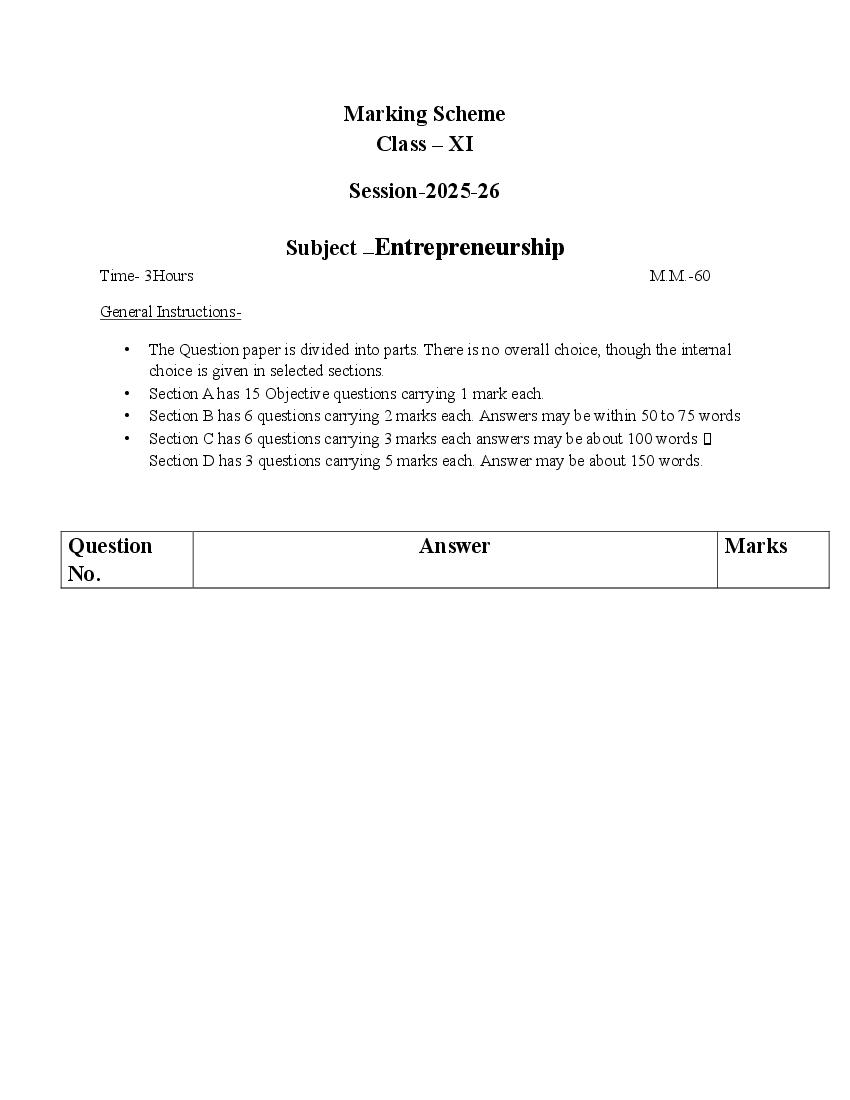
Class – XI
Session-2025-26
Subject –Entrepreneurship
Time- 3Hours M.M.-60
General Instructions-
• The Question paper is divided into parts. There is no overall choice, though the internal
choice is given in selected sections.
• Section A has 15 Objective questions carrying 1 mark each.
• Section B has 6 questions carrying 2 marks each. Answers may be within 50 to 75 words
• Section C has 6 questions carrying 3 marks each answers may be about 100 words
Section D has 3 questions carrying 5 marks each. Answer may be about 150 words.
Question Answer Marks
No.
Page 2
Q2. (c) imitative entrepreneur 1
Q3. (a) Wilhelm Roentgen 1
Q4. (a) Zero Level Channel 1
Q5. (b) Unit Cost 1
Q6. (d) Venture Capitalist 1
Q7. Trailblazers 1
Q8. Marketing Survey –Market survey means the original filed 1
research work for the purpose of collecting primary data, with
reference to a defined problem on hand.
Q9. Resources – “Anything or means (Physical tangible/ 1
Non-Physical tangible) required or required to support the
activities of organization to archive pre-
determined organizational goals are refused as rewards.
Q10. 1
Results, Attributes
Q11. 1
True
Q12. 1
Profit, Loss
Q13. 1
(a) Both A & R are true and R is correct explanation of A.
Q14. 1
(b) Both A & R are true but R is not correct explanation of A
Q15. (a) Both A & R are true and R is correct explanation of A. 1
Q16. Attitude – Attitude constitute an important psychological attribute 2
of individuals which shape their behavior. It may be defined as a
person feels about something – a person, a place, a commodity, a
situation or an idea.
OR
Types of Entrepreneurs –
1. Innovative Entrepreneurs
2. Imitative Entrepreneurs
3. Fabian Entrepreneurs
4. Drone Entrepreneurs
(½ marks for each point)
Page 3
process by identifying problems and opportunities, determining
objectives, describing situation. Defining successful outcome and
assessing the range of costs and benefits associated with several-
alternatives for solving a problem.
Q18 Business Intelligence – business intelligence is the ability of an 2
organization to collect, maintain and organize data.
Example– sales data during off season discounts.
Q19. Macro Environment – Macro environment refers to all forces that 2
are part of the larger society and are the “uncontrollable” to which
companies adapt through setting the controllable factors.
Natural Macro Economic
Environment
Cultural Demographic
Political Technological
Page 4
which are undertaken to boost the sales through its subcomponents
tools.
Sales Promotion Advertising
Public Relation Promotion Mix
Personal
Selling
Q21. Exhibitions Publicity 2
Unit of Sales- can be defined as the measure of what products are
sold. It is the amount of product or service, you use to figure your
operations and profit for example – it you were a retail who sold
athletic shoes, your unit of sales is a single pair of shoes.
OR
Classification of employees on the basic of jobs :- 1.
Managerial Staff
Q22. 2. Non-Managerial Staff 3
3. Others
4. Professionals
Commercial Functions :- 1.
Production
2. Finance
3. Marketing
4. Personnel
5. Accounting
(Explain any three ) 1x3=3
OR
Entrepreneurial value – Values are beliefs that guide actions and
judgement across a variety of situations such as honesty,
truthfulness, integrity etc. entrepreneurs share some of these
qualities that guide and divert them and hence they have come be
called entrepreneurial values.
Page 6
Core
value 3
Personality factor
Environmental factor
Q23.
Characteristics of Go-getters–
1. They have a higher-than-average level of both dominance
and sociability and are very driven and independent.
2. They are competitive, but your drive to succeed is
sometimes tempered by your interest in and concern for
others.
3. They represent the largest percentage of founders. Their
natural style leads itself to managing and leading both
processes and people. 3
4. They show a great deal of initiative, coupled with
compelling sense of urgency to get thigs done.
Q24. 5. They are typically good leaders and good managers,
excelling at motivating themselves and those around them.
(Explain any three point)
Pricing – Pricing is the process of determining what company
will receive in exchange for its products. (1) 3
Importance –
a. Key to Revenue
Q25. b. Attract Customers
c. Edge over Competition
d. Crucial to profits (Explain any two point)1x2=2 3
e. Platform for achieving other objectives.
Steps in Market Survey:-
1) Planning the Survey
Q26.
2) Field work
3) Analysis and interpretation of date
4) Report marketing
(Explain three points. 1x3=3)
Debt-financing: - Debt financing is a financing method involving
Page 7
which is only indirectly related to the sales and profits of the
Page 9
requires that some assets e.g., car, house etc.
be used as collateral. (1)
Sources of debts: -
1. Debenture
2. Public deposit 3
3. Loan from Bank/FI
4. Grants
5. Private money lenders
Q27.
6. Trade credit (1/2x4=2)
Breakeven point – fixed cost
Contribution per unit
Fixed cost – Rs4,00,000/-
Variable cost per unit – direct labour per unit + Direct Material per
unit + Variable O/H per unit
= 22+12+06= Rs40/- per unit
Selling price per unit = Rs60/- per unit
B.E.P. (in units) = 400000 = 400000= 20000 units
60-40 20
B.E.P. (in Rs) = 20000x60 = Rs12,00,000/-
OR
Breakeven point – B.E.F. can be defined as the point where the
total cost of the firm is exactly equal to its total revenue. At this
point the firm earns zero economic profit. The breakeven points is 5
the sales volume at which there is neither profit nor loss, cost
being equal to revenue. B.E.P. is neutral point. Sales below this
point show costs and sales excess this point show profit. It is the
Q28. relationship among cost of production, volume of production,
profit and sales value.
B.E.P. (in volume) = Fixed cost
Contribution per unit
Entrepreneurship – is the set of the activities performed by
entrepreneur (1)
Process of Entrepreneurship :–
1. Self Discovery
2. Identifying opportunities
3. Generating and evaluation ideas
4. Planning
Page 10
6. Start-Up
Page 12
8. Harvest
(½ marks for each point explained)
OR
Maslow’s Theory of Motivation: – The theory was proposed by
Abraham Maslow and is bored on the assumption that people are
motivated by a series of five universal needs. These needs are
ranked, according to the order in which they influence human
behaviour, in hierarchical fashion.
5
Q.29 (Explain these 5 needs in detail)
(1 mark for each need point)
Barriers to Entrepreneurship: –
1. EnvironmentalBarriers: – (a) Economic
(b) Social
(c) Cultural
(d) Political
2. Personal Barriers :–
(a) Motivational
(b) Perceptual
(Explain in detail all these points)
Page 14
OR 5
Problems faced by women Entrepreneurs: –
1) Patriarchal society
2) Lack of opportunity
3) Enabling technologies for woman
4) Social barriers
5) Attitude of creditors towards women
6) Organized sector
(Explain any 5 point)
Q30. (1 marks for each explained point)
Costs – A cost is a derived value of money consumed to produce
a current or future outcome; hence cost provide management a
decision supporting view to improve business economics. Costs
are expressed as a value measured in relationship to a casual
volume of consumption. (1 mark)
Type of Costs –
1) Start-Up-Cost
2) Operational Cost
i. Fixed Cost 5
ii. Variable Cost
(Explain both types of Cost in detail)
(Mark 2 x 2 = 4)
OR
Resource Mobilization: – Resource-Mobilization is the process of
getting resources from resource provider, using different
mechanisms, to implement the organizations work for achieving
the pre-determined organizational goals. It deals in acquiring the
needed resources in a “timely-cost effective manner.” (1)
Types of Resources: –
1) Physical resources
2) Human Resources
3) Financial Resources
4) Material Resources
5) Intangible Resources
Page 15
Resources) (1 x 4 = 4 Mark)
Document Details
| Board / Org | Haryana Board |
| Exam | Class 11 |
| Type | Sample Paper |
| Pages | 17 |
| Updated | 24 Sep 2026 |