MBOSE Class 12 Sample Question Paper 2027 Biology
Finished viewing? Save it for later —
Download MBOSE Class 12 Sample Question Paper 2027 Biology (PDF · 6 pages)About MBOSE Class 12 Sample Question Paper 2027 Biology
MBOSE Class 12 Sample Question Paper 2027 Biology is available here for free download. Published by Meghalaya Board for Class 12, this sample paper can be viewed online or downloaded as a PDF (6 pages). Candidates preparing for Class 12 can use MBOSE Class 12 Sample Question Paper 2027 Biology to understand the exam pattern, the type of questions asked, and the overall difficulty level.
Frequently Asked Questions
How can I download MBOSE Class 12 Sample Question Paper 2027 Biology?
Open this page and click the Download button to save MBOSE Class 12 Sample Question Paper 2027 Biology as a PDF. It is completely free on AglaSem Docs.
Is MBOSE Class 12 Sample Question Paper 2027 Biology free to download?
Yes. MBOSE Class 12 Sample Question Paper 2027 Biology can be viewed online and downloaded as a PDF free of cost on AglaSem Docs.
How many pages does MBOSE Class 12 Sample Question Paper 2027 Biology have?
MBOSE Class 12 Sample Question Paper 2027 Biology contains 6 pages, which you can read online or download together as a single PDF.
Where can I find more Class 12 study material?
You can find more Class 12 question papers, sample papers, syllabus, and answer keys on AglaSem Docs.
MBOSE Class 12 Sample Question Paper 2027 Biology – Text
Read the full text of this sample paper below — useful to quickly search, copy and reference the content online without downloading the PDF.
📄 View text version (7 pages)
Page 1
MBOSE Class 12
Sample Question Paper
2027 Biology
EXAM YEAR TYPE SUBJECT
Meghalaya Class 12 2027 Sample Paper Biology
Notes · Sample Papers · Previous Year Papers · Mock Tests
Page 2
.co s e m
s em l a
a ag
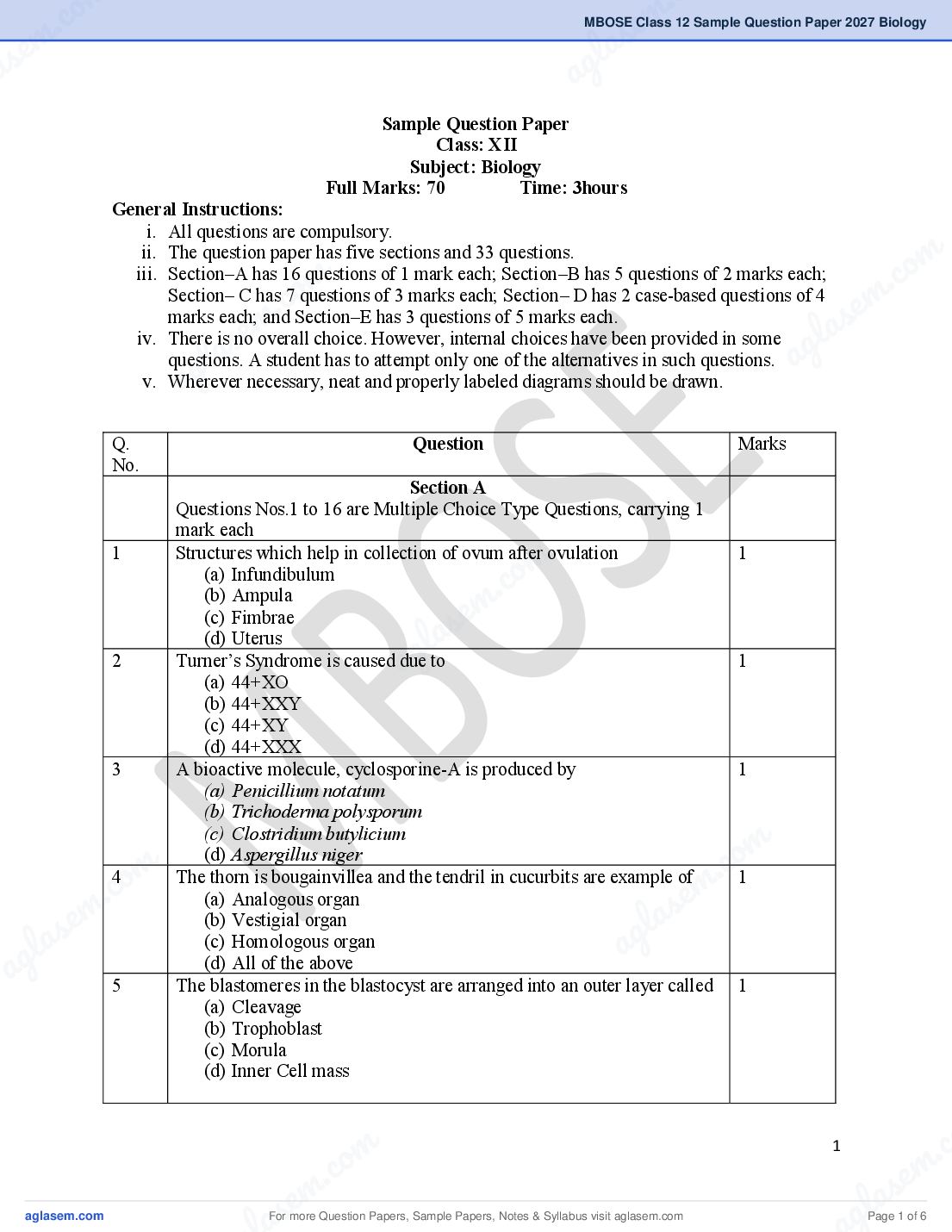
Sample Question Paper
Class: XII
Subject: Biology
Full Marks: 70 Time: 3hours
General Instructions:
i. All questions are compulsory.
m
co
ii. The question paper has five sections and 33 questions.
om .
iii. Section–A has 16 questions of 1 mark each; Section–B has 5 questions of 2 marks each;
. c
Section– C has 7 questions of 3 marks each; Section– D has 2 case-based questions of 4
em
e m
marks each; and Section–E has 3 questions of 5 marks each.
l as
as
iv. There is no overall choice. However, internal choices have been provided in some
l ag
ag
questions. A student has to attempt only one of the alternatives in such questions.
v. Wherever necessary, neat and properly labeled diagrams should be drawn.
Q. Question Marks
No.
Section A
Questions Nos.1 to 16 are Multiple Choice Type Questions, carrying 1
mark each
om
1 Structures which help in collection of ovum after ovulation 1
(a) Infundibulum
. c
(b) Ampula
e m
(c) Fimbrae
l as
ag
(d) Uterus
2 Turner’s Syndrome is caused due to 1
(a) 44+XO
(b) 44+XXY
(c) 44+XY
(d) 44+XXX
3 A bioactive molecule, cyclosporine-A is produced by 1
(a) Penicillium notatum
(b) Trichoderma polysporum
(c) Clostridium butylicium
m
m .co1
(d) Aspergillus niger
.co m
4 The thorn is bougainvillea and the tendril in cucurbits are example of
m (a) Analogous organ
s e
s e (b) Vestigial organ
g la
g la (c) Homologous organ a
a 5
(d) All of the above
The blastomeres in the blastocyst are arranged into an outer layer called 1
(a) Cleavage
(b) Trophoblast
(c) Morula
(d) Inner Cell mass
om
1
. c
. c e m
m as
se
For more Question Papers, Sample Papers, Notes & Syllabus visit
gl
Page 1 of 6
Page 3
(a) Bacteria
(b) Protozoan
(c) Virus
(d) Fungi
7 Occurrence of more than one embryo in a seed is referred to as 1
(a) Polyembryony
(b) Apomixes
(c) Endosperm
(d) False fruit
8 In a certain place A, it is observed that the Birth Rate and Immigration is 1
more than Death Rate and Emigration. Therefore, Population Density
will
(a) Decrease
(b) Increase
(c) Remain the same
(d) None of the above
9 The anti-codon in the tRNA is CGA; therefore, its complementary 1
codon will be
(a) GGU
(b) GCA
(c) GCU
(d) GAC
10 Each ovule has one or two protective envelopes called 1
(a) Funicle
(b) Hilum
(c) Integuments
(d) Embryo
11 The phenotypic ratio of a cross is 3:1. Name the cross 1
(a) Incomplete dominance
(b) Monohybrid cross
(c) Dihybrid cross
(d) All of the above
12 Earthworm and Fungi are 1
(a) Producers
(b) Consumers
(c) Decomposers
(d) Scavengers
For question nos. 13 to 16, two statements are given- one labeled as
Assertion (A) and the other labeled as Reason (R). Select the correct
answers to these questions from the codes (A), (B), (C) and (D) as given
below.
(a) Both assertion (A) and Reason (R) are true and Reason (R) is the
correct explanation of the Assertion (A)
(b) Both Assertion (A) and Reason (R) are true but Reason (R) is not
the correct explanation of the Assertion (A).
2
For more Question Papers, Sample Papers, Notes & Syllabus visit Page 2 of 6
Page 4
.co s e m
s em l a
a ag
(c) Assertion (A) is true, but Reason (R) is false.
(d) Assertion (A) is false but Reason (R) is true.
13 Assertion (A): Colostrum contain antibody IgG. 1
Reason (R): Colostrum is produced during initial stage of lactation.
14 Assertion (A): Chromosome 1 has the most genes (2968). 1
m
co
Reason (R): Chromosome X has the fewest gene (231).
om .
15 Assertion (A): A variety of finches was discovered by Darwin in 1
. cGalapagos Island.
e m
e m
Reason (R): The variety of finches is a result of adaptive radiation.
l as
16
as
Assertion (A): Tubectomy and vasectomy are two surgical methods that
l
1
ag
ag prevent conception.
Reason (R): Surgical intervention blocked gamete transport.
Section B 2 x 5 = 10
17 What is linkage? Name the two types of linkages. 1+1
18 What is natural selection? Name the different types of natural selection 1+1
19 (A) Draw a neat labeled diagram of a matured embryo sac of plants. 2
OR
(B) Name the structure from which corpus luteum is formed? Name the 1+1
hormone secreted by it?
m
c. o
20 Observe the diagram shown below of pBR322. Answer the questions 1+1
that follow:
e m
l as
ag
(a). What is pBR322?
(b). What is the role of ori?
21 (A) Differentiate between Benign and Malignant tumours 1+1
OR
m
m (B) What is an antibiotic? Name the first antibiotic discovered.
c. o3 x 7= 21
m 23 .22co Section- C
s e m 3
e la
In human, when is Amniocentesis performed? How is it misused?
las What are fossils? What is the study of fossil called? Name the type of
ag 1+1+1
ag 24
rock where fossils are found?
Form and write appropriate pair of the following 1+1+1
A B
(i) Female gametophyte Pollen grain
(ii) Microspore Male gametophyte
(iii) Generative cell Embryo Sac
25 i. Give the full form of BOD? 1+1+1
ii. Two water sample A and B were collected. BOD of sample A is
om
3
. c
. c e m
m as
se
For more Question Papers, Sample Papers, Notes & Syllabus visit
gl
Page 3 of 6
Page 5
Which sample of water is most polluted? Give reasons.
26 Study the diagram of transcription unit given below and answer the 1+1+1
questions that follow.
(a) What are the names used for Strand A and Strand B?
(b) State whether the gene promoter is located in the 3’ end or 5’ end
of the structural gene.
27 The tropical rainforest is home to more than 40,000 species of plants, 1+1+1
3000 species of fishes, 1300 species of birds, 427 species of mammals,
427 species of amphibians, 378 species of reptiles and 125000 species of
insects, snails and worms.
(a) From the given data, calculates the total number of expected
vertebrate species in a rain forest?
(b) What is so special about the tropics that might account for their
greater biological diversity?
28 (i) Name the source from which insulin was extracted earlier? 1+1+1
(ii) Why is this insulin no more in use for treatment of diabetes?
(iii) How many polypeptide chains are involved in active insulin?
Section – D 4x2=8
29 (A) In a road accident, the injured were brought to a hospital. They 1+1+1+1
were administered with Tetanus antitoxin
(a) What is tetanus antitoxin?
(b) Why were the injured administered with this antitoxin?
(c) Name the kind of immunity this administration provides?
(d) What is vaccination?
OR
(B) Efforts are made by the IARI (Indian Agriculture Research 1+1+1+1
Institute) and Khadi and Village Industries Commission (KVIC) to
generate alternate fuel. Biogas is one such fuel.
(a) Name the microbes used in production of biogas.
(b) What is the raw material required?
(c) What is the composition of biogas?
(d) Give the benefits of setting up a biogas plant.
30 (A) Study the given figure and answer the questions that follow. 1+1+1+1
4
For more Question Papers, Sample Papers, Notes & Syllabus visit Page 4 of 6
Page 6
.co s e m
s em l a
a ag
m
om . co
. c e m
e m l as
l as
(a) Define population.
ag
ag (b) Name the population growth pattern represented by equation
𝑑𝑁
( 𝑑𝑡 = 𝑟𝑁)
(c) What does ‘r’ stand for in the equation?
(d) Which one of the two curves is more realistic for a population?
OR
(B) Study the given diagram, and answer the following questions.
1+1+1+1
m
m .co
s e
l a
ag
m
m a) Mention the type of food chain depicted above?
.co
.co m
b) Mention the trophic level occupied by the frog?
m s e
la
c) Name the producer in the above food chain?
s e d) What is the mode of nutrition in consumers?
g
g la a
a 31 (A) Give reasons why.
Section-E 5x3=15
1+1+1+1+1
(a) Development of the endosperm precede the development of the
embryo?
(b) Groundnut seeds are exalbuminous and castor seeds are
albuminous?
(c) Micropyle is a small pore in the seed coat of a seed.
om
5
. c
. c e m
m as
se
For more Question Papers, Sample Papers, Notes & Syllabus visit
gl
Page 5 of 6
Page 7
mature.
(e) Apple and cashew are not called true fruits?
OR
(B) Study the figure given below and answer the questions that follow.
1+2+1+1
(a) A, B and C are the three sperms, which one of these three will
gain entry into the ovum?
(b) Describe the changes induced by it on X and Y?
(c) Where will this process take place?
(d) How many blastomeres are there in a blastula?
32 A) A man with blood group ‘A’ married a woman with blood group 3+2
‘B’. They have a son with ‘AB’ blood group and a daughter with
blood group ‘O’. Work out the cross and write the Phenotype and
Genotype of the siblings.
OR
B) What is an operon? What happens in the lac operon in the absence 1+2+2
of an inducer and in the presence of an inducer?
33 (A) Answer the following questions: 1+1+1+2
a) What are transgenic animals?
b) Name the first transgenic cow.
c) What type of milk was produced by the first transgenic cow?
d) Write any two benefits of transgenic animals.
OR
(B) Answer the following questions: 1+1+1+1+1
(a) What is gel electrophoresis?
(b) Name the type of gel used in electrophoresis to separate DNA
fragments.
(c) How is the DNA cut before running in the gel?
(d) Why do DNA fragments moved towards the Anode?
(e) Name the compound used to visualized the DNA on exposure to
UV radiation.
****
6
For more Question Papers, Sample Papers, Notes & Syllabus visit Page 6 of 6
Document Details
| Board / Org | Meghalaya Board |
| Exam | Class 12 |
| Type | Sample Paper |
| Pages | 6 |
| Updated | 03 Nov 2026 |