MBOSE Class 12 Sample Question Paper 2027 Anthropology
Finished viewing? Save it for later —
Download MBOSE Class 12 Sample Question Paper 2027 Anthropology (PDF · 9 pages)About MBOSE Class 12 Sample Question Paper 2027 Anthropology
MBOSE Class 12 Sample Question Paper 2027 Anthropology is available here for free download. Published by Meghalaya Board for Class 12, this sample paper can be viewed online or downloaded as a PDF (9 pages). Candidates preparing for Class 12 can use MBOSE Class 12 Sample Question Paper 2027 Anthropology to understand the exam pattern, the type of questions asked, and the overall difficulty level.
Frequently Asked Questions
How can I download MBOSE Class 12 Sample Question Paper 2027 Anthropology?
Open this page and click the Download button to save MBOSE Class 12 Sample Question Paper 2027 Anthropology as a PDF. It is completely free on AglaSem Docs.
Is MBOSE Class 12 Sample Question Paper 2027 Anthropology free to download?
Yes. MBOSE Class 12 Sample Question Paper 2027 Anthropology can be viewed online and downloaded as a PDF free of cost on AglaSem Docs.
How many pages does MBOSE Class 12 Sample Question Paper 2027 Anthropology have?
MBOSE Class 12 Sample Question Paper 2027 Anthropology contains 9 pages, which you can read online or download together as a single PDF.
Where can I find more Class 12 study material?
You can find more Class 12 question papers, sample papers, syllabus, and answer keys on AglaSem Docs.
MBOSE Class 12 Sample Question Paper 2027 Anthropology – Text
Read the full text of this sample paper below — useful to quickly search, copy and reference the content online without downloading the PDF.
📄 View text version (10 pages)
Page 1
MBOSE Class 12
Sample Question Paper
2027 Anthropology
EXAM YEAR TYPE SUBJECT
Meghalaya Class 12 2027 Sample Paper Anthropology
Notes · Sample Papers · Previous Year Papers · Mock Tests
Page 2
.co s e m
s em l a
a ag
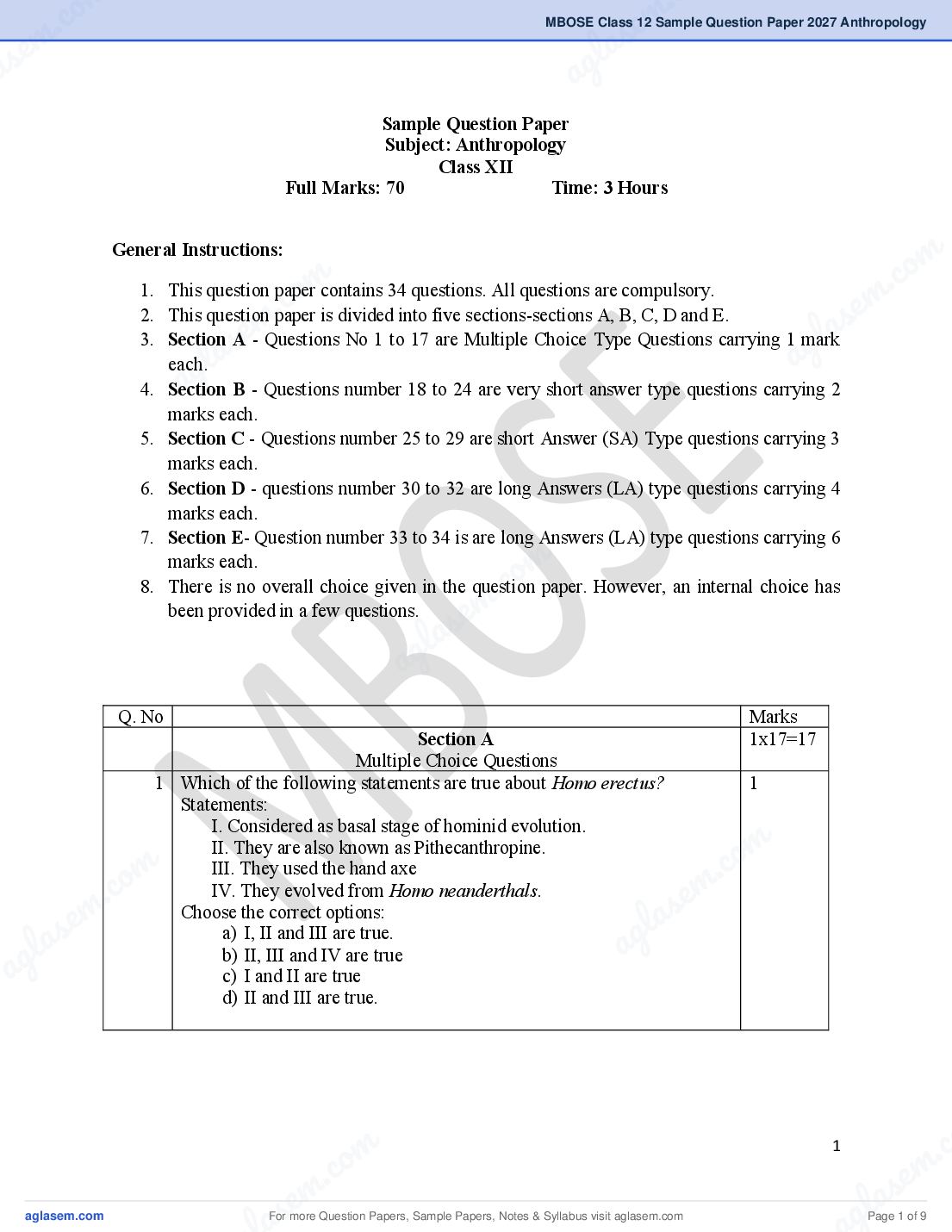
Sample Question Paper
Subject: Anthropology
Class XII
Full Marks: 70 Time: 3 Hours
General Instructions:
o m
m . c
. co is divided into five sections-sections A, B, C, D and E.
1. This question paper contains 34 questions. All questions are compulsory.
s e m
m
Ae- Questions No 1 to 17 are Multiple Choice Type Questions carrying 1 mark
2. This question paper
3. Section s l a
each.la ag
g
a B - Questions number 18 to 24 are very short answer type questions carrying 2
4. Section
marks each.
5. Section C - Questions number 25 to 29 are short Answer (SA) Type questions carrying 3
marks each.
6. Section D - questions number 30 to 32 are long Answers (LA) type questions carrying 4
marks each.
7. Section E- Question number 33 to 34 is are long Answers (LA) type questions carrying 6
m
.co
marks each.
8. There is no overall choice given in the question paper. However, an internal choice has
e m
been provided in a few questions.
l as
ag
Q. No Marks
Section A 1x17=17
Multiple Choice Questions
1 Which of the following statements are true about Homo erectus? 1
Statements:
I. Considered as basal stage of hominid evolution.
m
.co
II. They are also known as Pithecanthropine.
m
.co
III. They used the hand axe
e m
s
IV. They evolved from Homo neanderthals.
e m Choose the correct options:
la
las a) I, II and III are true.
ag
ag b) II, III and IV are true
c) I and II are true
d) II and III are true.
om
1
. c
. c e m
m as
se
For more Question Papers, Sample Papers, Notes & Syllabus visit
gl
Page 1 of 9
Page 3
a) It prevents sunburn and skin cancer
b) It absorbs more heat
c) It is less prone to acne and pimples
d) It is culturally more acceptable.
3 Eustatic movement refers to: 1
a) uplifting of earth due to the melting of the ice mass
b) rise and fall of the general sea level due to melting or forming of
glaciers
c) gliding movement of tectonic plates
d) mountain forming movement acting tangentially to the earth
surface
4 Senescence refers to 1
a) Childhood
b) Adolescence
c) Adulthood
d) Old age
5 There are two statements marked as Assertion (A) and Reason (R). mark 1
your answer as per the codes provided below.
Assertion (A): Every person is biologically and genetically different from
others.
Reason (R): Individual differences are generated from interacting
influences of heredity and environment.
a) Both (A) and (R) are true but (R) is not the correct explanation
of (A)
b) Both (A) and (R) are true and (R) is the correct explanation of
(A)
c) (A) is true but (R) is false
d) (A) is false but (R) is true
6 Match List I and List II 1
List I List II
A. Palaeozoic i. mammals
B. Cenozoic ii. fishes
C. Mesozoic iii. first metazoa
D. Proterozoic iv. reptiles
Choose the correct codes below:
a) A-i, B-iii, C-ii, D-iv
b) A-ii, B-i, C-iv, D-iii
c) A-iii, B-iv, C-ii, D-i
d) A-iv, B-i, C-ii, D-iii
2
For more Question Papers, Sample Papers, Notes & Syllabus visit Page 2 of 9
Page 4
.co s e m
s em l a
a ag
7 The characteristic tools of Mesolithic Age are- 1
a) Crude tools
b) Microlithics
c) Polished tools
d) Flake tools
m
om
8 Which of the following is false about Art mobilier. 1
. co
. c
a) These are engravings and carvings on stone, bones, antlers and
em
e m
ivory
l as
l as
b) They are moveable
c) They are also found on the walls and ceilings of caves. ag
ag d) They are also known as home arts.
9 Which of the following is not associated with Neolithic cultures 1
a) Invention of pottery
b) Invention of bow and arrow
c) Art of weaving
d) Building houses
10 There are two statements marked as Assertion (A) and Reason (R). Mark 1
your answer as per the codes provided below.
m
.co
Assertion (A): A tribe lacks the specialized division of labour.
Reason (R): A tribe possesses a well-defined political boundary.
e m
l as
a) Both (A) and (R) are true but (R) is not the correct explanation of
ag
(A)
b) Both (A) and (R) are true and (R) is the correct explanation of
(A)
c) (A) is true but (R) is false
d) (A) is false but (R) is true
11 A process of determining the guilt or innocence by submitting the 1
accused to dangerous test is known as
a) Trial
b) Oath
m
.co
c) Ordeal
m
.co
d) Weire-guild
e m
s
12 What is a potential consequence of breaking a taboo in many societies? 1
e m a) Social ostracization
la
las b) Immediate acceptance of the new belief
ag
ag c) Financial rewards
d) Appreciation by all members
13 Which of the following statements are true regarding ‘gender’? 1
a) It is biologically determined
b) It is a numerical concept
c) It is same as the sex of the person
d) It is a social construct
om
3
. c
. c e m
m as
se
For more Question Papers, Sample Papers, Notes & Syllabus visit
gl
Page 3 of 9
Page 5
a) Endogamy
b) Exogamy
c) Homogamy
d) Polygamy
15 Membership of caste is ________________ 1
a) Acquired
b) Hereditary
c) Transferred
d) Awarded
16 Sunil customarily takes his mother’s surname. The custom is known as 1
a) Patrilineal
b) Matrilineal
c) Alineal
d) Nonlineal
17 Mr. Rompan is good in cane and bamboo works and he teaches it to 1
everyone who wants to learn. He was made the chief trainer in his
community administration. This is an example of-
a) Diffused positive sanction
b) Organized positive sanction
c) Diffused negative sanction
d) Organized negative sanction
Section B. 2x7=14
18 What are mural arts? 2
19 What are the different adaptations of humans through the shape of the 2
nose?
20 What are teratogens. Give examples. 2
21 A). “Each tool is basically an artifact while an artifact is not necessarily a 2
tool”
Bring out the differences between tools and artifacts.
Or
B). Compare the handaxe of the Paleolithic and Mesolithic period. 2
22 A). What is the headman/chief known as in Garo and Khasi tribes. 2
Or
B). Name any two major characteristics of Indian caste system. 2
23 Mention any two provisions of the Sixth Schedule. 2
24 Mention any two gender roles a man is expected to play in Indian 2
families.
4
For more Question Papers, Sample Papers, Notes & Syllabus visit Page 4 of 9
Page 6
.co s e m
s em l a
a ag
Section C 3x5=15
25 Define adaptation. Write the adaptational features of humans living in the 1+2
mountain region.
26 A). List the factors responsible for formation of racial groups. Describe 1+ 2
m
om
any one of them.
. co
. c Or
em
e m 1+ 2
l as
l as
B) What is prenatal development? What are the stages of prenatal
development? ag
g
a A). Name the Eras of the Geological Time Scale in correct hierarchical 1+1+1
27
order from oldest to the latest. Name the Era in which the modern
man evolved? The present day falls under which epoch?
Or
1+1+1
B). What is glaciation? In which Epoch did the last glaciation take
place? What are the types of valleys formed by rivers and by
m
glaciers?
. c o
e m
28 A). Mention any three significant accomplishments of the Homo 3
neanderthal.
l as
Or
g
B). Describe the Anvil-stoneatechnique.
3
29 A). What is Sanskritization? Mention any two impacts of Sanskritization. 1+ 1+ 1
Or
3
B). Mention the causes for backwardness of tribal people.
Section D 4x3=12
30 A). What is growth? Describe any three factors affecting human growth. 1+3
m
m Or
.co
.co em
1x4=4
e m la s
B). Give the comparison between growth and development based on at
las least four points.
a g
ag 31 A). ‘Any sort of contact between two societies with different culture 4
imposes change on both societies.’
Describe any four ways by which cultures come in contact.
Or
B). The Neolithic Period is also known as ‘Neolithic Revolution’. What 4
are the revolutionary achievements of the Neolithic Age?
om
5
. c
. c e m
m as
se
For more Question Papers, Sample Papers, Notes & Syllabus visit
gl
Page 5 of 9
Page 7
Or
B). Describe the status of women in North East India with respect to 3+1
matrilineal society. Do you think that women in matrilineal society
enjoy a better status? Give reasons for your answer.
Section E 6x2=12
33 A) Name the major races of the world. Describe any two of them. 2+4
Or
B) Give the outline classification of Indian population by B.S. Guha. 3+3
Add a note on the criticisms of this classification.
34 Read the following passage carefully and answer the questions that
follow:
Unlike other species that adapt to their environments strictly
through genetic mutation and natural selection, humans possess an
additional, highly effective mechanism for adaptation: culture.
Biocultural evolution is the process through which human biology and
culture continuously shape one another. Rather than viewing human
evolution as purely genetic, anthropologists recognize that our tools,
social behaviours, and symbolic language modify the environment. In
turn, these environmental modifications exert selective pressures on our
genes.
Our biological evolution has shaped our cultural development. The
physical evolution of bipedalism freed our hands, allowing for the
creation and use of complex tools, art, and sewing. Furthermore,
biocultural adaptations show how culture can reduce the need for
physical evolutionary change. Instead of growing thick fur to survive
freezing climates, humans invented the cultural practice of making
clothing.
As an end product of the whole process of inorganic and organic
evolution, man has developed a complex and plastic nervous system
which possesses a protracted span of memory for details has the ability to
use verbal symbol, language. By virtue of symbolic faculty, man can
store up any sort of information and pass it on to the next generation.
Questions
1
A. What is biocultural evolution?
a) The process by which only animals adapt to their physical
environment.
6
For more Question Papers, Sample Papers, Notes & Syllabus visit Page 6 of 9
Page 8
.co s e m
s em l a
a ag
b) The mutual interaction and feedback loop between human
biology and cultural practices.
c) The evolution of human culture without any genetic changes.
d) The extinction of species due to biological assaults.
B. According to the passage, how has the cultural practice of tool- 1
m
making interacted with human biology?
a) Tools completely replaced the need for human hands.
om . co
c
b) The physical evolution of human hands and bipedalism enabled
. em
e m
the crafting of complex tools, which further influenced social
l as
l as
learning and survival.
ag
g
c) Tool-making caused the human brain to shrink over time.
a d) Tools directly caused mutations in human DNA.
1
C. How does culture act to reduce the need for biological evolution,
as mentioned in the passage?
a) By causing random genetic mutations in human populations.
b) By speeding up the process of natural selection.
c) By allowing humans to adapt to environments through technology
and behaviour (e.g., clothing for cold climates) rather than relying
m
.co
solely on physical biological changes.
m
d) By eliminating the struggle for existence among humans.
s e
D). Plastic nervous system means____________
a
1
l
a) nervous system is made of plastic like material
ag
b) nervous system is wrapped with plastic
c) nervous system ability to adapt and expand
d) nervous system is made up of nanoparticles.
E. What is the role of language in bio-cultural inheritance? 2
*****
m
m .co
m .co s e m
s e g la
g la a
a
om
7
. c
. c e m
m as
se
For more Question Papers, Sample Papers, Notes & Syllabus visit
gl
Page 7 of 9
Page 9
Sec A Sec B Sec C Sec D Sec E
UNIT NO. UNIT NAME MCQ (17 SA1 (7Q) SA2 (5Q) LA1 (3Q) LA2(2Q) Total
Q) 2marks 3marks 4 marks 6 marks
1 mark
Part I
UNIT 1 Hominid Evolution 1(1) 3(1) 4 (2)
UNIT 2 Human Adaptation 1(1) 2(1) 3(1) 6(3)
UNIT 3 Human Growth 1(2) 2(1) 3( ) 4(1 ) 8(4)
4( )
UNIT 4 Human Race 3(1) 6(1) 9(2)
6( )
Part II
UNIT 1 Human Culture Evolution 1(2) 3(1) 6(1) 11(4)
3( )
UNIT 2 Prehistoric Technology 1(1) 2(1) 3( ) 3(2)
2( )
UNIT 3 Main Features of Prehistoric 1(2) 2(1) 4( ) 4(3)
Cultures
UNIT 4 Political aspects of Society 1(2) 2(1) 4(1 ) 8(4)
Unit 5 Gender and Culture 1(2) 2(1) 4( ) 4 (3)
Unit 6 Indian Society 1(4) 2(1) 3(1) 4(1) 13(7)
2( ) 3( )
Marks (No. of Questions) 17 (17) 14(7 ) 15 (5) 12(3) 12(2) 70(34)
Note: Figures within brackets to indicate the number of questions and figures outside the brackets to indicate marks.
For alternative/choice questions, number of questions have been left blank as ( )
8
For more Question Papers, Sample Papers, Notes & Syllabus visit Page 8 of 9
Page 10
.co s e m
s em l a
a ag
m
om . co
. c em
em l as
l as ag
ag
m
m .co
s e
l a
ag
m
m .co
m .co s e m
s e g la
g la a
a
om
9
. c
. c e m
m as
se
For more Question Papers, Sample Papers, Notes & Syllabus visit
gl
Page 9 of 9
Document Details
| Board / Org | Meghalaya Board |
| Exam | Class 12 |
| Type | Sample Paper |
| Pages | 9 |
| Updated | 03 Nov 2026 |