AHSEC HS 2nd Year Syllabus 2026 Psychology
Finished viewing? Save it for later —
Download AHSEC HS 2nd Year Syllabus 2026 Psychology (PDF · 7 pages)About AHSEC HS 2nd Year Syllabus 2026 Psychology
AHSEC HS 2nd Year Syllabus 2026 Psychology is available here for free download. Published by Assam Board for Class 12, this syllabus can be viewed online or downloaded as a PDF (7 pages). Candidates preparing for Class 12 can use AHSEC HS 2nd Year Syllabus 2026 Psychology to understand the exam pattern, the type of questions asked, and the overall difficulty level.
Frequently Asked Questions
How can I download AHSEC HS 2nd Year Syllabus 2026 Psychology?
Open this page and click the Download button to save AHSEC HS 2nd Year Syllabus 2026 Psychology as a PDF. It is completely free on AglaSem Docs.
Is AHSEC HS 2nd Year Syllabus 2026 Psychology free to download?
Yes. AHSEC HS 2nd Year Syllabus 2026 Psychology can be viewed online and downloaded as a PDF free of cost on AglaSem Docs.
How many pages does AHSEC HS 2nd Year Syllabus 2026 Psychology have?
AHSEC HS 2nd Year Syllabus 2026 Psychology contains 7 pages, which you can read online or download together as a single PDF.
Where can I find more Class 12 study material?
You can find more Class 12 question papers, sample papers, syllabus, and answer keys on AglaSem Docs.
AHSEC HS 2nd Year Syllabus 2026 Psychology – Text
Read the full text of this syllabus below — useful to quickly search, copy and reference the content online without downloading the PDF.
📄 View text version (7 pages)
Page 1
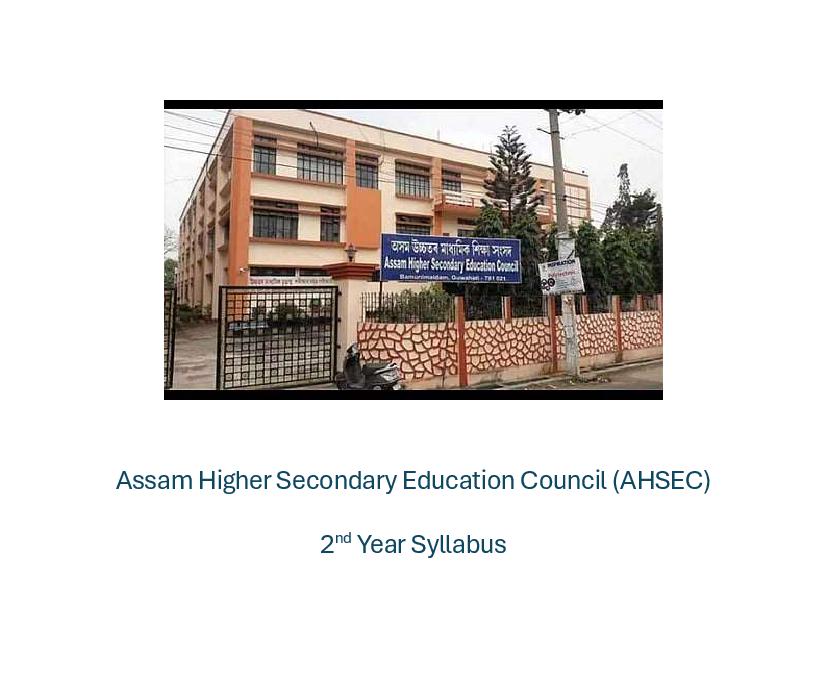
2nd Year Syllabus
Page 2
SYLLABUS FOR HIGHER SECONDARY FINAL YEAR COURSE
Rationale:
Psychology is introduced as an elective subject at the higher secondary stage of
school education. As a discipline, psychology specializes in the study of
experiences, behaviors and mental processes of human beings within a socio-
cultural historical context. This course purports to introduce the learners to the basic
ideas, principles, and methods in Psychology. The emphasis is to create interest and
exposure needed by learners to develop their own knowledge base and
understanding.
The course deals with psychological knowledge and practices which are contextually
rooted. It emphasizes the complexity of behavioral processes and discourages
simplistic cause-effect thinking. This is pursued by encouraging critical reasoning,
allowing students to appreciate the role of cultural factors in behavior and illustrating
how biology and experiences shape behavior.
It is suggested that the teaching - learning processes should involve students in
evolving their own understanding, therefore, teaching of Psychology should be
based on the use of case studies, narratives, experiential exercises, analysis of
common everyday experiences, etc.
Objectives:
To develop appreciation about human mind and behavior in the context of
learners’immediate society and environment.
To develop in learners an appreciation of the nature of
psychologicalknowledge and its application to various aspects of life.
To enable learners to become perceptive, socially aware and self-reflective.
To facilitate students’ quest for personal growth and effectiveness, and to
enable them to become responsive and responsible citizens.
Page 3
SYLLABUS FOR HIGHER SECONDARY FINAL YEAR COURSE 2023-2024
One Paper Time: Three hours Theory Marks: 70
Practical Marks: 30
Unit wise Distribution of Marks & Periods:
Units Topics No. of Marks
periods
I Variations in Psychological Attributes 20 10
II Self and Personality 20 10
III Meeting Life Challenges 20 10
IV Psychological Disorders 20 10
V Therapeutic Approaches 20 10
VI Attitude and Social Cognition 20 10
VII Social Influence and Group Processes 20 10
Total 140 70
Unit wise Distribution of Course Contents
Unit I Variations in Psychological Attributes 20 Periods
1. Individual Differences in Human Functioning
2. Assessment of Psychological Attributes
3. Intelligence
4. Theories of Intelligence
5. Information Processing approach of intelligence
6. Individual Differences in Intelligence
7. Culture and Intelligence
8. Emotional Intelligence
9. Special Abilities: Aptitude: Nature and Measurement
10. Creativity
Unit II Self and Personality 20 Periods
1. Concept of Self
2. Cognitive and Behavioural aspects of Self
Page 4
4. Concept of Personality
5. Major Approaches to the Study of Personality
Type Approaches
Trait Approaches
Psychodynamic Approach and Post Freudian
Approaches
Behavioural Approach
Cultural Approach
Humanistic Approach
6. Assessment of Personality
Self-report Measures
Projective Techniques
Behavioural Analysis
Unit III Meeting Life Challenges 20 periods
1. Nature, Types and Sources of Stress
2. Effects of Stress on Psychological Functioning and
Health
Stress and Health
General Adaptation Syndrome
3. Coping with Stress
Stress Management Techniques
4. Promoting Positive Health and Well-being
Unit IV Psychological Disorders 20 Periods
1. Concepts of Abnormality and Psychological Disorders
Historical Background
2. Classification of Psychological Disorders
3. Factors Underlying Abnormal Behaviour
4. Major Psychological Disorders
Page 5
Obsessive-Compulsive and Related Disorders
Trauma-and Stressor-Related Disorders
Somatic symptom and related disorders
Dissociative disorders
Depressive Disorder
Bipolar and Related Disorders
Schizophrenia Spectrum and Other Psychotic
Disorders
Neurodevelopmental Disorders
Disruptive, Impulse-Control and Conduct Disorders
Feeding and Eating Disorders
Substance Related and Addictive Disorders
Unit V Therapeutic Approaches 20 Periods
1. Nature and Process of psychotherapy
Therapeutic relationship
2. Types of Therapies
Behaviour Therapy
Cognitive Therapy
Humanistic-Existential Therapy
Alternative Therapies
Factors contributing to healing in Psychotherapy
Ethics in Psychotherapy
3. Rehabilitation of the Mentally Ill
Unit VI Attitude and Social Cognition 20 Periods
1. Explaining Social Behaviour
2. Nature and Components of Attitudes
3. Attitude Formation and Change
Attitude Formation
Attitude Change
Attitude-Behaviour Relationship
4. Prejudice and Discrimination
5. Strategies for Handling Prejudice
Page 6
1. Nature and Formation of Groups
2. Type of Groups
3. Influence of Group on Individual Behaviour
Social Loafing
Group Polarisation
Practical 30 Marks 50 Periods
A. Test administration:
Students are required to administer and interpret five
psychological tests related to various psychological attributes like
intelligence, aptitude, attitude, personality, etc.
B. In the Practical examination, the student will be required to
administer and interpret one psychological test.
Distribution of Marks:
Practical File 10 Marks
Viva Voce 05 Marks
One Practical (5 marks for conduct of 15 Marks
practical and 10 marks for reporting)
Total 30 Marks
Prescribed Textbook:
1. Manobigyan, HS 2nd Year, Published by AHSEC.
2. Psychology, Class XII, Published by NCERT.
Page 7
Notes
Model Papers Class 6 Notes
Sample Papers Class 7 Notes
Half Yearly Sample Papers Class 8 Notes
Class 9 Notes
Important Resources
Class 10 Notes
Periodic Table
Class 11 Notes
Writing Skills / Formats
Maps of India / World Class 12 Notes
Books and Solutions
NCERT Books
NCERT Book Solutions
HC Verma Chapter Wise Solutions
RD Sharma Solutions
CGBSE Solutions
Document Details
| Board / Org | Assam Board |
| Exam | Class 12 |
| Type | Syllabus |
| Pages | 7 |
| Updated | 24 Sep 2026 |