Manipur Board Class 11 Syllabus 2027 English
Finished viewing? Save it for later —
Download Manipur Board Class 11 Syllabus 2027 English (PDF · 14 pages)About Manipur Board Class 11 Syllabus 2027 English
Manipur Board Class 11 Syllabus 2027 English is available here for free download. Published by Manipur Board for Class 11, this syllabus can be viewed online or downloaded as a PDF (14 pages). Candidates preparing for Class 11 can use Manipur Board Class 11 Syllabus 2027 English to understand the exam pattern, the type of questions asked, and the overall difficulty level.
Frequently Asked Questions
How can I download Manipur Board Class 11 Syllabus 2027 English?
Open this page and click the Download button to save Manipur Board Class 11 Syllabus 2027 English as a PDF. It is completely free on AglaSem Docs.
Is Manipur Board Class 11 Syllabus 2027 English free to download?
Yes. Manipur Board Class 11 Syllabus 2027 English can be viewed online and downloaded as a PDF free of cost on AglaSem Docs.
How many pages does Manipur Board Class 11 Syllabus 2027 English have?
Manipur Board Class 11 Syllabus 2027 English contains 14 pages, which you can read online or download together as a single PDF.
Where can I find more Class 11 study material?
You can find more Class 11 question papers, sample papers, syllabus, and answer keys on AglaSem Docs.
Manipur Board Class 11 Syllabus 2027 English – Text
Read the full text of this syllabus below — useful to quickly search, copy and reference the content online without downloading the PDF.
📄 View text version (15 pages)
Page 1
Manipur Board Class
11 Syllabus 2027
English
EXAM YEAR TYPE SUBJECT
Manipur Class 11 2027 Syllabus English
Notes · Sample Papers · Previous Year Papers · Mock Tests
Page 2
m .co
m .co s e m
se g l a
a
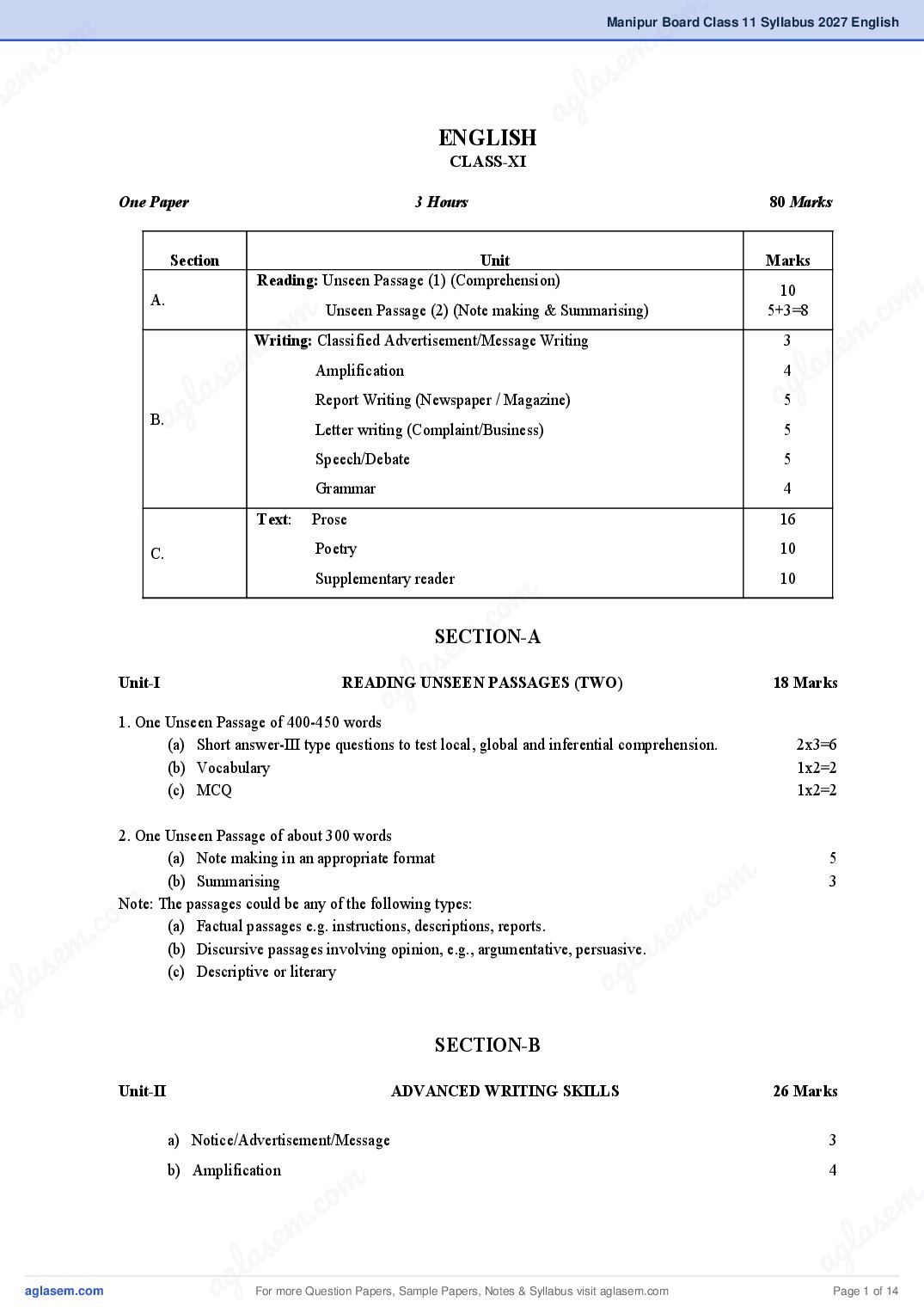
ENGLISH
CLASS-XI
One Paper 3 Hours 80 Marks
Section Unit Marks
Reading: Unseen Passage (1) (Comprehension)
10
m
.co
A.
m Unseen Passage (2) (Note making & Summarising) 5+3=8
m .co
Writing: Classified Advertisement/Message Writing 3
s e m
e 4 a
s Amplification
l
B. ag
l a Report Writing (Newspaper / Magazine) a5g
Letter writing (Complaint/Business) 5
Speech/Debate 5
Grammar 4
Text: Prose 16
C. Poetry 10
Supplementary reader 10
o m
. c
m
SECTION-A
e
s
a PASSAGES (TWO)
READINGlUNSEEN
Unit-I
ag 18 Marks
1. One Unseen Passage of 400-450 words
(a) Short answer-III type questions to test local, global and inferential comprehension. 2x3=6
(b) Vocabulary 1x2=2
(c) MCQ 1x2=2
2. One Unseen Passage of about 300 words
(a) Note making in an appropriate format 5
(b) Summarising m 3
m
Note: The passages could be any of the following types:
.co
m .co (a) Factual passages e.g. instructions, descriptions, reports.
s e m
s e (b) Discursive passages involving opinion, e.g., argumentative, persuasive.
g l a
la a
(c) Descriptive or literary
ag
SECTION-B
Unit-II ADVANCED WRITING SKILLS 26 Marks
a) Notice/Advertisement/Message 3
b) Amplification 4
m .
.co s e m
s em l a
g la ag
a For more Question Papers, Sample Papers, Notes & Syllabus visit Page 1 of 14
Page 3
d) Letter (Complaint/Business) 5
e) Speech/Debate 5
f) Grammar 4
SECTION-C
Unit-III PROSE 16 Marks
Selected Pieces:
(i) Relative Duties of Young men - Henry Ward Beecher
(ii) The Image - R.K. Narayan
(iii) No Time For Fear - Phillip Yancey
(iv) Paul Julius Reuter - Harry Menicol
(v) Life Skills - K. Kalidas Singh
Note:
a) One critical question out of two questions. 5
b) One Short Answer-I Type out of two questions based on text. 4
c) One SA-II Type Question out of two 3
d) One SA-III Type Question out of two given questions 2
e) Two MCQ 2
POETRY 10 Marks
Selected Pieces :
(i) Seven Ages of Man - W. Shakespeare
(ii) Stopping by Woods on a Snowy Evening - Robert Frost
(iii) No Men are Foreign - James Kirkup
(iv) La Belle Dame Sans Merci - John Keats
(v) Ozymandias of Egypt - P.B. Shelley
(vi) Death the Leveller - James Shirley
Note:
a) One out of two extracts from poems from the text to test comprehension
and appreciation. 4
b) Two out of three Sort Answer-III questions from the poems to test local and global
comprehension of text (about 40 words each) 2x2=4
c) Two MCQ 1x2=2
For more Question Papers, Sample Papers, Notes & Syllabus visit Page 2 of 14
Page 4
m .co
m .co s e m
se g l a
a
SUPPLEMENTARY READER
Selected pieces : 10 Marks
m
.co
(i) The Man with the Scar
m
(ii) A Scene from Abraham Lincoln
.co
(iii) God is Near
m s e m
e
(iv) Human Rights & Their Evolution
s l a
g l a ag
Note: a
a) One out of two long answer type questions based on Supplementary Reader to test
comprehension of theme, character and incidents, etc. of about 100 words. 5
b) One out of two SA-II Type Questions 3
c) Two MCQ 1x2=2
PRESCRIBED TEXTBOOKS:
m
.co
1. An Anthology of English Prose and Poetry, Book-I for Class-XI.
em
Printed at : Samadon Press, Sagolband Moirang Hanuba Maning Leirak, Imphal for the
s
lXIa & XII.
Council of Higher Secondary Education, Manipur.
a g
2. Supplementary Reader for Classes
Printed at :Samadon Press, Sagolband Moirang Hanuba Maning Leirak, Imphal for the
Council of Higher Secondary Education, Manipur.
REFERENCE BOOKS:
m
m 1. Writing with a Purpose by Champa Tickoo and Jaya Sasikumar (Oxford University Press)
.co
m .co 2. Oxford English Grammar for Class XI (Oxford University Press)
s e m
s e Press)
g l a
3. Communicative English for Class XI by Renu Anand and Gayatri Khanna (Oxford University
g la 4. A Remedial English Grammar for Foreign Students by F.T. Wood a
a 5. A Practical English Grammar by A. J. Thomson and A. V. Martinet
m .
.co s e m
s em l a
g la ag
a For more Question Papers, Sample Papers, Notes & Syllabus visit Page 3 of 14
Page 5
CLASS-XI
SECTION-A
MARKS –18
I. READING SKILLS
1. One unseen passage to assess comprehension, interpretation, analysis and vocabulary.
The passage may be factual, descriptive or literary, length about 400-450 words.
Type of questions:
Short Answer-III: - 6(3)
Very Short Answer: - 2(2)
Multiple Choice Question: - 2(2)
2. One unseen passage for Note-making and Summarization (about 300 words)
I. Note-making:
(i) Title: - 01
(ii) Numbering and Indenting: - 01
(iii) Notes: - 03
II. Summary (upto 50 words)
(i) Content: - 02
(ii) Expression: -01
For more Question Papers, Sample Papers, Notes & Syllabus visit Page 4 of 14
Page 6
m .co
m .co s e m
se g l a
a
SECTION-B
MARKS – 26
II. HIGHER LEVEL WRITING SKILLS AND GRAMMAR
3. Notice/Classified Advertisement/Message:
m
.co
(i) Format - 01
o m m
(ii) Content
. c - 01
s e
s em
(iii) Expression - 01
l a
g l a ag
a
4. Amplification (one out of two/three questions):
(i) Content/Understanding Idea/ - 01
Concept
(ii) Expression - 03
5. Report Writing: (Newspaper/Magazine)
To be answered in about 120 words: (one out of two given questions) 5 Marks
(i) Format - 01
. c om
(ii) Content relevance
e
- 02 m
(iii) Expression
las - 02
ag
6. Letter Writing: (Complaint/Business) one out of two questions, to be written
in about 120 words: 5 Marks
(i) Format - 01
(ii) Content relevance - 02
(iii) Expression - 02
m
m
c. o (i) Organisation of ideas
7. Speech/Debate in about 150 words on a contemporary age appropriate topic:
m.co 5 Marks
m
- 01
s e
s e (ii) Content - 02
g l a
g la (iii) Expression - 02 a
a
8. Grammar (Two VSA + two MCQ) 4 Marks
Questions on Gap-filling/sentence completion (Tense, preposition, clauses) Speech, Voice,
transformation, etc.
m .
.co s e m
s em l a
g la ag
a For more Question Papers, Sample Papers, Notes & Syllabus visit Page 5 of 14
Page 7
Marks – 36
III. PROSE
To assess competency, comprehension, interpretation, analysis, evaluation and extrapolation beyond the
text. There shall have long Answer Type Questions, Short Answer type questions including Multiple
Choice Questions.
9. One out of two long answer type questions based on the chapters/lessons from the prescribed text to be
answered in about 100 words. 5x1=5marks
10. One SA-I Question out of the two given questions from the text in about 60 words. 4x1=4marks
11. One out of two SA-II type Questions in about 50 words each to be answered. 3x1=3 marks
12. One SA-III type Question out of the two given questions to be answered in about 40 words.s 2x1=2marks
13. Two MCQ Type Questions. 1x2=2marks
IV. POETRY
14. One poetry extract out of two given extracts to be answered. 1x4=4marks
15. Two SA-III type questions in about 40 words each out of three given questions. 2x2=4marks
16. Two MCQ type questions. 1x2=2marks
V. SUPPLEMENTARY READER
17. One LA/E Type Question to be answered out of two given questions in about 100 words. 5x1=5marks
18. One SA-II Type Question out of the two given questions in about 50 words. 3x1=3marks
19. Two MCQ type questions. 1x2=2marks
******
For more Question Papers, Sample Papers, Notes & Syllabus visit Page 6 of 14
Page 8
m .co
m .co s e m
se g l a
a
DESIGN OF
QUESTION PAPER
Subject : English
Class : XI
Full Mark: 100 (80 marks Written Examination+20 marks Internal assessment)
Time: 3 Hours (80 MARKS WRITTEN EXAMINATION)
WEIGHTAGE TO OBJECTIVES m
Objectives
m Marks Percentage
.co
I
Knowledge (K)
m .co
Understanding/Comprehension (U/C)
16
40
20%
50%
s e m
s e
Application (A)/ Expression 24 30% l a
g l a Total: 80 100%
ag
aWEIGHTAGE TO FORMS OF QUESTIONS:
Form of Questions No. of Question
Time (in
Marks Percentage
minute)
Essay/Long Answer (E/LA) 06 65 30 38
Short Answer (SA-I) 02 35 08 10
II Short Answer (SA-II) 04 30 12 15
Short Answer (SA-III) 06 20 12 15
Very Short Answer (VSA) 08 14 08 10
MCQ 10 16 10 12
Total: 36
m 180 80 100
WEIGHTAGE TO CONTENT:
.co
UNIT
s em
CONTENTS Marks Percentage
A g
6(3) + 2(2) VSA + 2(2) MCQ la
Unseen Passage (Comprehension)
10(7)
a
(READING) Note Making + Summarizing
8(2)
18(9)
5(1) + 3(1)
Notice/ Classified Advertisement/ Message 3(1)
III Amplification 4(1)
B Report (Newspaper/ Magazine) 5(1)
26(9)
(WRITING) Letter (Complaint/ Business) 5(1)
Speech/ Debate 5(1)
Grammar- 2(2) VSA + 2(2) MCQ 4(4)
Prose 5(1) + 4(1) + 3(1) + 2(1) + 2(2) MCQ 16 (6)
C
m36(18)
.co
Poetry 4(2) + Extract 4(4) VSA + 2(2) MCQ 10(8)
m (TEXT)
c. o IV SCHEME OF SECTIONS :
Supplementary 5(1) + 3(1) + 2(2) MCQ 10(4)
Total :
e
80 (36)m 80
e m A, B, & C
l as
las V SCHEME OF OPTIONS : LA/E, SA-I, SA-II, SA-III
ag
ag VI
DIFFICULTY LEVEL :
Difficult : 30% of total mark
Average : 50% of total mark
Easy : 20% of total mark
Project Work: (5marks)
1.
Periodic tests:Introduction: 1 mark Viva-Voce:
VII 20 Marks for Internal Assessment 2.
(10 marks) Profile/Content: 3marks (5 marks)
3. Conclusion: 1 mark
Special Instruction: 1) Two questions of MCQ will be assertion-reason type question from prescribed texts based on
comparative study of the lessons.
m .
.co m
Abbreviation : K(Knowledge),U(Understanding),C(Comprehension), Exp.(Expression), Skill(S), E(Essay Type), SA
s e
em
(Short Answer Type), VSA (Very Short Answer Type), MCQ(Multiple Choice Question)
s l a
g la ag
a For more Question Papers, Sample Papers, Notes & Syllabus visit Page 7 of 14
Page 9
Classes XI-XII
Total Marks: 20
For Class XI-XII (English) Internal Assessment, activities should be aligned with the
objective of the NEP 2020, emphasizing communication skills, critical thinking, creativity
,collaboration, and real-life language use. Suggested activities, therefore, take into
consideration an integration of the four language skills i.e Listening, Speaking, Reading,
Writing, and Project work with Viva.
Assessment of Listening and Speaking Skills
1.Listening Activities:
* Listening to a speech and summarizing
* Note-taking from audio lecture
* Listening to poetry recitation, song and interpretation
2. Speaking Activities:
* Group Discussion on current issues
* Debate ( formal/informal)
* Extempore Speech
* Seminar Presentation
* News Reading and Analysis
* Story Telling
-For the above activities subject teachers may refer to books prescribed in the syllabus.
- In addition to the above, teachers may plan their own activities and create their own
material for assessing the listening and speaking skills.
Parameters for Assessment: The listening and speaking skills are to be assessed on the
following parameters:
a. Interactive competence (Initiation & turn taking, relevance to the topic)
b. Fluency (cohesion, coherence and speed of delivery)
c. Pronunciation
d. Language (grammar and vocabulary)
For more Question Papers, Sample Papers, Notes & Syllabus visit Page 8 of 14
Page 10
m .co
m .co s em
se g la ASSESSMENT
a
SUGGESTIVE RUBRICS FOR LISTENING AND SPEAKING
1 2 3 4 5
Interaction Contributions Contributions are Develops Interaction is Initiates
are often interaction adequately initiated &
mainly Unrelated to those adequately, and developed. logically
unrelated to of the other makes Takes turn but develops
those of speaker. however needs simple
other speakers. Generally passive minimal some prompting. conversation
m
Shows hardly
m in effort to on
.co
.co m
any initiative in the development initiate familiar topics.
the
m of conversation. conversation. Takes turns s e
s e l a
ag
development of Needs appropriately.
g l aconversation. constant
a Very limited prompting to
interaction. take turns.
Fluency and Noticeably/ Usually fluent; Is willing to Speaks without Speaks fluently
coherence long pauses; produces speak noticeable almost
rate Simple speech at effort, with a little with
of speech slow. fluently, but loses length, repetition. no repetition
Frequent coherence in however Demonstrates &
repetition complex repetition is hesitation to find minimal
m
.co
and/or communication. noticeable. words or use hesitation
self- Often hesitates
e m Hesitates correct Develops
correction this and/or resorts
las and/or grammatical topic fully &
is
all ag
to slow speech.
Topics partly
corrects;
self
structures and/or
self-
coherently
right informal developed; not occasionally correction.
in always concluded loses Topics
conversation. logically. coherence. not
Links Topics fully developed to
Only basic developed, merit.
sentences; but usually
breakdown of not logically
m
.co
coherence concluded.
m
.co m
evident.
s e
s emPronunciation Frequent Frequently Largely
g l a
Mostly correct Pronounces
g la inaccurate unintelligible correct a
pronunciation correctly
a pronunciation. articulation. pronunciation & clear &
Communication Frequent & clear articulation. articulates
is severely phonological articulation Is clearly clearly.
affected. errors. except understood Is
Major occasional most of the time; always
Communication errors. very few comprehensible
problems. phonological appropriate
errors. intonation.
m .
.co s e m
s em l a
g la ag
a For more Question Papers, Sample Papers, Notes & Syllabus visit Page 9 of 14
Page 11
and grammars communicate on communicate communicate on communicate
almost no some of the topics, on most of most of the topics on most of the
Grammar flexibility, and with limited the topics, with appropriate topics using a
mostly vocabulary. with limited vocabulary. wide range
struggles for Frequent errors, vocabulary. Minor errors that of appropriate
appropriate but A few do not hamper vocabulary,
words. self- corrects. grammatical communication. words
Many errors. new words and
grammatical expression.
errors No
impacting grammatical
communication. errors.
Assessment of Reading and Writing
3. Reading Activities
* Reading unseen passages.
* critical review of newspaper editorials.
* Comparative study of two texts .
* Literary appreciation of poems and prose prescribed in syllabus.
* Reading journal.
* Character analysis from prescribed texts.
4.Writing Activities
* Article Writing.
* Report Writing.
* Letter Writing.
* Speech/Debate/Essay Writing.
* Creative/Script Writing.
* Notice/Diary Writing etc.
Parameters for Assessment: The Reading and writing skills are to be assessed on the following parameters:
* Reading Fluency ( pronunciation, pace, expression )
* Reading Comprehension and understanding.
* Identification of main ideas, details, and inference.
* Content relevance and Creativity in writing.
* Organisation and Coherence of Ideas.
* Language Accuracy.
For more Question Papers, Sample Papers, Notes & Syllabus visit Page 10 of 14
Page 12
m .co
m .co s em
se g la ASSESSMENT
a
SUGGESTIVE RUBRICS FOR READING AND WRITING
Descriptor
Level
1 2 3 4 5
Unable to Limited reading Demonstrates Demonstrates Demonstrates
demonstrates fluency and basic reading good reading excellent reading
m
the expected comprehension;
m comprehension; skills and fluency and
.co
reading and
.co
difficulty identifies some understanding; comprehension;
s e m
writing
s emindentifying key key ideas; identifies most accurately
g l a
g la ideas; writing writing conveys
competencies. key ideas; identifies key a
a lacks coherence meaning but writing is ideas and
and contains contains coherent with inferences;
frequent errors. noticeable minor language writing is well
organisational errors. organised,
and language creative, and
errors. accurate.
. c om
e m
s
Project Work + Viva: 10 Marks
laWork and Viva:
g
Note:- Components of the Project
a
For Class XI:
i) Introduction-1 Mark ii) Profile/Content/Component-3 Marks iii) Conclusion-1
Mark = 5 Marks
Viva - 5 Marks.
For Class XII:
o m
c
mi) Selection & Relevance of the Topic: 1 mark. ii) Content: 2 marks. iii) Language
c. o use: 2 marks. iv) Creativity & Originality: 2marks = 7 Marks sem.
s em Viva – 3 Marks g l a
g la a
a
5) The following points must be kept for consideration while assessing the project
work/Project-Portfolio
* Preparation/submission of Project Report (800-1000 words).
* Process and Methodology.
* Quality of the content of the Project.
m .
.co m
* Accuracy of information.
s e
s em l a
g la ag
a For more Question Papers, Sample Papers, Notes & Syllabus visit Page 11 of 14
Page 13
* Creativity and Originality.
* Knowledge and experience gained.
* Presentation.
Suggestions for Project Work:
For Class XI more emphasis shall be given to listening and speaking skills.
For Class XII more emphasis shall be given to reading and writing skills.
* The Project can be inter-disciplinary in theme. The ideas/issues highlighted in the
chapters/ poems/ drama given the prescribed books can also be developed in the
form of a project. Students can also take up any relevant and age-appropriate
theme.
* Students listen to podcasts/ interviews/radio or TV documentary on a topic and
prepare a report countering or agreeing with the speakers.
* Report on a visit to public places- Historical Sites, Zoological Parks, Museum,
Market Places etc.
* Language use in social media.
* Local language and dialect survey.
* Documentation of folk tales and oral tradition.
* Translation project (Local language to English)
* Study of advertisement and persuasive language etc.
6) Steps of Assessment by Viva Voce :
* Introduction: Ask the student to briefly introduce the project/topic. Assess clarity,
confidence, and communication skills.
* Understanding of the project/topic: Ask 3-4 questions related to the project’s
objectives, theme, or content. Assess the student’s comprehension and depth of
knowledge.
* Analysis and Interpretation: Ask the student to explain key findings, observations,
or conclusions. Assess critical thinking and analytical ability.
* Personal Learning and Reflection: Ask what the student learned from the project
and how it was useful. Assess reflection, insight, and application of learning.
* Research and Methodology: Ask the student how information was collected and
organised. Assess originality, effort, and research skills.
Instructions for the Teachers: -
1. Properly orient students about the Project work.
2. Facilitate the students in the selection of theme and topic.
For more Question Papers, Sample Papers, Notes & Syllabus visit Page 12 of 14
Page 14
m .co
m .co s em
Create a rubric for assessment and share with the studentsla
se 3.
ag before they start so that they
know the parameters of assessment.
Parameters for Overall Assessment: -
1. Pronunciation:
* When evaluating the pronunciation of the students, teachers must listen for clearly
articulated words, pronunciation of unusual spellings and intonation.
m
.co
* Assess the students for the pronunciation skills and determine at which level the student
m
.co m
needs improvement.
m s e
2. Vocabulary:
After as e g l a
l a
noting their pronunciation levels, evaluate the students on the use of extensive and
ag vocabulary during the viva. Check if students are using vocabulary appropriate
appropriate
to the context about which they are speaking.
3. Accuracy:
Grammar has always been an important component of language skills. As students
speak/answer the questions during the viva, listen to their grammatical structures. Are they
competent enough to use multiple tenses? Is their word order correct in a given sentence?
m
.co
An effective speaker will automatically use the correct grammatical structures of his
em
language.
4. Communication: s
laof the students means looking at more than language.
a g
Assessing the communication skills
Look at how creatively students use the language to make their points understood.
Students with a low level of vocabulary and grammar may still have good communication
skills if they are able to make the teacher understand their point of view.
5. Interaction:
* During the viva teachers need to ask the students some questions. Questions need to be
o m
based on the projects that have been suggested or chosen by the students.
m c
. can be ready
c. o * It is imperative for a teacher to read the essays/project reports before
s e m
they
e m to ask questions.
l a
l as * Teachers need to observe how students answer the questionsg
a are posed to them:
that
ag Are they able to understand and answer questions independently or can they answer
only when the questions are translated into simpler words or repeated? Are they able
to give appropriate responses in a conversation?
* These elements of interaction are necessary for clear and effective communication. A
student with effective interaction skills will be able to answer questions with relative
m
ease and follow the flow of conversation.
.
.co s e m
s em l a
g la ag
a For more Question Papers, Sample Papers, Notes & Syllabus visit Page 13 of 14
Page 15
* Fluency may be the easiest quality to judge in the students' speech: How comfortable
are they as they speak and express themselves? How easily do the words come out? Are
there inappropriate pauses and gaps in the way a student speaks?
* Fluency is a judgment of this communication and is an important criterion when
evaluating speaking skills. These criteria: pronunciation, vocabulary, accuracy,
interaction and fluency are all the hallmarks of a student's overall speaking abilities.
* Teachers must also remember that some students may excel in one area and struggle in
another. Helping the students understand these issues will enable them to become
effective speakers in future. Let your students know that you will be assessing them in
these various areas when you evaluate their progress and encourage them to work and
improve in these areas.
* Finally, teachers must remember that a proper evaluation of the students will take into
consideration more than just one oral interview on the final ASL project. Teachers must
take note of a student's progress throughout the academic year
N.B- 1. Three (3) Periodic Test shall be conducted during an academic session.
2. Contents of the Periodic Test should be Listening, Speaking, Reading, Writing,
and Project work with Viva .
3. The best two of three Periodic Test scores shall be considered and scaled down to
10 marks for the final periodic assessment i.e 10 marks shall be allotted to the
periodic test, while the remaining 10 marks shall be allotted for Project Work
with Viva.
4. All materials/records for the conduct of Internal Assessment should be retained
by the school until the end of the academic session.
5. For Internal Assessment, students may be provided with audio-visual aids to assess
their listening and speaking skills.
6. External Examiners may be appointed to conduct and evaluate the Internal
Assessment as per CoHSEM regulations and norms. However, Internal Examiners
shall be appointed by the respective Institution.
--------------------------------------------------------------
For more Question Papers, Sample Papers, Notes & Syllabus visit Page 14 of 14
Document Details
| Board / Org | Manipur Board |
| Exam | Class 11 |
| Type | Syllabus |
| Pages | 14 |
| Updated | 04 Nov 2026 |