ICSE Class 10 Question Paper 2025 Robotics and Artifical Intelligence
Finished viewing? Save it for later —
Download ICSE Class 10 Question Paper 2025 Robotics and Artifical Intelligence (PDF · 11 pages)About ICSE Class 10 Question Paper 2025 Robotics and Artifical Intelligence
ICSE Class 10 Question Paper 2025 Robotics and Artifical Intelligence is available here for free download. Published by CISCE for Class 10, this question paper can be viewed online or downloaded as a PDF (11 pages). Candidates preparing for Class 10 can use ICSE Class 10 Question Paper 2025 Robotics and Artifical Intelligence to understand the exam pattern, the type of questions asked, and the overall difficulty level.
Frequently Asked Questions
How can I download ICSE Class 10 Question Paper 2025 Robotics and Artifical Intelligence?
Open this page and click the Download button to save ICSE Class 10 Question Paper 2025 Robotics and Artifical Intelligence as a PDF. It is completely free on AglaSem Docs.
Is ICSE Class 10 Question Paper 2025 Robotics and Artifical Intelligence free to download?
Yes. ICSE Class 10 Question Paper 2025 Robotics and Artifical Intelligence can be viewed online and downloaded as a PDF free of cost on AglaSem Docs.
How many pages does ICSE Class 10 Question Paper 2025 Robotics and Artifical Intelligence have?
ICSE Class 10 Question Paper 2025 Robotics and Artifical Intelligence contains 11 pages, which you can read online or download together as a single PDF.
Where can I find more Class 10 study material?
You can find more Class 10 question papers, sample papers, syllabus, and answer keys on AglaSem Docs.
ICSE Class 10 Question Paper 2025 Robotics and Artifical Intelligence – Text
Read the full text of this question paper below — useful to quickly search, copy and reference the content online without downloading the PDF.
📄 View text version (11 pages)
Page 1
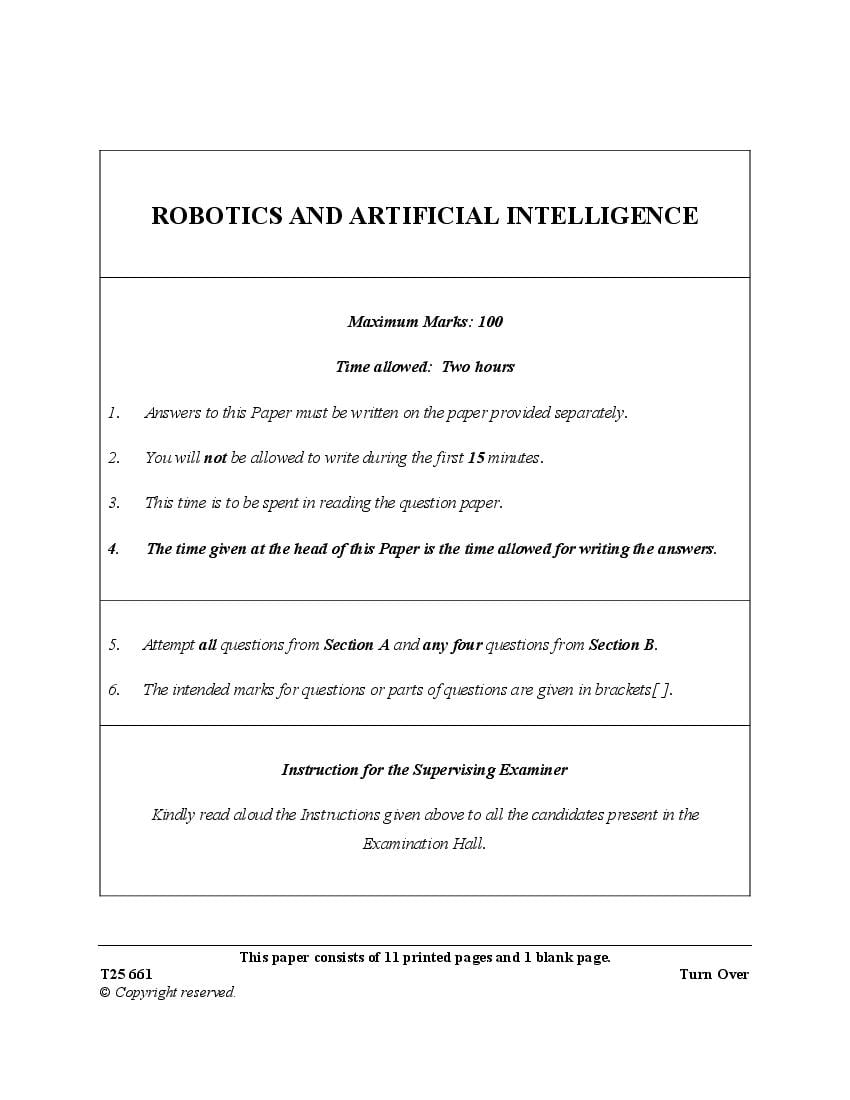
Maximum Marks: 100
Time allowed: Two hours
1. Answers to this Paper must be written on the paper provided separately.
2. You will not be allowed to write during the first 15 minutes.
3. This time is to be spent in reading the question paper.
4. The time given at the head of this Paper is the time allowed for writing the answers.
5. Attempt all questions from Section A and any four questions from Section B.
6. The intended marks for questions or parts of questions are given in brackets[ ].
Instruction for the Supervising Examiner
Kindly read aloud the Instructions given above to all the candidates present in the
Examination Hall.
This paper consists of 11 printed pages and 1 blank page.
T25 661 Turn Over
© Copyright reserved.
Page 2
(Attempt all questions from this Section.)
Question 1
Choose the correct answers to the questions from the given options. [20]
(Do not copy the questions. Write the correct answers only.)
(i) Study the image given below.
In which field is this robot used?
(a) Medicine delivery
(b) Connected vehicles
(c) Smart homes
(d) Driver assisted cars
(ii) Python programming is __________.
(a) low level programming language
(b) high level programming language
(c) machine level programming language
(d) assembly level programming language
T25 661 2
Page 3
(a) Modelling
(b) Problem scoping
(c) Data acquisition
(d) Evaluation
(iv) __________ are evenly spaced projections along the circumference of the gear.
(a) Pitch Circle
(b) Dedendum
(c) Teeth
(d) Hub
(v) The main function of a controller in robotics is to:
(a) keep the shape of the robot intact.
(b) change rotational directions of the Actuators.
(c) reduce friction between two gears.
(d) process sensory input and generate appropriate commands.
(vi) Why are Cobots important in industrial settings?
(a) They DO NOT work well with humans.
(b) They improve productivity by replacing human workers.
(c) They provide a safer human-robot collaboration.
(d) They do not require human control.
T25 661 3 Turn Over
Page 4
(a) Accessing using an index.
(b) Converting tuple into a list.
(c) Appending a new element.
(d) Using len().
(viii) Which of the following is an example of a linear actuator in a robotic system?
(a) A motor rotating.
(b) A piston extending.
(c) A rotary joint.
(d) A gear system transmitting rotational force.
(ix) In Matplotlib, xlabel and ylabel are used to:
(a) add legend to the plot.
(b) set the axis limit.
(c) label x-axis and y-axis.
(d) colour the x-axis and y-axis.
(x) The sensor commonly used to detect obstacle in the path of a robot is:
(a) force sensor
(b) pressure sensor
(c) velocity sensor
(d) ultrasonic sensor
T25 661 4
Page 5
(a) increase in sales
(b) financial losses
(c) increased competition
(d) promotion
(xii) __________ is an example of an external non-contact sensor used in robotics.
(a) Temperature sensor
(b) Position sensor
(c) Proximity sensor
(d) Force sensor
(xiii) The Turing test is conducted between ____________.
(a) two computer programs
(b) an AI machine and a human
(c) two humans
(d) two AI machines
(xiv) Identify the steps in machine learning for teaching a machine to make
decisions.
(a) Collecting data programing
(b) Collecting data training testing predictions
(c) Programing for every move
(d) Programing without any data
T25 661 5 Turn Over
Page 6
probabilistic data, whereas automated systems follow
deterministic rules.
Reason (R): Autonomous systems rely on predefined rules and algorithms,
while automated systems use real-time data to make decisions.
(a) Both (A) and (R) are true and (R) is the correct explanation for (A).
(b) Both (A) and (R) are true but (R) is not the correct explanation for (A).
(c) (A) is true but (R) is false.
(d) (A) is false but (R) is true.
(xvi) Who proposed the Turing test?
(a) Allen Turing
(b) Charles Babbage
(c) John won Newman
(d) Isaac Newton
(xvii) What will be the output of the code given below?
st="This is a test String"
v=st.count("s")
print(v)
(a) 1
(b) 2
(c) 3
(d) 4
T25 661 6
Page 7
0.9
0.8
0.7
0.6
0.5
0.4
0.3
0.2
0.1
0.0
0 1 2 3 4 5
(a) Line graph
(b) Pie plot
(c) Bar graph
(d) Scatter plot
(xix) Which one of the following is a single board computer?
(a) Raspberry Pi
(b) TensorFlow
(c) PyTorch
(d) Media center
(xx) Give the output of the following Python code.
my_list = [1, 2, 3, 4]
my_list.append(5)
my_list.insert(2, 10)
print(my_list)
(a) [1, 2, 3, 4, 5, 10]
(b) [1, 10, 2, 3, 4, 5]
(c) [1, 2, 10, 3, 4, 5]
(d) [1, 2, 3, 10, 4, 5]
T25 661 7 Turn Over
Page 8
Answer the following questions:
(i) What are warehouse robots and how are they used in transport industry? [2]
(ii) Read the paragraph below and answer the question that follows. [2]
"The helical gears are similar to spur gears but have angled teeth. This helical
tooth arrangement enables smoother and quicker operation compared to spur
gears. Helical gears are commonly used in applications where high torque
transmission and reduced noise are essential."
Write any two key differences between helical gears and spur gears.
(iii) What are temperature sensors? [2]
(iv) What is the function of a velocity sensor in robotics? [2]
(v) Write any two differences between an autonomous system and automated [2]
system.
(vi) Mention any two types of cyber threats. [2]
(vii) How does data acquisition play a key role in Artifical Intelligence project [2]
cycle?
(viii) What will be the output of the following Python code? [2]
x = [1, 2, 3, 4]
x.append([5, 6])
print(x)
(ix) What will be the output of the following Python code? [2]
a = "hello"
b = "world"
print(a + b)
T25 661 8
Page 9
x = {1: 'apple', 2: 'banana'}
x[3] = 'cherry'
print(x)
SECTION B (60 Marks)
(Answer any four questions from this Section.)
The answers in this section should consist of the programs in either Python environment or any
program environment with Python as the base.
Each program should be written using variable description / mnemonic codes so that the logic of
the program is clearly depicted.
Flowcharts and algorithms are not required.
Question 3
(i) Write any three benefits of health care robots. [3]
(ii) Give the steps involved in machine learning. [3]
(iii) Write a Python program to plot a bar chart using the Matplotlib library. Your [9]
program should do the following:
1. Import the necessary libraries.
2. Create a list of categories and their corresponding values.
3. Plot a bar chart with appropriate labels and a title.
Question 4
(i) Describe the role of sensors in robotics. Give any two examples of different [3]
types of sensors.
(ii) Explain how gears are used in robotics. Describe any two types of gears. [3]
T25 661 9 Turn Over
Page 10
palindrome.
Question 5
(i) (a) State the type of sensor which is used for each of the following purposes. [3]
1. Proximity detection
2. Vision sensing
(b) Name a type of sensor used in air conditioners.
(ii) Give any two differences between linear and rotary actuators. Give examples [3]
of their use in robotics.
(iii) Write a Python program that performs operations on a list of integers. Your [9]
program should do the following:
1. Create a list of integers: [ 2,4,6,9,5]
2. Check and print even numbers.
3. Check and print odd numbers.
Question 6
(i) Discuss any two advantages of visualising motion in a robot design. State any [3]
one use of Tinkercad.
(ii) What are the different types of sources of data from where we can collect [3]
reliable and authentic datasets?
(iii) Write a Python program to count the number of vowels in a given string. Your [9]
program should do the following:
1. Define a string.
2. Traverse the string and count the vowels (a, e, i, o, u) using a loop.
3. Print the total count of vowels.
T25 661 10
Page 11
(i) Briefly explain the 4Ws of the Aritificial Intelligence project cycle. [3]
(ii) What is Evaluation in stages of Artificial Intelligence project cycle? [3]
(iii) Write a Python program that creates a tuple with elements from a list. Your [9]
program should do the following:
1. Create a list with multiple elements.
2. Convert the list to a tuple.
3. Print the tuple and demonstrate accessing an element of the tuple.
Question 8
(i) Briefly explain training data and testing data. [3]
(ii) (a) How does the decision making by humans differ from that of the [3]
machines?
(b) Artificial Intelligence is making lives easier. Give any two reasons.
(iii) Write a Python program that performs the following operations on a list of [9]
integers:
1. Create a list of integers: [5, 15, 25, 35, 45].
2. Append the integer 55 to the list.
3. Insert the integer 20 at index 1.
4. Remove the integer 35 from the list.
5. Find the index of the integer 25 and print it.
6. Print the final list.
T25 661 11
Document Details
| Board / Org | CISCE |
| Exam | Class 10 |
| Type | Question Paper |
| Pages | 11 |
| Updated | 24 Sep 2026 |