Kerala Class 9 First Term Model Question Paper 2025 English
Finished viewing? Save it for later —
Download Kerala Class 9 First Term Model Question Paper 2025 English (PDF · 7 pages)About Kerala Class 9 First Term Model Question Paper 2025 English
Kerala Class 9 First Term Model Question Paper 2025 English is available here for free download. Published by Kerala Board for Class 9, this sample paper can be viewed online or downloaded as a PDF (7 pages). Candidates preparing for Class 9 can use Kerala Class 9 First Term Model Question Paper 2025 English to understand the exam pattern, the type of questions asked, and the overall difficulty level.
Frequently Asked Questions
How can I download Kerala Class 9 First Term Model Question Paper 2025 English?
Open this page and click the Download button to save Kerala Class 9 First Term Model Question Paper 2025 English as a PDF. It is completely free on AglaSem Docs.
Is Kerala Class 9 First Term Model Question Paper 2025 English free to download?
Yes. Kerala Class 9 First Term Model Question Paper 2025 English can be viewed online and downloaded as a PDF free of cost on AglaSem Docs.
How many pages does Kerala Class 9 First Term Model Question Paper 2025 English have?
Kerala Class 9 First Term Model Question Paper 2025 English contains 7 pages, which you can read online or download together as a single PDF.
Where can I find more Class 9 study material?
You can find more Class 9 question papers, sample papers, syllabus, and answer keys on AglaSem Docs.
Kerala Class 9 First Term Model Question Paper 2025 English – Text
Read the full text of this sample paper below — useful to quickly search, copy and reference the content online without downloading the PDF.
📄 View text version (7 pages)
Page 1
ENGLISH
STD: IX Time : 2.30 hrs
Max. Score: 80
Instructions
First fifteen minutes is the cool off time. You may use the time to read the questions and plan the
answers.
Read the questions carefully before answering.
Certain sections of the questions have choice. Follow the choice regulations.
When you select a question, all its sub questions (if any) must be answered from the same
question.
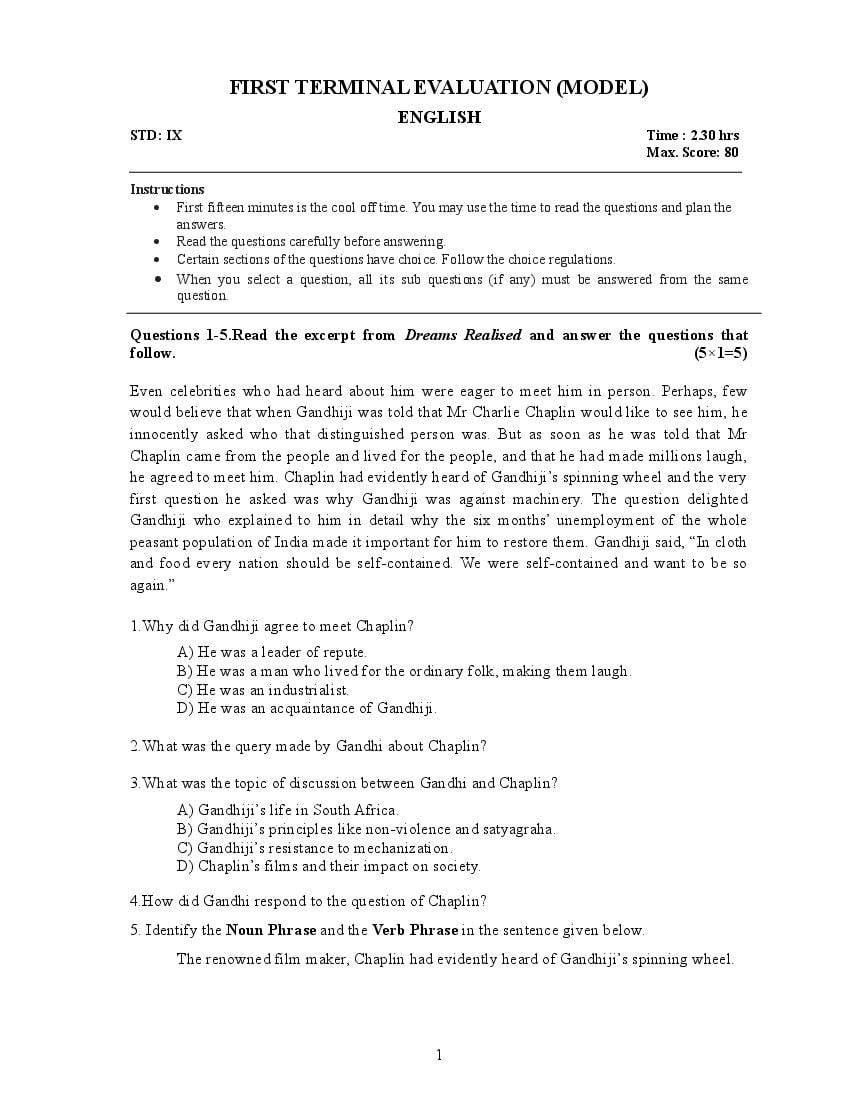
Questions 1-5.Read the excerpt from Dreams Realised and answer the questions that
follow. (5×1=5)
Even celebrities who had heard about him were eager to meet him in person. Perhaps, few
would believe that when Gandhiji was told that Mr Charlie Chaplin would like to see him, he
innocently asked who that distinguished person was. But as soon as he was told that Mr
Chaplin came from the people and lived for the people, and that he had made millions laugh,
he agreed to meet him. Chaplin had evidently heard of Gandhiji’s spinning wheel and the very
first question he asked was why Gandhiji was against machinery. The question delighted
Gandhiji who explained to him in detail why the six months’ unemployment of the whole
peasant population of India made it important for him to restore them. Gandhiji said, “In cloth
and food every nation should be self-contained. We were self-contained and want to be so
again.”
1.Why did Gandhiji agree to meet Chaplin?
A) He was a leader of repute.
B) He was a man who lived for the ordinary folk, making them laugh.
C) He was an industrialist.
D) He was an acquaintance of Gandhiji.
2.What was the query made by Gandhi about Chaplin?
3.What was the topic of discussion between Gandhi and Chaplin?
A) Gandhiji’s life in South Africa.
B) Gandhiji’s principles like non-violence and satyagraha.
C) Gandhiji’s resistance to mechanization.
D) Chaplin’s films and their impact on society.
4.How did Gandhi respond to the question of Chaplin?
5. Identify the Noun Phrase and the Verb Phrase in the sentence given below.
The renowned film maker, Chaplin had evidently heard of Gandhiji’s spinning wheel.
1
Page 2
that follow. (4×1=4)
The next day, though you're here with me,
I can't help looking at the clock:
A rose? A rose? What could that be?
Is it a flower or a rock?
Why do we treat the fleeting day
with so much needless fear and sorrow?
It's in its nature not to stay:
Today is always gone tomorrow.
With smiles and kisses, we prefer
to seek accord beneath our star,
although we're different (we concur)
just as two drops of water are.
6. Why does the poet use the reference of rose and rock together in the poem?
7. What does the expression ‘fleeting day’ imply?
A) The transient nature of time and acceptance of change.
B) The permanence of time and resistance to change.
C) The tendency to avoid the passage of time.
D) A sense of loss
8. ‘I can’t help looking at the clock.’ Why does the poet say so?
9. Identify the poetic device used in the line ‘Today is always gone tomorrow.’
10. Read the following lines from Nothing Twice and prepare a note of appreciation focusing
on its theme, images and poetic devices. (1×5=5)
Nothing can ever happen twice.
In consequence, the sorry fact is
that we arrive here improvised
and leave without the chance to practise.
Even if there is no one dumber,
if you're the planet's biggest dunce,
you can't repeat the class in summer:
this course is only offered once.
Questions 11-14. Read the passage and answer the questions given below. (4×1=4)
Many years ago, a Spanish officer named Coronado heard the story of seven great cities. His
friends told him that the walls of these cities are made of gold and the people eat meat from
golden plates, and dress well. They called these cities the Seven Cities of Gold. Coronado
thought to himself that things in these cities must be worth a lot of money. So, he went to find
2
Page 3
Coronado wanted to achieve his goal very badly. Coronado and his men rode for many days.
When they saw some cities, his men yelled out that they found the Seven Cities of Gold. But
Coronado wasn't happy because those cities couldn’t be the Seven Cities of Gold, they were
made of dirt. The cities weren't bright and golden. They were dirty and brown. The people
didn't eat meat from golden plates. They ate vegetables from regular bowls. They wore the
most basic clothes. That night, the people of the cities entertained Coronado and his men and
served them food. They advised Coronado to go home and told him that there was no gold
there. Coronado was angry and left the city next morning. He looked back at the cities again.
The sun reflected light on the dirt houses. Coronado thought he saw a bit of gold. "No," he
corrected himself. "It's just the sun." He turned away and went home.
11. What stories did Coronado hear some years ago?
12. What do we infer about Coronado from the passage given above?
A) sluggish and callous
B) ambitious and materialistic
C) selfish and materialistic
D) indifferent and lethargic
13. Why was Coronado unhappy?
A) The cities were dull and dirty.
B) The cities weren’t bright, but golden.
C) The cities were brown and untidy.
D) The cities were tidy and brown.
i. Only C is correct
ii. Both A and C are correct
iii. Both C and D are correct
iv. Only D is correct
14. What did the people of the city advise Coronado to do?
Questions 15-21. Answer all the questions.
15. A.The story Half a Day highlights the contrast between the narrator’s boyish perception of
him and the reality of his aging and the passage of time. Based on your reading of the
story, prepare a short essay on the topic ‘The fleeting nature of time and the fast pace
of societal changes.’
OR
B. The protagonist of the story The Toilet finds toilet as a place that safeguards her and
foster her creativity. In the light of your reading the story, prepare a review of the
story focusing on its theme, characterisation and development of the plot.
(1×7=7)
3
Page 4
fest is to introduce the books of famous Nobel laureates to the students. Prepare an
event invitation including all the details for the purpose.
OR
B. Read the picture given below. Based on your reading of the story The Toilet, write a
paragraph that meaningfully connects the picture with the themes and experiences
presented in the story. (1×4=4)
17. Read the passage given below and frame four appropriate questions that reveal your
understanding of ideas and context of the passage.
High buildings had taken over, the street surged with children, and disturbing noises
shook the air. Then there was a band announcing the opening of a circus, with clowns
and weightlifters walking in front. A line of trucks carrying central security troops
crawled majestically by. (1×4=4)
18. Read the picture given below. Using the visual cues and your imagination, prepare a
short story that reflects human emotions, relationships and social situations. (1×4=4)
4
Page 5
changing landscape reflecting his confusion and changing attitude. Prepare the
character sketch of the narrator of the story.
OR
B. The feelings of gratitude and the concept of debts beyond money in Selma Lagerlof’s
speech really impresses you a lot. You draft an email to one of your friends sharing
the insights that you gained from the speech. Draft the likely email. (1×6=6)
20 A. The excerpt Dreams Realised gives us an insight into Gandhiji’s idea of non-violence,
the role of women in the freedom struggle and the concept of self-reliance. In the
light of your reading of the excerpt, prepare a text of the speech to be delivered in the
school assembly on January 30, the Martyrs’ Day.
OR
B. On June 5, World Environment Day, you are asked to deliver a speech in the school
assembly based on recent natural disasters highlighting the need for environmental
protection, the importance of awareness campaigns and the role students can play in
the conservation of nature and promoting sustainable living. Prepare a text of the
speech. (1×6= 6)
21. Selma Lagerlof mentions Runeberg who is one among the writers who led her to the
world of literature. Prepare a short profile of Johan Ludvig Runeberg from the given
data. (1×6= 6)
Birth : 5 February 1804 Jakobstad, Finland
Alma Mater : Royal Academy of Turku
Wife : Fredrika Runeberg
Influenced by : Romanticism and Classical Literature
Famous as : National Poet of Finland
First work : Our Land (later became Finnish
National Anthem)
Major works : Farmer Paavo, King Fjalar, The Tales
of Ensign Stal (epic poem)
Death : 6 May 1877 Porvoo, Finland
Questions 22-25. Read the table about the Wonders of the World carefully and answer
the questions that follow. (4×1=4)
Wonders of the World Country Location
Great Wall of China China Asia-Pacific Region
Taj Mahal India Agra, U.P
Machu Pichu Peru Cusco Region
Petra Jordan Ma’an Governorate
Christ the Redeemer Brazil Corcovado Mountain
5
Page 6
23. Choose the wonder that is not located in Asia.
A) The Great Wall of China
B) Christ the Redeemer
C) Machu Pichu
D) Taj Mahal
24. Which Wonder of the World is located in Agra, U.P?
A) Petra
B) Taj Mahal
C) Machu Picchu
D) Christ the Redeemer
25. Which of the following Wonders is situated in the Ma’an Governorate?
A) Great Wall of China
B) Christ the Redeemer
C) Petra
D) Machu Picchu
26.Report the following dialogue. (2×1=2)
Father : Are you sure there is nothing amiss?
Daughter : No, Father, all is well.
27.Edit the passage given below. (6×½=3)
High buildings had took (a) over, the street surged with children, and disturbing noises
shaken(b) the air. A band are(c)announcing the opening of an(d) circus, with clowns and
weightlifters walked(e) in front. A line of trucks who(f) carried central security troops
crawled majestically by.
28.Fill in the blanks using the appropriate forms of the phrasal verbs given in brackets.
(5×1=5)
Gandhiji ......(a)........ to England and attended many meetings arranged in his honour.
While attending a meeting in Morley College Hall, he ......(b)...... his views on the role of
Indian women in freedom struggle. He ......(c)....... describing how they bravely took part
in processions against the British. Though the British Government tried to ........(d).......
their spirit, they …………(e)……… the lathi blows without raising even a little finger.
(put down, put across, turn down, set off, go on, put up with)
29. Fill in the blanks using the words given in brackets. (2×1=2)
In her .............(a)................ studio, the ...............(b).............. woman engaged herself in
creating vibrant landscapes.
(tree-lined, double-storeyed, soft-spoken)
6
Page 7
(4×1/2=2)
About Indian independence, Gandhiji made his point of view clear ......(a).... many a
meeting. “I am not here to beg ......(b).... independence, but I have come as a result
......(c)..... last year’s suffering. There is no such thing as a gift of independence .....(d).....
one nation to another.”
(for, from, of, in, at)
31.Complete the conversation between Madam and Mholo suitably. (5×1=5)
Madam : You are Irene’s sister, ..................... (a).....................?
Mholo : Yes. I have been waiting for her.
Madam : She has gone out. If you don’t mind, .....................(b).....................
Mholo : That’s so kind of you. Would you mind .....................(c)
.....................?
Madam : No, I don’t mind. But she might be late. You had better.....................
(d).....................
Mholo : Yes ma’am, I’m going home. .....................(e).....................?
Madam : No, the dogs won’t bite you.
32. Read the sentences given below. Rewrite the sentences as mentioned. (2×1=2)
A. My father took me to school.
B. I challenged my father openly.
A. I …………………………………………
B. My father ……………………………….
7
Document Details
| Board / Org | Kerala Board |
| Exam | Class 9 |
| Type | Sample Paper |
| Pages | 7 |
| Updated | 24 Sep 2026 |