APTET Question Paper with Answers 19 Jun 2018 Paper 2 Telugu (Shift 1)
Finished viewing? Save it for later —
Download APTET Question Paper with Answers 19 Jun 2018 Paper 2 Telugu (Shift 1) (PDF · 53 pages)About APTET Question Paper with Answers 19 Jun 2018 Paper 2 Telugu (Shift 1)
APTET Question Paper with Answers 19 Jun 2018 Paper 2 Telugu (Shift 1) is available here for free download. Published by Andhra Pradesh Exams for Andhra Pradesh Teacher Eligibility Test, this question paper can be viewed online or downloaded as a PDF (53 pages). Candidates preparing for Andhra Pradesh Teacher Eligibility Test can use APTET Question Paper with Answers 19 Jun 2018 Paper 2 Telugu (Shift 1) to understand the exam pattern, the type of questions asked, and the overall difficulty level.
Frequently Asked Questions
How can I download APTET Question Paper with Answers 19 Jun 2018 Paper 2 Telugu (Shift 1)?
Open this page and click the Download button to save APTET Question Paper with Answers 19 Jun 2018 Paper 2 Telugu (Shift 1) as a PDF. It is completely free on AglaSem Docs.
Is APTET Question Paper with Answers 19 Jun 2018 Paper 2 Telugu (Shift 1) free to download?
Yes. APTET Question Paper with Answers 19 Jun 2018 Paper 2 Telugu (Shift 1) can be viewed online and downloaded as a PDF free of cost on AglaSem Docs.
How many pages does APTET Question Paper with Answers 19 Jun 2018 Paper 2 Telugu (Shift 1) have?
APTET Question Paper with Answers 19 Jun 2018 Paper 2 Telugu (Shift 1) contains 53 pages, which you can read online or download together as a single PDF.
Where can I find more Andhra Pradesh Teacher Eligibility Test study material?
You can find more Andhra Pradesh Teacher Eligibility Test question papers, sample papers, syllabus, and answer keys on AglaSem Docs.
APTET Question Paper with Answers 19 Jun 2018 Paper 2 Telugu (Shift 1) – Text
Read the full text of this question paper below — useful to quickly search, copy and reference the content online without downloading the PDF.
📄 View text version (28 pages)
Page 1
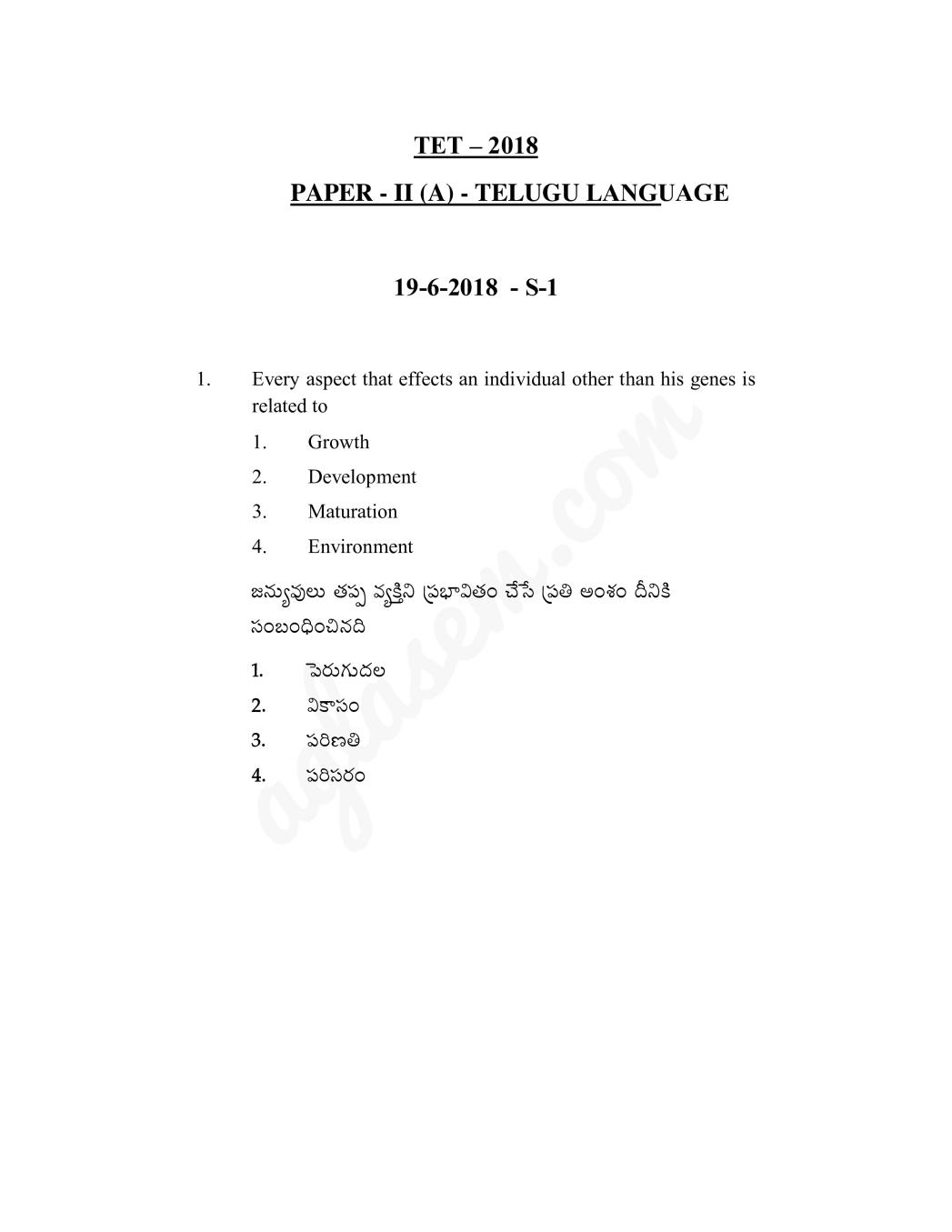
PAPER - II (A) - TELUGU LANGUAGE
19-6-2018 - S-1
1. Every aspect that effects an individual other than his genes is
related to
1. Growth
2. Development
3. Maturation
4. Environment
Page 2
particular pattern -
1. Growth
2. Development
3. Heredity
4. Environment
3. Exactly measurable change in an organism is
1. Heredity
2. Growth
3. Maturation
4. Development
Page 3
1. Pituitary gland
2. Adrenal gland
3. Thyroid gland
4. Para thyroid gland
5. The developmental theory proposed by Piaget
1. Theory of moral development
2. Theory of social development
3. Theory of cognitive development
4. Theory of language development
Page 4
development in the following number of levels and stages
1. 3 levels – 6 stages
2. 4 levels – 2 stages
3. 6 levels – 3 stages
4. 3 levels – 4 stages
7. The theorist who explained about ‘Language Acquisition
Device’ – LAD is
1. Vygotsky
2. Piaget
3. Kohlberg
4. Chomsky
Page 5
Psychologist’s theory
1. Freud
2. Bruner
3. Pavlov
4. Bandura
9. “The ability to think abstractly is intelligence” – defined by
1. Binnet
2. Termen
3. Simon
4. Guilford
Page 6
1. Mental age
2. Two factor theory
3. Emotional intelligence
4. Multiple intelligence
11. Investigating solutions to problems of real life is called
1. Experimental research
2. Longitudinal studies
3. Action research
4. Cross-sectional studies
Page 7
1. Hallucinations
2. Delusions
3. Dementia
4. Projection
13. Almost a permanent change in behavioural style of an
individual as a result of reinforced practice is
1. Learning
2. Motivation
3. Aspiration
4. Memory
Page 8
1. Learning
2. Adjustment
3. Conflict
4. Development
15. Learning principle that encourages drilling is
1. Law of effect
2. Law of readiness
3. Law of extinction
4. Law of exercise
drilling
Page 9
1. Conditioned Reflex
2. On Memory
3. The Work of Digestive Glands
4. Education – Democracy
17. Name the Psychologist who proposed schedules of
reinforcement
1. Ivan Pavlov
2. Skinner
3. Bandura
4. Kohler
Page 10
cooperative learning
1. Kohler
2. Koffka
3. Vygotsky
4. Chomsky
(cooperative learning)
19. The theory of Hierarchy of needs was proposed by
1. Mc Cleland
2. Atkinson
3. Gardner
4. Maslow
Page 11
1. Recognition
2. Recall method
3. Saving method
4. Active memory
21. Consciously forgetting bad and annoying experiences is
called,
1. Interference
2. Retention
3. Repression
4. Fugue
Page 12
him in learning swimming. Type of transfer here is
1. Positive transfer
2. Negative transfer
3. Zero transfer
4. Bilateral transfer
23. The IQ of Trainable ‘Mentally Retarded’ Individuals is
1. < 29
2. 30 - 50
3. 50 - 70
4. 70 - 90
29
2. 30 - 50
3. 50 - 70
4. 70 - 90
Page 13
sequence, stated by
1. Bruner
2. Bandura
3. Vygotsky
4. Koffka
25. The programmed learning was the product of the following
theory
1. Classical conditioning
2. Trial and error learning
3. Operant conditioning
4. Insightful learning
Page 14
1. 2005
2. 2009
3. 2010
4. 2011
27. RMSA programme is related to offer qualitative education to
this school level
1. Pre-primary level
2. Primary level
3. Secondary and Senior Secondary level
4. Degree level
RMSA
Page 15
belong to this type of evaluation in CCE
1. Summative
2. Formative
3. Qualitative
4. Quantitative
CCE
29. An individual’s readiness to respond to a particular situation,
person, object in a consistent manner is
1. Value
2. Stimulus
3. Interest
4. Attitude
Page 16
imitation in learning is
1. Alfred Binet
2. Skinner
3. Albert Bandura
4. Kohler
Page 26
The meaning of ‘ruins’ is;
1. Rivers and seas.
2. Temples and forts.
3. Collapsed and decayed buildings.
4. Green fields.
62. Choose the word that refers to ‘a number of judges’
1. Troupe
2. Vacation
3. Passage
4. Bench
63. Choose the word with a prefix.
1. Under
2. Unhappy
3. Umbrella
4. University
Page 27
1. Scent
2. Beedle
3. Parishe
4. Laddle
65. Choose the Homophone of ‘died’.
1. Deed
2. Dead
3. Dried
4. Dyed
66. He is a huge fan of games.
Choose the antonym of the word ‘huge’.
1. Big
2. Strong
3. Ordinary
4. Sincere
Page 28
Choose the meaning of the phrasal verb ‘came up’.
1. Fixed
2. Fought
3. Thought
4. Removed
68. He cannot run fast.
This sentence indicates;
1. ability
2. power
3. inability
4. disability
69. We should help ……….. weak.
Choose the correct article that fits the blank.
1. a
2. an
3. the
4. No article is needed.
Page 29
Choose the correct preposition that fits the blank.
1. to
2. with
3. into
4. by
71. Ganesh, who is the tallest boy in the class, is my best friend.
This sentence has;
1. A defining relative clause.
2. A non-defining relative clause.
3. A noun clause.
4. An adverbial clause.
72. He may not have stolen the pen.
This sentence indicates;
1. a purpose
2. a certainty
3. a doubt
4. an interest
Page 30
Choose the correct question tag for this sentence.
1. does he ?
2. doesn’t he ?
3. isn’t he ?
4. is he ?
74. Who is that in a car
This sentence ends with;
1. a comma
2. an exclamatory mark
3. a full stop
4. a question mark
75. ‘Who is that?’ said Amma.
The correct reported speech of this sentence is;
1. Amma said that is what.
2. Amma asked that is what.
3. Amma said that was what.
4. Amma asked who that was.
Page 31
Choose the correct form of verb that fits the subject.
1. are
2. have
3. has
4. will
77. My mother ………… sweets at this moment.
Choose the correct tense form that fits the blank.
1. is making
2. was making
3. making
4. made
78. He was the first to voice the question.
The part of speech of the word, ‘voice’ is;
1. a noun
2. a verb
3. an adjective
4. an adverb
Page 32
1. Thus
2. Thirdly
3. At the same time
4. On the other hand
80. I could not stop laughing when he told jokes
This sentence has;
1. one main clause
2. one subordinate clause
3. one main clause and one subordinate clause
4. two subordinate clauses and a main clause.
81. Choose the grammatically correct sentence.
1. These all book are interesting.
2. These all books are interesting.
3. All these books are interesting.
4. All this books are interesting.
Page 33
1. to separate the subject and predicate.
2. to separate a subordinate clause from the rest of the
sentence.
3. to end each sentence in a poem.
4. to end an imperative sentence.
83. Choose the sentence in passive voice.
1. She was rescued and placed in a home.
2. She has rescued and placed in a home.
3. She had rescued and placed in a home.
4. She will be in a home.
84. Varun is ………….. Gopi.
Choose the grammatically correct expression that fits the
blank.
1. taller to
2. taller then
3. taller than
4. the tallest of
Page 34
1. Educational qualification of the applicant.
2. The details of the applicant’s friends.
3. The details of the applicant’s village.
4. The pilgrim places visited by the applicant.
86. Choose the list of words with the correct alphabetical order.
1. gesture, great, gate, greatest
2. gate, gesture, great, greatest
3. gate, great, greatest, gesture
4. great, greatest, gesture, gate
87. Yesterday I bought a mopping cloth.
Choose the synonym of the word ‘mopping’.
1. Wearing
2. Stitching
3. Dressing
4. Cleaning
Page 35
Choose the correct preposition that fits the blank.
1. for
2. of
3. to
4. with
89. Read the following passage and choose the correct
answer to the question.
Character is destiny. Character is that on which the destiny of
a nation is built. One cannot have a great nation with men of
small character. We must have young men and women who
look upon others as the living image of themselves as our
Shastras have so often declared.
. This passage is about;
1. Character
2. Images
3. Destiny of the speaker
4. Nationality
Page 36
answer to the question.
Character is destiny. Character is that on which the destiny of
a nation is built. One cannot have a great nation with men of
small character. We must have young men and women who
look upon others as the living image of themselves as our
Shastras have so often declared.
Young men and women should;
1. treat others as themselves.
2. have small character.
3. have Shastras in hand.
4. have weak character
Page 53
Paper-II(A)- Telugu Language - Set-Q 19.06.2018 Morning Session
Q.Nos CDP Q.Nos Telugu Q.Nos English Q.Nos Telugu Q.Nos Telugu
1 4 31 3 61 3 91 2 121 1
2 2 32 2 62 4 92 4 122 4
3 2 33 3 63 2 93 3 123 4
4 1 34 3 64 1 94 1 124 2
5 3 35 2 65 4 95 4 125 3
6 1 36 4 66 3 96 3 126 1
7 4 37 1 67 3 97 3 127 4
8 1 38 3 68 3 98 1 128 1
9 2 39 4 69 3 99 2 129 2
10 4 40 1 70 2 100 3 130 4
11 3 41 2 71 2 101 1 131 3
12 4 42 3 72 3 102 4 132 2
13 1 43 3 73 1 103 1 133 4
14 1 44 4 74 4 104 2 134 2
15 4 45 1 75 4 105 4 135 3
16 1 or 3 46 2 76 3 106 1 136 4
17 2 47 3 77 1 107 3 137 2
18 3 48 2 78 2 108 2 138 1
19 4 49 1 79 2 109 1 139 3
20 3 50 3 80 3 110 3 140 1
21 3 51 3 81 3 111 3 141 4
22 3 52 2 82 2 112 4 142 1
23 2 53 2 83 1 113 2 143 3
24 1 54 3 84 3 114 3 144 1
25 3 55 2 85 1 115 1 145 2
26 2 56 4 86 2 116 2 146 4
27 3 57 2 87 4 117 1 147 1
28 1 58 3 88 2 118 4 148 2
29 4 59 4 89 1 119 3 149 3
30 3 60 1 90 1 120 2 150 4
Document Details
| Board / Org | Andhra Pradesh Exams |
| Exam | Andhra Pradesh Teacher Eligibility Test |
| Type | Question Paper |
| Pages | 53 |
| Updated | 30 Apr 2026 |