Karnataka 2nd PUC Question Paper 2026 Answer Key Biology
Finished viewing? Save it for later —
Download Karnataka 2nd PUC Question Paper 2026 Answer Key Biology (PDF · 7 pages)About Karnataka 2nd PUC Question Paper 2026 Answer Key Biology
Karnataka 2nd PUC Question Paper 2026 Answer Key Biology is available here for free download. Published by Karnataka Board for Class 12, this question paper can be viewed online or downloaded as a PDF (7 pages). Candidates preparing for Class 12 can use Karnataka 2nd PUC Question Paper 2026 Answer Key Biology to understand the exam pattern, the type of questions asked, and the overall difficulty level.
Frequently Asked Questions
How can I download Karnataka 2nd PUC Question Paper 2026 Answer Key Biology?
Open this page and click the Download button to save Karnataka 2nd PUC Question Paper 2026 Answer Key Biology as a PDF. It is completely free on AglaSem Docs.
Is Karnataka 2nd PUC Question Paper 2026 Answer Key Biology free to download?
Yes. Karnataka 2nd PUC Question Paper 2026 Answer Key Biology can be viewed online and downloaded as a PDF free of cost on AglaSem Docs.
How many pages does Karnataka 2nd PUC Question Paper 2026 Answer Key Biology have?
Karnataka 2nd PUC Question Paper 2026 Answer Key Biology contains 7 pages, which you can read online or download together as a single PDF.
Where can I find more Class 12 study material?
You can find more Class 12 question papers, sample papers, syllabus, and answer keys on AglaSem Docs.
Karnataka 2nd PUC Question Paper 2026 Answer Key Biology – Text
Read the full text of this question paper below — useful to quickly search, copy and reference the content online without downloading the PDF.
📄 View text version (7 pages)
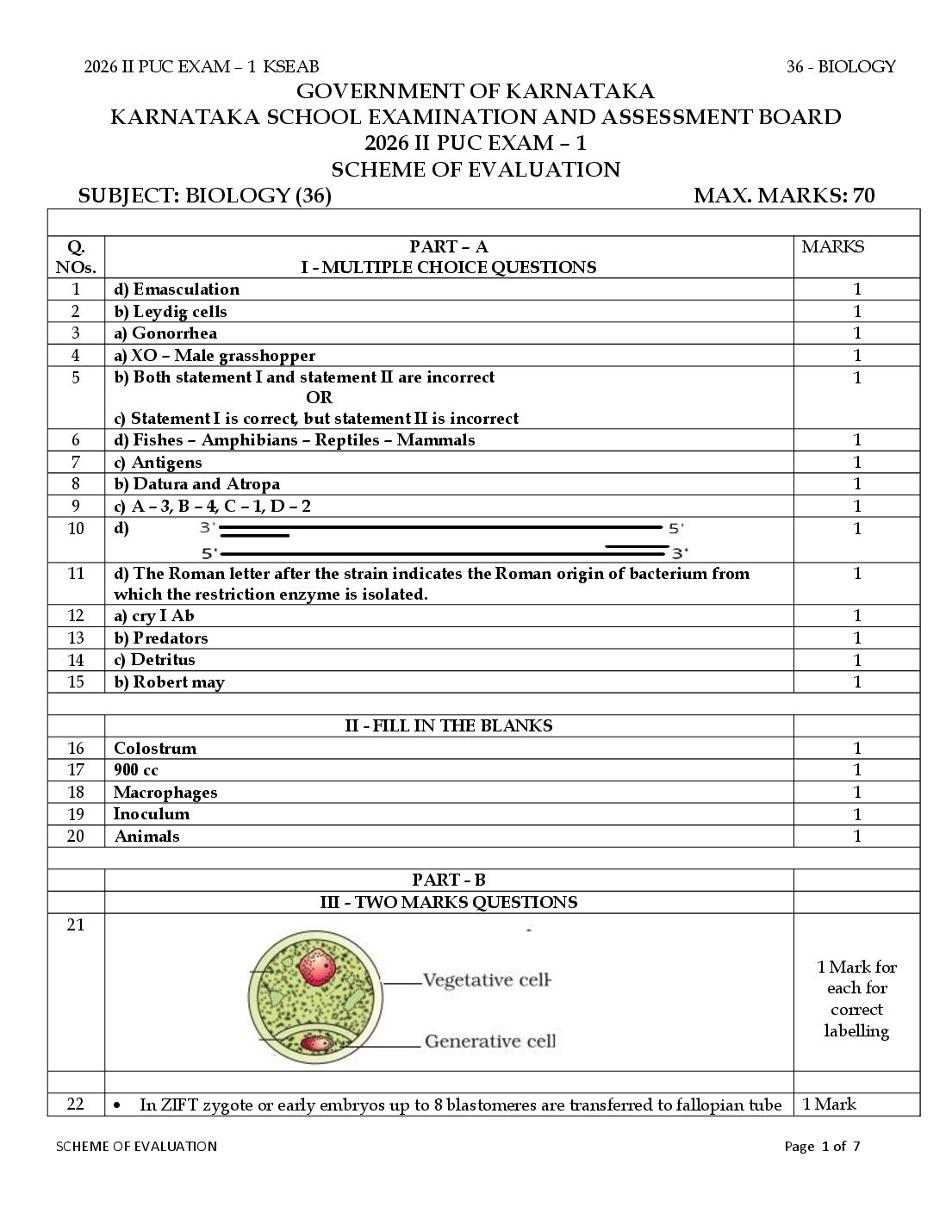
Page 1
GOVERNMENT OF KARNATAKA
KARNATAKA SCHOOL EXAMINATION AND ASSESSMENT BOARD
2026 II PUC EXAM – 1
SCHEME OF EVALUATION
SUBJECT: BIOLOGY (36) MAX. MARKS: 70
Q. PART – A MARKS
NOs. I - MULTIPLE CHOICE QUESTIONS
1 d) Emasculation 1
2 b) Leydig cells 1
3 a) Gonorrhea 1
4 a) XO – Male grasshopper 1
5 b) Both statement I and statement II are incorrect 1
OR
c) Statement I is correct, but statement II is incorrect
6 d) Fishes – Amphibians – Reptiles – Mammals 1
7 c) Antigens 1
8 b) Datura and Atropa 1
9 c) A – 3, B – 4, C – 1, D – 2 1
10 d) 1
11 d) The Roman letter after the strain indicates the Roman origin of bacterium from 1
which the restriction enzyme is isolated.
12 a) cry I Ab 1
13 b) Predators 1
14 c) Detritus 1
15 b) Robert may 1
II - FILL IN THE BLANKS
16 Colostrum 1
17 900 cc 1
18 Macrophages 1
19 Inoculum 1
20 Animals 1
PART - B
III - TWO MARKS QUESTIONS
21
each for
correct
labelling
22 • In ZIFT zygote or early embryos up to 8 blastomeres are transferred to fallopian tube 1 Mark
SCHEME OF EVALUATION Page 1 of 7
Page 2
• In IUI the semen collected either from the husband or a healthy donor is
artificially introduced either into vagina or into uterus. 1 Mark
23 1 Mark each
a) b)
24 •Replication ½ Mark for
•Expression each value
•Stability point
•Mutation
25 •Organs having similar origin and structure but perform different functions are 1 Mark
called homologous organs.
Examples: 1 Mark for
• Fore limbs of Man, Cheetah, Whale, Bat any one
• Thorns of Bougainvillea and tendrils of Cucurbita example
• Vertebrates heart
• Vertebrates brain
26 • In bacteria antibiotics act against life as they inactivate or kill bacteria
• In humans’ antibiotics act in favour of protecting humans from action of I Mark each
pathogenic bacteria
27 • Habitat loss and fragmentation
• Over exploitation ½ Mark each
• Alien species invasion
• Coextinction
PART - C
IV - THREE MARKS QUESTIONS
28
each correct
labelling
29 The chorionic villi and uterine tissue become interdigitated with each other and jointly 1 Mark
form a structural and functional unit between developing embryo (foetus) and maternal
body is called placenta
OR
A temporary connection between foetus and maternal tissue is called placenta
SCHEME OF EVALUATION Page 2 of 7
Page 3
Functions:
• Transport of O2 and CO2
• Transport of nutrients 1 Mark for
• Removal of metabolic waste any two
• Section of hormones functions
30 • Increases phagocytosis of sperms
• Reduces sperm motility 1 Mark each
• Makes uterus unsuitable for implantation for any three
• Makes uterine cavity hostile for sperms
• Suppress fertilizing capacity of sperms
31 “Allelic frequency in a population are stable and is constant from generation to 1 Mark
generation”
• Gene migration/Gene flow ½ Mark each
• Genetic drift for any four
• Mutation
• Recombination
• Natural selection
32 a) Ascariasis
b) Pneumonia 1 Mark each
c) Ringworm
33 a) Streptokinase
b) Cyclosporin – A 1 Mark each
c) Statins
34 1 Mark for
trophic level
values (need
not be same
values but
should be
decreasing)
unit
PART - D
V - FIVE MARKS QUESTIONS
35 • A functional megaspore undergoes three successive free nuclear mitotic division
immediately not followed by cytokinesis or cell wall formation
• This results in 8 nuclei; among 8 nuclei 3 nuclei move towards chalazal end and
cellularization occur forming antipodals 1 Mark for
• 3 nuclei; move towards micropylar end and cellularize to become egg apparatus, each value
which consists of 1 egg and 2 synergids point
• The two nuclei in the center are polar nuclei enclosed in a common wall forming
central cell.
SCHEME OF EVALUATION Page 3 of 7
Page 4
• Hence a mature embryo sac is 7 celled and 8 nucleate.
Diagrammatic
representation
4M
36
each correct
labelling
37
2 Marks up to
F1 progeny
2 Marks up to
F2 progeny
ratio.
38 Lactose operon is a cluster of regulatory and three structural genes that encode for the
metabolism of lactose. 1 Mark.
In the absence of lactose (Inducer):
In the absence of lactose, repressor-inducer complex cannot be formed. Repressor binds
SCHEME OF EVALUATION Page 4 of 7
Page 5
to operator preventing RNA polymerase binding to promoter. 2 Marks
This switches off transcription of structural genes and hence translation. There is no
production of gene products; β – galactosidase, permease and transacetylase.
In the presence of lactose (Inducer):
Lactose binds to repressor forming repressor-inducer complex. This complex cannot
bind to operator.
RNA polymerase binds to promoter switch on the transcription of structural genes and 2 Marks
is simultaneously followed by translation producing the gene products; β –
galactosidase, permease and transacetylase.
Diagrammatic representation can also be given 4 Marks
2 Marks
2 Marks
39 a) The property of a normal cell to inhibit an uncontrolled cell division by remaining in 1Mark
contact with neighboring cells is called contact inhibition.
The property of tumorous cell or neoplastic cell that spread to other areas of the body 1 Mark
from their site of origin through blood and lymph is called metastasis.
b) Cancer treatment: 1 Mark each
• Surgery: The tumors are removed surgically with
• Radiotherapy: Tumors are irradiated lethally, taking proper care neighboring explanation
normal tissues. ½ Mark only
• Chemotherapy: Several chemicals or drugs are used to kill cancerous cells that for
are specific to tumors. mentioning
• Immunotherapy: Biological response modifier such as α – interferon which the types of
activates the immune system and helps in destroying the tumor treatment.
40 Normal physiology and development: Transgenic animals can be specifically designed
to allow the study of how genes are regulated, and how they affect the normal
functions of the body and its development.
Study of disease: Many transgenic animals are designed to increase our understanding
of how genes contribute to the development of disease. These are specially made
to serve as models for human diseases so that investigation of new treatments for
diseases is made possible. Today transgenic models exist for many human
SCHEME OF EVALUATION Page 5 of 7
Page 6
diseases such as cancer, cystic fibrosis, rheumatoid arthritis and Alzheimer’s.
Biological products: Medicines required to treat certain human diseases can contain
biological products, but such products are often expensive to make. Transgenic
animals that produce useful biological products can be created by the
introduction of the portion of DNA (or genes) which codes for a particular
product such as human protein (α-1-antitrypsin) used to treat emphysema. ½ Mark each
Vaccine safety: Transgenic mice are being developed for use in testing the safety of for
vaccines before they are used on humans. Transgenic mice are being used to test mentioning
the safety of the polio vaccine. benefits and
Chemical safety testing: This is known as toxicity/safety testing. The procedure is the ½ Marks each
same as that used for testing toxicity of drugs. Transgenic animals are made that for
carry genes which make them more sensitive to toxic substances than non- explanation.
transgenic animals. They are then exposed to the toxic substances and the effects
studied. Testing toxicity in such animals will allow us to obtain results in less
time.
41 a) Nt + 1 = Nt + [ (B + I) – (D + E)] 1 Mark
b) Four basic processes: Mentioning 4
• Natality: Number of births during a given period in the population that are factors 2
added to the initial density is called natality. Marks
• Mortality: Number of deaths in a population during a given period that is Definition 2
removed from the initial density is called mortality. Marks
• Immigration: Number of individuals of the same species that have come into the
habitat from elsewhere during the given period is called immigration.
• Emigration: Number of individuals of the same species that have left the habitat
and gone elsewhere during the given period is called emigration.
PART – D
VI - FIVE MARKS QUESTIONS (HOTS)
42 Hemophilia
Sex linked recessive gene disorder. ½ Mark
Shows transmission from unaffected carrier female to some of the male progeny ½ Mark
A single protein that is part of the cascade of proteins involved in clotting of blood is
affected. Due to this, in an affected individual a simple cut will result in non-stop 1 Mark
bleeding.
The possibility of female becoming haemophilic is extremely rare because mother of 1 Mark
such female must be at least a carrier and father should be haemophilic
α – Thalassemia
Gene disorder linked to chromosome 16 is α – Thalassemia an autosomal recessive 1 Mark
disorder. It is controlled by 2 genes HBA1, HBA2 and 4 alleles.
It results in less production of α – globin protein and affecting the function of 1 Mark
haemoglobin causing anaemia.
43 a) Individual - A Individual - B
Maternal chromosome: 4 9 1 Mark
Paternal chromosome: 3 11 1 Mark
OR
SCHEME OF EVALUATION Page 6 of 7
Page 7
Maternal chromosome Paternal chromosome
Individual – A: 4 3
Individual – B: 9 11
b) 6 each/6 and 6 1 Mark
c) 5, 7, 8 1 Mark
d) Individual ‘B’ 1 Mark
44 a)
• Pvu I OR Pst I
• BamH I OR Sal I Any two
• Pvu I OR BamH I (1M each)
• Pvu I OR Sal I
• Pst I OR BamH I
• Pst I OR Sal I
1 Mark
b) Because it complicates the gene cloning process by creating multiple fragments in
cloning vector. 1 Mark
c) It encodes for protein that are required for plasmid replication 1 Mark
d) “ori”
PART – E
(For visually challenged students only)
10. d) Polymerase chain reaction 1 Mark
43. • Isolation of DNA,
• Digestion of DNA by restriction endonucleases,
• Separation of DNA fragments by electrophoresis,
• Transferring (blotting) of separated DNA fragments to synthetic membranes, such
each value
as nitrocellulose or nylon, point
• Hybridisation using labeled VNTR probe, and Detection of hybridized DNA
fragments by autoradiography.
44. Origin of replication (Ori): This is a sequence in plasmid where replication starts and 2 Marks
any piece of DNA when linked to this sequence can be made to replicate within
the host cells. It is also responsible for controlling the copy number of the linked
DNA. If one wants to recover many copies of the target DNA it should be cloned
in a vector whose ori site supports high copy numbers.
Selectable marker: It helps in identifying and eliminating non-transformants and 2 Marks
selectively permits the growth of transformants. Normally, genes encoding
resistance to antibiotics such as ampicillin, chloromphenicol, tetracycline and
kanyamycin etc are considered useful selectable markers for E. coli. Normal E.
coli cells do not carry resistance against any of these antibiotics.
Cloning sites: These are the restriction sites that are cleaved by RENs for the 1 Mark
introduction of desired genes.
SCHEME OF EVALUATION Page 7 of 7
Document Details
| Board / Org | Karnataka Board |
| Exam | Class 12 |
| Type | Question Paper |
| Pages | 7 |
| Language | english |
| Updated | 24 Sep 2026 |