Karnataka 2nd PUC Question Paper 2026 Answer Key Chemistry
Finished viewing? Save it for later —
Download Karnataka 2nd PUC Question Paper 2026 Answer Key Chemistry (PDF · 12 pages)About Karnataka 2nd PUC Question Paper 2026 Answer Key Chemistry
Karnataka 2nd PUC Question Paper 2026 Answer Key Chemistry is available here for free download. Published by Karnataka Board for Class 12, this question paper can be viewed online or downloaded as a PDF (12 pages). Candidates preparing for Class 12 can use Karnataka 2nd PUC Question Paper 2026 Answer Key Chemistry to understand the exam pattern, the type of questions asked, and the overall difficulty level.
Frequently Asked Questions
How can I download Karnataka 2nd PUC Question Paper 2026 Answer Key Chemistry?
Open this page and click the Download button to save Karnataka 2nd PUC Question Paper 2026 Answer Key Chemistry as a PDF. It is completely free on AglaSem Docs.
Is Karnataka 2nd PUC Question Paper 2026 Answer Key Chemistry free to download?
Yes. Karnataka 2nd PUC Question Paper 2026 Answer Key Chemistry can be viewed online and downloaded as a PDF free of cost on AglaSem Docs.
How many pages does Karnataka 2nd PUC Question Paper 2026 Answer Key Chemistry have?
Karnataka 2nd PUC Question Paper 2026 Answer Key Chemistry contains 12 pages, which you can read online or download together as a single PDF.
Where can I find more Class 12 study material?
You can find more Class 12 question papers, sample papers, syllabus, and answer keys on AglaSem Docs.
Karnataka 2nd PUC Question Paper 2026 Answer Key Chemistry – Text
Read the full text of this question paper below — useful to quickly search, copy and reference the content online without downloading the PDF.
📄 View text version (12 pages)
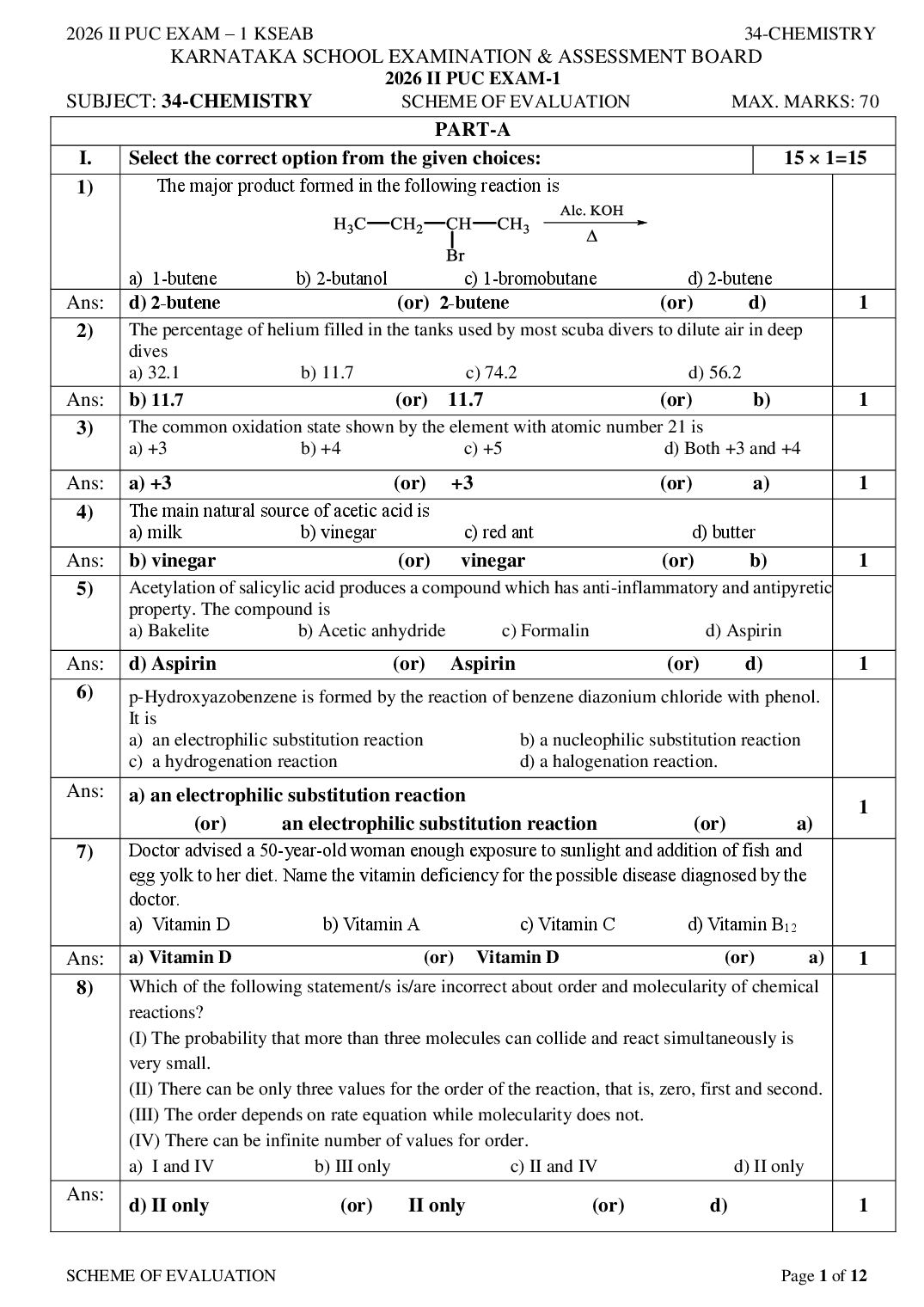
Page 1
KARNATAKA SCHOOL EXAMINATION & ASSESSMENT BOARD
2026 II PUC EXAM-1
SUBJECT: 34-CHEMISTRY SCHEME OF EVALUATION MAX. MARKS: 70
PART-A
I. Select the correct option from the given choices: 15 × 1=15
1) The major product formed in the following reaction is
a) 1-butene b) 2-butanol c) 1-bromobutane d) 2-butene
Ans: d) 2-butene (or) 2-butene (or) d) 1
2) The percentage of helium filled in the tanks used by most scuba divers to dilute air in deep
dives
a) 32.1 b) 11.7 c) 74.2 d) 56.2
Ans: b) 11.7 (or) 11.7 (or) b) 1
3) The common oxidation state shown by the element with atomic number 21 is
a) +3 b) +4 c) +5 d) Both +3 and +4
Ans: a) +3 (or) +3 (or) a) 1
4) The main natural source of acetic acid is
a) milk b) vinegar c) red ant d) butter
Ans: b) vinegar (or) vinegar (or) b) 1
5) Acetylation of salicylic acid produces a compound which has anti-inflammatory and antipyretic
property. The compound is
a) Bakelite b) Acetic anhydride c) Formalin d) Aspirin
Ans: d) Aspirin (or) Aspirin (or) d) 1
6) p-Hydroxyazobenzene is formed by the reaction of benzene diazonium chloride with phenol.
It is
a) an electrophilic substitution reaction b) a nucleophilic substitution reaction
c) a hydrogenation reaction d) a halogenation reaction.
Ans: a) an electrophilic substitution reaction
1
(or) an electrophilic substitution reaction (or) a)
7) Doctor advised a 50-year-old woman enough exposure to sunlight and addition of fish and
egg yolk to her diet. Name the vitamin deficiency for the possible disease diagnosed by the
doctor.
a) Vitamin D b) Vitamin A c) Vitamin C d) Vitamin B12
Ans: a) Vitamin D (or) Vitamin D (or) a) 1
8) Which of the following statement/s is/are incorrect about order and molecularity of chemical
reactions?
(I) The probability that more than three molecules can collide and react simultaneously is
very small.
(II) There can be only three values for the order of the reaction, that is, zero, first and second.
(III) The order depends on rate equation while molecularity does not.
(IV) There can be infinite number of values for order.
a) I and IV b) III only c) II and IV d) II only
d) II only (or) II only (or) d) 1
SCHEME OF EVALUATION Page 1 of 12
Page 2
9) Which of the following groups when present at para position increases the basic strength of
aniline?
a)-NO2 b) -Br c) -NH2 d) -COOH
Ans: c) -NH2 (or) -NH2 (or) c) 1
10) Among the following cells, the cell used in the apollo space program for providing electric
power is
a) SHE b) H2-O2 fuel cell c) Daniel cell d) Mercury cell
Ans: b) H2-O2 fuel cell (or) H2-O2 fuel cell (or) b) 1
11) Isopropyl magnesium bromide and n-propyl magnesium bromide react separately with H2O to
yield the organic compounds, respectively are
a) Isopropyl bromide and n-propyl bromide b) Isopropyl alcohol and n-propyl alcohol
c) n-propyl alcohol and isopropyl alcohol d) Propane and propane
Ans: d) Propane and propane (or) Propane and propane (or) d) 1
12) A binary solution has two components ‘A’ and ‘B’. The mole fraction of component ‘A’ is 0.5,
then the number of moles of components ‘A and ‘B’ in the solution is
a) n A n B b) n A n B c) n A = n B d) zero
Ans: c) n A = n B (or) nA = nB (or) c) 1
13) Match the following given in List I with List II
List I List II
(Elements) (Their maximum oxidation states)
i) Thorium (Th) a) +7
ii) Protactinium (Pa) b) +6
iii) Lawrencium (Lr) c) +3
iv) Uranium (U) d) +5
v) Plutonium (Pu) e) +4
Choose the correct option.
a) i-e, ii-d, iii-a, iv-b, v-c b) i-e, ii-d, iii-c, iv-b, v-a
c) i-b, ii-a, iii-c, iv-e, v-d d) i-b, ii-e, iii-c, iv-d, v-a
Ans: b) i-e, ii-d, iii-c, iv-b, v-a (or) i-e, ii-d, iii-c, iv-b, v-a (or) b) 1
14) The complex Co ( NH3 )5 ( NO2 ) Cl2 is obtained in the red form when nitrite ligand is bound
to cobalt through oxygen (–ONO) and its linkage isomer is obtained as a _______ form when
nitrite ligand is bound to “Co” through nitrogen (–NO2).
a) orange b) blue c) white d) yellow
Ans: d) yellow (or) yellow (or) d) 1
15) Given below are two statements:
Statement I: Alcohols are acidic in nature; The acidic character of alcohols is due to the polar
nature of the O–H bond in it.
Statement II: Alcohols are weaker acids than water.
In the light of the above statements, choose the most appropriate answer from the options given
below:
a) Statement I is incorrect but Statement II is correct.
b) Both Statement I and Statement II are correct.
c) Both Statement I and Statement II are incorrect.
d) Statement I is correct but Statement II is incorrect.
Ans: b) Both Statement I and Statement II are correct.
1
(or) Both Statement I and Statement II are correct. (or) b)
SCHEME OF EVALUATION Page 2 of 12
Page 3
II. Fill in the blanks by choosing the appropriate word from those given in the 5×1=5
brackets: [reducing, zero, sodium alkoxide, one, pleasant, pungent]
16) Oxidation State of ‘Ni’ in [Ni(CO)4] is _________.
Ans: zero 1
17) In Williamson ether synthesis, an alkyl halide is allowed to react with __________.
Ans: sodium alkoxide 1
18) The carbohydrates which reduce Fehling’s solution and Tollens’ reagent are called as _______
sugars.
Ans: reducing 1
19) The lower aldehydes have sharp ________ odours.
Ans: pungent 1
20) Van’t Hoff factor (i) for a non-electrolyte in a solution is _________.
Ans: one 1
PART - B
III. Answer any three of the following. Each question carries 2 marks. 3×2=6
21) What are transition elements? Give an example.
Ans: Elements which have incomplete d subshell (partially filled d-orbitals) either in neutral atom
(or) in their ions are called transition elements. (or) The d-block elements, which are 1
having incompletely filled (n-1)d orbitals in their atomic (or) ionic states are called transition
elements.
Example: Sc, Ti, V, Cr, Mn, Fe, Co, Ni, Cu and etc., (Any suitable example 1 mark) 1
22) Write the SN2 mechanism involved in the conversion of chloromethane to methanol.
2
(or) (or)
2
(1 mark for each step)
23) What is half-life of a reaction? Represent it symbolically.
Ans: The half-life of a reaction is the time in which the concentration of a reactant is reduced to
1
one half of its initial concentration.
It is represented as “ t 1 2 ” (or) “ t 50 % ” (or) “ t 0.5 ” 1
24) List any two nitrogenous bases commonly found in both DNA and RNA.
Ans: Adenine, Guanine and Cytosine (or) (A), (G) and (C) 2
(Any two; for each 1 mark)
SCHEME OF EVALUATION Page 3 of 12
Page 4
25) Write the products formed when anisole reacts with ethanoyl chloride in the presence of
anhydrous AlCl3 catalyst.
1+1
PART - C
IV. Answer any three of the following. Each question carries 3 marks. 3×3=9
Using Valence Bond Theory: account for hybridisation, geometry and magnetic property
26) of [Co(NH3)6]3+ ion.
[Given: Atomic mass of cobalt is 27].
Ans: Electronic configuration of Co3+: [Ar] 3d6 4s0
Geometry: one-mark, Magnetic property: one
mark; Explanation: one mark
In presence of NH3 electrons pairing takes place;
Hybridisation: d2sp3.
Magnetic property: Diamagnetic.
Geometry: Octahedral.
27)
What is Lanthanoid contraction? Mention two consequence of it.
Ans: The overall decrease in atomic radii and ionic radii from lanthanum to lutetium (across
lanthanoids) is called Lanthanoid contraction. 1
1. The separation of lanthanoids in pure state becomes difficult. (or)
Difficulty in separation of lanthanoids due to similar chemical properties.
2. The atomic radii of 3rd row transition series elements are almost similar to that of 2nd
row transition series elements. (or) 2
The identical radii of Zirconium (Zr) and Hafnium (Hf).
3. The covalent character increases.
4. Basicity decreases.
(Any correct consequences: 1 mark for each)
SCHEME OF EVALUATION Page 4 of 12
Page 5
28) Write the geometrical isomers of the complex MX 2 ( L − L )2 , where “M”, “X” and
“L-L” are central metal atom/ion, monodentate ligand and didentate ligand respectively.
Identify the optically inactive form of it.
1+1
Trans form is optically inactive. 1
29) Complete the following chemical equations.
(i) _______ + 8 Na2CO3 + 7 O2 → 8 Na2CrO4 + 2 Fe2O3 + 8 CO2
(ii) 2 Na2CrO4 + ________ → Na2Cr2O7 + 2 Na+ + H2O
(iii) Na2Cr2O7 + 2 KCl → _________ + 2 NaCl
Ans: (i) 4 FeCr2O4 (or) 4 FeO.Cr2O3 1
(ii) 2 H+ (Strictly H2SO4 and 2HCl are not to be considered as an answer) 1
(iii) K2Cr2O7 1
30) Write the IUPAC name and structure of Co2 ( CO )8 and mention the number of
bridged CO groups.
Ans: Octacarbonyldicobalt(0) 1
1
Two (or) 2 1
V Answer any two of the folowing. Each question carries 3 marks: 2×3=6
31) Derive an integrate rate equation for the rate constant of first-order reaction.
Ans: Consider the general first order reaction
R → Products
− d[R] d R
Rate = = k[ R] (or) = − k.dt
dt R 1
Integrate on both sides, we get
ln [R] = − k t + I
When, t = 0, then R = [R]0, where [R]0 is the initial concentration of the reactant.
SCHEME OF EVALUATION Page 5 of 12
Page 6
ln [R]0 = − k 0 + I
ln [R]0 = I 1
Substitute the value of I in the above equation.
ln [R] = − k t + ln [R]0
Rearrange,
[R]
ln =−kt
[R]0
1 [R]0 2.303 R 0 1
k = ln (or) k = log
t [R ] t R
32) Write a neat labelled diagram, cell representation and half-cell reaction of Standard
Hydrogen Electrode (S.H.E.).
1
(Any two labelling 1 mark)
Cell representation: Pt (s) |H2 (g) |H+ (aq) 1
Half-cell reaction:
1
As anode: H 2 (g) → H + (aq) + e −
2
1
(or) (or) H + (aq) + e− H 2 (g) 1
2
1
As cathode: H + (aq) + e− → H 2 (g) (Any one cell reaction; 1 mark)
2
33) What are ideal solutions? Write two characteristics of it.
Ans: The solutions which obey Raoult’s law over the entire range of concentration are known as 1
ideal solutions.
Characteristics:
1. The enthalpy of mixing of the pure components to form the solution is zero. (or) mix H = 0
2. The volume of mixing is also zero. (or) mix V = 0 2
3. Intermolecular attractive forces between A-A, B-B and A-B are same.
4. Ptotal = PAo χ A + PBoχ B (or) Ptotal = PA + PB (Any two characteristics; 1 mark each)
34) Mention any three factors which decide the products of electrolysis.
1. Nature of material being electrolysed.
2. Type of electrodes.
3. It depend on the different oxidising and reducing species present in the electrolytic cell 3
and their standard electrode potentials.
4. Concentration of electrolytic solution. (Any three factors, 1 mark each)
SCHEME OF EVALUATION Page 6 of 12
Page 7
PART - D
VI. Answer any four of the following. Each question carries 5 marks. 4 × 5 = 20
35) a) Name the two monosaccharides obtained when lactose is subjected to hydrolysis.
b) What are non-essential amino acids? Mention the name of a -amino acid which is (2+2+1)
optically inactive.
c) Name the hormone which mediates responses to external stimuli.
Ans: a) β-D-galactose and β-D-glucose (Strictly − (D) forms are expected) 1+1
b) The amino acids, which can be synthesised in the body, are known as non-essential amino 1
acids.
Glycine (or) Gly 1
c) Epinephrine (Adrenaline) (or) Norepinephrine (Noradrenaline) 1
(Any one hormone; 1 mark)
36) a) When an alkyl chloride reacts with sodium iodide in dry acetone gives alkyl iodide.
(i) Name this reaction.
(ii) Write the general equation. (3+2)
(iii) Mention the role of dry acetone.
b) What is meant by racemic modification? “They are optically inactive”. Give reason.
Ans: a) (i) Finkelstein reaction. 1
(ii) RX + NaI ⎯⎯⎯⎯→
Dry Acetone
RI + NaX 1
(iii) Driving the reaction forward by promoting precipitation of the by-product sodium halide
(NaX). (or) Dry acetone facilitates the forward reaction. (or) Serves as a solvent. 1
(or) Facilitating the SN2 reaction by dissolving reactants.
b) A mixture containing two enantiomers in equal proportions will have zero optical rotation is
called racemic modification (racemic mixture).
(or)
Equimolar mixture of d and l isomers is called racemic modification (racemic mixture). 1
(or)
Mixture of 50% d and 50% l isomers is called racemic modification (racemic mixture).
Because the optical rotation due to one isomer will be cancelled by the rotation due to the other 1
isomer.
37) a) Write the chemical equations involved in the preparation of methanamine through
Gabriel phthalimide synthesis. (3+2)
b) Illustrate the carbylamine reaction with general chemical equation.
Ans: a)
3
(or) (or)
3
SCHEME OF EVALUATION Page 7 of 12
Page 8
(or) (or)
3
(1 mark for each step)
b) Aliphatic and aromatic primary amines on heating with chloroform and ethanolic potassium
hydroxide form isocyanides or carbylamines. This reaction is known as carbylamine reaction. 1
1
(or) (or)
2
38) a) Write the steps involved in the mechanism of acid catalysed dehydration of ethanol to
ethene.
b) Complete the following reactions;
(3+2)
Ans: a)
1
1
1
(In this mechanism, charges are strictly expected where it is necessary)
(or)
(or)
1
1
1
(In this mechanism, charges are strictly expected where it is necessary)
SCHEME OF EVALUATION Page 8 of 12
Page 9
b)
1+1
39) Addition of H2O to an organic compound with chemical formula C3H4 in the presence of
sulphuric acid and mercury (II) sulphate gives “A”. “A” is oxidized with sodium
hypoiodite gives “B” and “C”. When “A” is heated with barium hydroxide (catalyst)
forms “D” by readily loss of water. “C”, upon heating with sodium hydroxide and
calcium oxide in the ratio of 3:1 gives an organic compound “E”. Write the structures of
“A”, “B”, “C”, “D” and “E”.
‘A’ 1
‘B’
1
‘C’ 1
‘D’
1
‘E’ 1
40) a) Explain Hell-Volhard–Zelinsky reaction with chemical equation.
b) Write the chemical reaction for the conversion of toluene to benzaldehyde using chromyl
chloride. Name the reaction. (2+2+1)
c) Name the gas used to facilitate the nucleophilic addition of ethylene glycol to aldehydes
and ketones.
Ans: a) Carboxylic acids having an α-hydrogen are halogenated at the α -position on treatment with
1
halogen in the presence red phosphorus to give α-halocarboxylic acids. This reaction is known
as Hell-Volhard-Zelinsky reaction.
1
(or) (or)
2
(Any suitable example with self-explanatory equation 2 mark)
SCHEME OF EVALUATION Page 9 of 12
Page 10
b)
(or)
1
Etard reaction 1
c) Dry HCl gas (or) Dry Hydrogen chloride gas 1
PART – E (PROBLEMS)
VII. Answer any three of the following. Each question carries 3 marks. 3×3=9
41) Calculate the mass of a non-volatile solute which should be dissolved in 114g octane to
reduce its vapour pressure to 80%. [Given Molecular formula of octane is C8H18; Molar
mass of solute = 40 g mol – 1]
Ans: For a dilute solution:
p1o − p1 w 2 M1
= 1
p1o M 2 w1
100 − 80 w 2 114 100 − 80 w 2
= (or) = 1 1
100 40 114 100 40
20 w 2 40
= 5 w 2 = 40 w 2 =
100 40 5
w 2 = 8.0 g 1
(or) (or)
For a concentrated solution:
p1o − p1 n2
= 1
p1o
n1 + n 2
w2 w2
100 − 80 40 20
= (or) = 40 1
100 w 114 100 w 2 + 1
2
+
40 114 40
20 w 2 40
= 5w 2 = w 2 + 40 5w 2 − w 2 = 40 4w 2 = 40
100 40 w 2 + 40
w 2 = 10.0 g 1
(Strictly expecting correct unit with final answer)
42) The rate constant for the first order decomposition of H2O2 is given by the following
equation: logk=14.34 − 1.25×10⁴ K T . Calculate Ea for the reaction.
[Given: R= 8.314 JK-1mol-1]
SCHEME OF EVALUATION Page 10 of 12
Page 11
Ans: K
Given; log k =14.34 −1.25×10⁴ - - - - - - - - - (1)
T
Ea
We know that: logk =logA − - - - - - - - -(2) 1
2.303RT
On comparing equation (1) and (2)
Ea 1.25×104
=
2.303RT T 1
Ea = 1.25×104 ×2.303×8.314
Ea =239339.275 Jmol-1 (or) Ea = 239.339 kJmol-1 (or) Ea = 239.34 kJmol-1 1
(Strictly expecting correct unit with final answer)
43) The cell in which the reaction occurs
2Fe3+(aq) + 2I−(aq) 2Fe2+(aq) + I2(s) ; Eocell = 0.230Vat 298K
Calculate the value of log Kc (Kc = equilibrium constant) of the cell reaction.
Ans: 0.0591 Eo n 0.059 Eo n
E oCell = log K c (or) log K c = Cell OR E Cell
o
= log K c (or) log K c = Cell 1
n 0.0591 n 0.059
0.230 2 0.230 2
log K c = OR log K c = 1
0.0591 0.059
log Kc = 7.7834 (or) log Kc = 7.78 OR log Kc = 7.7966 (or) log Kc = 7.79 1
44) 1.00 g of a non-electrolyte solute dissolved in 50 g of benzene lowered the freezing point
of benzene by 0.40 K. The freezing point depression constant of benzene is 5.12 K kg
mol–1. Find the molar mass of the solute.
Ans: 1000 w 2 Kf 1000 w B Kf
M2 = (or) MB = 1
Tf w1 Tf w A
1000 1 5.12
M2 = 1
0.4 50
M2 = 256g mol−1 1
(Strictly expecting correct unit with final answer)
45) Calculate the limiting molar conductivity of Cl- ion by using the data:
−1
Ca2+ =119.0 Scm2mol−1 and o m for CaCl2 = 271.6 Scm mol .
2
omCaCl2 =omCa2+ + 2omCl− (or) 2omCl− =omCaCl2 −omCa2+
1
271.6 −119.0
om Cl− = 1
2
omCl− = 76.3Scm2 mol−1 1
(Strictly expecting correct unit with final answer)
SCHEME OF EVALUATION Page 11 of 12
Page 12
46) A first order reaction takes 40 min for 30% decomposition. Calculate t 1 2 (half-life period).
Ans: 2.303 R 0
k= log 1
t R
2.303 100 2.303 100
k= log (or) k= log
40 70 40 60 70
2.303 2.303
k= 0.1549 k= 0.1549
40 40 60
k =0.00891 min −1 (or) k =8.91×10⁻³ min −1 (or) k =0.0001486 s−1 (or) k =1.486×10⁻⁴ s−1 1
0.693 0.693 0.693 0.693
t 12 = t 12 = t 12 = 77.77min (or) t 12 = t 12 = t 12 = 4663.5s 1
k 0.00891 k 0.0001486
(Strictly expecting correct unit with final answer)
(This is a final scheme of evaluation given by KSEAB. There is no scope to change)
*******END*******
SCHEME OF EVALUATION Page 12 of 12
Document Details
| Board / Org | Karnataka Board |
| Exam | Class 12 |
| Type | Question Paper |
| Pages | 12 |
| Language | english |
| Updated | 24 Sep 2026 |