ICSE Class 10 Question Paper 2025 Western Music
Finished viewing? Save it for later —
Download ICSE Class 10 Question Paper 2025 Western Music (PDF · 8 pages)About ICSE Class 10 Question Paper 2025 Western Music
ICSE Class 10 Question Paper 2025 Western Music is available here for free download. Published by CISCE for Class 10, this question paper can be viewed online or downloaded as a PDF (8 pages). Candidates preparing for Class 10 can use ICSE Class 10 Question Paper 2025 Western Music to understand the exam pattern, the type of questions asked, and the overall difficulty level.
Frequently Asked Questions
How can I download ICSE Class 10 Question Paper 2025 Western Music?
Open this page and click the Download button to save ICSE Class 10 Question Paper 2025 Western Music as a PDF. It is completely free on AglaSem Docs.
Is ICSE Class 10 Question Paper 2025 Western Music free to download?
Yes. ICSE Class 10 Question Paper 2025 Western Music can be viewed online and downloaded as a PDF free of cost on AglaSem Docs.
How many pages does ICSE Class 10 Question Paper 2025 Western Music have?
ICSE Class 10 Question Paper 2025 Western Music contains 8 pages, which you can read online or download together as a single PDF.
Where can I find more Class 10 study material?
You can find more Class 10 question papers, sample papers, syllabus, and answer keys on AglaSem Docs.
ICSE Class 10 Question Paper 2025 Western Music – Text
Read the full text of this question paper below — useful to quickly search, copy and reference the content online without downloading the PDF.
📄 View text version (8 pages)
Page 1
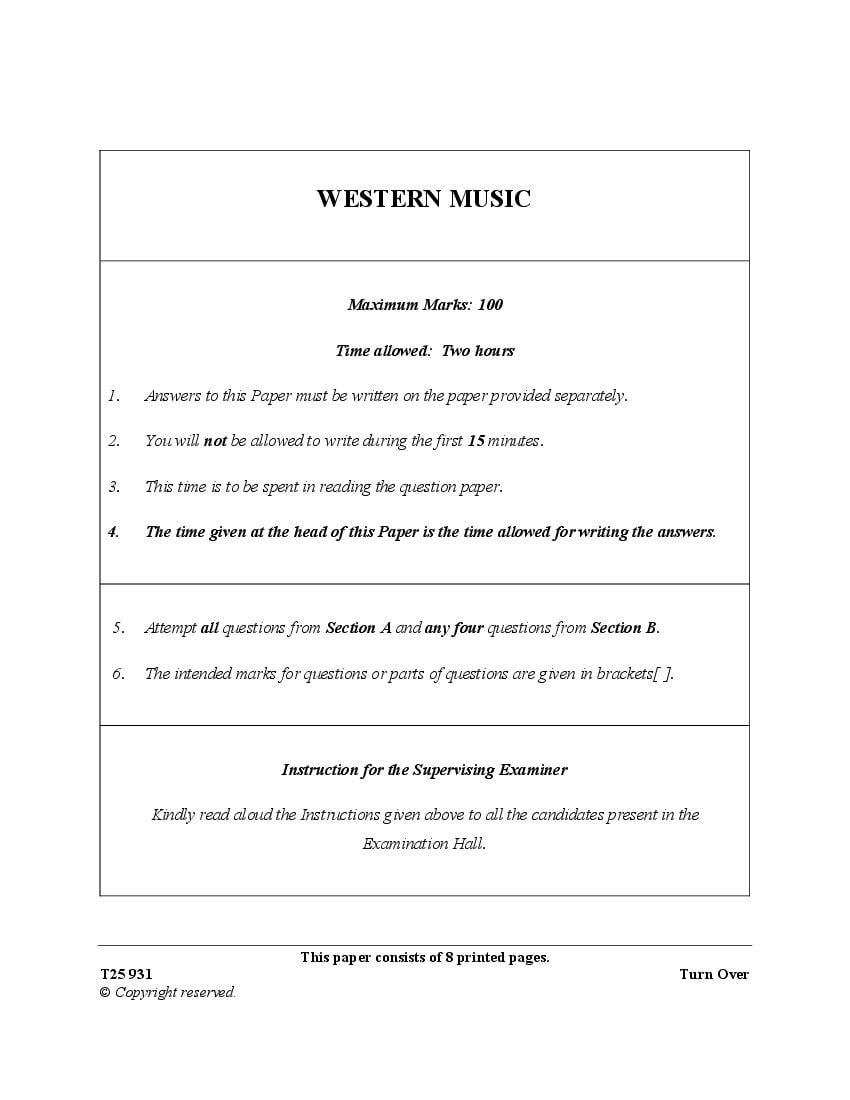
Maximum Marks: 100
Time allowed: Two hours
1. Answers to this Paper must be written on the paper provided separately.
2. You will not be allowed to write during the first 15 minutes.
3. This time is to be spent in reading the question paper.
4. The time given at the head of this Paper is the time allowed for writing the answers.
5. Attempt all questions from Section A and any four questions from Section B.
6. The intended marks for questions or parts of questions are given in brackets[ ].
Instruction for the Supervising Examiner
Kindly read aloud the Instructions given above to all the candidates present in the
Examination Hall.
This paper consists of 8 printed pages.
T25 931 Turn Over
© Copyright reserved.
Page 2
(Answer all questions from this Section.)
Question 1
Choose the correct answers to the questions from the given options. [20]
(Do not copy the questions, write the correct answers only.)
(i) The viola functions as the tenor of the string family.
(b) False
(ii) The sounding pitch of piccolo is:
(a) The same as the written pitch
(b) An octave below written pitch
(c) An octave above the written pitch
(d) A fifth above the written pitch
(iii) Identify the instrument.
(a) Trombone
(b) Clarinet
(c) Saxophone
(d) Trumpet
T25 931 2
Page 3
(b) False
(v) The left pedal on the pianoforte is used for:
(a) Playing softly
(b) Sustaining the notes
(c) Muting the notes
(d) Creating a muffled tone
(vi) The classical guitar is an invention of the twentieth century.
(b) False
(vii) The double bass is used extensively in classical orchestral music as well as jazz
music.
(b) False
(viii) Which of these effects cannot be produced on wind instruments?
(a) Vibrato
(b) Tremolo
(c) Flutter Tonguing
(d) Spiccato
T25 931 3 Turn Over
Page 4
high pitches.
(b) False
(x) How is the lap steel guitar tuned?
(a) EADGBE
(b) E A D G C F
(c) EBFCDA
(d) Usually tuned to an open chord
(xi) The bassoon is a double reed instrument.
(b) False
(xii) Which of the statements is true for the snare drum?
(a) It is a pitched percussion instrument
(b) It is an unpitched percussion instrument
(c) It can be tuned to only one or two notes
(d) It can be tuned in fifths
(xiii) What type of dynamic changes can the harpsichord produce?
(a) Crescendo
(b) Decrescendo
(c) Both crescendo and decrescendo
(d) It cannot produce any dynamic changes
T25 931 4
Page 5
orchestra to tune before a performance.
(b) False
(xv) The composer J. S. Bach used which of these instruments prominently in his
music?
(a) Mouth organ
(b) Harpsichord
(c) Pianoforte
(d) Synthesizer
(xvi) Pick the odd one.
(a) Trumpet
(b) Saxophone
(c) Tuba
(d) Trombone
(xvii) ‘Arco’ means to pluck the strings using fingers.
(b) False
(xviii) Which of these is a transposing instrument?
(a) Viola
(b) Harp
(c) Clarinet
(d) Marimba
T25 931 5 Turn Over
Page 6
(a) Chord
(b) Double Stopping
(c) Strumming
(d) Harmonics
(xx) Which of these is NOT a membranophone?
(a) Snare drum
(b) Chimes
(c) Bass drum
(d) Djembe
SECTION B (80 Marks)
(Answer any four questions from this Section.)
Question 2 [20]
What do you understand by ‘Sonata Allegro form’? Give a detailed example from a
symphony or concerto that you have studied with a focus on the structure, instrumentation,
theme, and modulations.
Question 3
Write a brief life sketch of any two of the following composers. [20]
(i) J. Brahms
(ii) G. F. Handel
(iii) A. Dvorak
(iv) P. I. Tchaikovsky
T25 931 6
Page 7
Write short notes on any four of the jazz styles given below. Refer to any music that you [20]
have enjoyed listening to.
(i) Ragtime
(ii) New Orleans / Dixieland
(iii) Swing Era
(iv) Bebop
(v) Free Jazz
(vi) Acid Jazz
Question 5
J.S. Bach is known as the ‘father’ of music. Outline his life and comment on his unique [20]
contributions to the field of classical music.
Question 6
How have DAWs impacted the music making process today? With reference to a DAW [20]
that you have learnt about, comment on its advantages and disadvantages.
Question 7
Summarise the contributions and life of any two modern musicians / bands from popular [20]
genres that have inspired your musical journey.
Question 8
How have your musical experiences impacted you in your life so far? Write an essay on [20]
what being a student of music has taught you, including challenges you have faced.
T25 931 7 Turn Over
Page 8
Explain the features of the following electronic music genres. Refer to artists you have [20]
heard.
(i) House music
(ii) Dubstep
(iii) Drum & Bass
(iv) Industrial
Question 10
Which large scale musical form is composed for a solo instrument and the orchestra? How [20]
is it structured? Give an example that you have listened to and write short notes on its
movements.
Question 11
Write short notes on any four of the following with examples from music that you have [20]
listened to and studied:
(i) Frontline group
(ii) Rhythm Section
(iii) Swing feel
(iv) Improvisation
(v) Scatting
(vi) Jazz form (32 bar head)
T25 931 8
Document Details
| Board / Org | CISCE |
| Exam | Class 10 |
| Type | Question Paper |
| Pages | 8 |
| Updated | 24 Sep 2026 |