ICSE Class 10 Question Paper 2025 Yoga
Finished viewing? Save it for later —
Download ICSE Class 10 Question Paper 2025 Yoga (PDF · 12 pages)About ICSE Class 10 Question Paper 2025 Yoga
ICSE Class 10 Question Paper 2025 Yoga is available here for free download. Published by CISCE for Class 10, this question paper can be viewed online or downloaded as a PDF (12 pages). Candidates preparing for Class 10 can use ICSE Class 10 Question Paper 2025 Yoga to understand the exam pattern, the type of questions asked, and the overall difficulty level.
Frequently Asked Questions
How can I download ICSE Class 10 Question Paper 2025 Yoga?
Open this page and click the Download button to save ICSE Class 10 Question Paper 2025 Yoga as a PDF. It is completely free on AglaSem Docs.
Is ICSE Class 10 Question Paper 2025 Yoga free to download?
Yes. ICSE Class 10 Question Paper 2025 Yoga can be viewed online and downloaded as a PDF free of cost on AglaSem Docs.
How many pages does ICSE Class 10 Question Paper 2025 Yoga have?
ICSE Class 10 Question Paper 2025 Yoga contains 12 pages, which you can read online or download together as a single PDF.
Where can I find more Class 10 study material?
You can find more Class 10 question papers, sample papers, syllabus, and answer keys on AglaSem Docs.
ICSE Class 10 Question Paper 2025 Yoga – Text
Read the full text of this question paper below — useful to quickly search, copy and reference the content online without downloading the PDF.
📄 View text version (12 pages)
Page 1
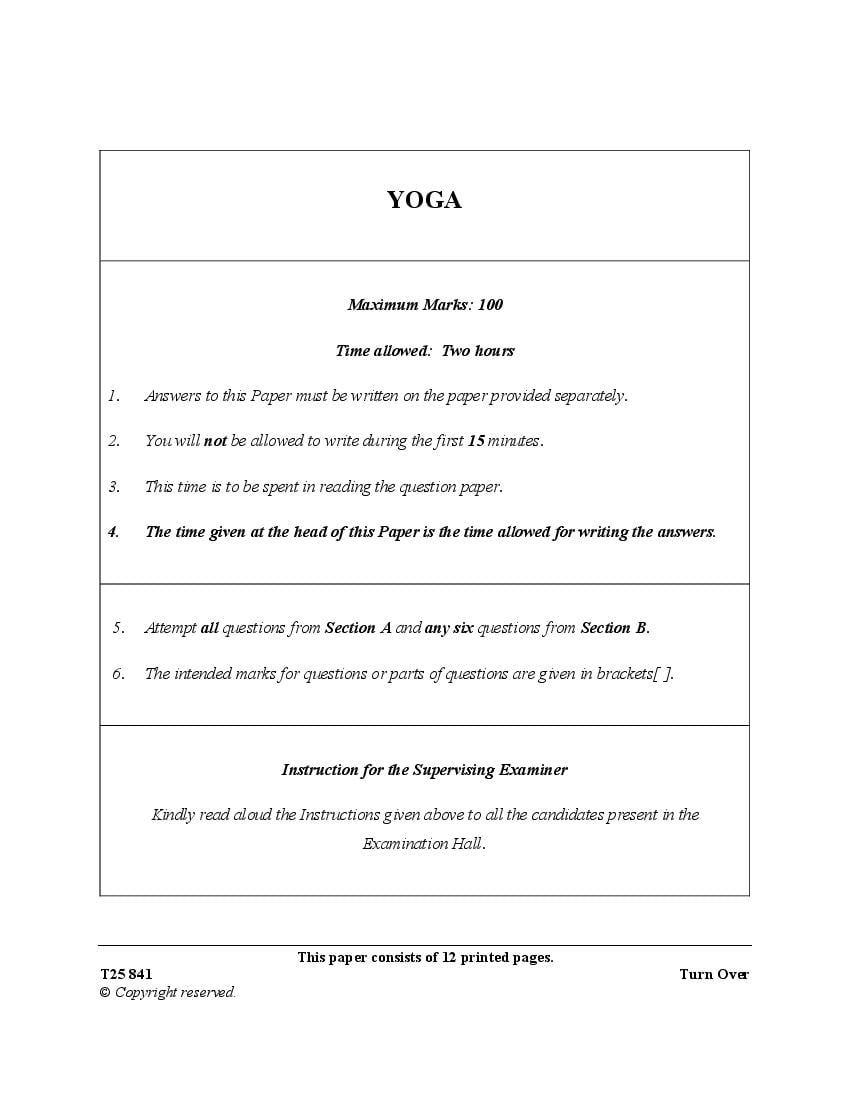
Maximum Marks: 100
Time allowed: Two hours
1. Answers to this Paper must be written on the paper provided separately.
2. You will not be allowed to write during the first 15 minutes.
3. This time is to be spent in reading the question paper.
4. The time given at the head of this Paper is the time allowed for writing the answers.
5. Attempt all questions from Section A and any six questions from Section B.
6. The intended marks for questions or parts of questions are given in brackets[ ].
Instruction for the Supervising Examiner
Kindly read aloud the Instructions given above to all the candidates present in the
Examination Hall.
This paper consists of 12 printed pages.
T25 841 Turn Over
© Copyright reserved.
Page 2
(Attempt all questions from this Section.)
Question 1
Choose the correct answers to the questions from the given options. [20]
(Do not copy the questions, write the correct answers only.)
(i) The chamber of the heart which has the thickest wall is the:
(a) Right auricle
(b) Right ventricle
(c) Left auricle
(d) Left ventricle
(ii) The secretion of this endocrine gland increases blood supply to the muscles under
conditions of stress while decreasing it to the skin and visceral organs:
(a) Pituitary gland
(b) Thyroid gland
(c) Adrenal gland
(d) Pineal gland
(iii) Statement (1): The iris controls the size of the pupil.
Statement (2): The pupil is made up of radial and circular muscles.
(a) Statement (1) is true while Statement (2) is false.
(b) Statement (2) is true while Statement (1) is false.
(c) Statement (2) is the cause of Statement (1).
(d) Statements (1) and (2) are both true but are independent of each other.
T25 841 2
Page 3
(a) Uterus
(b) Urinary bladder
(c) Kidneys
(d) Liver
(v) The yogic kriya shown in the picture:
(a) Mainly stimulates the mind
(b) Mainly cleans the ears
(c) Mainly blocks out sound
(d) Mainly exercises the fingers
(vi) During dialysis, the patient’s blood is drawn from which artery through the
dialysis machine for purification?
(a) Coronary artery
(b) Renal artery
(c) Radial artery
(d) Hepatic artery
(vii) This particular yogic kriya is the best for improving concentration:
(a) Karnarandharadhauti
(b) Jivhamulashodhanam
(c) Vaman dhauti
(d) Trataka
T25 841 3 Turn Over
Page 4
(a) Erythrocytes
(b) Leucocytes
(c) Thrombocytes
(d) Platelets
(ix) The main therapeutic benefit of the asana shown in the picture is that:
(a) It brings hormonal balance
(b) It rests the heart
(c) It stretches the hamstrings
(d) It energises the body
(x) The yoga sutra that emphasises the importance of stilling thoughts is:
(a) Yoga sutra 1.33
(b) Yoga sutra 1.2
(c) Yoga sutra 2.3
(d) Yoga sutra 1.14
(xi) The sage who proclaimed, “All life is yoga,” is:
(a) Swami Vivekananda
(b) Ramana Maharishi
(c) Sri Aurobindo
(d) Sant Narsi Mehta
T25 841 4
Page 5
Pratyahara, Pranayama, Samadhi. Another term belonging to the same category is:
(a) Smriti
(b) Styana
(c) Vairagya
(d) Asana
(xiii) The first line of the song ‘Vaishanava Janto’ by Narsi Mehta means “A man of
God is one who understands the pain of others”. Which aspect from Yoga sutra
1.33 does this line highlight?
(a) Maitri
(b) Karuna
(c) Mudita
(d) Upeksha
(xiv) Amita is able to witness her thoughts as if she is a third person to them. The
aspect of the Sankhya philosophy that she is accessing is:
(a) Mahabhutas
(b) Manas and ahankara
(c) Tanmatras
(d) Purusha and Prakriti
(xv) The sage who wrote a work titled, ‘40 verses on reality’ was:
(a) Swami Vivekananda
(b) Sri Aurobindo
(c) Ramana Maharishi
(d) Ved Vyasa
T25 841 5 Turn Over
Page 6
(a) Sankhya
(b) Vedanta
(c) Purva Mimansa
(d) Tolle’s philosophy
(xvii) The vena cava empties blood into the:
(a) Left ventricle
(b) Right ventricle
(c) Left auricle
(d) Right auricle
(xviii) Mohan is a very hyperactive student. The asana that will help him to calm down
the most is:
Picture A Picture B Picture C
(a) Asana shown in picture A
(b) Asana shown in picture B
(c) Asana shown in picture C
(d) None of the above
T25 841 6
Page 7
rope is a snake. This thought (chitta vritti) is an example of:
(a) Pramana
(b) Viparyaya
(c) Vikalpa
(d) Smriti
(xx) The author of the book ‘The Synthesis of Yoga’ is:
(a) Swami Vivekananda
(b) Sri Aurobindo
(c) Ramana Maharishi
(d) Rishi Yajnavalkya
Question 2
(i) State whether the following are True or False: [5]
(a) The hypothalamus relays pain and pressure impulses to the cerebrum.
(b) The tympanum is a part of the outer ear.
(c) The pulse can be measured over an artery or a vein.
(d) Carbon monoxide poisoning is caused by improper functioning of
thrombocytes.
(e) Myopia is an eye defect in which near objects are seen clearly while distant
objects appear blurred.
T25 841 7 Turn Over
Page 8
(a) Renal artery 1. Empties into the vena cava
(b) Simple reflex action 2. Applying brakes on vehicle if
someone suddenly comes in front
(c) Hepatic vein 3. Blinking when light is flashed
(d) Conditional reflex action 4. Empties into the liver
(e) Hepatic portal vein 5. Arises from the aorta
(iii) Select the odd one out: [5]
(a) Upavishthakonasana, Marichyasana III, Janushirshasana, Paschimottanasana
(b) Left auricle, Aorta, Pulmonary artery, Left ventricle
(c) Axon, Ganglion, Cyton, Neuron
(d) Lungs, Heart, Skin, Kidney
(e) Malleus, Pinna, Incus, Stapes
(iv) Name the following: [5]
(a) The cerebral lobe that controls vision.
(b) The endocrine gland whose over secretion results in gigantism.
(c) The blood vessel that has a large lumen and a thin muscular coat.
(d) Kalpa feels her heartbeat accelerating when under stress. Name the part of
the autonomic nervous system responsible for this.
(e) The vitamin required for the clotting of blood.
T25 841 8
Page 9
(Answer any six questions from this Section.)
Question 3
(i) Write about a significant event that occurred during the childhood of Sant Narsi [2]
Mehta.
(ii) Write any two significant teachings of Sant Narsi Mehta. [2]
(iii) ‘The Divine holds our hand through all and if he seems to let us fall, it is only to [3]
raise us higher.’ – Sri Aurobindo.
Does the above statement apply to Narsi Mehta’s life? How? Explain with an
incident from his life.
(iv) Does the sentence mentioned in part (iii) apply to your life? How? Explain with [3]
an example from your life.
Question 4
(i) Name the sage shown in the picture. What was the name of his guru? [2]
(ii) Write two significant aspects of his relationship with his guru. [2]
(iii) Describe the event in his life that made him famous in America. [3]
T25 841 9 Turn Over
Page 10
atheist is one who does not believe in himself.’ Explain with an example.
(b) Describe any two teachings of this sage excluding the one mentioned in
(iv)(a) above.
Question 5
(i) In his epic poem ‘Savitri’, Sri Aurobindo writes ‘Pain is the hand of Nature [2]
sculpturing men to greatness’. Write an incident from the life of Sri Aurobindo
that brings out the truth of the above statement.
(ii) Name the Indian sage who left his home at a very young age in the quest of [2]
spiritual truth. What do you understand from his teachings?
(iii) Name the author of the Srimad Bhagvatam and explain any two meaningful [3]
aspects of this scripture.
(iv) Name the author of the Shukla Yajurveda and explain any two meaningful [3]
aspects of this scripture.
Question 6
(i) Explain the niyama ‘Swadhyay’. Describe one way in which you practice [2]
‘Swadhyay’ in your life.
(ii) Explain the term ‘avirati’. [2]
(iii) ‘Non-violence is a weapon of the strong.’ – M. K. Gandhi. [3]
This statement brings out the truth of a ‘yama’ listed by Rishi Patanjali in his
ashtang yoga. Which one is it? Explain this statement by Gandhiji in your own
words.
T25 841 10
Page 11
(a) Samadhi
(b) Nirbeej Samadhi
(c) Sabeej Samadhi
Question 7
Explain the following terms:
(i) Pratyahara [2]
(ii) Vikalpa Vritti [2]
(iii) Pramana vritti with an example. [3]
(iv) Pratipaksha Bhavanam with an example. [3]
Question 8
(i) Explain the kinds of Karma listed in the Kaivalyapada. [2]
(ii) Explain the term ‘Dharma megha samadhi’ from the Kaivalyapada. [2]
(iii) Write about a teaching from the Vibhuti pada or the Kaivalyapada that has [3]
impacted you deeply. In what way has it impacted you?
(iv) Write the power obtained when the object of Samyama is: [3]
(a) The Sun
(b) The Moon
(c) The Polestar
T25 841 11 Turn Over
Page 12
(i) Explain the term ‘tirthankara’ from the Jain school of philosophy. [2]
(ii) While walking in the woods, Ira stays in the present moment by paying attention [2]
to the silence between the chirping of the birds. She is practicing a teaching of a
philosophy you have studied. Name this philosophy and explain another teaching
from this philosophy.
(iii) An orthodox school of Indian philosophy states that everything in existence is [3]
made up of one essence i.e. Brahman.
Name this school. How will this teaching help you to deal in a more conscious
way with a difficult person in your life?
(iv) Write three points of comparison between Vedanta and Purva Mimansa. [3]
Question 10
(i) Write three points of comparison between the yoga and Sankhya schools of [3]
philosophy.
(ii) Which one of the five yoga sutras studied by you has positively impacted your [3]
life the most? Why?
(iii) Explain the following terms: [4]
(a) Mahayana sect
(b) Mahabhutas
Question 11
Write the following sutras in Sanskrit. Explain them word for word and write a sentence
in English summing up the meaning of the sutras:
(i) Sutra 2.28 [5]
(ii) Sutra 2.3 [5]
T25 841 12
Document Details
| Board / Org | CISCE |
| Exam | Class 10 |
| Type | Question Paper |
| Pages | 12 |
| Updated | 24 Sep 2026 |