APTET Question Paper with Answers 17 Jun 2018 Paper 2 Maths and Science (Shift 2)
Finished viewing? Save it for later —
Download APTET Question Paper with Answers 17 Jun 2018 Paper 2 Maths and Science (Shift 2) (PDF · 66 pages)About APTET Question Paper with Answers 17 Jun 2018 Paper 2 Maths and Science (Shift 2)
APTET Question Paper with Answers 17 Jun 2018 Paper 2 Maths and Science (Shift 2) is available here for free download. Published by Andhra Pradesh Exams for Andhra Pradesh Teacher Eligibility Test, this question paper can be viewed online or downloaded as a PDF (66 pages). Candidates preparing for Andhra Pradesh Teacher Eligibility Test can use APTET Question Paper with Answers 17 Jun 2018 Paper 2 Maths and Science (Shift 2) to understand the exam pattern, the type of questions asked, and the overall difficulty level.
Frequently Asked Questions
How can I download APTET Question Paper with Answers 17 Jun 2018 Paper 2 Maths and Science (Shift 2)?
Open this page and click the Download button to save APTET Question Paper with Answers 17 Jun 2018 Paper 2 Maths and Science (Shift 2) as a PDF. It is completely free on AglaSem Docs.
Is APTET Question Paper with Answers 17 Jun 2018 Paper 2 Maths and Science (Shift 2) free to download?
Yes. APTET Question Paper with Answers 17 Jun 2018 Paper 2 Maths and Science (Shift 2) can be viewed online and downloaded as a PDF free of cost on AglaSem Docs.
How many pages does APTET Question Paper with Answers 17 Jun 2018 Paper 2 Maths and Science (Shift 2) have?
APTET Question Paper with Answers 17 Jun 2018 Paper 2 Maths and Science (Shift 2) contains 66 pages, which you can read online or download together as a single PDF.
Where can I find more Andhra Pradesh Teacher Eligibility Test study material?
You can find more Andhra Pradesh Teacher Eligibility Test question papers, sample papers, syllabus, and answer keys on AglaSem Docs.
APTET Question Paper with Answers 17 Jun 2018 Paper 2 Maths and Science (Shift 2) – Text
Read the full text of this question paper below — useful to quickly search, copy and reference the content online without downloading the PDF.
📄 View text version (57 pages)
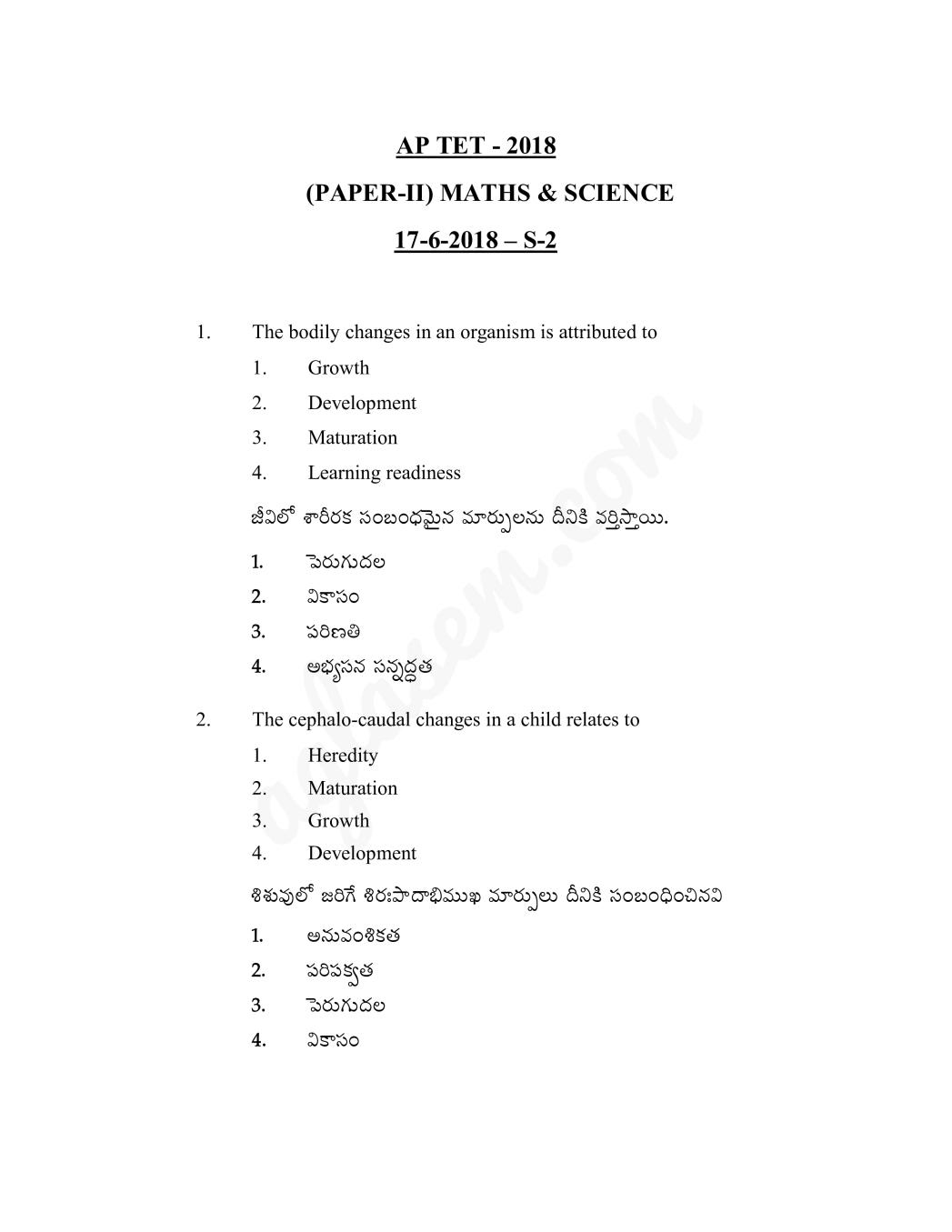
Page 1
(PAPER-II) MATHS & SCIENCE
17-6-2018 – S-2
1. The bodily changes in an organism is attributed to
1. Growth
2. Development
3. Maturation
4. Learning readiness
2. The cephalo-caudal changes in a child relates to
1. Heredity
2. Maturation
3. Growth
4. Development
Page 2
1. Heredity
2. Growth
3. Process
4. Development
4. This stage is also called as Pre-school Age
1. Infant stage
2. Baby hood
3. Early childhood
4. Late childhood
Page 3
children develop the concept of object permanence is
1. Sensory Motor stage
2. Pre operational stage
3. Concrete operational stage
4. Formal operational stage
6. A person’s thinking, reasoning and competency processes
plays an important role in moral development – This was
stated by this Psychologist
1. Piaget
2. Chomsky
3. Vygotsky
4. Kohlberg
Page 4
theory
1. Piaget
2. Carl Rogers
3. Chomsky
4. Vygotsky
8. Individual’s development is the result of his interactions with
social environment – This is stated by
1. Freud
2. Erikson
3. Bruner
4. Skinner
Page 5
1. < 25
2. between 26 – 49
3. between 50 – 70
4. between 70 – 89
25
26 – 49
50 – 70
70 – 89
10. Individual's ability to understand his own strengths and
weaknesses is known as
1. Level of aspiration
2. Achievement motivation
3. Performance
4. Self-concept
Page 6
1. Greek
2. German
3. Latin
4. French
12. The method which is highly objective is
1. Observation
2. Introspection
3. Case study
4. Experimental method
Page 7
throughout it's life
1. Motivation
2. Learning
3. Movement
4. Growth
14. Individual's motivation is related to the following
1. Development
2. Needs
3. Growth
4. Maturation
Page 8
Experimental Studies”
1. Pavlov
2. Skinner
3. Thorndike
4. Kohler
“Animal Intelligence - Experimental Studies”
16. In Pavlov’s experiment, the Bell sound after conditioning is
called as
1. Natural stimulus
2. Conditioned stimulus
3. Conditioned response
4. Natural response
Page 9
1. Thorndike
2. Pavlov
3. Skinner
4. Bandura
18. The Psychologist who proposed that the language plays an
important role in cognitive development is
1. Hurlock
2. Bandura
3. Kohler
4. Vygotsky
Page 10
getting 10 points in SSC examinations. This is an example
for
1. Intrinsic motivation
2. Extrinsic motivation
3. Achievement motivation
4. Social motivation
SSC
20. The learning and experiences are stored in the brain by an
individual for a period is called
1. Memory
2. Retention
3. Recall
4. Recognition
Page 11
distorted the result is
1. Memory
2. Forgetting
3. Retention
4. Interference
22. A person who can read and write Telugu trying to learn
Kannada - the transfer of learning here is
1. Positive transfer
2. Negative transfer
3. Bilateral transfer
4. Zero transfer
Page 12
1. Dislexia
2. Disphasia
3. Disgraphia
4. Discalculia
24. Bruner introduced a learning method called
1. Motor learning
2. Perceptual learning
3. Problem-solving learning
4. Discovery learning
Page 13
type of evaluation
1. Summative
2. Formative
3. Qualitative
4. Quantitative
26. The weightages given in CCE to Summative and Formative
evaluations respectively are
1. 80% marks – 20% marks
2. 50% marks – 20% marks
3. 20% marks – 80% marks
4. 25% marks – 75% marks
CCE
Page 14
of different elements in a situation is
1. Conditioning
2. Trial and error
3. Insight
4. Imitation
28. The Psychologist who used Bobo dolls in his studies in
learning is
1. Bandura
2. Skinner
3. Pavlov
4. Vygotsky
Page 15
1. Class 1 to 5
2. Class 6 to 10
3. Class 1 to 10
4. Class 6 to 12
30. The Psychologist who discussed about “Instructional
Scaffolding” is
1. Piaget
2. Vygotsky
3. Bandura
4. Bruner
“Instructional Scaffolding”
Page 25
Choose the meaning of the word ‘pilgrimage’.
1. A movement against poverty.
2. A work to do in fields.
3. A place to sleep peacefully.
4. A journey to a holy place.
62. Choose the word that refers to ‘a number of people listening
to a concert or lecture’:
1. Board
2. Audience
3. Crowd
4. Troupe
63. Choose the word with a ‘suffix.’
1. Kingdom
2. King
3. Knight
4. Kite
Page 26
1. Sneze
2. Cease
3. Screem
4. Bable
65. Choose the word that can be used as a noun and a verb.
1. Historic
2. Written
3. Favourite
4. Design
66. Challenges in our lives strengthen over convictions.
Choose the antonym of the word ‘strengthen.’
1. Encourage
2. Driven
3. Sharpen
4. Weaken
Page 27
Identify the meaning of ‘came forward.’
1. Searched
2. Volunteered
3. Thought
4. Declared
68. He may not have stolen the pen.
This sentence indicates;
1. doubt
2. certainty
3. ability
4. purpose
69. Valmiki’s ………… Ramayana is a sacred book.
Choose the article that fits the context.
1. a
2. an
3. the
4. No article is needed.
Page 28
Choose the correct preposition that fits the context.
1. in
2. with
3. at
4. on
71. Choose the sentence that has a defining relative clause.
1. I know who you are.
2. Ramu who is on the road is my friend.
3. He said that he was busy.
4. Who is your elder brother ?
72. I would like to see that book.
This sentence indicates;
1. a wish
2. an obligation
3. a moral obligation
4. an offer
Page 29
Choose the correct question tag for this sentence.
1. is Rohit ?
2. isn’t Rohit ?
3. isn’t he ?
4. doesn’t he ?
74. Who did Gopi marry
This sentence ends with;
1. a question mark.
2. a full stop.
3. a comma.
4. an exclamatory mark.
75. ‘The boy is a fool,’ said the gentleman.
Choose the reported speech of this sentence.
1. The boy said the gentleman is a fool.
2. The boy said that the gentleman was a fool.
3. The boy asked the gentleman not to be a fool.
4. The gentleman said that the boy was a fool.
Page 30
Choose the correct form of verb that fits the blank.
1. have
2. are
3. is
4. will
77. I ………… Mumbai six times in 2015.
Choose the correct tense form that fits the blank.
1. visit
2. visits
3. visited
4. have visited
78. What are these fabrics ?
The part of speech of the word ‘these’ is;
1. a pronoun
2. an adjective
3. a preposition
4. a conjunction
Page 31
1. Meanwhile
2. To sum up
3. Likewise
4. So
80. Choose the coordinate conjunction from the following.
1. as soon as
2. either ….. or
3. so …… that
4. as long as
81. Choose the grammatically correct sentence.
1. The stranger entered into the room.
2. The stranger entered in the room.
3. The stranger entered the room.
4. The stranger entered to the room.
82. Choose the correctly punctuated sentence.
1. What is it, amma said the girl.
2. What is it ? amma ?, said the girl.
3. What is it, amma ? said the girl.
4. “What is it, amma ?” said the girl.
Page 32
1. I don’t know where he lives.
2. He was born to Venkatachalamaiah and Varalakshmi.
3. Peraiah Sastry inspired him.
4. Satyam was interested in nothing.
84. Teja is ………… boy in the class.
Choose the grammatically correct expression that fits the
context.
1. the tallest
2. the taller than
3. taller than
4. as tall as
85. In a personal letter we find the phrase ‘with love’ in;
1. The body
2. The heading.
3. The opening
4. The closing
86. Choose the correct list of words with alphabetical order.
1. cool, cools, cooled, cooling
2. cooled, cool, cools, cooling
3. cool, cooled, cooling, cools
4. cooling, cools, cool, cooled
Page 33
Choose the synonym of the word ‘reputation.’
1. Celebration
2. Popularity
3. Morality
4. Sensation
88. I am amazed …………… you, Victoria.
Choose the correct preposition that fits the blank.
1. of
2. with
3. at
4. by
89. Read the following passage and choose the correct
answer to the question.
Socrates was the evangelist of clear thinking. He went about
the streets of Athens preaching logic – just as 400 years later
Jesus would go about the villages of Palestine preaching love.
And like Jesus without ever writing down a word, he
exercised an influence over the minds of men that a library of
books could not surpass.
Socrates preached;
1. about library books
2. about Jesus
3. about Athens
4. about logic and clear thinking
Page 34
answer to the question.
Socrates was the evangelist of clear thinking. He went about
the streets of Athens preaching logic – just as 400 years later
Jesus would go about the villages of Palestine preaching love.
And like Jesus without ever writing down a word, he
exercised an influence over the minds of men that a library of
books could not surpass.
Socrates and Jesus;
1. had influence over the minds of men
2. were born in Athens
3. preached logic in the streets of Palestine
4. preached love in Athens
Page 35
=1 x
1. 0
2. 1
3. 5
4. 10
3
92. If x = 0.2 then the value of x 2 is
3
x = 0.2 x 2
1. 0.008
2. 0.08
3. 0.06
4. 0.8
93. If A = {1, 4, 6}, B = {3, 6}, C = {3, 4, 5} then A (B C)
is
A = {1, 4, 6}, B = {3, 6}, C = {3, 4, 5} A (B C)
1. {1, 3, 4, 5, 6}
2. {3, 4, 5, 6}
3. {4, 6}
4. {1, 4, 6}
Page 36
on adding 5 to it is
1. 245
2. 247
3. 252
4. 257
95. The perimeter of a triangle with vertices (0, 4) (0, 0) and
(3, 0) is
(0, 4) (0, 0) (3, 0)
1. 5
2. 7+ 5
3. 11
4. 12
96. P(–5, 7) and Q(3, –11) are end points of the diameter of a
circle then the centre is
P(–5, 7) Q(3, –11)
1. (–1, –2)
2. (1, –2)
3. (–1, 2)
4. (1, 2)
Page 37
base 2cm and height 16cm, then the diameter of each sphere
is, (in cm)
1. 6
2. 4
3. 3
4. 2
98. The area of a parallelogram is 60 cm2 and one of it’s altitude
is 5cm then the length of its corresponding side is (in cms)
60 cm2
1. 12
2. 6
3. 4
4. 2
Page 38
99. If one root of the quadratic equation 3x2 + Kx – 3 = 0 is
3
then the value of ‘K’ is
1
3x2 + Kx – 3 = 0
3
‘K’
1. 7
2. 8
3. 9
4. 10
100. The smallest square number that is divisible by 4, 9 and 10 is
4, 9 10
1. 360
2. 900
3. 1800
4. 3600
101. 35th term of an Arithmetic Progression is 69 then the sum of
first 69 terms is
1. 2380.5
2. 4671
3. 4761
4. 9522
Page 39
102. If x = , y= then the value of
3 2 3 2
x2 + xy + y2 is
3 2 3 2
x = , y= x2 + xy + y2
3 2 3 2
1. 98
2. 99
3. 40 6
4. 99 + 40 6
103. A factory required 42 machines to produce a given number of
articles in 63 days then the number of machines required to
produce the same number of articles in 54 days is
1. 81
2. 54
3. 49
4. 36
Page 40
is Rs.1,54,000 then his salary before enhancement is
(in Rupees)
1,54,000
1. 1,38,000
2. 1,40,000
3. 1,04,000
4. 1,69,400
105. A number is selected at random from the first 50 natural
numbers then the probability that it is composite number is
4
1.
25
8
2.
25
17
3.
25
21
4.
25
Page 41
complementary event will be
‘P’
1. P–1
2. P
1
3.
P
4. 1–P
107. More More More More More More
than or than or than or than or than or than or
Marks equal equal equal equal equal equal
obtained to 0 to 10 to 20 to 30 to 40 to 50
No. of
students 63 58 55 51 48 42
The frequency of the class 30–40 is
30–40
1. 3
2. 4
3. 48
4. 51
Page 42
detected on rechecking that the value of 45 was wrongly
copied as 15 then the correct mean is
1. 46
2. 45
3. 44
4. 43
2
109. If Cosec = then the value of Sin2 .Cos is
3
2
Cosec = Sin2 .Cos
3
3
1.
8
3
2.
4
3
3.
4
3
4.
8
Page 43
7 AM in the morning then the angle of elevation of the sun
rays with the ground at the same time is
5 3
1. 30o
2. 45o
3. 60o
4. 90o
111. The quadrilateral with equal diagonals is
1. Rhombus
2. Parallelogram
3. Rectangle
4. Trapezium
1.
2.
3.
4.
Page 44
other at the point ‘O’ and AB DC. If AB = 2CD then the
ratio of areas of AOB and COD is
ABCD AB DC AC, BD
‘O’ AB = 2CD AOB
COD
1.
2. 4:1
3. 1:2
4. 2:1
113. One of the angle of a rhombus is a right angle then it is a
1. Rectangle
2. Square
3. Parallelogram
4. Trapezium
1.
2.
3.
4.
Page 45
is (in cm2)
1. 7.7
2. 7
3. 15.4
4. 77
Page 46
1. 1292
2. 1729
3. 1972
4. 1792
116. This educationist has given hierarchy to the objectives of
“Psychomotor domain”
1. B.S. Bloom
2. L.W. Andarson
3. D.R. Krattwohl
4. Eligebeth Simpson
1.
2.
3.
4.
Page 47
Method” is
1. Concrete to Abstract
2. Hypothesis to Conclusion
3. Example to Principle
4. Specific to General
1.
2.
3.
4.
118. This provides more learning as per Edgardale’s cone of
experience
1. Dramatic Experiences
2. Visual symbols
3. Direct purposeful experience
4. Verbal symbols
1.
2.
3.
4.
Page 48
1. Lack of clarity in thinking of child
2. Lack of proper written work
3. Having computational skills
4. Lack of answer verification habit
1.
2.
3.
4.
120. The Academic standard to be tested through the following test item.
“Write the numbers –3, –7, 0, 4, –2 in ascending order”
1. Representation – Visualisation
2. Communication
3. Connection
4. Reasoning – Proof
– – –
1.
2.
3.
4.
Page 49
filament
1. Electric bulb
2. Electric heater
3. Electric Iron
4. Electric cooker
122. This planet is also called as “Red planet”
1. Sun
2. Venus
3. Mars
4. Jupiter
1.
2.
3.
4.
Page 50
is
1. Only potential energy
2. Only kinetic energy
3. Potential energy increases while kinetic energy
decreases
4. Potential energy decreases while kinetic energy
increases
124. A pair of physical quantities which has same units
1. Velocity, Acceleration
2. Acceleration, Momentum
3. Momentum, Impulse
4. Impulse, Velocity
Page 51
reaches to water at 0ºC is (in cal)
(Specific heat of water = 1 cal/gmºC)
50ºC 0ºC
1 cal/gmºC
1. 1
2. 10
3. 50
4. 100
126. Characteristics of image formed by a concave mirror when
the object is placed in between focus and centre of curvature
1. Real, Inverted, Magnified
2. Real, Inverted, diminished
3. Virtual, Inverted, Magnified
4. Virtual, Inverted, diminished
Page 52
treated with hydrochloric acid
1. Oxygen
2. Hydrogen
3. Carbon dioxide
4. Carbon monoxide
128. Non metal present in gun powder is
1. Phosphorus
2. Carbon
3. Iodine
4. Sulphur
Page 53
1. Milk + Water
2. Chalk powder + Water
3. Sugar + Water
4. Salt + Water
130. One of the following is added to water to kill disease causing
organisms present in water
1. Oxygen
2. Carbon dioxide
3. Carbon monoxide
4. Chlorine
Page 54
1. Diesel
2. Petrol
3. Coal tar
4. Petroleum
132. The method used to separate dissolved substances from a
liquid is
1. Decantation
2. Sedimentation
3. Filtration
4. Crystallization
Page 55
1. Knitting
2. Shearing
3. Spinning
4. Ginning
134. The correct statement with reference to food chain and food
web is
1. Food chain is the part of food web
2. Food web is the part of food chain
3. Food chain and food web are the same
4. There is no relation between the two
Page 56
1. Proteins
2. Fats
3. Fibres
4. Vitamins
1.
2.
3.
4.
136. A student wished to know different stages of ‘production of
woolen fabrics’ and visited that centre. But, he missed to see
first two stages. Those are
1. Shearing, Knitting
2. Dyeing, Knitting
3. Shearing, Scouring
4. Sorting, Bleaching
Page 57
Cotton variety. B.T. means
1. Bacillus thuringiensis
2. Bacillus tobacum
3. Bacteria tricoderma
4. Bacteria tobacum
B.T.
B.T.
138. Certain plant and animal species are restricted to a particular
area. They are called as
1. Endangered species
2. Endemic species
3. Invasive Alien species
4. Native Alien species
1.
2.
3.
4.
Page 58
1. Oxygen demand
2. Carbon cycle
3. Natural disasters
4. Ozone layer protection
140. The best practice used in agriculture to prevent water wastage
is
1. Pond irrigation
2. Drip irrigation
3. Irrigation
4. Sprinkler irrigation
Page 59
1. If agglutination takes place with Anti ‘A’ but not with
Anti ‘B’, it is ‘A’ group blood
2. If agglutination takes place with Anti ‘A’ but not with
Anti ‘B’, it is ‘B’ group blood
3. If agglutination takes place with Anti ‘A’ and Anti ‘B’,
it is ‘O’ group blood
4. If agglutination does not take place with Anti ‘A’ and
Anti ‘B’, it is ‘AB’ group blood
Anti ‘A’ Anti ‘B’
‘A’
Anti ‘A’ Anti ‘B’
‘B’
Anti ‘A’ Anti ‘B’
‘O’
Anti ‘A’ Anti ‘B’
‘AB’
Page 60
happiness etc.
1. Medulla
2. Diencephalon
3. Cerebellum
4. Mid brain
1.
2.
3.
4.
143. Malphigian tubules are excretory organs in
1. Earthworm
2. Housefly
3. Flatworm
4. Star fish
Page 61
cells
1. Vasa deferentia
2. Epididymis
3. Prostate gland
4. Testis
Page 62
1. Benjman S. Bloom
2. David Krathwohl
3. Elizebath Simpson
4. R. H. Dave
Page 63
include this area in secondary school curriculum
1. Adolescence Education
2. Peace Education
3. Information Technology
4. Health Education
147. To teach the topic “Measurement of time” in project method
the type of project that can be used is
1. Display Project
2. Verification Project
3. Investigatory Project
4. Constructivistic Project
Page 64
1. Cycas, Pinus
2. Opuntia, Acacia
3. Moss, Fern
4. Hydrilla, Vallisnaria
149. When a base falls into the eye, at first, the eye has to be
dipped and opened with plenty of water and then, it is to be
cleaned with the following substance also
1. Sodium Bicarbonate
2. Dilute Boric acid
3. Silver Nitrate
4. Glycerin
Page 65
situation can be recorded in a descriptive manner by the
teacher in this record
1. Communicative record
2. Progress report
3. Biography
4. Anecdotal record
Page 66
Paper-II(A)- Telugu Medium-Set-M (M&S) 17.06.2018 Afternoon Session
Q.Nos CDP Q.Nos Telugu Q.Nos English Q.Nos Maths Q.Nos Science
1 1 31 1 61 4 91 4 121 1
2 4 32 3 62 2 92 1 122 3
3 4 33 4 63 1 93 3 123 4
4 3 34 2 64 2 94 2 124 3
5 1 35 3 65 4 95 4 125 3
6 4 36 4 66 4 96 1 126 1
7 3 37 3 67 2 97 4 127 3
8 2 38 2 68 1 98 1 128 4
9 1 39 1 69 4 99 2 129 1
10 4 40 4 70 3 100 2 130 4
11 3 41 2 71 2 101 3 131 4
12 4 42 3 72 1 102 2 132 4
13 2 43 2 73 3 103 3 133 4
14 2 44 2 74 1 104 2 134 1
15 3 45 1 75 4 105 3 135 3
16 2 46 3 76 3 106 4 136 3
17 3 47 4 77 3 107 1 137 1
18 4 48 2 78 2 108 4 138 2
19 2 49 3 79 1 109 4 139 4
20 2 50 1 80 2 110 3 140 2
21 2 51 3 81 3 111 3 141 1
22 1 52 2 82 4 112 2 142 2
23 3 53 3 83 2 113 2 143 2
24 4 54 1 84 1 114 1 144 4
25 2 55 2 85 4 115 2 145 Add Score
26 1 56 4 86 3 116 4 146 1
27 3 57 4 87 2 117 2 147 1
28 1 58 4 88 3 118 3 148 3
29 2 59 1 89 4 119 3 149 2
30 4 60 2 90 1 120 4 150 4
Document Details
| Board / Org | Andhra Pradesh Exams |
| Exam | Andhra Pradesh Teacher Eligibility Test |
| Type | Question Paper |
| Pages | 66 |
| Updated | 09 Jun 2026 |