APTET Question Paper with Answers 12 Jun 2018 Paper 1 (Shift 2)
Finished viewing? Save it for later —
Download APTET Question Paper with Answers 12 Jun 2018 Paper 1 (Shift 2) (PDF · 64 pages)About APTET Question Paper with Answers 12 Jun 2018 Paper 1 (Shift 2)
APTET Question Paper with Answers 12 Jun 2018 Paper 1 (Shift 2) is available here for free download. Published by Andhra Pradesh Exams for Andhra Pradesh Teacher Eligibility Test, this question paper can be viewed online or downloaded as a PDF (64 pages). Candidates preparing for Andhra Pradesh Teacher Eligibility Test can use APTET Question Paper with Answers 12 Jun 2018 Paper 1 (Shift 2) to understand the exam pattern, the type of questions asked, and the overall difficulty level.
Frequently Asked Questions
How can I download APTET Question Paper with Answers 12 Jun 2018 Paper 1 (Shift 2)?
Open this page and click the Download button to save APTET Question Paper with Answers 12 Jun 2018 Paper 1 (Shift 2) as a PDF. It is completely free on AglaSem Docs.
Is APTET Question Paper with Answers 12 Jun 2018 Paper 1 (Shift 2) free to download?
Yes. APTET Question Paper with Answers 12 Jun 2018 Paper 1 (Shift 2) can be viewed online and downloaded as a PDF free of cost on AglaSem Docs.
How many pages does APTET Question Paper with Answers 12 Jun 2018 Paper 1 (Shift 2) have?
APTET Question Paper with Answers 12 Jun 2018 Paper 1 (Shift 2) contains 64 pages, which you can read online or download together as a single PDF.
Where can I find more Andhra Pradesh Teacher Eligibility Test study material?
You can find more Andhra Pradesh Teacher Eligibility Test question papers, sample papers, syllabus, and answer keys on AglaSem Docs.
APTET Question Paper with Answers 12 Jun 2018 Paper 1 (Shift 2) – Text
Read the full text of this question paper below — useful to quickly search, copy and reference the content online without downloading the PDF.
📄 View text version (64 pages)
Page 1
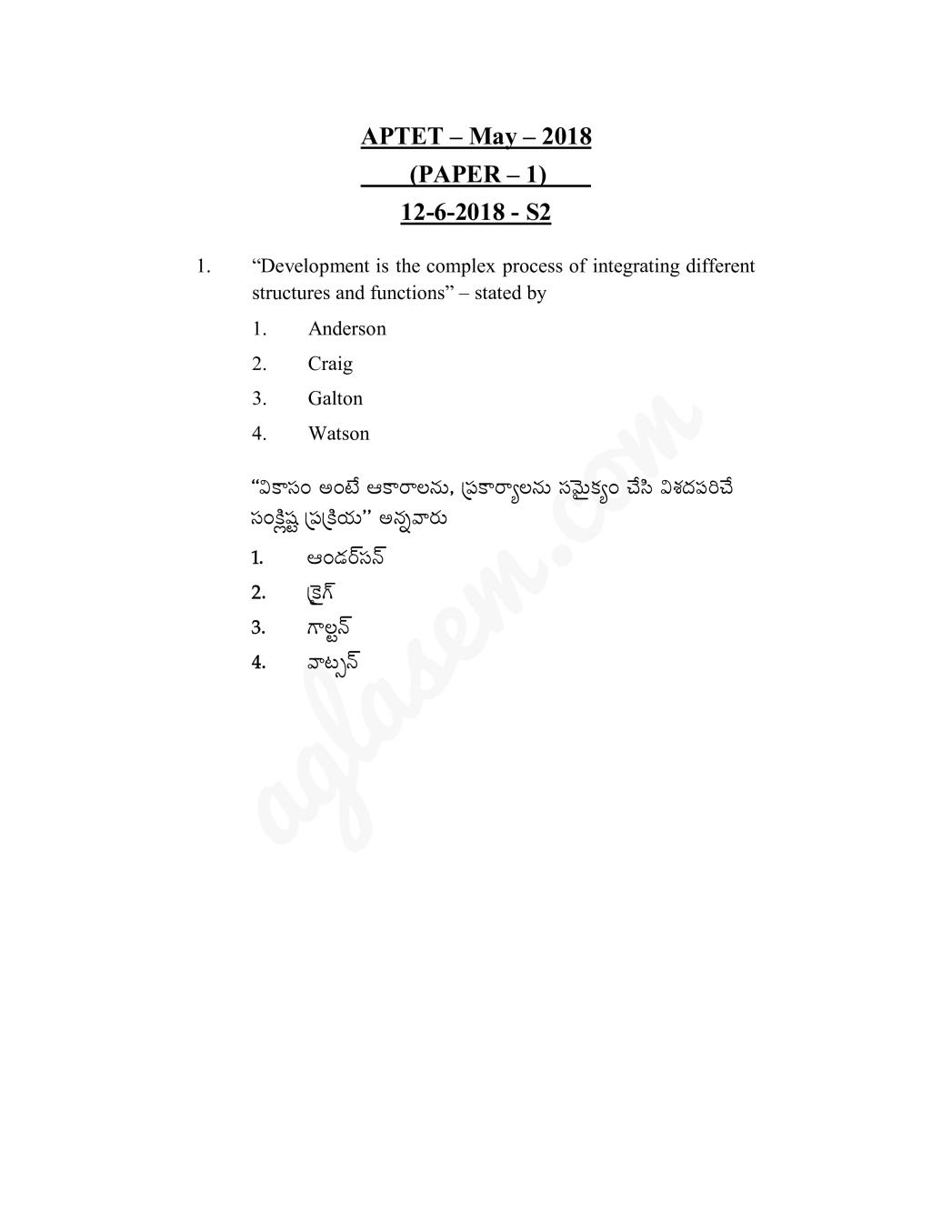
(PAPER – 1)
12-6-2018 - S2
1. “Development is the complex process of integrating different
structures and functions” – stated by
1. Anderson
2. Craig
3. Galton
4. Watson
Page 2
1. Dugdale – Jukes family
2. Goddard – Martin Kallikak family
3. Freeman – Edward family
4. Pearson – Darwin family
3. The first stage in language development is
1. Bobbling stage
2. Sound imitating stage
3. Pre-linguistic stage
4. Language comprehension stage
Page 3
class about goat. Then he saw a black dog on his way and
presumed it as a goat. This is due to
1. Assimilation
2. Adjustment
3. Animism
4. Ego centrism
5. According to Kohlberg’s, stages of moral development
morality of individual principles and conscience relates to
1. Pre-conventional level, stage 1
2. Conventional level, stage 3
3. Conventional level, stage 4
4. Post conventional level, stage 6
Page 4
faced by the children during play age is
1. Trust Vs Mistrust
2. Autonomy Vs Doubt
3. Industry Vs Inferiority
4. Initiative Vs Guilt
7. Ravan’s standard progressive matrices is a
1. Individual test of intelligence
2. Group test of intelligence
3. Performance test of intelligence
4. Verbal test of intelligence
Page 5
1. Bhatia
2. George K Binnet
3. Simon
4. Srivastava
9. One of the following is a mixed gland
1. Adrenal gland
2. Pancreas
3. Thyroid gland
4. Testis
Page 6
scolding from his teacher. The conflict of Ravi is
1. Approach - Approach
2. Avoidance - Avoidance
3. Approach – Avoidance
4. Double approach - Avoidance
11. The mental age of 10 years old Kumar is 7 years, then his
intelligence quotient is
1. 70
2. 75
3. 100
4. 30
Page 7
of students. Here the activeness of students is
1. Independent variable
2. Dependent variable
3. Interfacing (intervening) variable
4. Mixed variable
13. The theory of transfer of learning proposed by Charles Judd is
1. Theory of identical elements
2. Theory of generalization
3. Theory of ideals
4. Theory of transposition
Page 8
‘French’ and then German. While writing German
examination she is recollecting French but not German. This
is due to
1. Proactive inhibition
2. Retro active inhibition
3. Deja vu
4. Repression
15. Razak learnt a list of meaningless words in 18 attempts. After
one month he was asked to re-learn the same list. This time he
took 9 attempts. His savings score is
1. 25 %
2. 75 %
3. 50 %
4. 200 %
Page 9
1. Food
2. Sleep
3. Rest
4. Safety
17. One of the following is related to cognitive domain.
1. Synthesis
2. Imitation
3. Organisation
4. Articulation
Page 10
during this age
1. 3 years
2. 7 years
3. 10 years
4. 12 years
19. In Pavlov’s experiment food is a
1. Conditioned stimulus
2. Unconditioned stimulus
3. Conditioned response
4. Unconditioned response
Page 11
1. Classical conditioning
2. S-type conditioning
3. Reinforcement
4. Instrumental conditioning
S-
21. The meaning of the word Gestalt is
1. Part
2. Reinforcement
3. Chimpanzee
4. Configuration
Page 12
process as suggested by Bandura.
1. Attention
2. Retention
3. Reinforcement
4. Extinction
23. As per RTE Act - 2009, the number of teaching hours
prescribed in an academic year for classes 6th to 8th.
RTE Act - 2009
1. 220
2. 800
3. 1000
4. 1420
Page 13
1. F.C. Thorne
2. Williamson
3. Darly
4. Rogers
25. In Directive leadership
1. Decisions will be taken by members
2. Leader alone takes decisions
3. Leader will give importance to the opinions of
members.
4. Leadership is nominal
Page 14
1. Oral – language disability
2. Reading disability
3. Writing disability
4. Arithmetic disability
27. Both collaborative and cooperative learning are
1. Teacher centred
2. Student centred
3. School centred
4. Vocation centred
Page 15
1. Observational learning theory
2. Theory of instruction
3. Psychoanalytic theory
4. Operant conditioning
29. In NCF 2005 Institutional reforms were discussed in this
chapter
1. Chapter 2
2. Chapter 3
3. Chapter 4
4. Chapter 5
NCF 2005
Page 16
1. Films
2. Slides
3. Microscope
4. Overhead projector
Page 17
TELUGU
31.
32.
33.
Page 18
35.
36.
Page 19
38.
39.
40.
Page 20
42.
43.
44.
Page 21
46.
47.
48.
Page 22
50.
51.
Page 23
53.
54.
Page 24
56.
57.
Page 25
59.
60.
Page 26
Choose the meaning of the word “mumbling”.
1. speaking unclearly and quietly
2. not willing to do something
3. hanging downward
4. admiring
62. C.V. Raman’s advice to young scientists was to look at the
world around them and not to confine themselves to their
laboratories.
Choose the synonym of the word “confine”.
1. disappear
2. restrict
3. move
4. walk
63. He groaned in despair.
Choose the antonym of the word “despair”.
1. misery
2. gloom
3. sorrow
4. hope
64. Choose the word with correct spelling.
1. grual
2. stupefied
3. desparate
4. voracous
Page 27
Choose the meaning of the phrase “gone away”
1. escaped from the difficulties
2. adjusted to the problems
3. moved away from a place
4. discussed about his house
66. Choose the word with a prefix.
1. darkness
2. unknown
3. humbly
4. cruelty
67. Being tired, he lay down on the sofa.
This sentence is :
1. an interrogative sentence
2. an imperative sentence
3. a simple sentence
4. a compound sentence
68. Choose the grammatically correct sentence
1. Both Hari and I don’t like horror films.
2. Both I and Hari don’t like horror films.
3. Both Hari and I don’t liked horror films.
4. Both I and Hari doesn’t like horror films.
Page 28
Choose the correct form of the verb that fits the blank.
1. repair
2. will repair
3. will have repaired
4. repairs
70. That is really a beautiful painting.
Choose the part of speech of the word ‘that’.
1. a conjunction
2. a pronoun
3. an adjective
4. a linker
71. Napolean, who won the French honour, died at St.Helena.
This sentence has
1. a conditional clause
2. a defining relative clause
3. a non defining relative clause
4. a noun clause
72. I ______ this letter at once.
Choose the correct form of the verb that fits the blank.
1. will post
2. will be posting
3. will have posted
4. posted
Page 29
Choose the article that fits the blank.
1. a
2. an
3. the
4. No article is needed.
74. They may feel jealous _____ your success.
1. at
2. of
3. on
4. with
75. Alexander was the greatest soldier in the world.
Choose the positive degree of this sentence.
1. Alexander was greater than many other soldiers in the
world.
2. Alexander was one of the greatest soldiers in the
world.
3. The greatest soldier in the world was Alexander.
4. No other soldier in the world was so great as
Alexander.
Page 30
invitation :
1. By all means
2. With pleasure
3. I am sorry
4. It is not possible
77. Don’t throw it.
Choose the correct question tag of this sentence.
1. will you?
2. won’t you?
3. are you?
4. is it?
78. “That boy will be hung”, said the gentleman.
Choose the correct reported speech of the sentence.
1. The gentleman said if that boy would be hung.
2. The gentleman asked that that boy will be hung.
3. The gentleman said that boy will be hanged.
4. The gentleman said that that boy would be hung.
79. They heard a soft voice.
Choose the passive voice of the sentence.
1. A soft voice was heard by they.
2. A soft voice was heard by them.
3. They were heard a soft voice.
4. They have heard a soft voice.
Page 31
relative clause.
1. a colon
2. a semicolon
3. a comma
4. a hyphen
81. In an informal letter “Yours lovingly” is used in this part of a
letter.
1. Body
2. Opening
3. Closing
4. Heading
82. Choose the list of words in the correct alphabetical order.
1. shrew, shrine, shriek, shrank
2. shriek, shrank, shrew, shrine
3. shrank, shrew, shriek, shrine
4. shrine, shriek, shrank, schrew
Page 32
question given after.
Socrates was a funny-looking man with a high, bald, dome-
shaped head, a face very small in comparison, a round
upturned nose and a long way beard that didn’t seem to
belong to such a perky face. His ugliness was a standing joke
among his friends.
Socrates’ appearance was:
1. gloomy and miserable
2. delightful
3. handsome
4. a sense of joy to the people
84. Read the passage and choose the correct answer to the
question given after.
The people of the town were staring at the sight of two swans
carrying a turtle in the sky. “Look at that! This is a rare sight
that two birds are carrying a turtle with the help of a stick,”
they shouted in admiration.
The people of the town shouted in admiration because:
1. they saw two swans carrying turtles in the sky.
2. they lived in the town.
3. the turtle was carrying two swans in the sky.
4. they saw two swans carrying a turtle with the help of a
stick.
85. The following is a manual of instruction.
1. A textbook
2. A lesson plan
3. A composition note book
4. A question paper
Page 33
was:
1. Ruth Wier
2. A.S. Hornby
3. Noam Chomsky
4. Watson
87. Role play is a / an:
1. reading task
2. writing technique
3. listening activity
4. oral fluency activity
88. Bilingual method was advocated by
1. Skinner
2. C.J. Dodson
3. Watson
4. Chomsky
89. The test that is used for assessing the academic status of a
learner in his class.
1. an intelligence test
2. an achievement test
3. an aptitude test
4. personality test
Page 34
1. Extensive reading
2. Elaborated reading
3. Intensive reading
4. In-depth reading
Page 35
10-12
1
1.
1012
1
2.
1210
3. 1012
4. 1210
92. If 25% of a number is 40 then the number is
1. 10
2. 100
3. 140
4. 160
93. Compound ratio of 3 : 4 and 2 : 3 is
1. 1:2
2. 2:1
3. 8:9
4. 9:8
Page 36
not be an integer
a b
1. a+b
2. a b
3. a b
4. a b
3 7
95. The reciprocal of is
8 13
3 7
8 13
104
1.
21
104
2.
21
21
3.
104
21
4.
104
Page 37
b a is
4ab5 b a
1. 0
2. 1
3. 4
4. 5
97. The compound interest on Rs. 50,000 at 4% per annum for 2
years is
1. 4000
2. 4050
3. 4080
4. 4280
0.216 0.064
98. The value of is
0.36 0.16 0.24
0.216 0.064
0.36 0.16 0.24
1. 2
2. 1
3. 0
4. 1
Page 38
99. If the cost of 7 m. cloth is ` 120 then the cost of cloth per
3 4
meter is (in rupees)
2 3
7 ` 120
3 4
4
1.
63
5
2. 19
7
5
3. 19
12
3
4. 15
4
100. The value of 3.6 0.8
3.6 0.8
1. 2.8
2. 2.7
3. 2.8
4. 2.7
Page 39
16cm, then the perimeter of a triangle ABC is (in cm)
ABC AB + BC = 10 , BC+CA = 12 ,
CA+AB = 16
1. 9.5
2. 19
3. 38
4. 76
o o
102. In a quadrilateral, angles are xo, x 10 , x 30 and 2xo
then the smallest angle among them is,
o o
xo, x 10 , x 30
2xo
1. 48o
2. 52o
3. 58o
4. 68o
Page 40
(in square units)
'd'
1. d2
2. 4d
d2
3.
2
d2
4.
4
104. The scale indicated in a bar graph is 1cm = 5 units, then the
indicating value of the bar of length 4.3cm is (in units)
1. 2.15
2. 5
3. 21.5
4. 215
Page 41
then the value of x is
16, 13, 8, 12, 19, 17, 12, 16, x, 19
12 x
1. 19
2. 16
3. 12
4. 8
106. Monthly salary of a person is Rs.15000. On a pie chart, if the
expenses on food and house rent are shown as 60O at the
centre then, the amount he spent on food and house rent is
(in rupees)
60O
1. 2500
2. 5000
3. 6000
4. 9000
Page 42
3xyz x3 y3 + z3 is
x = 2, y = 1, z = 3 3xyz x3 y3 + z3
1. 0
2. 2
3. 36
4. 54
108. The largest 5-digit number having three different digits is
1. 99999
2. 98978
3. 98987
4. 99987
5 2 7
109. A rational number is multiplied by and added to get
2 3 12
then the number is
5 2
2 3
7
12
27
1.
12
75
2.
24
1
3.
2
1
4.
2
Page 43
1. 6
2. 9
3. 12
4. 15
111. The product of a non-zero whole number and its successor is
always divisible by
1. 2
2. 3
3. 4
4. 5
112. The highest number of the following
1
1.
2
2. 0
1
3.
2
4. 2
Page 44
(in cm2)
1. 16
2. 64
3. 96
4. 128
114. The length and breadth of a rectangle are 36cm and 16cm and
the area of rectangle is same as the area of a square, then the
side of a square is (in cms)
1. 24
2. 26
3. 48
4. 52
Page 45
analysis can be defined in term of concepts of logic" – stated
by
1. Lock
2. C.G. Hempel
3. August Comte
4. Benjamin
“
1.
2. C.G.
3.
4.
Page 46
Domain is named as
1. Evaluating
2. Creating
3. Comprehension
4. Remembering
1.
2.
3.
4.
117. The method that is developed basing on the philosophy of
pragmatism is
1. Inductive method
2. Deductive method
3. Project method
4. Synthetic method
1.
2.
3.
4.
Page 47
scheme is
OBB
1. 50
2. 55
3. 53
4. 100
119. Based on the following scale points the text book is to be
assessed as per Hunter's score card
1. 40 point scale
2. 10 point scale
3. 1000 point scale
4. 4000 point scale
1.
2.
3.
4.
Page 48
1. Classification type
2. Matching type
3. Analogy type
4. Fill in the blank type
2 : 5 = 6 : ______.
1.
2.
3.
4.
Page 49
mixture of camphor and salt is
1. Crystallisation
2. Chromatography
3. Fractional distillation
4. Sublimation
122. Direction of rotation of the Uranus is from
1. West to East
2. East to West
3. North to South
4. South to North
Page 50
1. Calcium hydroxide
2. Ammonium hydroxide
3. Sodium hydroxide
4. Magnesium hydroxide
124. A vehicle travels at a speed of 1 kilometer per hour (kmph).
The time taken to cover 5 meters distance is
1. 18 minutes
2. 18 seconds
3. 0.2 minutes
4. 0.2 seconds
Page 51
1. Terriwool
2. Rayon
3. Nylon
4. Acrylic
126. The metal stored in kerosene is
1. Magnesium
2. Sodium
3. Phosphorus
4. Zinc
Page 52
type of accidents
1. Burns
2. Poisoning
3. Fractures
4. Sprains
SDR
128. The formation of water drops on the outer surface of a glass
containing ice and water is due to
1. Evaporation
2. Condensation
3. Transpiration
4. Diffusion
Page 53
the field of human physiology and medicine for their
researches on peptic ulcer disease
1. Alexander Fleming and Ernst
2. Watson and Crick
3. Ross and Jonas Salk
4. Robin Warren and Barry Marshall
130. Layers are reared for the production of
1. Meat
2. Eggs
3. Skin
4. Wool
Page 54
1. Mirchi
2. Coconut
3. Cotton
4. Paddy
132. The moulds on rotten vegetables belongs to
1. Bacteria
2. Algae
3. Fungi
4. Bryophyta
Page 55
1. Padmananda
2. Gunadhya
3. Kautilya
4. Visakhadattha
134. The language used in the inscriptions of Ashoka was
1. Telugu
2. Sanskrit
3. Prakrit
4. Hindi
Page 56
1. Settlements of peasants
2. Settlements of Businessmen
3. Major cities
4. Port cities
136. The capital was shifted from Anmakonda to Orugallu during
the regime of this king
1. Rudra Deva
2. Ganapati Deva
3. Rudrama Devi
4. Prataparudra
Page 57
1. 1508 – 1528 AD
2. 1509 – 1529 AD
3. 1519 – 1539 AD
4. 1518 – 1528 AD
1. 1508 – 1528
2. 1509 – 1529
3. 1519 – 1539
4. 1518 – 1528
138. The angle at which the Sun rays fall on the surface of the
Earth is called
1. Right angle
2. Angle of incidence
3. Obtuse angle
4. Acute angle
Page 58
1. June 21
2. March 21
3. December 22
4. September 23
140. The movement that was started in Sabarmathi Ashram on
March 12th 1930 was,
1. Khilafat Movement
2. Non-cooperation
3. Dandi March
4. Quit India Movement
Page 59
1. Uttar Pradesh
2. Haryana
3. Odisha
4. Bihar
142. The trains in our state are run by
1. North Central Railway
2. East Central Railway
3. South Central Railway
4. Eastern Railway
Page 60
children is
144. This is a peninsula
1. Chaina
2. Great Britain
3. India
4. Srilanka
Page 61
1. James Randy
2. A.W. Greece
3. Arhineaus
4. Henry Poincare
146. ‘Draws conclusions basing on hypothesis’ – This
specification belongs to the objective,
1. Understanding
2. Appreciation
3. Knowledge
4. Application
Page 62
‘principle of difficulty’ and ‘principle of repetition’ in the
same class is
1. Topical approach
2. Spiral approach
3. Logical approach
4. Concentric approach
148. Best example for contrived / vicarious experience is
1. Dissecting frog
2. Cell model
3. Observation of flower
4. Reading a story
Page 63
involved in this method of teaching
1. Project method
2. Discussion method
3. Lecture method
4. Demonstration method
150. One of the following is a performance test
1. Check list
2. Rating scale
3. Practical test
4. Sociometry
Page 64
Paper-I - Telugu Medium - Set-F 12.06.2018 Afternoon Session
Q. Nos. CDP Q. Nos. Telugu Q. Nos. English Q. Nos. Maths Q. Nos. EVS
1 1 31 4 61 1 91 1 121 4
2 3 32 3 62 2 92 4 122 2
3 3 33 2 63 4 93 1 123 2
4 1 34 4 64 2 94 4 124 2
5 4 35 2 65 3 95 2 125 4
6 4 36 3 66 2 96 2 126 2
7 2 37 4 67 3 97 3 127 1
8 2 38 2 68 1 98 4 128 2
9 2 39 2 69 3 99 4 129 4
10 2 40 3 70 2 100 2 130 2
11 1 41 2 71 3 101 2 131 4
12 2 42 1 72 1 102 3 132 3
13 2 43 3 73 4 103 3 133 3
14 1 44 4 74 2 104 3 134 3
15 3 45 3 75 4 105 3 135 1
16 4 46 4 76 3 106 1 136 1
17 1 47 1 77 1 107 2 137 2
18 1 48 2 78 4 108 4 138 2
19 2 49 3 79 2 109 4 139 1
20 4 50 4 80 3 110 2 140 3
21 4 51 2 81 3 111 1 141 1
22 4 52 1 82 3 112 3 142 3
23 3 53 1 83 4 113 2 143 2
24 1 54 3 84 4 114 1 144 3
25 2 55 3 85 1 115 2 145 2
26 2 56 4 86 2 116 2 146 4
27 2 57 3 87 4 117 3 147 2
28 2 58 2 88 2 118 2 148 2
29 4 59 2 89 2 119 3 149 1
30 3 60 1 90 1 120 3 150 3
Document Details
| Board / Org | Andhra Pradesh Exams |
| Exam | Andhra Pradesh Teacher Eligibility Test |
| Type | Question Paper |
| Pages | 64 |
| Updated | 09 Jun 2026 |