NBSE Class 11 Question Paper 2022 Chemistry
Finished viewing? Save it for later —
Download NBSE Class 11 Question Paper 2022 Chemistry (PDF · 4 pages)About NBSE Class 11 Question Paper 2022 Chemistry
NBSE Class 11 Question Paper 2022 Chemistry is available here for free download. Published by Nagaland Board for Class 11, this question paper can be viewed online or downloaded as a PDF (4 pages). Candidates preparing for Class 11 can use NBSE Class 11 Question Paper 2022 Chemistry to understand the exam pattern, the type of questions asked, and the overall difficulty level.
Frequently Asked Questions
How can I download NBSE Class 11 Question Paper 2022 Chemistry?
Open this page and click the Download button to save NBSE Class 11 Question Paper 2022 Chemistry as a PDF. It is completely free on AglaSem Docs.
Is NBSE Class 11 Question Paper 2022 Chemistry free to download?
Yes. NBSE Class 11 Question Paper 2022 Chemistry can be viewed online and downloaded as a PDF free of cost on AglaSem Docs.
How many pages does NBSE Class 11 Question Paper 2022 Chemistry have?
NBSE Class 11 Question Paper 2022 Chemistry contains 4 pages, which you can read online or download together as a single PDF.
Where can I find more Class 11 study material?
You can find more Class 11 question papers, sample papers, syllabus, and answer keys on AglaSem Docs.
NBSE Class 11 Question Paper 2022 Chemistry – Text
Read the full text of this question paper below — useful to quickly search, copy and reference the content online without downloading the PDF.
📄 View text version (4 pages)
Page 1
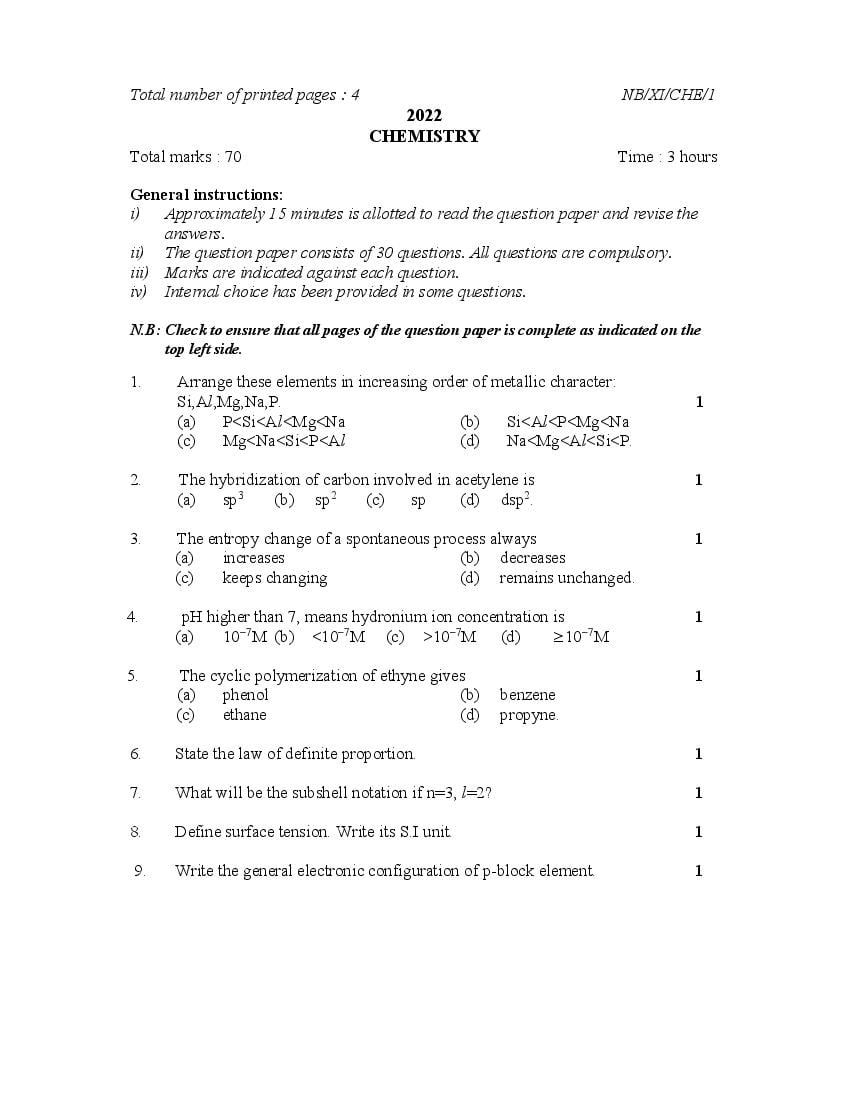
2022
CHEMISTRY
Total marks : 70 Time : 3 hours
General instructions:
i) Approximately 15 minutes is allotted to read the question paper and revise the
answers.
ii) The question paper consists of 30 questions. All questions are compulsory.
iii) Marks are indicated against each question.
iv) Internal choice has been provided in some questions.
N.B: Check to ensure that all pages of the question paper is complete as indicated on the
top left side.
1. Arrange these elements in increasing order of metallic character:
Si,Al,Mg,Na,P. 1
(a) P<Si<Al<Mg<Na (b) Si<Al<P<Mg<Na
(c) Mg<Na<Si<P<Al (d) Na<Mg<Al<Si<P.
2. The hybridization of carbon involved in acetylene is 1
(a) sp3 (b) sp2 (c) sp (d) dsp2.
3. The entropy change of a spontaneous process always 1
(a) increases (b) decreases
(c) keeps changing (d) remains unchanged.
4. pH higher than 7, means hydronium ion concentration is 1
(a) 10−7M (b) <10−7M (c) >10−7M (d) 10−7M
5. The cyclic polymerization of ethyne gives 1
(a) phenol (b) benzene
(c) ethane (d) propyne.
6. State the law of definite proportion. 1
7. What will be the subshell notation if n=3, l=2? 1
8. Define surface tension. Write its S.I unit. 1
9. Write the general electronic configuration of p-block element. 1
Page 2
10. Write the IUPAC name of 1
CH3
|
CH3−C−OH
|
CH3
11. a. A compound contains 4.07% hydrogen, 24.27% carbon and 71.65%
chlorine. Its molar mass is 98.96g. What is its empirical formula?
Or 2
b. How many moles of methane are required to produce 22g of CO2(g)
after combustion?
12. State Heisenberg’s uncertainty principle. Write its mathematical
expression. 2
13. Write the conjugate acid and conjugate base of the following:
Cl−, H3O+ 2
14. a. List two diagonal similarities of Li and Mg.
Or 2
b. Why does the solubility of alkaline earth metal hydroxide in water
increase down the group?
15. a. What are zeolites? Write one use.
Or 2
b. Why is graphite a conductor of electricity? Write one use of graphite.
16. What is Wurtz reaction? Give chemical reaction. 2
17. The mass of an electron is 9.1x10⁻³¹kg. If its kinetic energy is 3.0x10⁻²⁵J.
Calculate its wavelength. (h=6.626x10⁻³⁴JS). 3
18. What is ionization enthalpy? Why has nitrogen higher ionization
enthalpy than oxygen? 3
19. On a ship sailing in pacific ocean where temperature is 23.4⸰C, a balloon
is filled with 2L air. What will be the volume of the balloon when ship
reaches India, where temperature is 26.1⸰C? 3
20. Derive the relationship between K p and Kc for an equilibrium reaction. 3
Page 3
21. a. What is combination reaction and decomposition reaction? Give
one example each.
Or 3
b. What is redox reaction? Justify the reaction:
2Na(s) + H2(g) → 2NaH(s) is a redox reaction.
22. a. What is heavy water? What are hydrides? Write the different types
of hydrides.
Or 3
b. How is dihydrogen prepared in the laboratory? Write the chemical
reaction and its uses.
23. Write the preparation of sodium bicarbonate. Give chemical reaction.
Mention one use. 3
24. Explain the following: 3
i) Boric acid is considered as a weak acid.
ii) Carbon monoxide is poisonous.
25. a. What are inductive effects? Give the examples.
Or 3
b. Explain hyperconjugation effect with an example.
26. Define electrophile and nucleophile. Give the example. 3
27. a. What is smog? How is classical smog different from photochemical
smog?
Or 3
b. What is green chemistry? List two achievements of green chemistry.
28. a. i) Write any four postulates of VSEPR theory.
ii) Explain the structure of CH4 and H2O on the basis of VSEPR theory.
Or 5
b. What is bond order? Draw the energy level diagram of C2 molecule.
Write its electronic configuration and calculate its bond order.
Page 4
29. a. i) Derive the relation between Cp and Cv.
ii) The combustion of one mole of benzene takes place at 298K
and 1 atm. After combustion, CO2(g) and H2O(l) are produced
and 3267 KJ of heat is liberated. Calculate the standard enthalpy
of formation, ΔfH of benzene. Standard enthalpies of formation
of CO2(g) and H2O(l) are −393.5 KJ mol−1 and −285.83KJ mol−1
respectively.
Or 5
b. i) Define Gibb’s free energy. Predict the spontaneity of a process when
ΔG = 0, and ΔG = negative.
ii) The enthalpy change (ΔH)for the reaction -
N2(g) + 3H2(g) → 2NH3(g) is −92.38KJ at 298K. What
is ΔU at 298K?
30. a. i) Explain Friedel Crafts acylation reaction with an example.
ii) How is benzene hexachloride prepared? Give the chemical
reaction.
Or 5
b. i) Explain acidic character of alkyne.
ii) Complete the following reaction:
(a) CH2=CH2 + H2O dil .KMnO
/ 273
4
K
(b) + Cl2 Anhy
.AlCl
3
(c) + 3H2
Ni
**********************