NBSE Class 11 Question Paper 2022 Education – Text
Read the full text of this question paper below — useful to quickly search, copy and reference the content online without downloading the PDF.
📄 View text version (2 pages)
Page 1
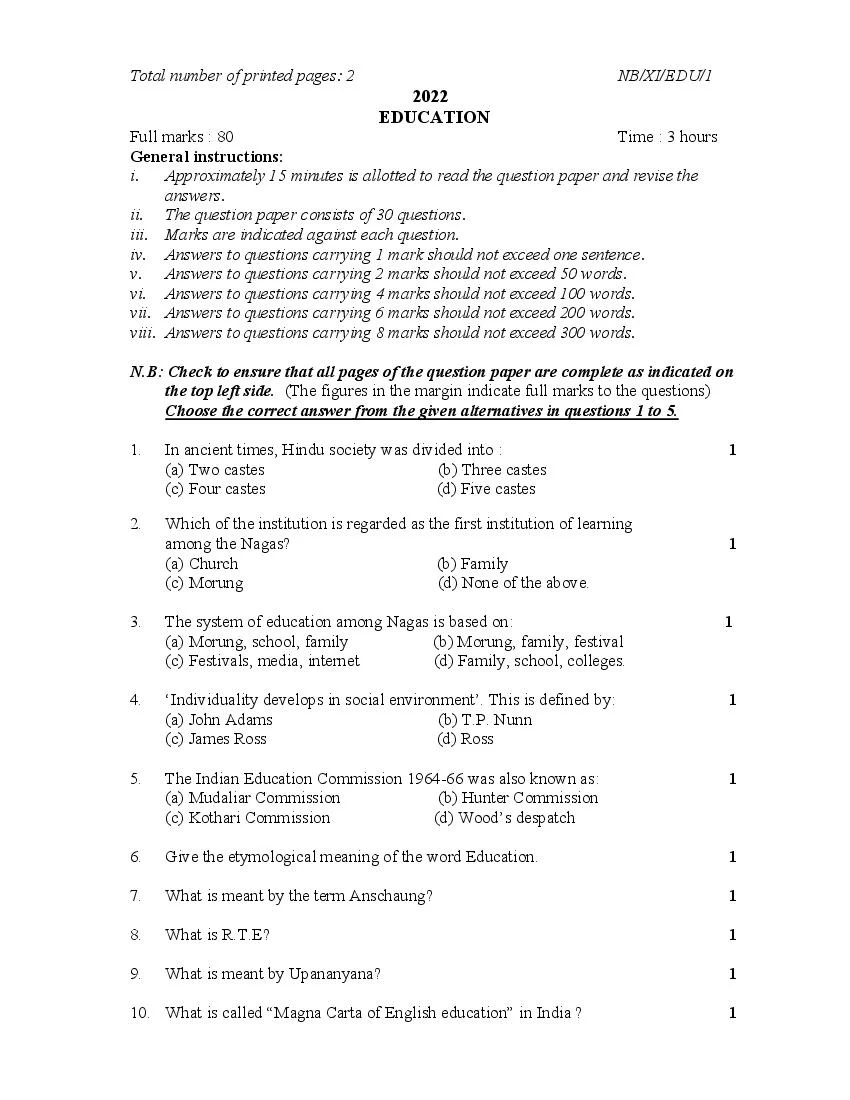
Total number of printed pages: 2 NB/XI/EDU/1 2022 EDUCATION Full marks : 80 Time : 3 hours General instructions: i. Approximately 15 minutes is allotted to read the question paper and revise the answers. ii. The question paper consists of 30 questions. iii. Marks are indicated against each question. iv. Answers to questions carrying 1 mark should not exceed one sentence. v. Answers to questions carrying 2 marks should not exceed 50 words. vi. Answers to questions carrying 4 marks should not exceed 100 words. vii. Answers to questions carrying 6 marks should not exceed 200 words. viii. Answers to questions carrying 8 marks should not exceed 300 words. N.B: Check to ensure that all pages of the question paper are complete as indicated on the top left side. (The figures in the margin indicate full marks to the questions) Choose the correct answer from the given alternatives in questions 1 to 5. 1. In ancient times, Hindu society was divided into : 1 (a) Two castes (b) Three castes (c) Four castes (d) Five castes 2. Which of the institution is regarded as the first institution of learning among the Nagas? 1 (a) Church (b) Family (c) Morung (d) None of the above. 3. The system of education among Nagas is based on: 1 (a) Morung, school, family (b) Morung, family, festival (c) Festivals, media, internet (d) Family, school, colleges. 4. ‘Individuality develops in social environment’. This is defined by: 1 (a) John Adams (b) T.P. Nunn (c) James Ross (d) Ross 5. The Indian Education Commission 1964-66 was also known as: 1 (a) Mudaliar Commission (b) Hunter Commission (c) Kothari Commission (d) Wood’s despatch 6. Give the etymological meaning of the word Education. 1 7. What is meant by the term Anschaung? 1 8. What is R.T.E? 1 9. What is meant by Upananyana? 1 10. What is called “Magna Carta of English education” in India ? 1
Page 2
-2- NB/XI/EDU/1 11. What is citizenship aim of education? 2 12. What is basic education? Why is it considered basic? 1+1=2 13. What were the factors taken into consideration while formulating educational provisions? 2 14. What is meant by the term secular education? 2 15. Name two activities performed by men in the Morung. 2 16. Briefly describe any two functions of education in relation to culture. 2 17. Differentiate between narrow and wider meaning of education. 4 18. Explain in brief any four educational practices of Pestalozzi. 4 19. Discuss the contents in Article 45 and Article 351 of the Indian constitution. 4 20. Explain the Gurukula system of education in ancient times. 4 Answer any three from Q.21 to Q.25. 3x6=18 21. Explain any six concepts of education. 22. Compare and contrast individual and social aim of education. 23. State any three advantages of radio and television as a means of education. 24. Explain any six components of discipline. 25. Prepare a frequency polygon with and without histogram of the following. (3+3=6) Marks 10-20 20-30 30-40 40-50 No. of Students 6 15 25 14 Answer any three from Q.26 to Q.30. 3x8=24 26. Explain the four synonyms of education. (2×4= 8) 27. When was NCERT established? Explain its roles and functions. (1+7=8) 28. Discuss the aims of education according to Mahatma Gandhi. 29. Who was the chairman of Education Commission 1882? What were the changes the commission suggested to improve education in India? (1+7=8) 30. Explain Continuous and Comprehensive evaluation (CCE) in detail. *********************************