NBSE Class 11 Question Paper 2022 Environmental Education – Text
Read the full text of this question paper below — useful to quickly search, copy and reference the content online without downloading the PDF.
📄 View text version (2 pages)
Page 1
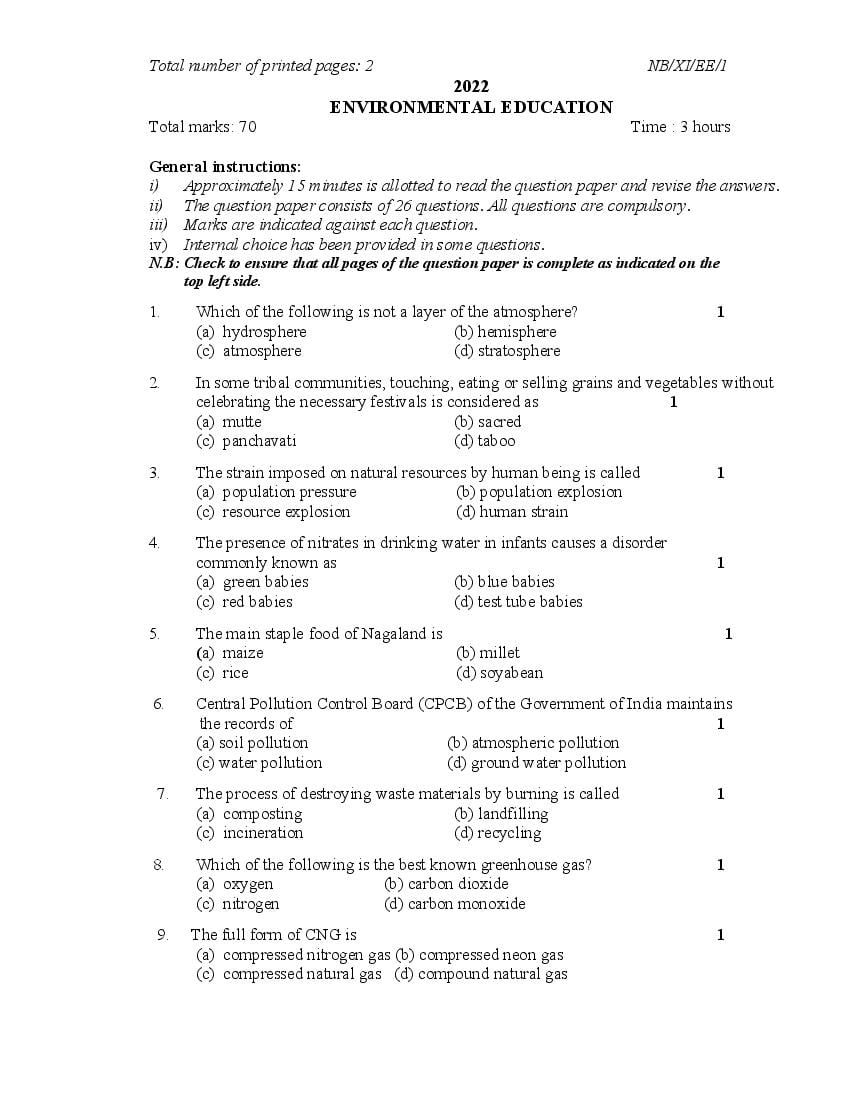
Total number of printed pages: 2 NB/XI/EE/1 2022 ENVIRONMENTAL EDUCATION Total marks: 70 Time : 3 hours General instructions: i) Approximately 15 minutes is allotted to read the question paper and revise the answers. ii) The question paper consists of 26 questions. All questions are compulsory. iii) Marks are indicated against each question. iv) Internal choice has been provided in some questions. N.B: Check to ensure that all pages of the question paper is complete as indicated on the top left side. 1. Which of the following is not a layer of the atmosphere? 1 (a) hydrosphere (b) hemisphere (c) atmosphere (d) stratosphere 2. In some tribal communities, touching, eating or selling grains and vegetables without celebrating the necessary festivals is considered as 1 (a) mutte (b) sacred (c) panchavati (d) taboo 3. The strain imposed on natural resources by human being is called 1 (a) population pressure (b) population explosion (c) resource explosion (d) human strain 4. The presence of nitrates in drinking water in infants causes a disorder commonly known as 1 (a) green babies (b) blue babies (c) red babies (d) test tube babies 5. The main staple food of Nagaland is 1 (a) maize (b) millet (c) rice (d) soyabean 6. Central Pollution Control Board (CPCB) of the Government of India maintains the records of 1 (a) soil pollution (b) atmospheric pollution (c) water pollution (d) ground water pollution 7. The process of destroying waste materials by burning is called 1 (a) composting (b) landfilling (c) incineration (d) recycling 8. Which of the following is the best known greenhouse gas? 1 (a) oxygen (b) carbon dioxide (c) nitrogen (d) carbon monoxide 9. The full form of CNG is 1 (a) compressed nitrogen gas (b) compressed neon gas (c) compressed natural gas (d) compound natural gas
Page 2
-2- NB/XI/EE/1 10. The largest consumer of electricity in India is 1 (a) agricultural sector (b) transport sector (c) industry sector (d) tourism sector 11. What is overcultivation? 2 12. What is land reclamation? 2 13. What is meant by sustainable development? 2 14. Mention any two causes of marine pollution. 2 15. Write any two consequences of noise pollution. 2 16. Write any two reasons why consumption of energy in our homes is going up? 2 17. Mention any two advantages of non-conventional sources of energy. 2 18. Differentiate between consumers and decomposers. 2+2= 4 19. Distinguish between private sector and public sectors with examples. 2+2= 4 20. Write four effects of global warming on human society. 4 21. List four consequences of high lead levels in children. 4 22. Write four strategies to reduce air pollution. 4 23. a. Mention any six factors contributing to land degradation in Nagaland. 6 Or b. What is rainwater harvesting? Name any four traditional methods of rainwater harvesting in India. 2+4=6 24. a. Write any six factors for development of a country. 6 Or b. State three reasons why unemployment and inflation are major economic problems in Nagaland? Write the three impacts of child marriage on the development of a society. 3+3=6 25. a. What is geothermal energy? Mention two advantages and limitations each of geothermal energy. 2+4=6 Or b. Write three advantages and three limitations of solar energy. 3+3=6 26. a. What are earthquakes? Write three impacts of earthquakes on environment and three preventive measures of earthquakes. 2+3+3=8 Or b. Mention four impacts of floods on the environment. Give any four preventive measures of floods. 4+4=8 ************************