ICSE Class 10 Syllabus 2022 Environmental Science
Finished viewing? Save it for later —
Download ICSE Class 10 Syllabus 2022 Environmental Science (PDF · 9 pages)About ICSE Class 10 Syllabus 2022 Environmental Science
ICSE Class 10 Syllabus 2022 Environmental Science is available here for free download. Published by CISCE for Class 10, this syllabus can be viewed online or downloaded as a PDF (9 pages). Candidates preparing for Class 10 can use ICSE Class 10 Syllabus 2022 Environmental Science to understand the exam pattern, the type of questions asked, and the overall difficulty level.
Frequently Asked Questions
How can I download ICSE Class 10 Syllabus 2022 Environmental Science?
Open this page and click the Download button to save ICSE Class 10 Syllabus 2022 Environmental Science as a PDF. It is completely free on AglaSem Docs.
Is ICSE Class 10 Syllabus 2022 Environmental Science free to download?
Yes. ICSE Class 10 Syllabus 2022 Environmental Science can be viewed online and downloaded as a PDF free of cost on AglaSem Docs.
How many pages does ICSE Class 10 Syllabus 2022 Environmental Science have?
ICSE Class 10 Syllabus 2022 Environmental Science contains 9 pages, which you can read online or download together as a single PDF.
Where can I find more Class 10 study material?
You can find more Class 10 question papers, sample papers, syllabus, and answer keys on AglaSem Docs.
ICSE Class 10 Syllabus 2022 Environmental Science – Text
Read the full text of this syllabus below — useful to quickly search, copy and reference the content online without downloading the PDF.
📄 View text version (9 pages)
Page 1
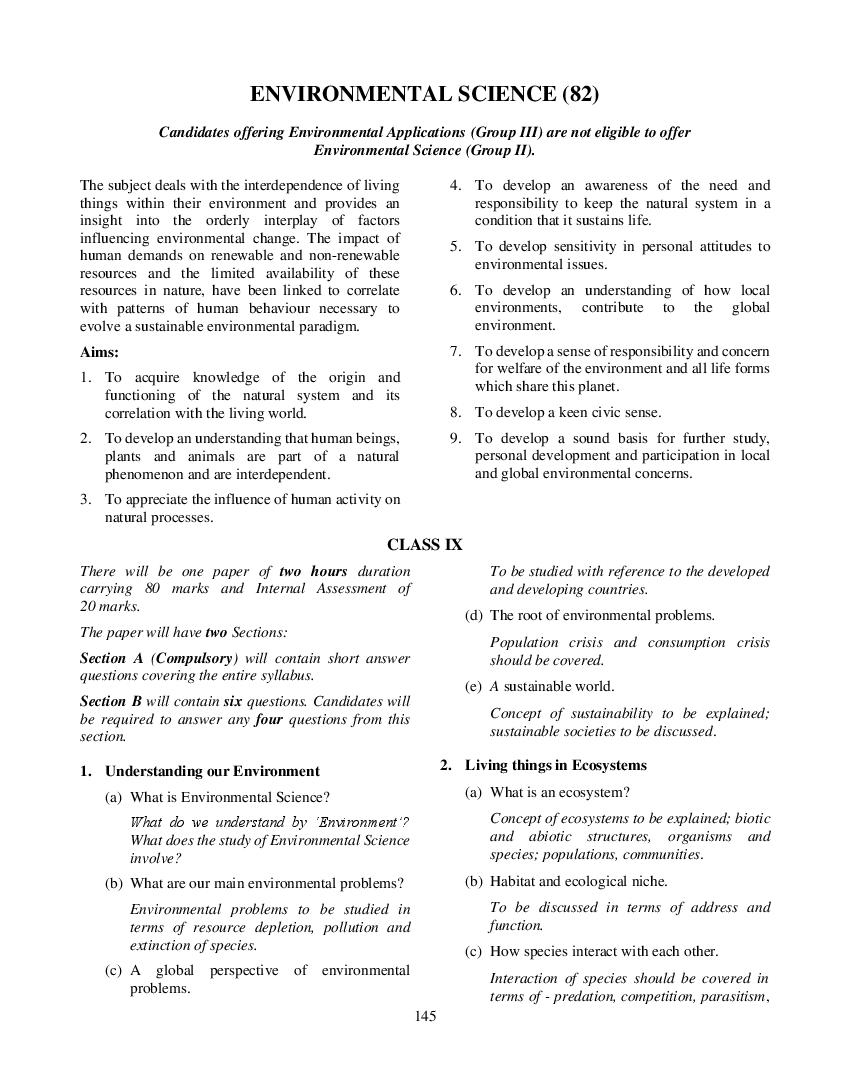
Candidates offering Environmental Applications (Group III) are not eligible to offer
Environmental Science (Group II).
The subject deals with the interdependence of living 4. To develop an awareness of the need and
things within their environment and provides an responsibility to keep the natural system in a
insight into the orderly interplay of factors condition that it sustains life.
influencing environmental change. The impact of
5. To develop sensitivity in personal attitudes to
human demands on renewable and non-renewable
environmental issues.
resources and the limited availability of these
resources in nature, have been linked to correlate 6. To develop an understanding of how local
with patterns of human behaviour necessary to environments, contribute to the global
evolve a sustainable environmental paradigm. environment.
Aims: 7. To develop a sense of responsibility and concern
for welfare of the environment and all life forms
1. To acquire knowledge of the origin and
which share this planet.
functioning of the natural system and its
correlation with the living world. 8. To develop a keen civic sense.
2. To develop an understanding that human beings, 9. To develop a sound basis for further study,
plants and animals are part of a natural personal development and participation in local
phenomenon and are interdependent. and global environmental concerns.
3. To appreciate the influence of human activity on
natural processes.
CLASS IX
There will be one paper of two hours duration To be studied with reference to the developed
carrying 80 marks and Internal Assessment of and developing countries.
20 marks.
(d) The root of environmental problems.
The paper will have two Sections:
Population crisis and consumption crisis
Section A (Compulsory) will contain short answer should be covered.
questions covering the entire syllabus.
(e) A sustainable world.
Section B will contain six questions. Candidates will
be required to answer any four questions from this Concept of sustainability to be explained;
section. sustainable societies to be discussed.
1. Understanding our Environment 2. Living things in Ecosystems
(a) What is Environmental Science? (a) What is an ecosystem?
What do we understand by ‘Environment’? Concept of ecosystems to be explained; biotic
What does the study of Environmental Science and abiotic structures, organisms and
involve? species; populations, communities.
(b) What are our main environmental problems? (b) Habitat and ecological niche.
Environmental problems to be studied in To be discussed in terms of address and
terms of resource depletion, pollution and function.
extinction of species. (c) How species interact with each other.
(c) A global perspective of environmental Interaction of species should be covered in
problems.
terms of - predation, competition, parasitism,
145
Page 2
Limiting Factors; synergisms. ecosystems will be tested for the purpose of
the examination. The rest are for knowledge
(d) Adapting to the environment.
and understanding.
Evolution by natural selection; co-evolution,
(e) Biogeographic zones of India.
extinction.
The different biogeographic zones/ regions of
3. How Ecosystems work India and predominant wildlife in these zones/
regions.
(a) Energy flow in ecosystems.
An explanation of how life depends on the sun; 5. Water
who eats what; respiration: burning the fuel.
(a) Our water resources.
Energy transfer: food chains, food webs and
trophic levels. Water resource in the form of frozen solid in
polar ice caps, surface water (rivers of
(b) The cycling of materials.
controversy, dams), groundwater (aquifers
The water cycle, the carbon cycle (how running low). Solutions to water shortages
humans are affecting the carbon cycle) and must be covered in terms of desalting the sea,
the nitrogen cycle; Not to be tested, for towing water, water conservation and water
knowledge and understanding only. harvesting.
Interdependence of natural cycles. (b) Freshwater pollution.
(c) How ecosystems change. Point pollution and non-point pollution;
wastewater treatment plants, pathogens. The
Succession- secondary and primary.
manner in which water pollution affects
4. Kinds of Ecosystems ecosystems; artificial eutrophication, thermal
pollution. Cleaning up water pollution. The
(a) Forests. special problem of groundwater pollution;
Tropical rainforests and threats to bottled water.
rainforests; temperate rainforests; temperate (c) Ocean pollution.
deciduous forests; Taiga.
How pollutants get into oceans; preventing
(b) Grasslands, Deserts and Tundra. ocean pollution; who owns the oceans?
Tropical savannas; temperate grasslands:
prairies, steppes and pampas; deserts; 6. Air
Tundra. Threats to the temperate grasslands, (a) What causes air pollution?
deserts and Tundra.
Air pollution due to - natural disasters;
(c) Freshwater ecosystems. domestic combustion; air pollution on
The study to cover - lakes and ponds; wetlands wheels; industrial air pollution.
- marshes and swamps; rivers. Threats to Major air pollutants - carbon monoxide,
wetlands and rivers must also be highlighted. oxides of nitrogen, oxides of sulphur, ozone,
(d) Marine ecosystems. lead, hydrocarbons, benzene and particulates
-their sources, health effects and the
Estuaries, coral reefs, oceans and how each is environmental effects must be studied.
threatened should be discussed. Polar
Classification of air pollutants based on
ecosystems of the Arctic and the Antarctic and
the threats to them must also be covered. composition - gaseous pollutants and
particulate matter (grit, dust, smoke and lead
oxide); broader classification - primary and
secondary pollutants.
146
Page 3
(continental, oceanic and anthropogenic); atmosphere and soil process.
their effect on our lives. (b) Soil erosion and desertification.
Air pollution episode - the Bhopal gas Causes and consequences of soil erosion and
tragedy. desertification - removal of vegetation,
(b) Thermal inversions, photochemical smog and overgrazing, overculture, clearance of slopes,
acid precipitation. drought, heavy rainfall, bad farming
Thermal inversions (Los Angeles), practices.
Photochemical Smog (Mexico City) and Acid (c) Land pollution.
Precipitation (Mumbai) - how acid Causes and consequences of land pollution -
precipitation affects ecosystems. salinization, fertilizers, pesticides, toxic
(c) Impact of air pollution. wastes, nuclear wastes, domestic wastes,
Impact of air pollution should be covered in ground water contamination.
terms of economic losses, lowered
agricultural productivity and health 9. People
problems. (a) World poverty and gap between developed
and developing countries.
7. Atmosphere and Climate Dimensions of world poverty and gap between
(a) The atmosphere. developed and developing countries using
Balance between photosynthesis and development indicators such as per-capita
respiration; layers of the atmosphere. Not to incomes, housing, levels of disease and
be tested, for knowledge and understanding nutrition.
only. (b) Poverty in developed countries, poverty in
(b) Climate. developing countries.
What determines climate (latitude, Rural poverty and urban poverty.
atmospheric circulation patterns, ocean (c) The implications of poverty trap for the
circulation patterns, local geography, environment in developing countries.
seasonal changes in climate). Not to be tested, Self-explanatory.
for knowledge and understanding only.
(c) Greenhouse earth. 10. Urbanisation
The Greenhouse Effect, rising carbon dioxide (a) Causes of urbanisation.
levels, GHGs and the earth’s temperature The push-pull factors to be discussed.
(global warming); effect on weather,
agriculture and sea-levels; slowing the (b) Manifestations of urbanisation.
temperature change. Growth of slums, growth of informal sector,
(d) The Ozone layer. pressure on civic amenities; degradation of
human resources; growing sense of despair.
Ozone in the troposphere, ozone in the
stratosphere; detection of the damage to the (c) Social, economic and environmental
ozone layer; causes and consequences of problems.
ozone thinning; alternatives to CFCs. Problems of housing, congestion, pollution,
loss of agricultural land and provision of
8. Soil and Land services to be covered.
(a) Deforestation.
11. Agriculture
Causes and consequences of rapid and
progressive deforestation in the developing (a) Unsustainable patterns of modern
world - fuel crisis, competition for land, land industrialised agriculture.
exploited for cash and food crops, population Monocultures, disappearance of traditional
pressures, increasing demand for timber to crop varieties, pollution risk due to use of
meet the needs of the developed world,
pesticides and inorganic fertilizers; problems
grazing and its link with desertification.
of irrigation – surface and ground water.
147
Page 4
units.
Self-explanatory. Any one project/assignment from the prescribed
syllabus.
(c) Food mountains in developed countries.
Surplus and waste. Suggested Assignments
(d) The Green Revolution. 1. Make a survey of any one threat to the local
Discussion on whether Green Revolution is a environment with suggestions as to how the
success or a failure. impact of the threat could be gradually reduced.
2. Make a functional model of an
apparatus/equipment that could be used to
alleviate the impact of any pollutant and, make a
survey to study the effectiveness of this
apparatus/equipment. (The report of the study is to
form a part of the Project Work.)
148
Page 5
There will be one paper of two hours duration (c) Strategies for controlling growth of
carrying 80 marks and Internal Assessment of 20 population.
marks.
Strategies to include family planning and
The paper will have two Sections: birth control, health care, education,
economic development; women-centered
Section A (Compulsory) will contain short answer
human development.
questions covering the entire syllabus.
(d) Development framework for poverty
Section B will contain six questions. Candidates will
alleviation.
be required to answer any four questions from this
section. Social mobilisation, agricultural
development, small-scale industries, human
1. Controlling Air Pollution development. Not to be tested, for knowledge
(a) From domestic combustion. and understanding only.
Reducing pollution from domestic cooking; 3. Managing the Urban Environment
clean cooking - kerosene as a desirable
(a) Urbanisation - a challenge to the future.
cooking fuel in rural areas.
Sustainable cities: the need of the hour.
(b) From industries.
(b) Planning environmental improvement.
Measures for controlling industrial air
pollution - technological measures (energy Efficient land use, planning energy, shelter
efficient devices, clean technologies), and transport; water supply management,
meteorological controls; zoning strategy; wastewater and sanitary waste management,
penalties and subsidies; construction activities.
Case Study: the Taj Trapezium. (c) Rural development to counter migration.
(c) From vehicles. Self-explanatory.
Vehicle emission control - modify engine (d) Development of secondary cities to counter
design (catalytic converters, four stroke migration.
engines), clean fuels, public transport options,
Self-explanatory.
traffic management, economic policy
measures. (e) Community participation and contribution of
private enterprises.
2. Addressing Population
Community participation in keeping
(a) The link between growing population and surroundings clean, participation of private
environmental degradation. enterprises in city improvement, measures to
UN’s population projections for 2050, the increase private enterprise participation.
climate link, the choice of alternative futures.
Growing population in the developing 4. Managing Soil and Land
countries and rising consumption in the (a) Conserving soil.
developed countries.
(b) The demographic transition. Erosion control techniques - terracing,
contour ploughing, dry farming, tree planting,
Stages of transition, transition stages of bunds, gullies, wind-breaks, use of organic
certain developed nations and developing fertilisers.
nations (such as India, China, Korea,
Malaysia). Not to be tested, for knowledge Soil conservation techniques - land-use
and understanding only. management, vegetative and mechanical
practices, conserving soil and water together;
149
Page 6
patterns (strip cropping), tree crops, and irrigation system; operation of a drip
foliage crops. irrigation system; advantages and
disadvantages.
(b) Land reforms.
New organic fertilizers – integrated nutrient
Meaning, measures enforced in India to give supply programme, organic fertilizers - bulky
land to the landless. organic manures, green manures, bio-
(c) Integrated rural development. fertilizers, and sewage sludge.
Objectives, self-help schemes like social and Gene banks – what are gene banks; objectives
community forestry. of maintaining gene banks.
(d) Role of women and community in (b) Problem of global food security, food aid.
conservation.
Global food imbalance, distributional
Self-explanatory. inequality; role of food aid in achieving global
food security.
(e) Combating deforestation.
Reforestation, energy plantations, forest 6. Biodiversity
harvesting of non-timber forest products,
(a) Biodiversity at risk due to human actions.
exploring alternative sources of livelihood,
change in consumption patterns. Reasons for loss of biodiversity; Man - the
super consumer: impact of his actions on the
(f) Managing forest grazing. earth’s resources; reasons for concern:
Causes and consequences of overgrazing, economic, ecological and aesthetic.
controlled forest grazing as in National
(b) Conserving our genetic resource: in-situ and
Forest Policy, 1988.
ex-situ; harvesting wildlife.
(g) Alternatives to timber. In-situ - wildlife sanctuaries, national parks
Recycling of timber and paper. and biosphere reserves.
Ex-situ – zoological parks, botanical gardens,
5. Food
gene banks in agricultural research centres
(a) Sustainable agriculture. and forestry institutions.
Integrated pest management – understanding Harvesting wildlife to meet commercial needs.
the term, aims, advantages, disadvantages.
(c) Conservation strategies at national and
Genetically modified organisms, application international levels.
in plants and animals and environmental
Wildlife (Protection) Act 1972, Project Tiger
risks.
1973, IUCN, the Ramsar Convention on
New crop strains – high yielding varieties and Wetlands, 1971, CITES, The Convention on
their viability, hybrid varieties. Biological Diversity.
Mixed cropping – advantages and
7. Energy
disadvantages; regenerative farming
techniques - intercropping, crop rotation, (a) Fossil fuels used to produce electricity.
agroforestry, polyvarietal cultivation and Electricity: energy on demand; dwindling
polyculture.
supplies of fossil fuels; renewable and non-
Conservation tillage farming - meaning of renewable energy resources. Not to be tested,
conservation tillage, advantages and for knowledge and understanding only.
disadvantages.
150
Page 7
Nuclear fission, advantages and (a) Global interdependence – economic and
disadvantages of nuclear energy; safety environmental.
concerns (the Chernobyl disaster); Concept of economic and environmental
nuclear fusion. global interdependence; global
(c) A sustainable energy future. environmental health – the shared
responsibility of nations; trade and aid as
Energy conservation; alternative energy ways of reducing world inequalities.
sources - solar energy, wind energy,
hydroelectricity, geothermal energy, biomass, (b) International cooperation.
liquid fuels from biomass- methanol, ethanol, The Montreal Protocol; the Global
gasohol, CNG, hydrogen. Environmental Facility (GEF) support; the
Earth Summit, UN’s International
8. Waste Conference on Population and Development
(a) Solid waste: the throwaway society. (Cairo); the Kyoto Treaty.
Solid waste, biodegradable and non- (c) Sustainable development.
biodegradable materials; where does the The concept of sustainable development,
trash go - landfills and incinerators. sustainable development and developed
(b) Solid waste: options for the future. countries; sustainable development and
developing countries.
Producing less waste, reusing, recycling,
(d) Role of non-governmental organisations.
composting, vermiculture, biotechnology;
finding alternatives to materials we use. Self-explanatory.
(e) Technology that sustains.
9. Environment and Development
Satellite imagery as a means of monitoring the
(a) Global environmental pollution. global environment: satellite remote sensing,
Who is responsible - developed or developing advantages in collecting environmental data,
countries? Need for mutual cooperation. applying data in areas of environmental
damage as deforestation, desertification, land
(b) Economic development and environmental degradation, wastelands, mining, ozone layer
degradation. depletion and predicting droughts and floods.
Role of developed and developing countries; The concept of alternate technology, adopting
contrasting views of developed and alternate technology to create self-sustaining
developing countries; debt trap. societies in the developed and developing
(c) International trade. world.
Its link to environmental deterioration – Role of biotechnology in achieving global
unfair trade practices. food security.
(d) Role of multinational corporations.
Definition of MNCs, their contribution to
development and debatable contribution to
environment; case study - Bhopal gas
tragedy; measures to regulate activities of
MNCs in developing countries.
151
Page 8
A minimum of three assignments as prescribed by the The assignments/project work are to be evaluated by
teacher, need to be completed. the subject teacher and by an External Examiner.
Suggested Assignments (The External Examiner may be a teacher nominated
by the Head of the school, who could be from the
1. Make a field study of the effect of human faculty, but not teaching the subject in the
interaction on the natural environment and prepare section/class. For example, a teacher of
a project report (1500 words) on the likely impact Environmental Science of Class XI may be deputed to
of the interaction on the global environment. be an External Examiner for Class X, Environmental
2. Prepare an original study/essay (2000 words) on Science projects.)
an area of the prescribed curriculum that is The Internal Examiner and the External Examiner will
indicative of his/her appreciation/concern for assess the assignments independently.
environmental issues and make a functional model
Award of Marks (20 Marks)
to support the above.
Subject Teacher (Internal Examiner) 10 marks
External Examiner 10 marks
The total marks obtained out of 20 are to be sent to the
Council by the Head of the school.
The Head of the school will be responsible for the
online entry of marks on the Council’s CAREERS
portal by the due date.
152
Page 9
Criteria Preparation Investigation/ Analysis/Inference Solutions Presentation Marks
Gathering Data Alternatives/
Innovations
Grade I Follows instructions with Is able to ask right Analyses Innovative Accurate. Feasible, 4 marks
understanding, modifies if questions. Knows whom systematically. Can ideas neat, well labelled
needed. Background to ask, when and how. see sequences or presented. diagrams. Index and
information correct. Level Can deal with more than correlation. Can Alternatives references given.
of awareness high. one variable. segregate fact from suggested.
opinion.
Grade II Follows instructions step- Is able to ask questions Makes observations Alternatives Accurate. Neat, well 3 marks
by-step. Awareness is and identify whom to ask correctly. Analysis presented. labelled diagrams,
good. Background when and how. Can fair. Innovative but index and references
information correct. handle two variables not practical. given.
only.
Grade III Follows simple instructions Needs help with the Observation - help Obvious A bit disorganised, 2 marks
only. Awareness basic. investigations. Has needed. Needs solutions but neat and
Background information suggestions but cannot guidance to see presented. Not accurate. Either
sketchy. decide. correlations or innovative. index or references
sequence. missing.
Grade IV Follows some instructions Needs to be told what Detailed instructions Thinks of Poorly organised. 1 mark
but confused. Has to be questions to be asked, required to draw solutions under Some things
made aware. Background whom to ask or where to inferences. Charts guidance. missing. Index and
information incorrect in gather the data from. have to be made. references missing.
places.
Grade V Confused about Gets stuck at every step. Even with help, Solutions not Overall impression 0 mark
instructions. Has to be Questionnaire has to be analysis is not clear. forthcoming. very poor. Not very
made aware. Needs help formulated. Takes teacher’s word accurate.
with background for it.
information.
153
Document Details
| Board / Org | CISCE |
| Exam | Class 10 |
| Type | Syllabus |
| Pages | 9 |
| Language | english |
| Updated | 22 Jul 2026 |