ICSE Class 10 Syllabus 2028 Hospitality Management
Finished viewing? Save it for later —
Download ICSE Class 10 Syllabus 2028 Hospitality Management (PDF · 5 pages)About ICSE Class 10 Syllabus 2028 Hospitality Management
ICSE Class 10 Syllabus 2028 Hospitality Management is available here for free download. Published by CISCE for Class 10, this syllabus can be viewed online or downloaded as a PDF (5 pages). Candidates preparing for Class 10 can use ICSE Class 10 Syllabus 2028 Hospitality Management to understand the exam pattern, the type of questions asked, and the overall difficulty level.
Frequently Asked Questions
How can I download ICSE Class 10 Syllabus 2028 Hospitality Management?
Open this page and click the Download button to save ICSE Class 10 Syllabus 2028 Hospitality Management as a PDF. It is completely free on AglaSem Docs.
Is ICSE Class 10 Syllabus 2028 Hospitality Management free to download?
Yes. ICSE Class 10 Syllabus 2028 Hospitality Management can be viewed online and downloaded as a PDF free of cost on AglaSem Docs.
How many pages does ICSE Class 10 Syllabus 2028 Hospitality Management have?
ICSE Class 10 Syllabus 2028 Hospitality Management contains 5 pages, which you can read online or download together as a single PDF.
Where can I find more Class 10 study material?
You can find more Class 10 question papers, sample papers, syllabus, and answer keys on AglaSem Docs.
ICSE Class 10 Syllabus 2028 Hospitality Management – Text
Read the full text of this syllabus below — useful to quickly search, copy and reference the content online without downloading the PDF.
📄 View text version (5 pages)
Page 1
INDIAN CERTIFICATE OF
SECONDARY EDUCATION
EXAMINATION
YEAR 2028
HOSPITALITY MANAGEMENT
(73)
Page 2
Research, Development and Curriculum Division (RDCD)
CISCE
January 2026
____________________________________________________________________________________________
© Copyright, Council for the Indian School Certificate Examinations
All rights reserved. The copyright to this publication and any part thereof solely vests in the Council for the Indian
School Certificate Examinations. This publication and no part thereof may be reproduced, transmitted, distributed or
stored in any manner whatsoever, without the prior written approval of the Council for the Indian School Certificate
Examinations.
Page 3
MISSION STATEMENT
The Council for the Indian School Certificate
Examinations is committed to serving the nation's
children, through high quality educational
endeavours, empowering them to contribute towards
a humane, just and pluralistic society, promoting
introspective living, by creating exciting learning
opportunities, with a commitment to excellence.
ETHOS OF CISCE
Trust and fair play.
Minimum monitoring.
Allowing schools to evolve their own niche.
Catering to the needs of the children.
Giving freedom to experiment with new ideas
and practices.
Diversity and plurality - the basic strength for
evolution of ideas.
Schools to motivate pupils towards the
cultivation of:
Excellence - The Indian and Global
experience.
Values - Spiritual and cultural - to be the bedrock
of the educational experience.
Schools to have an 'Indian Ethos', strong roots in
the national psyche and be sensitive to national
aspirations.
Page 4
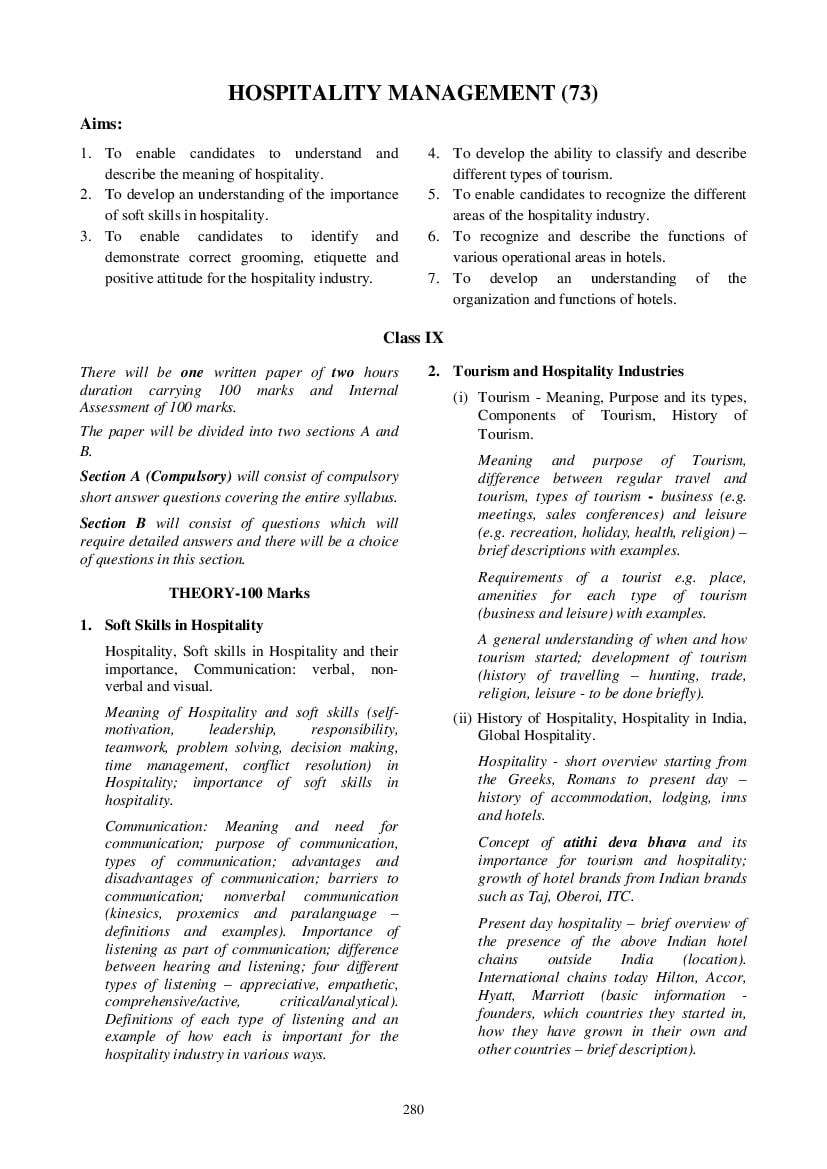
There will be one written paper of two hours duration carrying 100 marks and Internal Assessment of 100 marks.
THEORY- 100 Marks
1. Soft Skills
Hospitality English, Grooming basics, Etiquette.
Basic terms – meeting and greeting guests, common phrases used in operational areas, polite speech.
Introduction to personal grooming, positive body language, attitude and confidence building – brief details
of requirements of hospitality personnel.
Importance of Etiquette for hospitality; guidelines for everyday living, important manners for every day;
importance of personal image – being friendly, courteous, knowledgeable, giving professional service.
2. Tourism Products
Components of Tourism, Types of tourism.
Tourism Products and Services – Definition and features.
Components of Tourism – the four ‘A’s – attraction, accessibility, accommodation, amenities - meaning of
each term with one example related to a specific place of tourism.
Types of tourism - An understanding of Leisure, medical, education, religion, sports, business, and eco-
tourism with examples.
3. Hotels
Accommodation, Departmental areas in hotels.
Unclassified (no star category) hotels, budget hotels, ecotels, heritage hotels, boutique hotels, star category
hotels - general information with examples.
Departmental areas in hotels – Definition of each department; Operational levels FP, F&B, FO, AO, HR,
Sales and marketing – brief overview of function of each department.
4. Operational Departments of Hotels
Food Production, Food and Beverage service, Front Office, Accommodation Operations.
Food hygiene (brief explanations of Food Safety and Standards Authority of India (FSSAI), Hazard Analysis
and Critical Control Points (HACCP)) and food groups, label reading, basic meal planning, identification of
ten common kitchen equipment and brief discussion about the uses of each.
Food and Beverage service - Attributes and behaviour of F&B personnel, familiarization and uses of basic
cutlery, crockery and glassware, common types of napkin folding (any five each for formal and informal
occasions) and their uses to be discussed in brief, both for theory and practical. Discussion about formal and
informal occasions with colour and material.
Front Office – Any five types of hotel rooms (for example, single occupancy, double occupancy, suites in
different categories of hotels): currencies and capitals (China, Canada, Bangladesh, India, Bhutan, Japan,
Nepal, Pakistan, Sri Lanka, USA, UK, France, Germany, Italy, Russia, Australia, Singapore, Brazil,
Malaysia, Thailand).
Accommodation Operations - Care of clothing and brief descriptions of laundry services, safety and security
(comparison between home and hotels with regards to fire, electricity and precautions to be taken based on
SOPs and precautionary measures only).
ICSE Examination Year 2028
4
Page 5
A minimum of four assignments to be completed during the year, as assigned by the teacher.
Suggested list of assignments:
1. Choose two famous tourist areas in the State or city – give brief details about the history, significance, type
of tourism and how they fulfill the 4 ‘A’s of tourism.
2. Select five famous street foods of your State – discuss why are they popular and what is special about them.
3. Find out about four 5-star hotels in your city – brand, logo, number of rooms, location, outlets, etc.
4. Demonstrate five different types of napkin folds with their purpose and suggest on which occasions they can
be used.
5. Plan and develop menus for three different occasions along with a suitable location and table set up.
6. Identify kitchen and Food and Beverage (F&B) equipment and explain their uses.
7. For three countries, discuss the three most famous tourist attractions (with explanations of why they are tourist
destinations), the capital, currency, airline code and logo.
8. Compare the safety and security at home with that in hotels.
9. Choose three tourist destinations and briefly describe how they maintain geographical, historical, cultural and
environmental sustainability.
10. Discuss the differences in maintaining hygiene standards between home and hotels.
11. Role play on grooming and self-presentation – to include the use of hospitality English phrases and appropriate
etiquette.
12. Compare and contrast four different types of hotels - discussing their similarities and differences.
EVALUATION
The project work is to be evaluated by the subject teacher and by an External Examiner. The External Examiner
shall be nominated by the Head of the school and may be a teacher from the faculty, but not teaching the subject
in the relevant section/class. For example, a teacher of Home Science of Class IX may be deputed to be the
External Examiner for Class X Hospitality Management project work.
The Internal Examiner and the External Examiner will assess the candidate’s work independently.
Award of Marks: (100 Marks)
Subject Teacher (Internal Examiner) : 50 marks
External Examiner : 50 marks
The total marks obtained out of 100 are to be sent to CISCE by the Head of the School.
The Head of the school will be responsible for the online entry of marks on CISCE’s CAREERS portal by the due
date.
ICSE Examination Year 2028
5
Document Details
| Board / Org | CISCE |
| Exam | Class 10 |
| Type | Syllabus |
| Pages | 5 |
| Language | english |
| Updated | 04 Aug 2026 |