ICSE Class 10 Syllabus 2022 Performing Arts
Finished viewing? Save it for later —
Download ICSE Class 10 Syllabus 2022 Performing Arts (PDF · 19 pages)About ICSE Class 10 Syllabus 2022 Performing Arts
ICSE Class 10 Syllabus 2022 Performing Arts is available here for free download. Published by CISCE for Class 10, this syllabus can be viewed online or downloaded as a PDF (19 pages). Candidates preparing for Class 10 can use ICSE Class 10 Syllabus 2022 Performing Arts to understand the exam pattern, the type of questions asked, and the overall difficulty level.
Frequently Asked Questions
How can I download ICSE Class 10 Syllabus 2022 Performing Arts?
Open this page and click the Download button to save ICSE Class 10 Syllabus 2022 Performing Arts as a PDF. It is completely free on AglaSem Docs.
Is ICSE Class 10 Syllabus 2022 Performing Arts free to download?
Yes. ICSE Class 10 Syllabus 2022 Performing Arts can be viewed online and downloaded as a PDF free of cost on AglaSem Docs.
How many pages does ICSE Class 10 Syllabus 2022 Performing Arts have?
ICSE Class 10 Syllabus 2022 Performing Arts contains 19 pages, which you can read online or download together as a single PDF.
Where can I find more Class 10 study material?
You can find more Class 10 question papers, sample papers, syllabus, and answer keys on AglaSem Docs.
ICSE Class 10 Syllabus 2022 Performing Arts – Text
Read the full text of this syllabus below — useful to quickly search, copy and reference the content online without downloading the PDF.
📄 View text version (19 pages)
Page 1
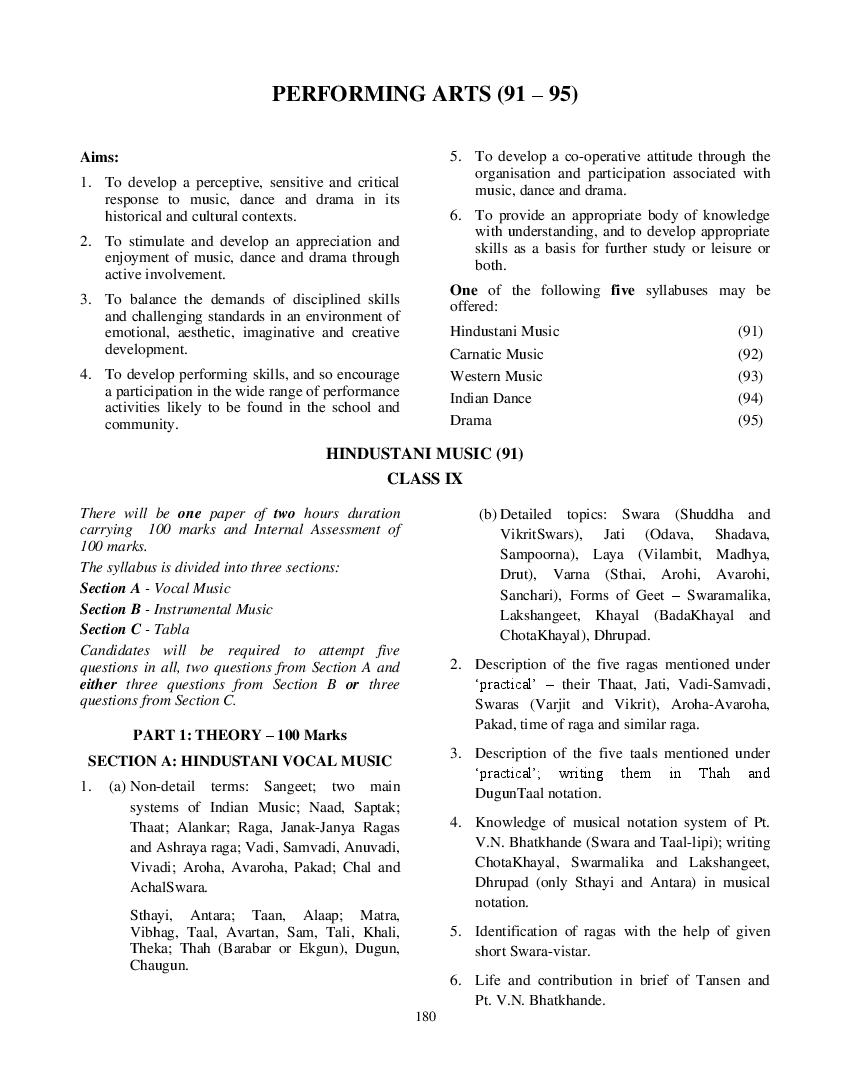
Aims: 5. To develop a co-operative attitude through the
organisation and participation associated with
1. To develop a perceptive, sensitive and critical music, dance and drama.
response to music, dance and drama in its
historical and cultural contexts. 6. To provide an appropriate body of knowledge
with understanding, and to develop appropriate
2. To stimulate and develop an appreciation and skills as a basis for further study or leisure or
enjoyment of music, dance and drama through both.
active involvement.
One of the following five syllabuses may be
3. To balance the demands of disciplined skills offered:
and challenging standards in an environment of
emotional, aesthetic, imaginative and creative Hindustani Music (91)
development. Carnatic Music (92)
4. To develop performing skills, and so encourage Western Music (93)
a participation in the wide range of performance Indian Dance (94)
activities likely to be found in the school and
community. Drama (95)
HINDUSTANI MUSIC (91)
CLASS IX
There will be one paper of two hours duration (b) Detailed topics: Swara (Shuddha and
carrying 100 marks and Internal Assessment of VikritSwars), Jati (Odava, Shadava,
100 marks.
Sampoorna), Laya (Vilambit, Madhya,
The syllabus is divided into three sections: Drut), Varna (Sthai, Arohi, Avarohi,
Section A - Vocal Music Sanchari), Forms of Geet – Swaramalika,
Section B - Instrumental Music Lakshangeet, Khayal (BadaKhayal and
Section C - Tabla ChotaKhayal), Dhrupad.
Candidates will be required to attempt five
questions in all, two questions from Section A and 2. Description of the five ragas mentioned under
either three questions from Section B or three ‘practical’ – their Thaat, Jati, Vadi-Samvadi,
questions from Section C. Swaras (Varjit and Vikrit), Aroha-Avaroha,
Pakad, time of raga and similar raga.
PART 1: THEORY – 100 Marks
3. Description of the five taals mentioned under
SECTION A: HINDUSTANI VOCAL MUSIC
‘practical’; writing them in Thah and
1. (a) Non-detail terms: Sangeet; two main DugunTaal notation.
systems of Indian Music; Naad, Saptak;
Thaat; Alankar; Raga, Janak-Janya Ragas 4. Knowledge of musical notation system of Pt.
and Ashraya raga; Vadi, Samvadi, Anuvadi, V.N. Bhatkhande (Swara and Taal-lipi); writing
Vivadi; Aroha, Avaroha, Pakad; Chal and ChotaKhayal, Swarmalika and Lakshangeet,
AchalSwara. Dhrupad (only Sthayi and Antara) in musical
notation.
Sthayi, Antara; Taan, Alaap; Matra,
Vibhag, Taal, Avartan, Sam, Tali, Khali, 5. Identification of ragas with the help of given
Theka; Thah (Barabar or Ekgun), Dugun, short Swara-vistar.
Chaugun.
6. Life and contribution in brief of Tansen and
Pt. V.N. Bhatkhande.
180
Page 2
1. Singing and identifying Shuddha and Pakad, time of raga and similar raga.
VikritSwaras. 3. Description of the five taals mentioned under
2. Idea of Laya; Vilambit, Madhya and Drutlayas. ‘practical’; writing them in Thah and Dugun in
3. Singing of 10 alankars in Dugun and Chaugun Taal notation.
Laya. 4. Knowledge of musical notation system of Pt.
4. Yaman, Khamaj, Kafi, Bhairavi, Alhaiya V.N. Bhatkhande (swara and Taal-lipi); writing
Bilawal - Singing of one Madhya laya khayal Razakhani Gat (with Bols).
song in any three ragas as mentioned above 5. Identification of ragas with the help of given
(with alaaps and taans). Lakshangeet and short swara-vistar.
Swarmalika in the other two ragas, One 6. Life and contribution in brief of Tansen and Pt.
Dhrupad Geet in any one raga (Only sthai and V.N. Bhatkhande.
antara); National Anthem - Jana Gana Mana
PRACTICAL
and National Song - VandeMataram (notation is
not required). 1. Handling of the instrument; correct posture and
5. Padhant (Reciting): Thekas of the following finger movement.
five taals with Taali, Khali shown on hands: 2. Playing of 10 alankars in Thah, Dugun and
Teen Taal, Keharwa, Dadra, Ektaal and Chaugun.
Chartaal; their Dugun also. 3. Yaman, Khamaj, Kafi, Bhairavi,
6. Identification of ragas. AlhaiyaBilawal – Playing of one Razakhani Gat
in all the ragas as mentioned above (with alaaps
SECTION B and todas). Dhun in any raga mentioned above.
HINDUSTANI INSTRUMENTAL MUSIC National Anthem-Jana Gana Mana and National
(EXCLUDING TABLA) Song – Vande Mataram (notation is required).
4. Padhant (Reciting) - Thekas of the following
THEORY five taals with Taali, Khali shown on hands:
Teen Taal, Keharwa, Dadra, Ektaal and
1. (a) Non-detail terms: Sangeet; two main
Chartaal; their Dugun also.
systems of Indian Music; Naad, Saptak;
5. Identification of ragas.
Thaat; Alankar; Raga, Janak-Janya Ragas
6. Playing of simple Bols like Da Ra Da Ra, Da
and Ashraya raga; Vadi, Samvadi, Anuvadi,
Ra Dir Dir, Da Dir, Da Ra, etc.
Vivadi; Aroha, Avaroha, Pakad;Chal and
AchalSwar. SECTION C
Chal and AchalThaat, Toda, Alaap; Matra,
Vibhag, Taal, Avartan, Sam, Taali, Khali, HINDUSTANI INSTRUMENTAL MUSIC
Theka; Thah (Barabar or Ekgun), Dugun, (PERCUSSION - TABLA)
Chaugun.
THEORY
(b) Detailed topics: Swara (Shuddha and
VikritSwars), Jati (Odava, Shadava, 1. (a) Non-detail terms: Matra, Taal,Vibhag;
Sampoorna), Laya (Vilambit, Madhya, Sam; Tali, Khali, Avartan, Theka, Kayada,
Drut), Varna (Sthai, Arohi, Avarohi,
Palta, Tihai, Mohra, Mukhada, Tukda,
Sanchari), Forms of Gat (Maseetkhani and
Razakhani). Kismen (varieties of Theka) and Peshkara.
(b) Detailed topic: Laya (Vilambit, Madhya
2. Description of the five ragas mentioned under and Drut), Layakari (Thah, Dugun, Tigun
‘practical’ – their Thaat, Jati, Vadi-Samvadi, and Chaugun), Origin and development of
Tabla.
181
Page 3
mentioned under ‘practical’; with their simple and Bayan (Varnas) like Ta, Dha, Ge, Kat, Tin,
development; writing of Thekas in Thah, Dhin, Tita etc.
Dugun and Chaugun layakaris.
3. Playing of Thekas of the following six Taals
3. Basic knowledge of: Sangeet,Swara and Saptak, with development: two kaayadas and its four
paltas with tihai in Teentaal, One tukda in each
PRACTICAL
Jhaptaal and Ektaal, one paran in chaartaal, two
1. Knowledge and practice of Vilambit, Madhya kismen each in Dadra and KeharwaTaal.
and Drut layas as also of Thah, Dugun and
4. Accompaniment (Sangat) in Taals (Dadra and
Chaugun, with the help of Tali, Khali and
Keharwa).
matras on hands while reciting Thekas of Taals
prescribed. 5. Padhant (Reciting) - Thekas in Thah and
Dugun. Simple developments of Taals
mentioned in para (3), showing Taali, Khali etc.
on hands.
182
Page 4
The syllabus is divided into three sections: Lakshangeet and Swarmalika in the other two
Section A - Vocal Music ragas, One Badakhayal in any one of the above-
Section B - Instrumental Music mentioned ragas (Only sthai and antara); Tarana
Section C - Tabla. (notation of Tarana is not required).
3. Padhant (Reciting)-Thekas of the following new
PART 1: THEORY – 100 Marks taals as also those learnt in Class IX in Dugun
SECTION A: HINDUSTANI VOCAL MUSIC and Chaugun, showing Tali, Khali and Matras on
hands: Rupak, Jhaptaal, Tilwada, Dhamar and
1. (a) Non-detail terms: Sound (Dhwani), Meend,
Deepchandi (Chanchar).
Kan (Sparsha swar), Gamak, Khatka, Tigun,
4. Identification of ragas learnt in Classes IX and X.
Tappa, Thumri, Poorvang, Uttarang, Poorva
Raga and Uttar Raga.
SECTION B
(b) Detailed topics: Nad, three qualities of Nad
(volume, pitch, timbre); Shruti and placement HINDUSTANI INSTRUMENTAL MUSIC
of 12 swaras; Dhrupad and Dhamar; (EXCLUDING TABLA)
relationship between Vadi Swar and time of THEORY
singing raga.
2. Description of the 10 ragas of Classes IX and X 1. (a) Non-detail terms: Sound (Dhwani); Kan;
mentioned under ‘practical’ – their Thaat, Jati, Meend, Soot; Zamzama; Gamak; Baj;
Vadi-Samvadi, Swaras (Varjit and Vikrit), Khatka; Jhala; Tigun.
Aroha-Avaroha, Pakad, time of raga and similar (b) Detailed topics: Nad; three qualities of Nad
raga. (volume, pitch, timbre); Shruti and placement
3. Writing in the Taal notation, all the 10 Taals of 12 swaras; Maseetkhani and Razakhani
learnt in Classes IX and X, their Dugun; Tigun Gat; Relationship between Vadi Swar and
and Chaugun. time of playing Raga.
4. Knowledge of musical notation system of Pt. 2. Origin and the development of the instrument.
V.N. Bhatkhande (swara and Taal-lipi); writing Methods of handling instruments; tuning of the
ChotaKhayal, BadaKhayal, Swarmalika and instrument with a labelled diagram.
Lakshangeet. 3. Complete description of all the 10 ragas
5. Identification of Ragas of Classes IX and X (a mentioned under ‘Practical’ in Classes IX and X.
few note combinations given). 4. Writing in the Tal notation, all the 10 Taals learnt
6. Life and contribution in brief of Amir Khusro in Classes IX and X, their Dugun; Tigun and
and Pt. Vishnu Digambar Paluskar. Chaugun.
7. A brief description of 4 eminent vocalists 5. Writing in complete musical notation of the
(present or recent past). Maseetkhani and Razakhani Gats.
8. Names of different parts (components) of the 6. Identification of Ragas (a few note combinations
Tanpura with the help of a simple sketch. Tuning given) of Classes IX and X.
and handling of the instrument. 7. Life and contribution in brief of Amir Khusro
and Pt. Vishnu Digambar Paluskar.
PRACTICAL 8. Brief description of four eminent instrumentalists
1. Singing of three alankars in Teental, Jhaptaal and (present or recent past).
Dadra each.
2. Bhairav, Bhopaali, Desh, Bageshwari, Malkauns
- Singing of Chotakhayal song in any three ragas
as mentioned above (with alaaps and taans).
183
Page 5
Tihai, Roopak – 1 Tihai, Sooltaal – 1 Tihai,
1. Playing of three alankars in Teental, Jhaptaal and
Teevra Taal – 1 Paran, Deepchandi Taal, Tilwada
Dadra each.
Taal (only Theka).
2. Bhairav, Bhopaali, Desh, Bageshwari, Malkauns
3. Padhant (Reciting)- Thekas of all Taals of Class
– Playing of five Razakhani Gat in all the above
IX and X with development mentioned in para
five mentioned Ragas and one Maseetkhani Gat
(2), giving Tali, Khali etc. by hands in Dugun
in any one of the five ragas as mentioned above
and Chaugun.
(with alaaps, toda and jhala). Dhun (notation of
4. Ability to accompany with vocalist and
Dhun is not required).
instrumentalist with development.
3. Padhant (Reciting)-Thekas of the following new
taals as also those learnt in Class IX in Dugun
PART 2: (To be assessed internally by the School in
and Chaugun, showing Tali, Khali and Matras on Class X).
hands: Rupak,Jhaptal, Tilwada, Dhamar and
Practical Work in Music (Hindustani) - 100
Deepchandi (Chanchar).
Marks
4. Identification of ragas learnt in Classes IX and X.
Course Work
SECTION C 1. Candidates will be required to practice and
HINDUSTANI INSTRUMENTAL MUSIC perform singing or playing. This performance
may be undertaken in connection with the topics
(PERCUSSION - TABLA)
suggested below. The practical work of
THEORY
candidates will be assessed by the teacher as
1. (a) Non-detail terms: Names of 10 Pranas, course work. The teacher is free to assess the
AadiLaya (Only in Dadra and Keharwa), course work either on the basis of continuous
Lehra (Nagma), Paran, Uthan, Chakkardar assessment or on the basis of periodical tests.
Tukda, Dumdar and Bedum Tihai, Gat, 2. Suggested topics for practical work:
Padhant, (i) Individual performances,
(b) Detailed topics: Origin and development of (ii) Practice for school functions,
Tabla, Basic 10 Varnas (Syllables) of Tabla, (iii)Performance in a group of either players or
Taal Jaati System, Solo and Sangat. singers, not necessarily in school,
2. Brief description of four eminent percussionist (iv)Prepare a Power Point presentation on an
(present or recent past). eminent vocalist or instrumentalist.
3. Writing in Taal notation, Thekas, in Thah, (v) A visit to a sound recording studio.
Dugun, Tigun and Chaugun, of all Taals learnt in 3. In addition to the course work the candidates will
Class IX and X. be tested in singing or playing one instrument by
4. Names of different parts (components) of the an External Examiner.
Tabla with the help of a simple sketch. Tuning of
Assessment
the instrument.
1. The teacher and the External Examiner will
5. Identification of Taals (a few bol combinations
assess the practice and performance of
given) of Classes IX and X.
candidates.
2. The following aspects of practice and
PRACTICAL
performance should be taken into consideration:
1. Technique of producing bols on Tabla like Tirkit,
(i) Musical performance, Expression, Diction,
Kran, etc.
Tonal quality, Breath control;
2. Development of following Taals: Teental – 1
(ii) Accuracy;
uthan, 2 new kaydas and its 4 paltas with tihai, 1
(iii)Style and interpretation.
184
Page 6
nominated by the Head of the school, who could will assess the assignments independently.
be from the faculty, but not teaching the Award of Marks (100 Marks)
subject in the section/class. For example, a
Subject Teacher (Internal Examiner) 50 marks
teacher of Music of Class VIII may be deputed to
External Examiner 50 marks
be an External Examiner for Class X, Music
Projects. The total marks obtained out of 100 are to be sent to
the Council by the Head of the school.
The Head of the school will be responsible for the
online entry of marks on the Council’s CAREERS
portal by the due date.
185
Page 7
Criteria Purity of Swar Laya Knowledge of raga/taal Ability to recall practical Overall effect or
and theoretical concepts presentation
Grade I Possesses an Has an accurate perception of Portrays the raga Performance and Inspired, error free
impeccable sense of rhythms, its speed and accurately and with presentation reveal a presentation of melody and
each part 8
pitch and note variations. Can build a solid appropriate feeling. Moves thorough knowledge of raga rhythm. Accurate
marks production is foundation for musical within the confines of the attributes and of the conception of pitch, correct
similarly perfect. variation. 'taal' structure. structure of the taal in identification of raga and
general. taal.
Grade II Has good total value Can maintain an even tempo Expresses great feeling but Presents well but betrays Pleasing rendition of
but lacks note and is usually accurate in the is less than faithful to the lack of crucial theoretical melodic and rhythmic forms,
each part 6
perfection or vice use of 'layakari" or rhythmic grammar of raga or taal. inputs like "Nyas" in the a good working knowledge
marks versa. variation. improvisation. of various degrees of pitch,
different ragas etc.
Grade III Has a moderate sense Is somewhat erratic in the Can only express the raga Diligent and keen but shows Uninspiring, but adequate
of pitch with a maintenance of the taal's in the most limited poor knowledge of concepts bookish presentation of
each part 4
satisfactory ability to speed. However somehow pathways. Has difficulty like 'alankara' and 'varna'. course material. Erratic
marks project musical notes. strives to manage the laya. knowing his/her position sense of pitch. Shaky
vis-a-vis the taal. knowledge of raga and taal.
Grade IV A bare semblance of Is unable to maintain an even The Raga is recognizable Moderate presentation not Barely scrapes through the
musical quality in 'laya' foundation. Consistently only as a vague idea. Is backed by inner reference to basic required idioms of
each part 2
both tone and pitch increases or decreases the often out of rhythm and has VadiSamvadi or Tali, Khali melody and rhythmic cycle.
marks concepts. Sometimes speed and cannot perform little knowledge of the of Raga and Taal. Poor concept of pitch, taal,
goes off scale. even 'Dugun' in proper time. dynamics of taal. and raga.
Grade V Does not seem to Has no idea of tune and its Does not correctly Presentation is confused Has no semblance to
have any concept of relationship to melody. maintain the basic elements with poorly stated phrases, musical effect of any sort.
each part 0
pitch. Rendition is Cannot maintain the rhythm of of raga and taal. broken in pitch and rhythms. Cannot keep a tune or
marks off-key. simple melodies. maintain tempo. No concept
of raga or taal.
186
Page 8
CLASS IX
There will be one written paper of two hours Sankarabharanam; Shanmukhayriya;
duration carrying 100 marks and Practical/Internal Amavardhini; Chakravakam; Kambhoji;
Assessment of 100 marks. Anandabhairavi; Bilahari; Saveri; PoorviKalyani;
1. The fundamental technical terms and their Hindolam; Mohana; Hamsadhwani.
meanings.
5. Manodharmasangita and its forms, Raga, Alapana
2. Principle of Sa, Re, Ga, Ma, notations - pad-dhai - kalpanasvaras - Dasavidhagamakas.
significance of symbols commonly used.
6. The scheme of 35 talas - Chaputala and its
3. Raga classification in Carnatic music - scheme of varieties - Desadi and Madhayaditalas - Kriya -
72 melakarthas - the names and syllabus of Anga - Laya - Gati - Matra (a detailed knowledge
12 chakras - katapayadi formula and its of any two) - Shadangas.
application - 8 kinds of janyaragas - 7. Musical forms and their classification - An
ragalakshana.
advanced knowledge of the following musical
4. Lakshanas of the following 16 ragas: forms: Gita, Tanavarna, Padavarna, Kriti,
Todi; Bhairavi; Kharaharapriya; Kalyani; Ragamalika, Padam, and Javali.
187
Page 9
PART 1: There will be one written paper of continuous assessment or on the basis of
two hours duration carrying 100 marks. periodical tests.
Candidates will be required to attempt five questions 2. Suggested topics for practical work:
from a choice of eight questions. (i) Individual performances, (ii) Practice for
school functions. (iii) Performance in a group of
1. History of Carnatic music with special reference
either players or singers, not necessarily in
to the following composers and theorists,
school, (iv) Making a musical instrument.
including their biographies and their contribution
to Carnatic music: 1,2,3 and any 10 of the other 3. In addition to the course work the candidates will
24 must be known. (1) Thyagaraja, be tested in singing or playing one instrument by
(2) Syama Sastry, (3) Muthuswami Dikshitar, an External Examiner. Where a candidate has
(4) Jayadeva, (5) Narayana Tirtha, chosen to make a musical instrument, the
(6)Venkatamakhi, (7) Paidala Gurruthy Sastry, instrument may be put up for inspection by the
(8) Purandaradas, (9) Somanadha, External Examiner. Where a candidate has
(10) Bhadrachala Ramadas, (11) Kshetrajna, personally taken part in performance, tape
(12) Arunachala Kavirayar, (13) Svati Tirunal, recorded evidence may be submitted for the
(14) Veena Kuppayyar,(15) Patnam Subramaina assessment by the External Examiner.
Iyer, (16) Gopal Krishna Bharati, (17) Subbarya Assessment
Sastry, (18) Mysore Sadasiva Rao,
1. The teacher and the External Examiner will
(19) Pallavi Seshayyar, (20) Tallapaku
assess the practice and performance of
Annamiah, (21) Kotiswara Iyer, (22) Muthiah
candidates.
Bhagavathar, (23) Mysore Vasudevachar,
(24) Papanasam Sivan,(25) Suddhananda Bharati, 2. The following aspect of practice and performance
(26) Balamurali Krishna, (27) Sadasiva should be taken into consideration: (i) Musical
Brahmendra. performance, Expression, Diction, Tonal quality,
Breath control; (ii) Accuracy; (iii) Style and
2. Classification of musical instruments into string, interpretation.
wind and percussion group. A general
knowledge of Vina, Violin, Gottuvadyam, 3. The External Examiner may be a teacher
Tambura, Flute and Mridangam - Training of nominated by the Head of the school, who could
human voice and compass of the concert be from the faculty, but not teaching the
instruments in South India. subject in the section/class. For example, a
teacher of Music of Class VIII may be deputed to
3. Musical sound and voice - Pitch, intensity, and be an External Examiner for Class X, Music
timbre - Sympathetic vibration - Resonance - Projects.
Echoes - Musical intervals - Modal shift of tonic
i.e. Grahabhedam. The Internal Examiner and the External Examiner
will assess the assignments independently.
PART 2: (To be assessed internally by the School in
Class X). Award of Marks (100 Marks)
Practical Work in Music (Carnatic) -- 100 Marks Subject Teacher (Internal Examiner) 50 marks
Course Work External Examiner 50 marks
1. Candidates will be required to practice and The total marks obtained out of 100 are to be sent to
perform singing or playing one or more musical the Council by the Head of the school.
instruments such as Tabla, Violin, etc. This The Head of the school will be responsible for the
practical and performance may be undertaken in online entry of marks on the Council’s CAREERS
connection with the topics suggested below. The portal by the due date.
practical work of candidates will be assessed by
the teacher as course work. The teacher is free to
assess the course work either on the basis of
188
Page 10
Criteria Purity of Swar Laya Knowledge of raga/tala Ability to recall practical Overall effect or
and theoretical concepts presentation
Grade I Possesses an Has an accurate perception of Portrays the raga Performance and Inspired, error free
impeccable sense of rhythms, its speed and accurately and with presentation reveals a presentation of melody and
each part 8
pitch and note variations. Can build a solid appropriate feeling. Moves thorough knowledge of rhythm. Accurate
marks
production is foundation for musical within the confines of the raga attributes and of the conception of pitch, correct
similarly perfect. variation. 'tal' structure. structure of the tala in identification of raga and
general. tala.
Grade II Has good total value Can maintain an even tempo Expresses great feeling but Presents well but betrays Pleasing rendition of
but lacks note and is usually accurate in the is less than faithful to the lack of crucial theoretical melodic and rhythmic forms,
each part 6
perfection or vice use of 'layakari" or rhythmic grammar of raga or tala. inputs like "Nyas" in the a good working knowledge
marks
versa. variation. improvisation. of various degrees of pitch,
different ragas etc.
Grade III Has a moderate sense Is somewhat erratic in the Can only express the raga Diligent and keen but Uninspiring, but adequate
of pitch with a maintenance of the taal's in the most limited shows poor knowledge of bookish presentation of
each part 4
satisfactory ability to speed. However somehow pathways. Has difficulty concepts like 'alankara' and course material. Erratic
marks
project musical notes. strives to manage the laya. knowing his/her position 'varna'. sense of pitch. Shaky
vis-a-vis the tal. knowledge of raga and tala.
Grade IV A bare semblance of Is unable to maintain an even The Raga is recognizable Moderate presentation not Barely scrapes through the
musical quality in 'laya' foundation. Consistently only as a vague idea. Is backed by inner reference basic required idioms of
each part 2
both tone and pitch increases or decreases the often out of rhythm and to VadiSamvadi or Tali, melody and rhythmic cycle.
marks concepts. Sometimes speed and cannot perform has little knowledge of the Khali of Raga and Tala. Poor concept of pitch, tala,
goes off scale. even 'Dugun' in proper time. dynamics of tala. and raga.
Grade V Does not seem to Has no idea of tune and its Does not correctly Presentation is a Has no semblance to
have any concept of relationship to melody. maintain the basic hotchpotch of poorly stated musical effect of any sort.
each part 0
pitch. Rendition is Cannot maintain the rhythm of elements of raga and taal. phrases, broken in pitch Cannot keep a tune or
marks off-key. simple melodies. and rhythms. maintain tempo. No concept
of raga or tala.
189
Page 11
CLASSES IX AND X
There will be one paper of two hours duration SECTION B: FORMS AND ANALYSIS OF
carrying 100 marks and Internal Assessment of MUSIC
100 marks.
2. Forms of Music
PART 1: THEORY – (100 Marks) (a) Symphony
The syllabus is divided into two Sections: Definition, structure (form), Sonata Form;
Analysis of any one symphony of the
Section A - Musical Instruments candidate’s choice. (* format for analysis
Section B - Forms and Analysis of Music for symphony given at the end of the
syllabus.)
Candidates will be required to attempt nine
questions in all, five questions from Section A all of (b) Concerto
which are compulsory and any four questions from Definition, structure (form); Analysis of any
Section B. one Concerto (of the Classical or Romantic
period) of the candidate’s choice (** format
SECTION A: MUSICAL INSTRUMENTS
for analysis for Concerto given at the end of
1. Musical Instruments: Sound production and the syllabus.)
playing techniques of the following families of (c) Jazz
instruments: Origin, characteristics, instrumentation,
(a) Keyboard family: Genres of Jazz: New Orleans, Swing,
Bebop.
Harpsichord, clavichord and acoustic
pianoforte. (d) Popular Music
(b) Pipe Organ Life, works, style and reasons for popular
appeal of any solo artiste (vocal or
(c) The String family:
instrumental) and / or band of the
Violin, Viola, Violoncello, Double Bass. candidate’s choice. Genres of music may
(d) The Guitar family: include but are not limited to:
Classical, Spanish, Hawaiian guitars. Folk, Country, Gospel, Soul, Reggae, Pop,
(e) Woodwind family: Rock, R&B, Hip Hop, Electronic Music.
Flute, Piccolo, Oboe, Clarinet, Cor Anglais,
Bassoon, Saxophone. 3. Life and Works
(f) Brass Family: (a) Life and works and unique contribution of the
Trumpet, French Horn, Trombone, Tuba. following composers:
(g) Percussion family J.S Bach, G.F Handel, J. Haydn, W.A
Timpani (Kettle Drums), Bass Drum, Snare Mozart, L.van Beethoven, F. Schubert, P.I
Drum, Tambourine, Tubular Bells, Tchaikovsky, J. Brahms, A. Dvořák.
Xylophone, Glockenspiel. (b) Life, works and style of the following
Note: exponents of Jazz; Louis Armstrong, Duke
• Candidates are expected to know the tuning Ellington, George Gershwin, Miles Davis.
notes and clefs of the following: The String
family and The Guitar family. They will be Note:
expected to be able to write these on staff Candidates are expected to write an essay of
notation, beginning with the lowest in pitch. approximately 500 words on the life, works and
They are expected to know the range of any one contribution of the composer/s and/or exponents
woodwind and any one brass instrument of their mentioned above.
choice.
• Any TWO Similarities and TWO differences
between members of the same family, for
example e.g.: oboe & clarinet; flute & piccolo,
trombone & tuba, etc.
190
Page 12
(a) Electronic Music (WESTERN)
Definition and scope of Electronic Music; - 100 Marks
description of the Theremin and the Moog
Synthesizer. Candidates for the examination in Music (Western)
will be required to have passed the Practical
(b) Basic knowledge of the following genres
Examination of the Associated Board of Royal
Industrial, House Music, Drum & Bass, School of Music, Grade 4, or a more advanced
Dubstep, Electro House.
grade or Grade 4 or a more advanced Grade of
(c) DAW (Digital Audio Workstation) Trinity College, London or Grade 4 or a more
(i) Definition, basic features and advanced grade of London College of Music (or an
applications of any one Home Studio equivalent examination approved by the Council).
DAW of the candidate’s choice. Course Work
(ii) Definition and usage in a DAW of the The Practical work of candidates in Western Music
following: audio samples, loops, live in preparation for the practical examination of:
audio, plug-ins and Timeline. - The Associated Board of Royal School of
(iii) Applications of DAWs in Electronic Music: Grade 4, or a more advanced grade,
Music, DJ music and new directions in
or
music.
- Trinity College, London: Grade 4 or a more
5. Personal Experience advanced grade,
Candidates should be able to write an essay or
(approximately 500 words) about their personal - London College of Music: Grade 4 or a more
experiences as a musician in any one of the advanced grade
following areas: (or an equivalent examination approved by the
(a) As a solo singer or instrumentalist. Council), will be taken as the requirement for
(b) Member of the school choir or orchestra. course work in Western Music.
(c) Part of a school Musical Theatre or any other Final Test
production.
The practical examination of the Associated Board
Note: The topics should be interpreted as widely as of Royal School of Music, Grade 4, or a more
possible. Candidates should listen to a variety of advanced grade, or Grade 4 or a more advanced
music within the category title. In answering Grade of Trinity College, London, Grade 4 or a
questions, which require paragraph answers, more advanced grade of London College of
candidates should refer knowledgeably and by Music (or an equivalent examination approved by
name, to the works to which they have listened. the Council), will be taken in fulfillment of the final
Questions will be framed so as to give all candidates test for practical work in Western Music.
a chance to show the following: (i) that they have Assessment
heard works in a given category; (ii) that they know The result of the practical examination issued by the
the characteristics of a particular category or kind of Associated Board of Royal School of Music, Grade
music; (iii) that they are aware of the context of a 4, or a more advanced grade, or Grade 4 or a more
particular category or kind of music; (iv) that they advanced grade of Trinity College, London, Grade 4
know the names of prominent composers and their or a more advanced grade of London College of
contribution to a particular category or kind of Music (or an equivalent examination approved by
music. the Council) will be taken as the assessment of
Part 2 of Western Music.
191
Page 13
SYMPHONY direction
- Name of the Symphony
Description of melodic and harmonic progression,
- Key key modulations, role of solo instrument, cadenza
- Composer (if used), and Sonata Form (if used). Note: the
- Instruments used cadenza format should be defined.
First movement: key, time signature, tempo Second Movement: key, time signature, tempo
direction direction
Exposition: both themes, closing theme/coda. Brief
Description of melodic and harmonic progression,
description of motifs, important modulations and
melody/harmony/rhythm. key modulations, role of solo instrument.
Development: modulations and treatment of themes
Third Movement: key, time signature, tempo
Recapitulation: Keys used, second subject remains
direction
in tonic key, bridging passage, closing theme.
Second movement: key, time signature, tempo Description of melodic and harmonic progression,
key modulations, role of solo instrument, cadenza
direction
(if used), and Sonata Form (if used).
Instrumentation used
Themes, motifs, all important points of harmony, Suggested Readings:
melody and orchestration
- The Encyclopedia of Music: Max Wade-
Third & Fourth movements (the symphony may Mathews & Wendy Thompson
have less than three or more than four movements) - The Enjoyment of Music: published by W.W.
as given in the above movements. All symphonic Norton & Co.
forms such as Sonata Form, Theme and Variations, - The History of Music; From the Cambridge
Minuet and Trio, Scherzo, Sonata-Rondo, where assignments in Music: Roy Bennett
applicable, must be described clearly. - The Harvard Dictionary of Music: Don Michael
Randel.
** TEMPLATE FOR ANALYSIS OF - The Oxford Dictionary of Music: Michael &
CONCERTO Joyce Kennedy & Tim Rutherford - Johnson.
- Definition, origin
- Name of the Concerto
- Key
- Composer
- Instruments and solo instruments used
192
Page 14
CLASSES IX AND X
There will be one paper of two hours duration PART 2: To be assessed internally by the School.
carrying 100 marks and Internal Assessment of Practical Work in Indian Dance - 100 Marks
100 marks. Course Work
Candidates will be required to select one dance The practical section is divided into two parts:
style from the following: Bharatanatyam, Kathak, 1) Nritya
Odissi, Kuchipudi, Manipuri and Kathakali. The 2) Abhinaya
course work and assessment for the Internal
Assessment shall focus solely on the dance style 1. Nritya
selected by the candidate. An overview of classical (i) The basic body stances and positions, the
dance in India may be required, along with simple neck and eye movements of the chosen
comparative studies between the different dance dance style.
styles, for the written Theory paper.
(ii) A minimum of 15 steps in Nritya to be
PART 1: Theory – (100 Marks) executed in the 3 speeds of slow, medium
and fast.
Candidates will be required to attempt five
(iii) An understanding of the different rhythms
questions out of eight questions.
(Tal) and the ability to perform a particular
1. Identification of different classical dance styles Tal in a passage of dance.
in India. The aesthetic appeal of each, (iv) Recitation of the Bols (syllables) and the
highlighting the distinctiveness of the ability to present the spoken syllables in
individual styles, namely Bharatanatyam, dance.
Kathak, Odissi, Kuchipudi, Manipuri and (v) Individual presentation of a short Nritya
Kathakali. item.
2. The mythological evolution of dance and an
elementary understanding of important texts 2. Abhinaya
like the Natya Shastra, and story lines (i) Knowledge of the Asamyuta (single hand
associated with classical dance in India. Also, gestures) and Samyuta (double hand
an appreciation of the myths surrounding the gestures) used in Abhinaya.
lives of Ganesh, Krishna, Shiva, Vishnu, etc. (ii) The Deva Hastas (Brahma, Vishnu, Shiva,
3. The sociological development of dance – its Krishna, Ganesh, etc.) with their attributes.
history, roots, growth and revival. (iii) The DasavatarHastas (gestures depicting
the 10 avatars of Vishnu).
4. An understanding of the guru-
(iv) A basic knowledge of the Nava Rasas (nine
shishyaparampara (including the tradition and
emotions) used in dance, namely:
lineage associated with the chosen dance form
(a) Shringar – love
only).
(b) Hasya – mirth
5. Prominent exponents of the various different
(c) Karuna – compassion
classical dance styles listed above.
(d) Roudra – anger
6. An understanding of the dance repertoire and (e) Veera – strength
musical accompaniment (for the chosen dance (f) Bhayanaka – fear
style only). (g) Bhibatsa – disgust
7. The relevance of dance in today’s world and (h) Adbuta – wonder
the modern developments in dance. (i) Shantam – peace
(v) Individual presentation of a short item of
Abhinaya.
193
Page 15
1. The teacher and the External Examiner will will assess the assignments independently.
assess the practice and performance of
Award of Marks (100 Marks)
candidates.
Subject Teacher (Internal Examiner) 50 marks
2. The External Examiner may be a teacher
External Examiner 50 marks
nominated by the Head of the school, who
The total marks obtained out of 100 are to be sent
could be from the faculty, but not teaching the
to the Council by the Head of the school.
subject in the section/class. For example, a
The Head of the school will be responsible for the
teacher of Indian Dance of Class VIII may be
online entry of marks on the Council’s CAREERS
deputed to be an External Examiner for Class
portal by the due date.
X, Indian Dance Projects.
194
Page 16
Criteria Regularity & Punctuality Movements Facial Expressions Make -Up
Grade I Participates regularly and is Highly appropriate, highly Highly appropriate, highly Highly appropriate, highly eye -
punctual. graceful and highly natural. graceful and highly natural. catching and highly natural.
each part 8
marks
Grade II Participates regularly but is not Mostly appropriate, mostly Mostly graceful, mostly Mostly appropriate, mostly eye -
punctual. graceful and mostly natural. appropriate, mostly natural. catching and mostly natural.
each part 6
marks
Grade III Participates very often but is Partially appropriate, somewhat Partially and somewhat natural. Partially appropriate, somewhat
neither regular nor punctual. graceful and natural. eye - catching and somewhat
each part 4
natural.
marks
Grade IV Rarely participates. Rarely appropriate and rarely Rarely appropriate and rarely Mostly inappropriate, does not
graceful. natural. catch the eye and mostly
each part 2
unnatural.
marks
Grade V Never participates. Inappropriate, artificial and lacks Inappropriate and unnatural. Inappropriate, not at all eye -
grace. catching and unnatural.
each part 0
marks
195
Page 17
CLASSES IX AND X
There will be one paper of two hours duration pieces as examples, which may include
carrying 100 marks and Internal Assessment of Pygmalion, Galileo, A Doll’s House, Antigone
100 marks.
and improvise.
PART 1: THEORY – (100 Marks)
SECTION B
The syllabus is divided into two Sections:
Four questions shall be set in this Section.
Section A – Drama as Art Candidates will be expected to have working
Section B – Technical aspects of Drama knowledge of the technical skills used by directors,
Candidates will be required to attempt five questions actors, and designers (sets, costumes, make-up,
in all, three questions from Section A and two lighting and sound). Questions will be set using
questions from Section B. resource material as a basis for technical design –
SECTION A candidates will be permitted to use sketches, notes
Six questions shall be set in this Section. Candidates and diagrams as part of their answers.
will be required to evaluate and analyse material as Candidates will be expected to have an appreciation
part of a drama process. Resource material would be of the following elements:
provided in each question in the form of extracted
1. Use of the stage and emphasis through set design,
pieces from plays, themes, situations or printed visual
positions, compositions and movement; Blocking
sequences. The resource materials are expected to
and its relation to the composition.
form stimuli that would be used by candidates to
answer the question. Answers can be in the form of a 2. The production process; Rehearsals.
written commentary and may be accompanied by 3. Equipment - from auditorium to backstage; Sets
sketches, diagrams and notes as required. Candidates (including parts of stage equipment used in a
would be permitted to creatively add dialogue to the set); Properties.
stimuli provided for each question.
4. Lighting and sound – equipment and design.
Candidates will be expected to have an appreciation
of the following elements: 5. Costumes and make-up (including design).
1. Use of people, space and conflict in drama. 6. Stage management.
2. The function of the director. 7. Different types of staging (as given in Section A)
and their effect on technical aspects of a
3. The actor – basic technique (Stage positions; production.
Body positions used by actors - in relation to the
audience and to other actors; Turns and gestures; PART 2: To be assessed internally by the School.
Movement and approaches; Entering and exiting;
Handling of properties), body, voice and role. Practical Work in Drama - 100 Marks
4. The stage – its various parts and different types Course Work
of staging (proscenium arch theatre, central The practical section is divided into two parts -
staging, street theatre, folk theatre, puppetry). Acting and Stagecraft – both of which must be
5. Composition, picturisation, movement, rhythm, studied by candidates.
dramatisation. 1. Acting: Candidates will be required to practise
6. Literature: no specific texts are prescribed, but and perform as actors. This practical and
candidates need to have studied some extracted performance may be undertaken either as acting
196
Page 18
a play. The practical work of candidates 1. The teacher and the External Examiner will
will be assessed by the teacher as course work. assess the practice and performance of
The teacher is free to assess the course work candidates.
either on the basis of continuous assessment or 2. The External Examiner may be a teacher
on the basis of periodical tests. Where a nominated by the Head of the school, who could
candidate has personally taken part in be from the faculty, but not teaching the
performance, video recorded evidence and subject in the section/class. For example, a
reviews may be submitted for the assessment by teacher of Drama of Class VIII may be deputed
the External Examiner. to be an External Examiner for Class X Drama
2. Stagecraft: In addition to the course work on Projects.
Acting, the candidates will be tested in one The Internal Examiner and the External Examiner
element of stagecraft by the teacher and by an will assess the assignments independently.
External Examiner. Candidates will be required
to choose one area from (i) Costumes, (ii) Make- Award of Marks (100 Marks)
up, (iii) Stage design including sets, (iv) Subject Teacher (Internal Examiner) 50 marks
Lighting, (v) Sound. Candidates should present
External Examiner 50 marks
designs prepared based on a play that has been
developed as coursework during the year. The total marks obtained out of 100 are to be sent to
Photographs, designs and video tapes may be the Council by the Principal of the school.
submitted for the assessment by the External The Head of the school will be responsible for the
Examiner where the candidate has prepared a online entry of marks on the Council’s CAREERS
design for a performance. portal by the due date.
197
Page 19
Criteria Regularity & Make - Up Acting Dialogue Emotional Appeal
Punctuality
Grade I Participates regularly Highly appropriate, highly Highly graceful, highly Highly correct, very Highly adequate intensity,
and is punctual. eye-catching and highly eye-catching, highly distinct, highly effective. highly appropriate to the
each part 8
natural. natural. occasion.
marks
Grade II Participates regularly Mostly appropriate, mostly Mostly graceful, mostly Mostly correct, mostly Mostly adequate intensity,
but is not punctual. eye - catching and mostly appropriate, mostly distinct, mostly effective. mostly appropriate to the
each part 6
natural. natural. occasion and role.
marks
Grade III Participates very often Appropriate, eye catching, Partially graceful, mostly Partially correct, partially Partially adequate intensity and
but is neither regular nor somewhat natural. appropriate, mostly distinct, partially rarely appropriate to the
each part 4
punctual. natural. effective. occasion and role.
marks
Grade IV Rarely participates. Partially appropriate and Needs frequent guidance. Rarely appropriate, rarely Rarely adequate intensity and
partially eye-catching. distinct, rarely effective. rarely appropriate to the
each part 2
occasion and role.
marks
Grade V Never participates. Inappropriate, not eye- Inappropriate and Inappropriate, distinct, Inadequate intensity and
catching and unnatural. unnatural. and ineffective. inappropriate to the occasion
each part 0
and role.
marks
198
Document Details
| Board / Org | CISCE |
| Exam | Class 10 |
| Type | Syllabus |
| Pages | 19 |
| Language | english |
| Updated | 22 Jul 2026 |