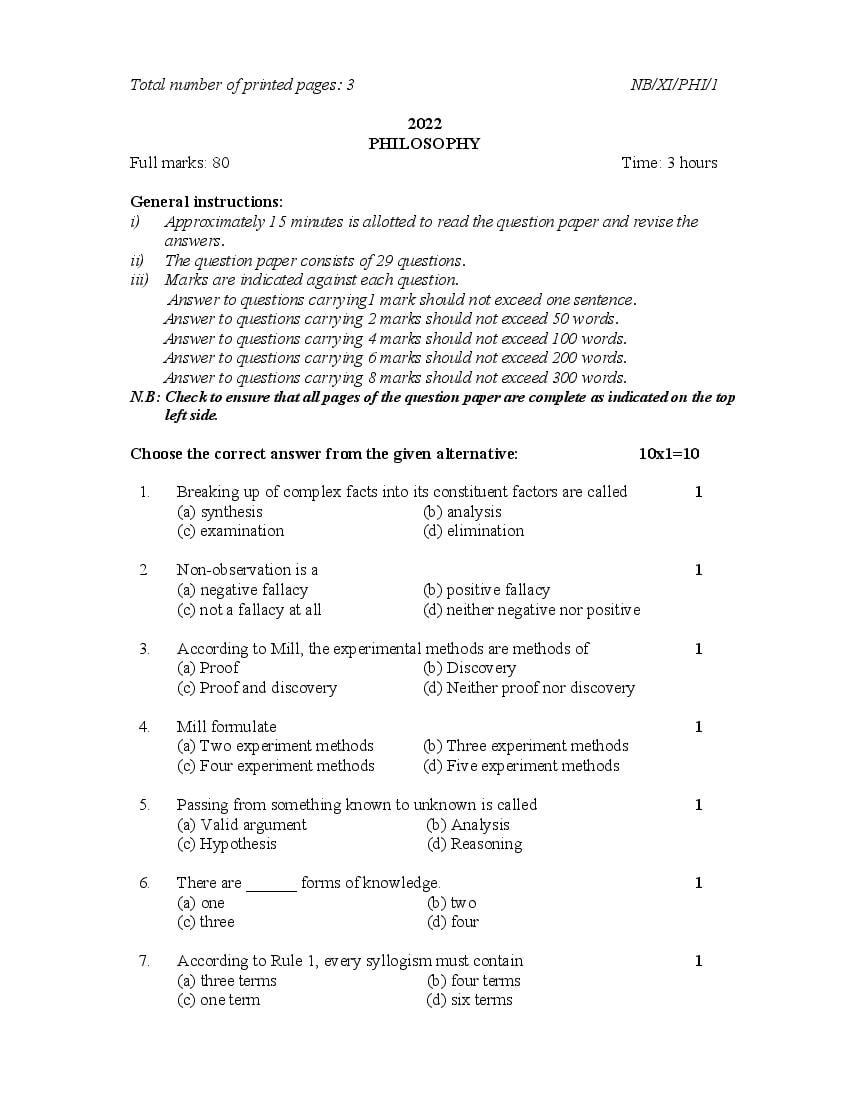
NBSE Class 11 Question Paper 2022 Philosophy
Finished viewing? Save it for later —
Download NBSE Class 11 Question Paper 2022 Philosophy (PDF · 3 pages)About NBSE Class 11 Question Paper 2022 Philosophy
NBSE Class 11 Question Paper 2022 Philosophy is available here for free download. Published by Nagaland Board for Class 11, this question paper can be viewed online or downloaded as a PDF (3 pages). Candidates preparing for Class 11 can use NBSE Class 11 Question Paper 2022 Philosophy to understand the exam pattern, the type of questions asked, and the overall difficulty level.
Frequently Asked Questions
How can I download NBSE Class 11 Question Paper 2022 Philosophy?
Open this page and click the Download button to save NBSE Class 11 Question Paper 2022 Philosophy as a PDF. It is completely free on AglaSem Docs.
Is NBSE Class 11 Question Paper 2022 Philosophy free to download?
Yes. NBSE Class 11 Question Paper 2022 Philosophy can be viewed online and downloaded as a PDF free of cost on AglaSem Docs.
How many pages does NBSE Class 11 Question Paper 2022 Philosophy have?
NBSE Class 11 Question Paper 2022 Philosophy contains 3 pages, which you can read online or download together as a single PDF.
Where can I find more Class 11 study material?
You can find more Class 11 question papers, sample papers, syllabus, and answer keys on AglaSem Docs.
NBSE Class 11 Question Paper 2022 Philosophy – Text
Read the full text of this question paper below — useful to quickly search, copy and reference the content online without downloading the PDF.
📄 View text version (3 pages)
Page 1
2022
PHILOSOPHY
Full marks: 80 Time: 3 hours
General instructions:
i) Approximately 15 minutes is allotted to read the question paper and revise the
answers.
ii) The question paper consists of 29 questions.
iii) Marks are indicated against each question.
Answer to questions carrying1 mark should not exceed one sentence.
Answer to questions carrying 2 marks should not exceed 50 words.
Answer to questions carrying 4 marks should not exceed 100 words.
Answer to questions carrying 6 marks should not exceed 200 words.
Answer to questions carrying 8 marks should not exceed 300 words.
N.B: Check to ensure that all pages of the question paper are complete as indicated on the top
left side.
Choose the correct answer from the given alternative: 10x1=10
1. Breaking up of complex facts into its constituent factors are called 1
(a) synthesis (b) analysis
(c) examination (d) elimination
2 Non-observation is a 1
(a) negative fallacy (b) positive fallacy
(c) not a fallacy at all (d) neither negative nor positive
3. According to Mill, the experimental methods are methods of 1
(a) Proof (b) Discovery
(c) Proof and discovery (d) Neither proof nor discovery
4. Mill formulate 1
(a) Two experiment methods (b) Three experiment methods
(c) Four experiment methods (d) Five experiment methods
5. Passing from something known to unknown is called 1
(a) Valid argument (b) Analysis
(c) Hypothesis (d) Reasoning
6. There are ______ forms of knowledge. 1
(a) one (b) two
(c) three (d) four
7. According to Rule 1, every syllogism must contain 1
(a) three terms (b) four terms
(c) one term (d) six terms
Page 2
8. The predicate of the conclusion is called 1
(a) Major term (b) Minor term
(c) Middle term (d) Copula
9. If both the conjuncts are true, the truth value is ____ for conjunction 1
(a) true (b) false
(c) both (d) none
10. There are ___ symbols in symbolic logic 1
(a) two (b) three
(c) four (d) five
Answer the following questions:
11 What are the two fallacies of observation? 2
12 State any two distinction between observation and experiment. 2
13 A man is found on a railway track wounded and lifeless. Frame two
hypothesis about the cause of his death. 2
14. State the difference between pure and mixed syllogism. 2
15. What are the words used to symbolize Disjunction? 2
16. Name the different kinds of induction. Explain any one. 2+2=4
17. Explain the fallacies of non-observation. 4
18. Is logic a science or an art? Explain 4
19. Define propositions according to construction. 4
20. Symbolise the following (Any two) 2x2=4
(a) Either he is a Naga or a Mizo.
(b) If the train is not on time, I will not reach my destination on time.
(c) Students will be promoted if and only if they work hard.
Answer any four from questions 21 –26
21. What is Scientific Induction? What are the marks or characteristics of
Scientific Induction? 2+4=6
22. What is hypothesis? State the proof required for a legitimate hypothesis
to attain the rank or a theory or law. 2+4=6
Page 3
23. Name the laws of thought. Explain any one 2+4=6
24. What are the different classifications of terms? Explain absolute
and relative terms. 3+3=6
25. Explain the structure of syllogism. 6
26. Construct truth table of the following (any two): 2x3=6
a. (p v q) • q
b. (p q) ≡ (p q)
c. (p • q) r
Answer any two from questions 27 - 29
27. Explain the steps involved in hypothesis. 8
28. Explain the joint method of agreement and difference using symbolic
and concrete example. 8
29. What are the different classifications of proposition? Explain forms of
proposition according to quality and quantity. 2+6=8
***********************