NBSE Class 11 Question Paper 2022 Physics
Finished viewing? Save it for later —
Download NBSE Class 11 Question Paper 2022 Physics (PDF · 4 pages)About NBSE Class 11 Question Paper 2022 Physics
NBSE Class 11 Question Paper 2022 Physics is available here for free download. Published by Nagaland Board for Class 11, this question paper can be viewed online or downloaded as a PDF (4 pages). Candidates preparing for Class 11 can use NBSE Class 11 Question Paper 2022 Physics to understand the exam pattern, the type of questions asked, and the overall difficulty level.
Frequently Asked Questions
How can I download NBSE Class 11 Question Paper 2022 Physics?
Open this page and click the Download button to save NBSE Class 11 Question Paper 2022 Physics as a PDF. It is completely free on AglaSem Docs.
Is NBSE Class 11 Question Paper 2022 Physics free to download?
Yes. NBSE Class 11 Question Paper 2022 Physics can be viewed online and downloaded as a PDF free of cost on AglaSem Docs.
How many pages does NBSE Class 11 Question Paper 2022 Physics have?
NBSE Class 11 Question Paper 2022 Physics contains 4 pages, which you can read online or download together as a single PDF.
Where can I find more Class 11 study material?
You can find more Class 11 question papers, sample papers, syllabus, and answer keys on AglaSem Docs.
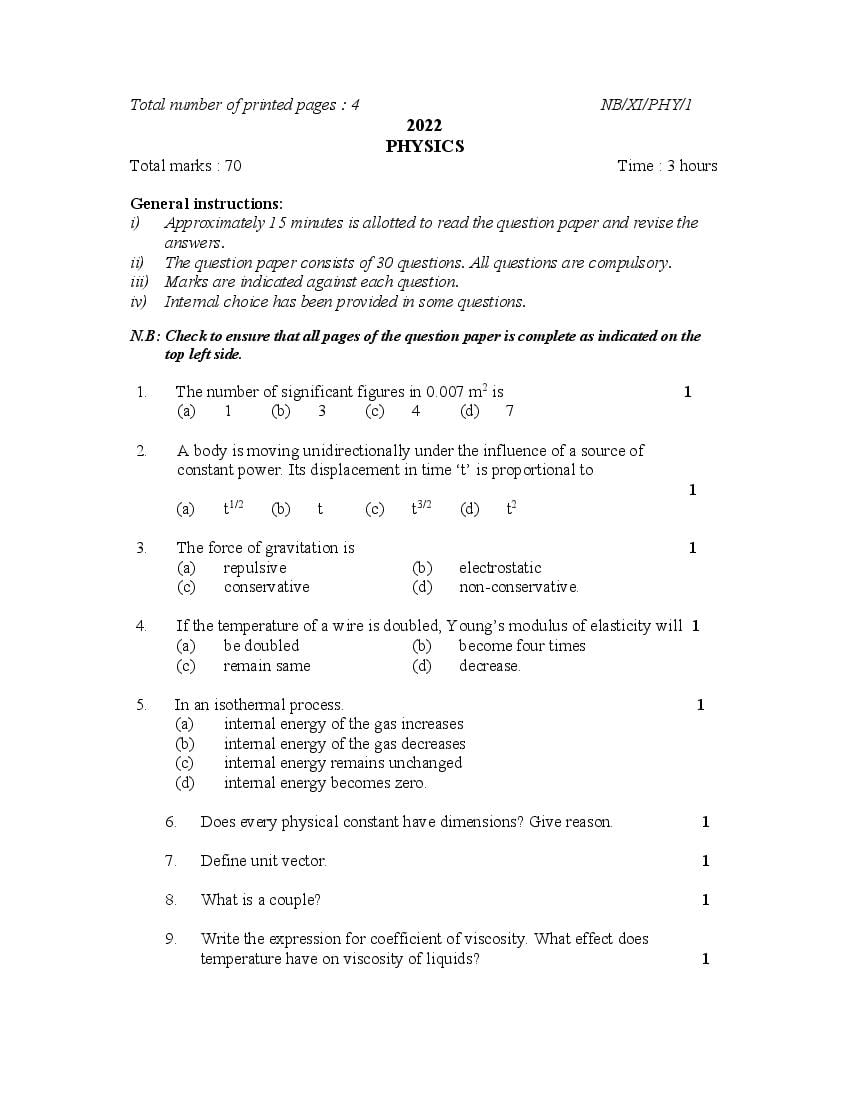
NBSE Class 11 Question Paper 2022 Physics – Text
Read the full text of this question paper below — useful to quickly search, copy and reference the content online without downloading the PDF.
📄 View text version (4 pages)
Page 1
2022
PHYSICS
Total marks : 70 Time : 3 hours
General instructions:
i) Approximately 15 minutes is allotted to read the question paper and revise the
answers.
ii) The question paper consists of 30 questions. All questions are compulsory.
iii) Marks are indicated against each question.
iv) Internal choice has been provided in some questions.
N.B: Check to ensure that all pages of the question paper is complete as indicated on the
top left side.
1. The number of significant figures in 0.007 m2 is 1
(a) 1 (b) 3 (c) 4 (d) 7
2. A body is moving unidirectionally under the influence of a source of
constant power. Its displacement in time ‘t’ is proportional to
1
(a) t1/2 (b) t (c) t3/2 (d) t2
3. The force of gravitation is 1
(a) repulsive (b) electrostatic
(c) conservative (d) non-conservative.
4. If the temperature of a wire is doubled, Young’s modulus of elasticity will 1
(a) be doubled (b) become four times
(c) remain same (d) decrease.
5. In an isothermal process. 1
(a) internal energy of the gas increases
(b) internal energy of the gas decreases
(c) internal energy remains unchanged
(d) internal energy becomes zero.
6. Does every physical constant have dimensions? Give reason. 1
7. Define unit vector. 1
8. What is a couple? 1
9. Write the expression for coefficient of viscosity. What effect does
temperature have on viscosity of liquids? 1
Page 2
10. State the first law of thermodynamics. 1
11. a. Dimensionally derive an expression for the time period of a simple
pendulum considering the period of oscillation of the pendulum
depends on its length (l), mass of bob (m) and acceleration due to
gravity (g).
Or 2
1
b. Check the equation s ut at 2 is dimensionally correct or not.
2
The symbols have their usual meaning.
12. Show that the velocity of uniform motion of an object is equal to the
slope of position-time graph. 2
13. a. Find the vector product of two vectors a 3iˆ 4 ˆj 5kˆ and
b 2iˆ ˆj 3kˆ.
Or 2
b. The angular speed of a motor wheel is increased from 1200rpm
to 3120rpm in 16 seconds. Calculate the angular acceleration of
the wheel.
14. State any two Kepler’s law of planetary motion. 2
15. Give two postulates of kinetic theory of an ideal gas. 2
16. a. What are damped and undamped oscillations?
Or 2
b. Mention any two characteristics of stationery waves.
17. a. A ball is thrown vertically upwards with a velocity of 20 m/s from
the top of a multistorey building. The height of the point from where
the ball is thrown is 25.0m from the ground. How high will the ball
rise and how long will it be before the ball hit the ground?
Take g=10m/s2.
Or 3
b. A cyclist starts from the center O of a circular park of radius 1Km
reaches the edge P of the park, then cycles along the circumference
and returns to the center along QO, if the round trip takes 10 minutes.
What is the net displacement average velocity and average speed of
the cyclist?
18. Prove that the coefficient of limiting friction is equal to the tangent of
angle of repose. 3
Page 3
19. Define momentum. Prove that the momentum of an isolated system is
conserved. 3
20. a. Raindrop falls under the influence of the downward gravitational
force and the opposing resistive force. Consider a drop of mass
1.00g falling from a height 1.00Km. It hits the ground with a speed
of 50.0 m/s.
a) What is the work done by the gravitational force?
b) What is the work done by the unknown resistive force?
Or 3
b. A bob of mass m is suspended by a light string of length L. It is
imparted by a horizontal velocity vo at the lowest point A such
that it completes a semi-circular trajectory in the vertical plane
with the string becoming slacked only on reaching the topmost
point C as shown in the figure. Obtain an expression for vo and
the speeds at point B and C.
21. State and prove the work energy theorem for a variable force. 3
22. Define moment of inertia. Hence, state the theorem of parallel and
perpendicular axes. 3
23. a. Define acceleration due to gravity. Show that the value of
acceleration due to gravity on the surface of the earth does not
depend upon the mass of the object.
Or 3
b. Obtain an expression for the orbital speed of a satellite when it is
placed at a distance ‘h’ from the surface of the earth.
24. State Wein’s displacement law. What is the most significant feature
of the black body radiation? On what factors does it depend? 3
25. a. Derive an expression for work done during adiabatic process.
Or 3
b. Derive the expression for efficiency of a Carnot’s heat engine.
Page 4
26. Define mean free path. Obtain an expression for the mean free path
of n particles. 3
27. Define simple harmonic motion. Obtain an expression for the velocity
and acceleration of SHM. 3
28. a. Using the velocity-time graph, derive the three kinematic equations
for uniformly accelerated motion.
Or 5
b. What is rectangular resolution of vector? Explain how a vector can
be resolved into x-y components.
29. a. Define angle of contact. Derive an expression for the ascent of a
liquid in a capillary tube.
Or 5
b. State and prove Pascal’s law. Explain the principle of a hydraulic
lift.
30. a. State and explain Newton’s formula for the speed of sound in air.
What correction did Laplace apply to it?
Or 5
b. Explain the formation of standing waves in a closed organ pipe and
the different modes of vibration.
******************************