NBSE Class 11 Question Paper 2022 Political Science – Text
Read the full text of this question paper below — useful to quickly search, copy and reference the content online without downloading the PDF.
📄 View text version (2 pages)
Page 1
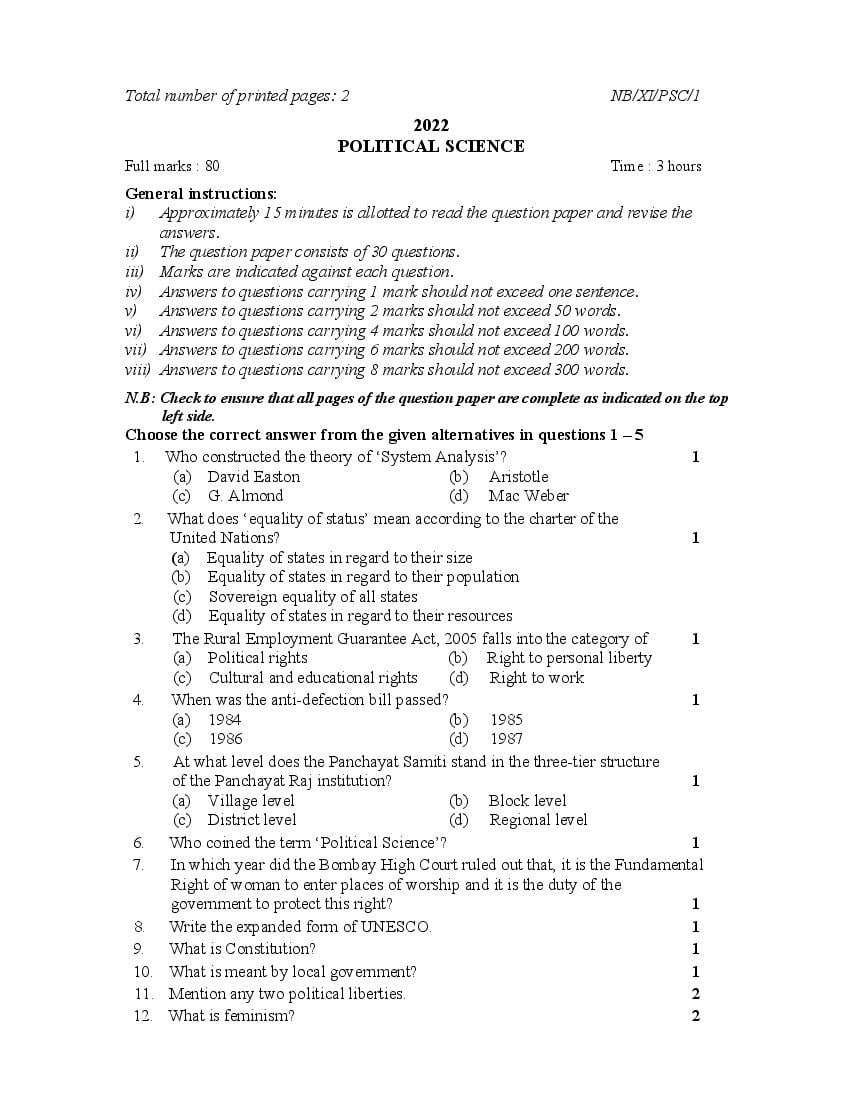
Total number of printed pages: 2 NB/XI/PSC/1 2022 POLITICAL SCIENCE Full marks : 80 Time : 3 hours General instructions: i) Approximately 15 minutes is allotted to read the question paper and revise the answers. ii) The question paper consists of 30 questions. iii) Marks are indicated against each question. iv) Answers to questions carrying 1 mark should not exceed one sentence. v) Answers to questions carrying 2 marks should not exceed 50 words. vi) Answers to questions carrying 4 marks should not exceed 100 words. vii) Answers to questions carrying 6 marks should not exceed 200 words. viii) Answers to questions carrying 8 marks should not exceed 300 words. N.B: Check to ensure that all pages of the question paper are complete as indicated on the top left side. Choose the correct answer from the given alternatives in questions 1 – 5 1. Who constructed the theory of ‘System Analysis’? 1 (a) David Easton (b) Aristotle (c) G. Almond (d) Mac Weber 2. What does ‘equality of status’ mean according to the charter of the United Nations? 1 (a) Equality of states in regard to their size (b) Equality of states in regard to their population (c) Sovereign equality of all states (d) Equality of states in regard to their resources 3. The Rural Employment Guarantee Act, 2005 falls into the category of 1 (a) Political rights (b) Right to personal liberty (c) Cultural and educational rights (d) Right to work 4. When was the anti-defection bill passed? 1 (a) 1984 (b) 1985 (c) 1986 (d) 1987 5. At what level does the Panchayat Samiti stand in the three-tier structure of the Panchayat Raj institution? 1 (a) Village level (b) Block level (c) District level (d) Regional level 6. Who coined the term ‘Political Science’? 1 7. In which year did the Bombay High Court ruled out that, it is the Fundamental Right of woman to enter places of worship and it is the duty of the government to protect this right? 1 8. Write the expanded form of UNESCO. 1 9. What is Constitution? 1 10. What is meant by local government? 1 11. Mention any two political liberties. 2 12. What is feminism? 2
Page 2
-2- NB/XI/PSC/1 13. Write any two points of the Objective Resolution. 2 14. What is cumulative vote system? 2 15. State any two qualifications needed to be appointed as a Judge of the Supreme Court. 2 16. What is Gram Sabha? 2 17. Examine the ancient Indian conception of politics. 4 18. Explain the significance of the principles of national self-determination. 4 19. Discuss in brief any four powers and functions of the Speaker of the Lok Sabha. 4 20. Explain any two democratic character of the Indian Constitution. 4 Answer any three from questions 21 - 25 3x6=18 21. Discuss the scope of the Political Theory with reference to the following: (3x2=6) a) An evaluation of various forms of government. b) A study of concepts of freedom, equality and justice. c) A study of the new rights. 22. Explain the factors that force people to leave their own country and become refugees in the neighbouring countries. What problems are being faced by such people? (4+2=6) 23. Write three merits and demerits each of the Proportional Representation. (6) 24. With reference to the powers of the President of India, briefly explain the following: (3x2=6) a) Executive powers b) Legislative powers c) Judiciary powers 25. Discuss any three features of a Federal Government. (6) Answer any three from questions 26 – 30 3x8=24 26. Examine the various measures undertaken to ensure social justice in India. (8) 27. What are Rights? Examine how Rights are different from claims. (2+6=8) 28. Explain how ASEAN and European Union have promoted peace and prosperity in South-East Asia and Europe respectively. (4+4=8) 29. Explain any four Writs which the Supreme Court and High Courts may issue for the protection of Fundamental Rights. (8) 30. Discuss the significance of a Democratic Constitution. (8) *********************************